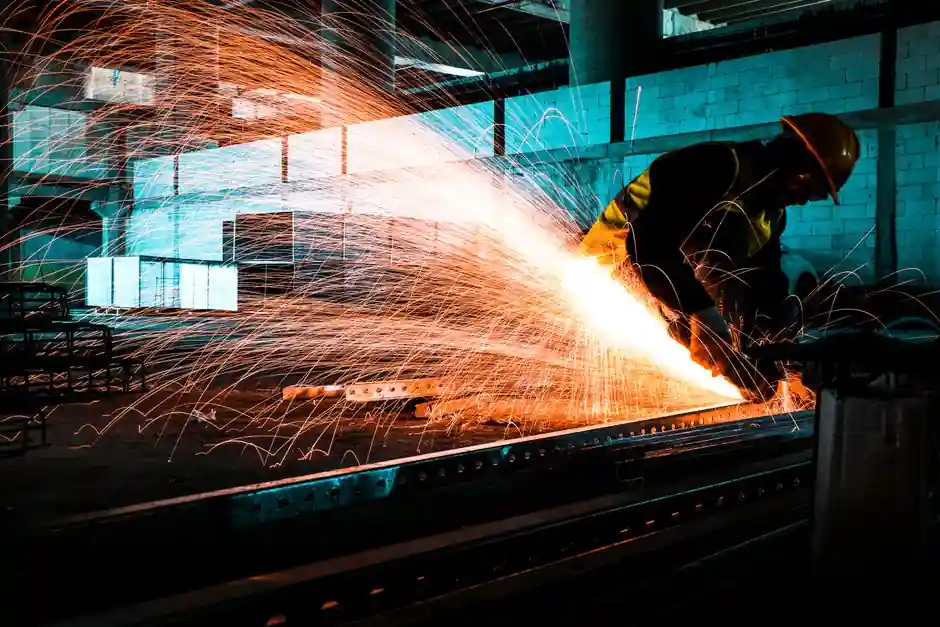
Electronics-housing fettling is a thin-wall, fine-finish problem, not a heavy foundry snagging job: typical housing castings are aluminum or zinc die castings with wall thickness 1.5-4 mm, gate stubs of 0.5-3 mm, and cosmetic surface requirements that exclude the 12-24 inch, 5-15 HP swing-frame class used in iron foundries [S5].
The practical spec band lands at 3-7 kW bench or pedestal units with 300-400 mm (12-16 inch) resinoid-bonded wheels, dust extraction matched to a 100-150 mm port, and a wheel speed envelope of 1600-2700 rpm, matching the PG-12 to PG-16 capacity ladder in the Vivegha pedestal line where PG-12 ships 300x40x38.1 mm wheel on a 3.7 kW spindle at 2700 rpm and PG-16 steps to 400x50x127 mm on a 5.5 kW spindle at 2100 rpm [S1]. Chicago Pneumatic groups the same duty under its vertical and angle grinder, angle sander, belt sander, and die grinder families for fettling of castings, confirming the format split [S3].
Why the Foundry Default Is Wrong for Housings
The 12-24 inch, 5-15 HP swing-frame class is sized to remove kilograms of gate and riser stock from iron and steel castings, where a 24-inch wheel on a 15 HP spindle is the only way to hit the parts-per-hour target [S5]. Housing work removes grams: a 1.5-3 mm aluminum gate on a 200x150 mm laptop chassis is faster on a 12-16 inch wheel, and the lighter wheel mass gives the operator the control needed to avoid burn-through on a 1.5 mm wall.
Wheel speed also changes: 1800-3600 rpm swing-frame operation stores enough kinetic energy in a bursting wheel to require rigid two-side guards, which is the single largest capital line for a foundry swing-frame install [S5]. A 12-inch bench grinder at 2700 rpm on a 50 mm spindle with resinoid-bonded wheels, as in the Vivegha PG-12, keeps the burst-energy band inside standard pedestal-guard geometries [S1]. For a different but adjacent format question, the Fettling Grinder Selection for Hardware Manufacturing: Spec Gates and Format Map guide lines up the same capacity ladder against hardware-scale stock-removal volumes, which is the closer analogue to housing work than the foundry-iron baseline.
Abrasive Choice for Aluminum and Zinc Die Castings
Aluminum and zinc housings fall into the soft, non-ferrous, low-tensile category, where silicon carbide is the spec-default abrasive because it is hard and friable and self-sharpens on soft substrates [S2]. White aluminum oxide is the secondary choice when heat tint on the housing face must be minimized, since it cuts cooler than brown alumina and is the standard recommendation for heat-sensitive steel and cosmetic aluminum surfaces [S2]. Brown alumina and zirconia alumina, the workhorse abrasives for ductile iron, grey iron, and carbon/alloy steel, are wrong here: they glaze on aluminum and the workpiece smears into the wheel, which destroys surface finish and pulls heat into the thin wall.
Grit selection tracks finish, not removal rate: 36-46 grit for the initial gate-stub grind, 60-80 grit for blending into the housing face, and 100-120 grit for any cosmetic pass before masking and painting. Resinoid bond is standard on the Vivegha PG-12 to PG-20 line for this duty, with the asterisked bore options (PG-16 50.8 mm, PG-20 152.4 mm) being alternate-spec wheel choices for users who already hold a particular wheel inventory [S1]. The encyclopedia reference on fettling grinder wheels and abrasive grades walks the same grain-by-alloy matrix and is the canonical place to verify a housing-alloy spec.
Spec Gates: Wheel Speed, Guarding, and Dust Extraction
The rated wheel speed (m/s) printed on every blotter must match the spindle RPM stamped on the machine nameplate, and the declared bore must match the arbor; a mismatch on any one of those three is the single most common cause of wheel burst on first spin-up [S7]. For a PG-12 class machine the spindle is 50 mm at 2700 rpm and the wheel is 300x40x38.1 mm, so the wheel blotter speed marking and the nameplate 2700 rpm must agree before the first abrasive is mounted [S1][S7].
Dust extraction is the second spec gate and the dominant 5-year cost line: abrasive consumables plus respirator-grade filter cartridges run 1.2-1.8x the machine purchase price over five years on a single-shift foundry cell, and electronics-housing cells trend higher because the fine-grit SiC wheels load faster and pull more dust per part [S4]. A 100-150 mm extraction port matched to a side-draft or down-draft booth is the minimum, and the bench grinder must carry a dust-collection shroud on both sides of the wheel because housing cells often run unattended batch fettling. The closer-geometry guide on angle grinder guarding and dust shrouds is a useful cross-reference when the housing cell uses a handheld or fixture-mounted angle head in place of a pedestal unit, which is a common configuration for small-batch housing work.
Electric vs Pneumatic vs Hydraulic for the Housing Cell
Three power classes compete for the fettling slot and the TCO ranking flips depending on duty cycle and available utilities: 5-9 kW direct-drive electric, 3-7 kW vane-motor pneumatic, and 4-7 kW hydraulic driven off an existing rig [S4]. For electronics housings the incumbent is electric at 3-7 kW, because the cells are clean, indoor, Zone 2 or non-classified, and the energy delta is roughly 70-80% in favor of electric wall-to-wheel (1 kWh ≈ 5-7 m³ compressed air at 7 bar) [S4]. Pneumatic only wins on aluminum and magnesium cleaning cells rated Zone 21, where the ignition-risk duty rules out most electrics; for housing work the alloy is aluminum but the volume and energy density are far below foundry magnesium cleaning, so an Ex-rated electric pedestal is the cleaner spec.
The Vivegha PG-12 at 3.7 kW and PG-16 at 5.5 kW are direct-drive electric at 1440 rpm motor speed stepped up to 2700 and 2100 rpm spindle speed via belt, matching the direct-drive electric class on the lower end of the 5-9 kW foundry band [S1][S4]. Hydraulic shows up only on cells that already run a hydraulic service loop, and is otherwise the wrong choice for a greenfield housing line.
Format Comparison: Bench, Swing-Frame, Handheld Angle
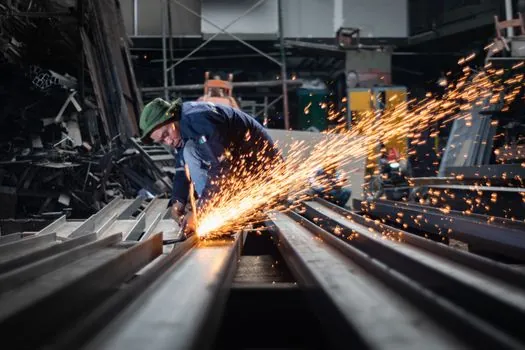
The format decision for a housing cell is narrower than for a foundry. Bench or pedestal snagging grinders carry 3-10 HP on 12-16 inch wheels and are the workhorse for hand-held housing parts up to about 5 kg [S5]. Swing-frame grinders carry 5-15 HP on 12-24 inch wheels and are sized for castings too heavy to lift, which excludes most housing parts [S5]. Handheld angle grinders, including the 0.4 HP (300 W) belt machine and the small die-grinder class, are the third option and the right pick for sub-1 kg housing shells where the operator needs to see and feel the gate stub [S3].
On the four housing-cell decision criteria the comparison looks like this: bench/pedestal (12-16 inch, 3-7 kW) scores high on stock-removal rate, high on dust extraction integration, medium on operator ergonomics, and low on capital cost; swing-frame (16-24 inch, 7-11 kW) scores highest on stock removal but worst on housing fit, because the wheel mass and pivot geometry overpower thin-wall parts; handheld angle (4-7 inch, 0.3-1.5 kW) scores worst on stock removal but best on cosmetic control and is the standard pick for sub-1 kg shells. For cells mixing both weights, the standard configuration is one PG-12 or PG-16 class pedestal plus one or two handheld angle stations fed from the same extraction manifold [S1][S3][S5].
Selection Sequence a Process Engineer Can Run
Step one is alloy and gate map: confirm the housing alloy (Al, Zn, Mg), wall thickness (1.5-4 mm typical), and gate-stub diameter (0.5-3 mm typical). Step two is volume: parts per shift, mass per part, and grams of gate stock per part; below 5 kg part mass and below roughly 50 g total gate stock per part the bench/pedestal class is the right pick, and the swing-frame class is over-spec'd. Step three is the abrasive spec: SiC, resinoid bond, 36-46 grit for the first pass and 60-80 grit for blending, on a wheel whose blotter speed, bore, and diameter match the nameplate. [S2]
Step four is dust extraction: 100-150 mm port, side-draft or down-draft booth, filter spec rated for SiC and aluminum dust, and a dust-collection shroud on both wheel sides. Step five is the ergonomic check: handheld mass under 12 kg for any operator-held configuration, vibration per ISO 5349, and noise per EN ISO 11203 with the booth closed [S4]. Step six is standards compliance: wheel guards per OSHA 29 CFR 1910.215 and ANSI B7.1, abrasive wheels per ISO 525, ISO 603, and EN 12413, with the blotter-to-nameplate speed check run on every wheel change [S2][S7].
Cost Stack and Trackable Signals for the Next 6 Months

The 5-year TCO for a 3-7 kW housing cell lands at 3-5x purchase price once wheel consumption, labor, dust extraction, and energy are tallied, dominated by abrasive consumables (30-40%) and labor (20-30%) [S4]. Two signals to watch over the next two quarters: any move to finer-grit SiC wheels (60-80 grit) on the PG-12 / PG-16 class as housing cosmetics tighten, which would pull wheel life down by roughly 20-30% per part; and any shift to Ex-rated electric pedestals in Zone 21 cells, which adds 25-40% to capital cost but recovers the 70-80% pneumatic energy penalty inside 18-24 months at two-shift duty [S4]. For readers who need a broader abrasive-wheel format map, the encyclopedia entry on floor grinder dust shrouds and the related TCO piece on fettling grinder cost drivers are the natural adjacent reads.