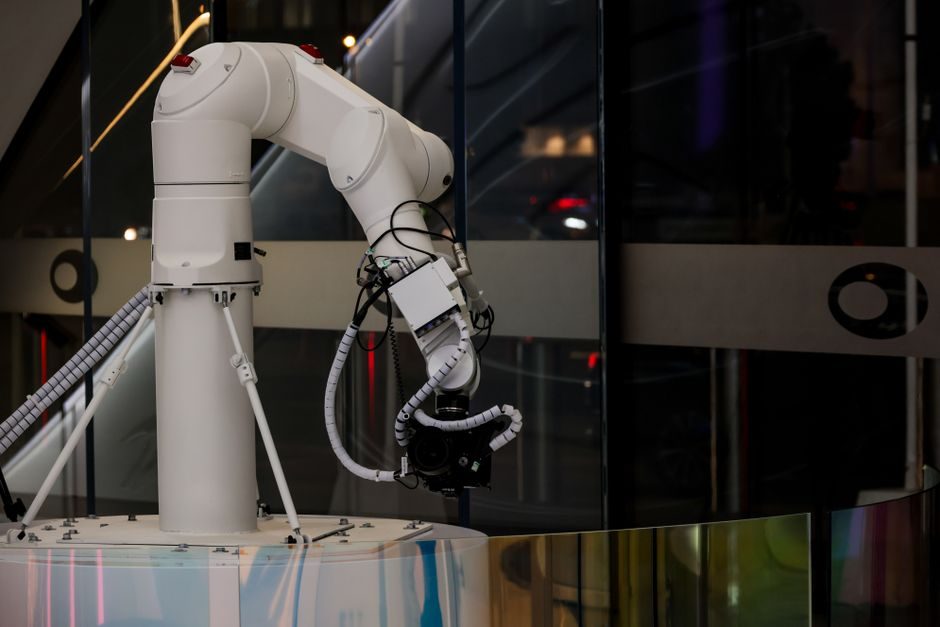
Embodied-AI capital flows, autonomous mobile robot (AMR) densification in distribution centers, and the migration of GPU-accelerated robot simulation onto plant networks are the three robotics forces shaping procurement decisions through H2 2026, with multiple Chinese vendors closing nine-figure funding rounds and simulation vendors formalising the hand-off from digital twin to real cell [S1][S2].
The practical fallout for process and discrete plants is that three formerly separate budget lines — labour, intralogistics, and engineering software — are converging on a single automation roadmap, and the spec language (cycle time, MTBF, payload kg, repeatability mm) is now coupled to AI-stack terms (token cost, sim-to-real gap, dataset coverage) that buyers did not have to score two years ago [S2].
Humanoid / Embodied-AI Hardware: 2026 Capital and Cell Readiness
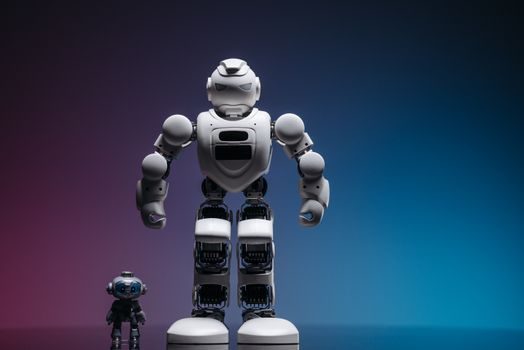
Embodied-AI humanoids have moved from trade-show demos to in-plant pilots, with Luming Robotics and Galbot identified as the two Chinese vendors driving the 2026 industrial-humanoid wave following a Galbot funding round reported in the nine-figure USD range on 2026-06-22 [S1]. Capital is concentrating on the perception-and-manipulation stack (vision-language-action models, dexterous grippers, force-torque wrists) rather than the mechanical platform, which means buyers evaluating 2026 humanoid pilots should score the AI middleware and teleop dataset lineage before they score the actuator count.
Galbot's "phenomenal rise" framing reflects a pattern in which venture capital is preferentially routed to vendors that can demonstrate partial autonomy in a constrained industrial cell — typically bin picking, kitting, or machine tending — rather than general bipedal walking [S1]. For a process engineer, the gate question is not "can it walk" but "what is the teleop fallback latency, and which safety-rated cell boundary does the pilot require" — questions normally answered inside the industrial PLC safety logic, not the robot controller.
Warehouse Robotics: AMR Density, Slotting Economics and 2026-2035 Forecast Frame
The Business Research Company's 150-page *Warehouse Robotics Market Report 2026–2035* segments the addressable spend across E-commerce, Food and Beverage, Electronics and Electrical, Metal and Machinery, Pharmaceuticals, and Other end-users, with a 2–3 business-day delivery window for the reissued PDF and explicit treatment of trade-war impact on the build cost of mobile bases [S3]. For a 2026 spec, the critical segment split is not the end-user vertical but the sub-system: AMR vs AS/RS vs goods-to-person vs fixed-pick-and-place, because the per-order-line ROI curves diverge by an order of magnitude depending on which sub-system dominates the brownfield footprint.
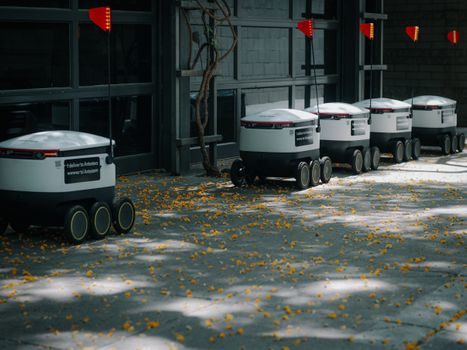
Two design points that have stabilised in 2026 spec sheets: AMR fleet managers are now expected to expose OPC UA Pub/Sub over a 5G or Wi-Fi 6E physical layer, and AS/RS stacker cranes are being specified with regenerative drives that feed back into the same DC bus used by the rack's photo-voltaic supplement, which is one reason stacker crane selection criteria now overlap with energy-recovery discussions previously confined to data-center UPS sizing. Buyers should confirm that the WMS/RF layer, the fleet manager, and the PLC safety zone controller share a single time-sync (IEEE 1588 PTP) before they accept a vendor's "open architecture" claim.
Simulation-to-Real: NVIDIA Isaac Sim 5.0 and the ARENA2036 Pattern
RoboDK's April 2026 case study out of ARENA2036 documents a working hand-off between NVIDIA Isaac Sim 5.0 and a live factory floor, with a digital-twin pipeline that exports calibrated URDF/MJCF plus a perception-test corpus that is replayed against the real cell before each shift change [S2]. The engineering content that matters is not the simulation software itself but the three artefacts the sim is contractually required to produce: a robot-agnostic path plan, a sensor-noise model tied to the real LiDAR/IMU, and a regression test that fails the build if sim-to-real drift exceeds a vendor-declared millimetre threshold on a benchmark pick task.
For a process engineer who has been burned by demos that never survived the 3 a.m. shift, the value of the ARENA2036 pattern is that it pushes the integration risk into a CI/CD-style gate, not a commissioning day. A practical 2026 acceptance test should require the vendor to replay at least 1,000 randomised pick poses from the simulator into the real cell and report the success-rate delta; vendors that refuse to commit a number typically do not have a calibrated digital twin [S2].
What 2026 Robotics Is — and Is Not — Ready to Replace
Robotics in 2026 is ready to replace: tote induction, label-and-place on a fixed conveyor, tote-to-shelf replenishment, machine tending on CNC lathes with a guarded envelope, and any sub-5 kg pick from a bin with structured lighting. It is not ready to replace: mobile manipulation in a crowded, unstructured human space; cable/hose assembly; and any process step where a regulatory sign-off is on the human operator rather than the cell — for example, certain in-process pressure transmitter calibrations still require a human witness under the controlled documentation rules of many EPC contracts. [S1]
Two constraints that the spec sheets consistently understate: (1) the on-prem GPU footprint required to host a perception model that can keep up with a 1 Hz AMR fleet at a 50,000 sq ft DC is materially larger than a plant IT team expects — typically 4–8x A100/H100 equivalents per 100 AMRs for inference alone, which collides with the server hardware rack-power ceiling; and (2) the safety zone around a humanoid pilot must be rated for the worst-case actuator failure, which usually pushes the pilot into a fenced cell even when the vendor markets the platform as "collaborative" [S1][S2].
Selection Criteria and a Three-Way Comparison
A pragmatic 2026 robotics spec scores the three principal options — fixed-pick-and-place, AMR/AGV, and humanoid pilot — against four decision criteria, and the answer depends more on the criterion weighting than on the technology: (1) per-pick cost in USD, with 2026 benchmarks clustering at $0.02–0.05 for fixed-pick, $0.08–0.15 for AMR-mediated goods-to-person, and an order of magnitude higher for humanoids still in pilot; (2) deployment lead time, with fixed-pick at 8–14 weeks, AMR at 12–26 weeks once the fleet manager is integrated, and humanoids at 6–12 months including a safety cell build; (3) sensitivity to upstream SKU churn, where fixed-pick and humanoids score well and AMRs suffer because the fleet map has to be re-learned; and (4) dependency on brownfield power and network, which is lowest for fixed-pick, moderate for AMR, and highest for humanoids because of the on-prem GPU cluster [S1][S2][S3].
Spec language that has measurably improved in 2026 contracts: "sim-to-real regression threshold (mm)" is now a line item rather than a footnote, and "teleop fallback latency (ms)" appears in pilot SOWs next to "mean time to human intervention" [S2]. Spec language that has *not* matured: any reference to a "general-purpose" humanoid — the only credible 2026 SOWs scope a humanoid to a single task family (kitting, machine tending, or tote induction) and refuse to commit on adjacent tasks until the second-generation cell is operational [S1].
Standards, Safety and the Procurement Office
Three standards touch a 2026 robotics deployment regardless of vendor: ISO 10218-1 and -2 for industrial robot safety, ISO/TS 15066 for collaborative operation risk assessment, and IEC 62443 for the network segment that the fleet manager and the PLC safety controller share. Buyers should reject any SOW that does not cite these three by number and that does not require a documented zone-of-interaction calculation per cell. [S2]
The second-tier rules that are creeping into 2026 contracts: cybersecurity patching cadence for the AMR fleet manager (a 30-day SLA is becoming a default in EU chemical and pharmaceutical RFPs), and a documented segregation between the IT/OT network boundary and the on-prem GPU cluster that hosts the perception model, mirroring the data center network segmentation pattern that has hardened over the past 24 months. The single most common contract failure in 2025–2026 was a fleet manager that could not be patched without taking the AMR fleet offline — that clause is now routinely pushed back to the vendor as a non-negotiable.
Trackable Signals Through H2 2026
Two signals to watch in the next two quarters: Galbot's next funding close (the 2026-06-22 round is the baseline; the next close is the first empirical read on whether embodied-AI capital is consolidating or fragmenting) [S1], and the first public 2026 production-line citation of a humanoid cell with a non-pilot safety sign-off, which would be the first credible data point that humanoids are moving from sponsored pilots to bought-and-paid-for capacity.
One engineering-trackable signal: the public release of an ARENA2036-style sim-to-real regression benchmark by an independent body (academia, ASTM, or a vendor consortium) — that document is the single artefact that would let a 2027 procurement office score a humanoid or AMR vendor on something other than a reference site visit, and its absence is the largest remaining gap in the 2026 robotics spec stack [S2].