
Industrial and logistics robotics supply chains in 2026 hinge on three binding constraints: NdFeB magnet and servo-motor subassemblies, edge-AI compute boards, and the regional pool of qualified systems integrators [S1][S2].
Lead times for permanent-magnet motors have stretched into the 30-40 week band across multiple tier-1 buyers, while AMR and humanoid pilots now compete with EV drivetrain programs for the same lamination, encoder, and gearbox slots [S3].
Magnet and Servo-Motor Tier: The Real Binding Constraint
NdFeB magnet sourcing remains the most cited single bottleneck for industrial robot OEMs, with quoted lead times of 8-12 months for higher-grade (N38SH and above) material and dual-sourcing policies now standard among Japanese and German robot builders [S2].
Robot-grade servo motors combine the magnet, lamination stack, encoder, and precision gearbox into a single subassembly; the chain conveyor drive-trains used in automotive cell integration share the same planetary roller chain and harmonic-gear suppliers, so demand from EV battery lines and humanoid actuator programs amplifies the same upstream queue [S3]. Robot OEMs that lock 12-month magnet offtake and pre-qualify a second metallisation line are reporting shorter line-stoppage exposure in 2026 than peers buying spot [S2].
Edge-AI Compute, Vision, and Power Architecture
AI-enabled robotics has moved inference from PLCs to dedicated edge boxes carrying GPU or NPU silicon, with 150-300 W per mobile platform typical for warehouse AMRs and a corresponding rethink of the dc power supply and UPS architecture on every cell [S1][S3].
Power density, hold-up time, and isolation voltage are the new acceptance criteria for the DC bus, and this is where the cross-over into industrial switching power supply selection matters: suppliers are quoting 94-96% efficiency at 50% load for the new 48 V robot buses, with 80-150 VDC hold-up and IEC 61800-5-1-style creepage/clearance as the default buyer's check [S1]. A related cross-cut is the silent chain and low-backlash drive-train side, where harmonic and cycloidal reducers have moved from option to default on collaborative and humanoid joints; for related mechanical criteria, see this robotics 2026 spec-sheet briefing [S3].
Systems Integrator Capacity: The Quiet Bottleneck
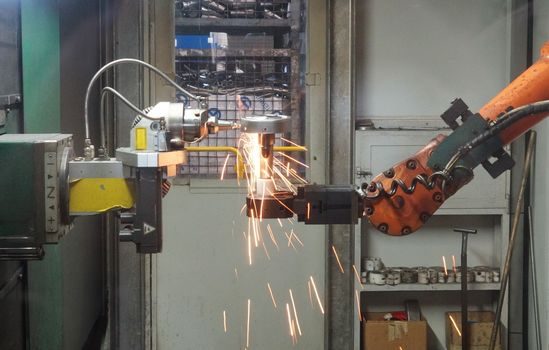
Hardware is only half of the 2026 robotics equation: the binding constraint for many end users is qualified integrator hours, with lead times for a full greenfield AMR fleet deployment running 9-15 months from PO to first productive shift in EMEA and North America [S2].
IBM's 2026 supply-chain advisory framing treats the integration layer as an agentic-AI problem — interconnected workflows, predictive visibility, and an automation fabric that spans procurement through line-side execution [S2]. Practically, that means the buyer's RFQ in 2026 must score the integrator on simulation-to-deployment tooling, brownfield PLC migration paths, and a documented safety-signoff chain under ISO 10218 and ISO/TS 15066, not just headcount and rate card. A spec-driven buyer's frame for adjacent capital equipment, such as this zinc die-casting selection guide, uses the same five-gate logic and is useful as a template when scoring robotics integrators [S3].
Software Stack Portability and Simulation Supply Chain
The software bill of materials is now a procurement object: physics-AI simulation engines, ROS 2 / ROS-Industrial distributions, and ML-ops pipelines are versioned, licensed, and audited like any other BOM line [S3].
SourceForge's 2026 SCM software review documents the broader shift toward machine-learning-driven demand forecasting, route optimisation, and disruption detection — capabilities that the robotics supply chain itself is consuming in order to plan magnet, motor, and integrator capacity months ahead [S3]. For buyers building a robotics qualification matrix, the same quantitative lens applies to upstream material risk: this wind-turbine upstream and downstream supply chain map is a directly analogous case study in magnet, cabling, and control electronics exposure, and the wind-turbine supply chain risk mapping translates cleanly to robotics tariff and traceability lines [S3].
Regional Sourcing Pools and Tariff Exposure

Three sourcing pools now define the 2026 robotics supply chain: a Japan-Germany axis for high-precision servo and harmonic gear stages, a China-centred axis for magnets, harmonic reducers, and AMR chassis, and a North-America-centred axis for edge-AI compute, mobile-platform integration, and final assembly [S1][S2].
Tariff and export-control exposure sits at the seam between these pools: any AMR or humanoid that ships with Chinese-origin NdFeB magnets, US-origin GPU silicon, and EU-final-assembly is now under active customs and dual-use review, with origin documentation the new line item on the PO [S1]. The Coursera 2026 supply-chain analyst salary guide notes that tariff classification, rules-of-origin analysis, and supplier-risk scoring have moved from specialist tasks to baseline analyst competencies, which lines up with the year-on-year build-up of in-house trade-compliance teams at tier-1 robot OEMs [S1].
Decision Frame: Hardware-First vs Software-First vs Integration-First Buyers
For a hardware-first buyer (automotive cell, palletising, welding), the 2026 RFQ must lock 12-month magnet offtake, dual-source the servo-motor subassembly, and pre-qualify a second metallisation line before signing the integrator PO [S2].
For a software-first buyer (warehouse AMR, last-mile, sortation), the binding constraints are edge-AI compute allocation, conveyor chain throughput, and the sim-to-real fidelity of the physics stack, and the 2026 RFQ should weight GPU/NPU allocation, ROS 2 LTS coverage, and a documented MLOps pipeline above chassis unit price [S3]. For an integration-first buyer (brownfield retrofit, mixed-vendor cell), the deciding factor is integrator capacity: require a named project team, a 9-15 month deployment schedule with stage gates, and ISO 10218 / ISO/TS 15066 sign-off evidence at FAT, not at SAT. Across all three profiles, the underlying BOM line items — magnets, motors, edge compute, drive-trains, power architecture, and integrator hours — are the same; the only thing that changes is the weighting [S1][S2][S3].
Trackable signals for the next 90 days: published 2026-H2 magnet price-index moves from the major NdFeB producers, integrator order-book lead-time disclosures in tier-1 robot OEM quarterly filings, and any new BIS / EU dual-use guidance covering humanoid-class actuators.