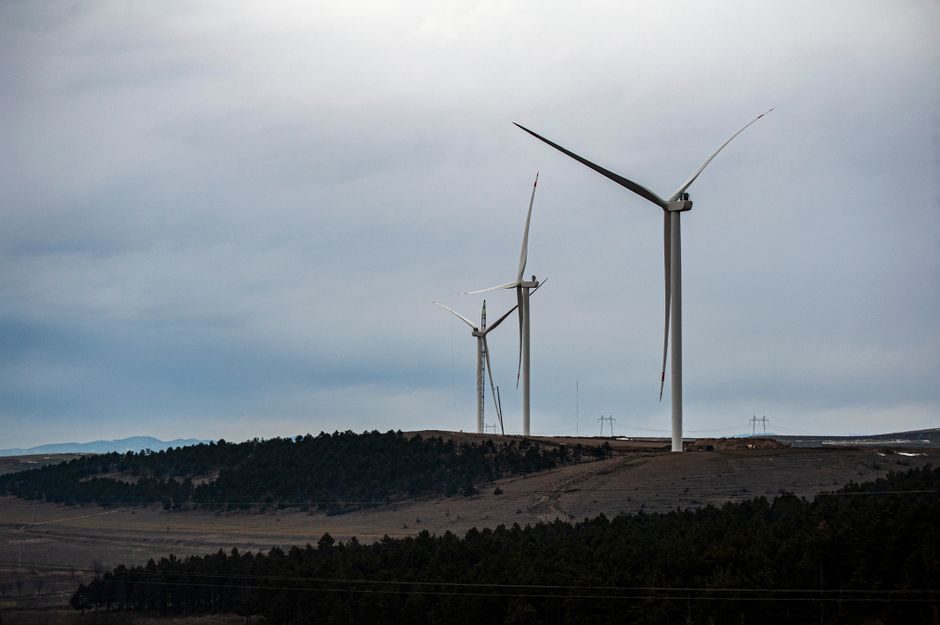
A wind turbine's bill of materials is dominated by a handful of engineered inputs — rare-earth permanent magnets, fibre-reinforced blade laminates, gear-box forged steel, and the power-conversion / cabling layer that ties each unit back to the onshore substation. The 2026 industry view still treats the chain as upstream raw materials → turbine & balance-of-system (BOS) assembly → downstream installation, grid connection and operations & maintenance (O&M), with rare-earth NdFeB magnets a confirmed end-use application in wind turbine generators [S3].
JL MAG Rare-Earth (06680) lists "wind turbine generators" alongside new-energy vehicles, variable-frequency air-conditioners, robotics and industrial servomotors as magnet application fields, which matches the way a process engineer reads a wind-farm bill of materials: rotor magnets, generator stator laminations, gear-box and yaw drives, blade and tower composites, converter/inverter electronics, array cabling, and the SCADA / metering layer that the flow meter and pressure transmitter population sits inside.
Upstream Layer: NdFeB Magnets, Blade Composites, Gear-Box Steel
The first cost-and-engineering pinch point is the rare-earth magnet. Wind turbine generators, particularly direct-drive permanent-magnet designs, use sintered NdFeB grades that anchor rotor magnetic flux. The upstream chain that feeds them — from cracked ore to finished magnet — is detailed in the rare earth manufacturing process reference, covering ore cracking, separation, reduction, electrolytic metal, alloy melting, hydrogen decrepitation, jet milling, pressing, sintering and grain-boundary diffusion. Grades commonly specified for large turbines sit in the N38SH–N42SH operating-temperature band, with N52 and higher-energy grades used where mass is constrained; a typical SH-grade operates with a maximum working temperature of 150 °C and a reversible temperature coefficient of flux around −0.10 %/K. [S1]
Blade composites are the second material bottleneck. A modern 80–100 m blade is a glass-fibre / carbon-fibre reinforced polymer (GFRP/CFRP) sandwich with a balsa or PVC foam core and a steel/cast-iron root fitting. Upstream feedstocks include E-glass roving, carbon fibre tows, epoxy and vinyl-ester resin systems, and structural foam. The tower is mostly S355 / S460 / S690 welded plate for onshore, with grades such as EN 10025-4 S460ML selected for thick-wall, low-temperature applications. Gear-box forging — a separate upstream chain — uses 42CrMo4, 18CrNiMo7-6 case-hardening steels and nitriding grades, with case depths and austenitising temperatures tied to AGMA gear-rating practice. The 2026 automation overlay on these upstream lines is covered in the rare earth smart manufacturing write-up, which traces the PLC / SCADA stack that controls sintering furnaces, hydrogen decrepitation and jet-mill classification.
Midstream: Generator, Power Electronics, Pitch & Yaw
At the turbine itself the midstream scope is the nacelle assembly: rotor hub, main shaft or direct-drive ring generator, gearbox (where used), yaw and pitch systems, converter, transformer, and the PLC cabinet that ties them together. Pitch and yaw servo drives are typically proportional valve-controlled hydraulic or electric servo systems; specifying engineers select proportional valves by nominal flow at 10 bar ΔP, step-response in milliseconds, and hysteresis under 2–3 %. Main-frame proportional valves in modern 3–6 MW turbines are commonly rated 60–200 L/min at 350 bar, with on-board electronics for CANopen or PROFIBUS commanding. [S2]
Generator cooling, gearbox lubrication and hydraulic pitch systems all produce instrumented pressure and flow signals. Gearbox bearing housings typically carry pressure sensor elements in the 0–25 bar range for lube-oil header pressure, with redundant transmitters in the lube skid. Hydraulic pitch accumulators carry pre-charge pressure monitored by a separate pressure transmitter, and the converter coolant loop is metered with a turbine flowmeter on the glycol-water branch. Procurement for offshore units in 2026 also demands ATEX/IECEx zone-2 rating for the nacelle instrumentation, with HART 7 over a 4-20 mA loop remaining the default protocol for non-safety transmitters even where Foundation Fieldbus segments exist on larger units.
Downstream: Array Cabling, Substation, SCADA & O&M
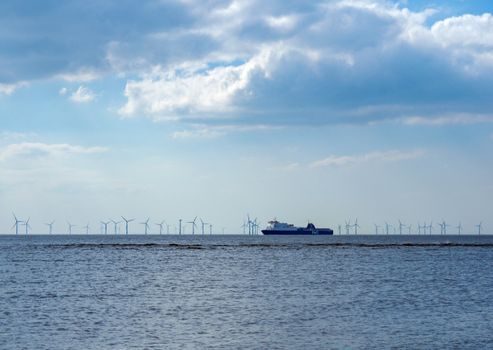
The downstream layer starts at the array-collection network. Offshore wind farms have to lay inter-array 33–66 kV XLPE three-core cables that daisy-chain turbines back to an offshore substation, then HV export cable to shore. The cabling geometry itself is a graph problem — N turbines, M candidate inter-array links, plus the option of a free-of-charge shore tie for any turbine inside a chosen index interval [ℓ, r], as captured in the EGOI 2025 Wind Turbines cable-routing problem statement [S4]. Minimising total installed cost is the entire game: every kilometre of 66 kV three-core copper conductor adds capital cost, and the topology chosen — string, star, or ring — drives both CAPEX and the cable cross-section derating required for the chosen installation method (J-tube pull-in, float-and-sink, or trench-and-bury).
On the operational side, downstream instrumentation is a flow meter-heavy environment. Cooling-water skids are metered with vortex or electromagnetic flowmeters sized for 1–10 m/s continuous flow; pitch hydraulic return lines use turbine flowmeters on a low-flow branch; gear-oil conditioning skids carry Coriolis meters for mass-flow and density trending. Hydraulic and pneumatic industrial valves — proportional directional, counterbalance, and pressure-compensated flow-control — gate every actuator, and the spec sheet that ties them to a turbine is increasingly run as a single Engineering Procurement Construction & Construction (EPC) package across the array, with FAT/SIT documentation standardised at the OEM level. Battery-storage and standby-generator at the O&M base layer are sizing topics in their own right and overlap with the data center 2026 generator and switch sizing reference at the UPS / genset boundary.
Selection Criteria for Components in the Chain
Specifying a component into this chain always comes back to four decision gates. First, environment: nacelle ambient swings from −20 °C to +45 °C with vibration of 0.5 g broadband, so any pressure transmitter chosen for a gearbox lube header must carry an IEC 60079-zone rating if installed in classified areas, plus an IP66/IP67 enclosure rating against oil mist. Second, electrical interface: 4-20 mA HART is the default for analogue process variables, while Foundation Fieldbus / PROFIBUS PA is used for integrated valve positioner and discrete I/O blocks, and EtherNet/IP or PROFINET runs the PLC backplane. Third, materials: hydraulic blocks in pitch/yaw systems are 316L stainless or zinc-nickel plated carbon steel, with NACE MR0175 compliance for any sour-service exposure on offshore sub-station hydraulic packs. Fourth, service life: a wind turbine is designed for a 20–25 year design life, so instrumentation MTBF targets are typically 200,000 hours or more, and suppliers must support calibration and repair windows out to year 25. [S3]
A practical comparison is the valve-and-actuator stack: proportional directional valves (PDV) offer sub-millisecond response and closed-loop position control for pitch; servo-valves (nozzle-flapper / jet-pipe) give higher bandwidth at higher cost; on/off solenoid valves are used for safe-state blade feathering. On the I&C side, flow meter selection follows the same rule — Coriolis for high-accuracy mass and density, magnetic for conductive glycol water, vortex for steam or low-pressure air, and turbine flowmeters for clean hydrocarbon oils. Procurement teams should treat the four gates — environment, electrical, material, life — as a non-negotiable checklist before any quote is released.
Limitations, Failure Modes and Standards
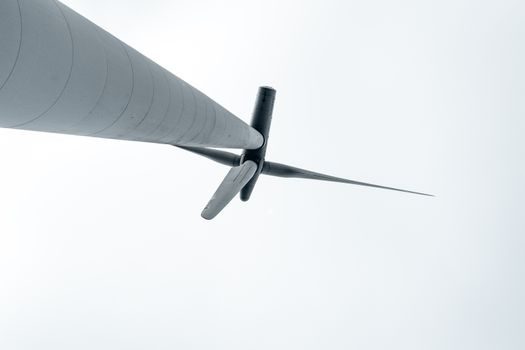
Every link in the chain has a known failure mode. NdFeB magnets lose flux under heat and reverse fields — N38SH flux loss can be 5 % over 150 °C × 1,000 h, which sets a hard limit on generator design. Blade composites suffer leading-edge erosion, lightning strike delamination, and bolt-loosening at the root joint, with structural inspection cycles tied to fatigue load spectra per IEC 61400-1. Gearbox bearings are the dominant O&M cost driver, with planet-carrier bearing failures well documented; offline oil-debris monitoring and online vibration trending are now standard. Hydraulic pitch accumulators risk nitrogen pre-charge leakage, with pressure transmitter cross-check and nitrogen top-up on a 6–12 month cycle. Array cables face armour fatigue at J-tube touch-down points and accelerated ageing of XLPE insulation under DC bias from converter harmonics, which is why type-test certificates per IEC 63026 / CIGRE TB 722 (relevant families) are required at FAT. [S4]
Standards that actually bite on the chain: AGMA 2001 / 2015 for gear rating, IEC 61400-1 / -2 / -3 / -25 / -27 series for turbine design, simulation, structural testing, communications and lightning protection, ISO 8686 for load measurement, API 6D for substation ball valves at 1,500 lb, ASME B16.34 for valve design, IEC 60079-0/-1/-7/-11 for hazardous-area instrumentation, and ATEX 2014/34/EU for EU equipment. Offshore, the array cabling design voltage is moving from 33 kV to 66 kV as turbines scale past 12 MW, with cross-sections around 95–300 mm² Cu or 185–630 mm² Al. None of these rules are negotiable; they are the floor a spec sheet has to clear before a vendor can ship into the EPC.
Sourcing Map and 2026 Signals
The 2026 sourcing map is still anchored in China for NdFeB magnets, blade and tower fabrication, gear-box forging and most of the power-conversion electronics, with Europe and South Korea leading in offshore substation and HVAC/HVDC export cables, and the US reshoring nacelle assembly for IRA-driven tax credits. JL MAG's 2024 announcement on application coverage [S3] — new-energy vehicles, automotive parts, energy-saving variable-frequency air-conditioners, wind turbine generators, robotics and industrial servomotors — mirrors the 2026 demand mix, with EV traction motors remaining the largest single magnet sink and wind generators second.
Two trackable signals for the rest of 2026: (1) the offshore 66 kV inter-array cable order book, which is the cleanest read on offshore-wind CAPEX; (2) the JL MAG / JL MAG-equivalent NdFeB monthly production of 2,000–2,500 tonnes per month per major Chinese producer, which is the cleanest read on magnet supply tightness. Cabling topology design work for new North-Sea offshore farms follows the EGOI 2025 framing [S4] — a minimum-cost network over N turbines with M candidate inter-array connections — and that framing now appears in the design notes of at least one offshore-wind EPC RFP circulating in 2026.