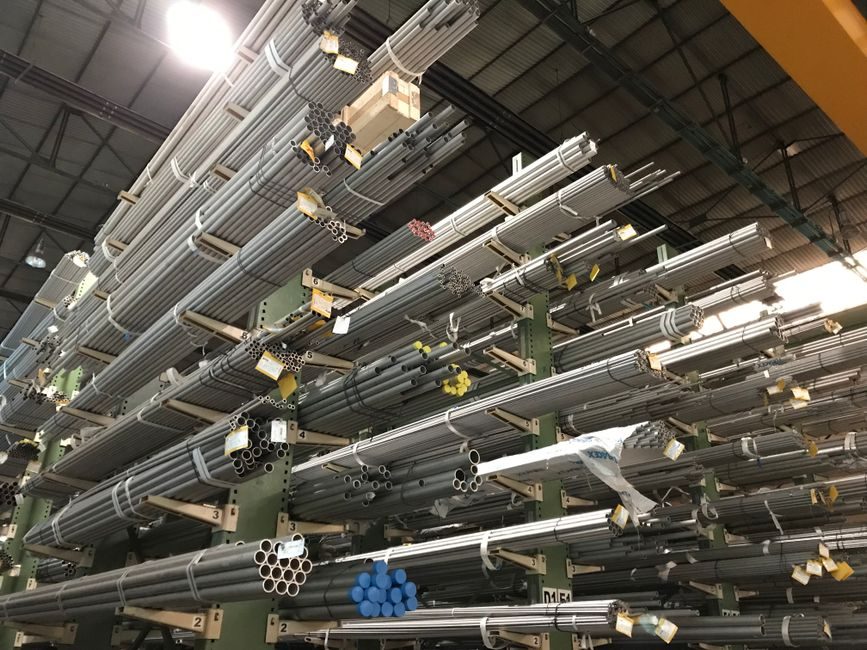
Chinese rubber tubing manufacturing capacity in 2026 is concentrated in four provincial clusters — Shandong (Qingdao, Jinan), Hebei (Xingtai/Qinghe), Guangdong (Shenzhen) and Zhejiang (Ningbo) — supplying NBR, silicone, EPDM and natural-rubber tubing across HVAC, automotive, food-grade and industrial hose lines [S2][S7][S8].
The buyer question is rarely "who makes rubber tubing" — every extrusion shop does. The buyer question is which factory has the right compound, the right cure, and the right QA paperwork for the duty envelope (temperature range, fluid compatibility, pressure class, regulatory grade). A typical NBR foam insulation tube ships at 30×35 mm or similar HVAC dimensions and is built around closed-cell NBR for condensation control [S1][S2].
Material and Compound Selection by Duty
NBR (nitrile-butadiene rubber) dominates closed-cell foam insulation tubing for HVAC, boiler and chiller lines because of its oil resistance and Class 1 fire-rated variants marketed for thermal insulation pipework [S2]. EPDM holds the weather, ozone and steam-exposure slot for outdoor gasketing and corrugated bellow seals, with one Qingdao-based parts maker listing EPDM as a primary compound alongside silicone [S8].
Silicone rubber tubing carries the food, beverage, medical and peristaltic-pump duty, with food-grade translucent and clear variants commonly cut in 1 m and 5 m lengths and used for beer, milk and pharmaceutical transfer [S2]. Natural rubber and SBR remain the workhorses for general-purpose water hose, with Indian IS 444-marked water hose representing the regulatory baseline for non-pressure potable and irrigation service [S3]. For reference on the underlying compounds, see the nitrile rubber and silicone rubber spec entries, and the broader industrial rubber compound map.
Supplier Cluster Map and Capability Tiers
Shandong — Jinan and Qingdao — anchors HVAC-grade NBR/PVC foam tube production, with Jinan Retek Industries listing refrigeration condensers, evaporators and compressors as adjacent main products, signalling factory depth in thermal-system OEM supply [S2]. Qingdao factories typically list rubber seals, rubber pipes, O-rings, mats and EPDM parts as a combined capability set, often ISO 9001 certified and able to compress-mould, extrude and die-cut from one site [S8].
Hebei (Xingtai / Qinghe County) is the auto-coolant tubing heartland, with hump silicone tubes, radiator connecting hoses and coolant-system soft tubes dominating the SKU mix at suppliers like Qinghe County Luotai Auto Parts [S2]. Guangdong — Shenzhen in particular — runs the higher-purity food/medical silicone tube line, with custom soft flexible silicone hose, thin-wall peristaltic-pump tubing and translucent food-grade clear tube as typical SKUs [S2]. Zhejiang (Ningbo) sits in the sealing-and-gasket tier, with companies such as Ningbo Kaxite Sealing cross-selling gaskets, sheet rubber and tubing from one factory footprint [S9].
Specification Bands and Dimensional Reality

Rubber tubing does not have one "standard" wall-thickness table — extrusion shops quote to a customer drawing, then hold ±0.1–0.3 mm on inner diameter and ±0.2–0.5 mm on outer diameter depending on the durometer and whether the tube is solid, sponge or foam. A 30×35 mm rubber tube is a wall-thick industrial / insulation-grade SKU, not a precision medical line [S1].
Closed-cell NBR foam tube for HVAC typically ships with a density of 40–80 kg/m³, thermal conductivity around 0.034–0.038 W/(m·K), and a service temperature window of roughly -40 °C to +105 °C; silicone food-grade tube typically spans -60 °C to +200 °C continuous with the peristaltic-pump rating driving 1 m and 5 m cut lengths [S2]. For pneumatic and instrument-air lines, the cross-reference pneumatic tubing covers the PU/nylon vs rubber tradeoff. Where steam, ozone or weather exposure is the design driver — outdoor seal legs, expansion joints — EPDM rubber is the spec call most factories will lead with.
Certifications, MOQ and Lead-Time Signals
ISO 9001:2015 is the baseline management-certification marker seen across Chinese rubber tubing OEM directories, with ISO 14001:2015 and ANSI/ESD surfacing at the higher-tier factories that supply OEM automotive and electronics accounts [S7]. On Okorder, OEM/ODM rubber extrusion tubing is explicitly marketed with "Professional OEM & Exporter" and "Custom is God" framing, alongside sponge/foam profile capability — a signal that custom profile extrusion is the default rather than the exception [S4].
MOQ bands on Made-in-China factory listings for OEM rubber parts range from 10 pieces for simple grommets and O-rings to 1,000+ pieces for customised moulded parts, with per-piece pricing starting around US$0.001 at the commodity end of the catalog [S6]. Annual-revenue bands listed on Made-in-China factory pages span "<US$1 million" up through "US$10+ million" and headcount bands of 51–100, 101–500, 501–1000 people, giving a reasonable proxy for which factories run single-shift job-shop extrusion versus three-shift volume production [S7]. Buyers specifying for a regulated duty — food contact, potable water, pharmaceutical — should still demand the actual compliance document (FDA, EU 1935/2004, USP Class VI, WRAS) rather than accept a generic ISO 9001 claim as evidence of regulatory fitness.
Application-Side Selection Logic
For HVAC refrigerant and hot-water insulation, default to closed-cell NBR foam tube at the 30–35 mm OD band and verify Class 1 fire-rating documentation; Jinan-area factories carry this as a stock SKU [S2]. For automotive coolant and radiator connecting lines, hump-pattern silicone tube from Hebei County (Qinghe) is the volume path, with the soft-texture hump geometry designed to absorb thermal expansion [S2].
For food, beverage, dairy and pharmaceutical transfer, food-grade translucent silicone tube (1 m / 5 m cut lengths) from Shenzhen and Guangdong factories is the standard shortlist [S2]. For peristaltic-pump and laboratory-fluid lines, specify platinum-cured silicone with documented peristaltic-life cycles and post-cure extraction data. For general-purpose water and air service in cost-sensitive builds, IS 444-marked natural-rubber water hose from Indian manufacturers such as Paras Industries is the long-standing specification, with IS 444 itself the regulatory anchor for non-pressure water hose in the Indian market [S3]. A wider look at how the tubing categories break down across these duties sits in this rubber tubing selection map.
Limitations, Failure Modes and Sourcing Risks
Rubber tubing fails on three axes: compound/duty mismatch, dimensional drift, and cert paperwork. Compound/duty mismatch is the most expensive — NBR foam will tolerate hot glycol but will harden and crack in ozone-rich outdoor service where EPDM or silicone would have run years longer; EPDM is the wrong call for petroleum-oil transfer where NBR or FKM (where listed) is required. [S2]
Dimensional drift between quoted and shipped lots is the second failure mode, particularly with sponge/foam extrusions where cell structure variation shifts inner diameter under clamping load. The third — and most disqualifying — risk is the cert gap: a factory listing ISO 9001 does not automatically carry FDA, EU 1935/2004, USP Class VI, WRAS, REACH or RoHS on every SKU, and the lot paperwork must be checked against the part number, not the company name [S7]. For a cross-material view that places rubber tubing against PU, nylon, PE and PTFE in instrument-air and fluid-handling service, this plastic tubing comparison is a useful adjacent reference. Process pinch-valve and sleeve-rubber sourcing — which draws on many of the same natural-rubber and EPDM compound lines — is covered in pinch valve sizing and selection.
Track, going forward, (1) whether the Zhejiang/Ningbo sealing suppliers extend their tubing SKU list to compete with the Hebei auto-coolant tier — a likely 12–18 month move given the Kaxite Sealing-style cross-sell pattern already visible [S9] — and (2) whether IS 444-marked Indian water-hose capacity expands its export presence into African and Middle East municipal tenders where the IS 444 designation is already accepted as a proxy for fitness-of-purpose [S3].