
Firefighting and Fire & Gas (F&G) safety relays are normally de-energized (ND) and trip by energizing the load, while Emergency Shutdown (ESD) relays are normally energized (NE) and trip by dropping power, per Phoenix Contact's process-industry guidance [S3].
The hard rule from the U.S. fire-alarm side: off-the-shelf electrical supply relays cannot be directly wired to a fire alarm system; the relay must be fire-alarm listed, supplied by the FACP manufacturer, or be a Listed Fire Relay, and polarity must be observed because of the integrated diode [S4].
Two Architectures, One Vocabulary Problem
Fire & Gas (F&G) and Emergency Shutdown (ESD) safety relays are the two main process-industry applications, and the two have opposite energy states under normal operation [S3]. Under normal conditions an F&G relay sits de-energized, and an alarm event energizes the relay to switch on sounders, beacons, and solenoid valves; this is the Energize-To-Safe (ETS) or Energize-To-Trip (ETT) pattern [S3].
An ESD relay behaves the inverse way: the load (e.g. an electric motor) is continuously powered in normal operation, so the relay is Normally Energized (NE) and drops out to De-energize-To-Safe (DTS) or De-energize-To-Trip (DTT) on a trip [S3]. Mixing these two is the most common F&G spec error on grassroots projects, because the words "trip" and "safe state" carry opposite meanings across the two topologies [S3].
1oo3 Voting for Marine and High-Consequence Firefighting
For shipboard firefighting and other high-consequence loops, Pepperl+Fuchs documents a "One out of three" (1oo3) safety-relay architecture that uses two redundant relays to ensure excellent reliability in harsh marine environments [S5]. The 1oo3 topology tolerates one failed channel without nuisance-tripping, which matters when a single welded contact on a fire-dam relay could silence an entire alarm string.
On the alarm-system integration side, the comparable redundancy tactic is the listed multi-relay module: a UL-listed, addressable relay that meets NFPA 72 for functions like door release and HVAC shutdown, rather than a general-purpose ice-cube relay [S6]. For a firefighting water-supply relay pumping operation, the priority is uninterrupted flow, which Gerard Naylis frames as relay-pumping evolutions designed to maintain adequate supply to the fire scene [S7].
Load, Voltage, and Contact Rating: The First Spec Cuts

The relay's load may be AC or DC, but must sit within the amperage rating of the relay contacts; a relay rated 10 A cannot switch a 20 A lighting load directly, and a contractor must be added downstream [S4]. Typical fire-alarm relay modules drive low-current control signals (often in the 5 V class) into another trade's data input rather than the safety-equipment load itself, which is why the relay spec is decoupled from the downstream load spec [S4].
For F&G beacon and solenoid-valve outputs, Phoenix Contact's checklist calls for power-loss diagnostics to the field devices, not just coil-continuity checks, because a sounder that fails silent defeats the F&G function regardless of relay health [S3]. The selection criteria safety relay reference page summarizes the same four axes: contact rating, voltage, diagnostics, and SIL capability.
Fail-Safe Direction vs. Code Path
Question 3 in the fire-alarm relay rules forces a binary: is the function a code-required fire-alarm feature (elevator recall, door release, HVAC shutdown) or a customer convenience (driveway gate, outdoor lighting)? For code-required functions, the wiring must be either fail-safe or raise a Trouble Signal when power to the relay fails [S4].
This is where the F&G and ESD vocabularies meet NFPA 72: an ETS fire-alarm relay that loses power must default to the alarm state (or signal trouble), while a non-code convenience relay can simply drop out [S4][S6]. When the load must be de-energized on alarm (electromagnetic door holders, electromagnetic door locks, a DJ booth's amplified stage rig), the contactor/relay is sized for that motor load and the electrician supplies the contactor; the fire-alarm relay only switches the contactor coil [S4].
Comparison: F&G, ESD, and Fire-Alarm Relay Modules

Three options line up against four decision criteria drawn from the research:
F&G safety relay (ETS/ND): use for sounders, beacons, and firefighting solenoid valves; energy state normally de-energized so a wiring fault cannot silence an alarm by itself; SIL-capable; requires power-loss diagnostics to field devices per [S3].
ESD safety relay (DTS/NE): use for motors, pumps, and process equipment that must keep running until a trip; energy state normally energized so loss of power inherently trips; SIL-capable; [S3] warns to check what happens to the SIS when the relay contact is welded.
Listed fire-alarm relay module (NFPA 72): use to integrate the FACP with elevators, HVAC, door holders, and access control; must be fire-alarm listed and polarity-respecting; AC or DC load within contact rating, often switching a 5 V-class control signal rather than the safety load directly [S4][S6].
Integration with Adjacent Life-Safety Loops
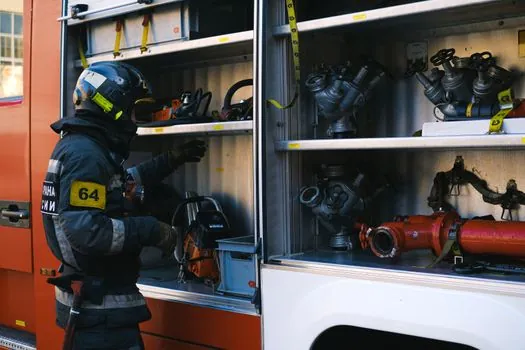
Firefighting relay selection rarely stands alone: it interlocks with detector selection upstream and PPE selection downstream. For chemical-plant and confined-space pre-entry, the oxygen detector specification drives whether a relay trips on low-O2 events, while toxic-gas detection in process plants shapes the F&G trip logic for the same relay string. On the responder side, firefighting helmet selection governs what the wearer can safely do once the relay has fired and the water is flowing. [S3]
For broader plant context, a machine safety overview clarifies how SIL-rated F&G relays differ from category-rated e-stops, and the fire safety reference page maps the same architecture onto building-code rather than process-industry paths.
Verification, Testing, and What the Inspector Will Check
Testing of a fire-alarm system verifies only that the relay changed state, not the operational performance of the downstream fire-safety function, so the electrician is responsible for the contactor and the mechanical trade is responsible for the load [S4]. Verification is by meter or by observing an activation LED on the relay, which is why addressable modules with onboard LEDs simplify commissioning [S4][S6].
A 1oo3 firefighting relay adds a third verification layer: channel disagreement alarms, not just coil continuity, so a single welded contact is caught before the next test interval [S5]. For shipboard installations, the proof point is a documented firefighting-water relay pumping evolution that maintains uninterrupted supply to the scene, tying relay hardware selection to operational drill practice [S7].
Trackable signals for the next procurement cycle: confirm whether the project's F&G relay is SIL 2 or SIL 3 and whether the listed fire-alarm relay is UL 864 / NFPA 72 compliant for the specific control function, and verify the contactor downstream is rated for the locked-rotor current of the fire pump motor it switches. A mis-sized contactor in that string is the most common field-failure path on grassroots firefighting water-supply builds [S4][S7].