A spring-loaded safety relief valve is a passive overpressure device that opens at a calibrated set pressure and reseats when system pressure falls back by a fixed blowdown; a needle valve is an active, manually or pneumatically adjusted throttling device whose tapered seat gives fine resolution at low Cv. They are not substitutes — putting a needle valve in a relief path is a common spec error that throttles discharge capacity and risks vessel rupture [S4].
NABIC's gunmetal high-lift line, for example, covers DN15 to DN100, set pressures from 1 to 12.5 bar, and fluid temperatures from -20 to 195°C on hot water, steam, compressed air, inert gas, CO₂ to 20°C, and ethylene glycol — the exact envelope a typical HVAC or low-pressure process skid needs [S1]. Needle valves on the same skid are usually 1/4" to 1/2" instrumentation ports handling a few litres per minute, not the multi-kg/s dump rates a relief event demands.
Functional split: protective dump vs metered throttle
Spring-loaded safety relief valves are defined by ASME / PTC 25-style performance metrics: set pressure, overpressure (typically +3% or +5% accumulation), blowdown (reseat pressure as a percentage of set), and certified orifice area — the discharge area that sizes the vessel's required relieving capacity [S4]. NABIC's Fig 500 series ships as a "high lift" variant, meaning the disc lifts well clear of the seat at full overpressure, giving near-rated capacity the moment the valve cracks [S1].
Needle valves are sized the opposite way: the engineer wants the smallest practical Cv so a hand-turn of the stem moves flow by a measurable percentage. Long stem threads, fine pitch, and a tapered (often Delrin or metal) seat tip are the design levers. A typical instrumentation needle might run a 0.5 to 5 Cv range; a relief valve on the same line could be discharging tens of Cv during a fire-case scenario. That two-orders-of-magnitude gap is why they cannot be swapped.
Spec envelopes: pressure, temperature, size, material
NABIC's six-model gunmetal range shows how tightly a low-pressure relief product is bounded [S1]: Fig 500 (DN15-DN65, 1-12.5 bar), Fig 542 (DN15-DN80, 1-10.5 bar), Fig 500SS with stainless wetted parts (DN15-DN40, 1-12.5 bar), Fig 500F (DN20-DN65 flanged inlet), Fig 520 (DN65-DN100), and Fig 542F (DN32-DN80 flanged). All share the same -20 to 195°C window and the same medium list — a deliberate "utility-grade" envelope rather than a process-grade one.
Needle valve envelopes are narrower on pressure class and broader on material. Common 316 SS bodies rated to 6000 psi (≈413 bar) are standard from brands like Swagelok, Parker, and Ham-Let; brass and carbon-steel variants dominate the lower 2000-3000 psi tier. Temperature is usually limited by the seat material — PTFE seats cap around 200°C, graphoil around 450°C in steam-service packages. The point: needle valves are commonly specced in corrosion-resistant alloys for sampling and chemical injection; relief valves in this class are gunmetal or ductile iron because the duty is size and lift, not chemical resistance.
Where each type belongs on a real skid
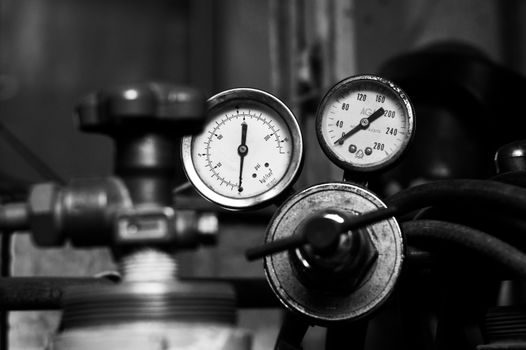
A packaged boiler feed skid typically carries one safety relief valve on the steam drum, one on the feedwater receiver, and a pressure-reducing valve feeding the downstream ring main; needle valves appear at gauge isolators, sample coolers, and chemical-dosing rotameters. The relief devices are sized for the full fired-input steam generation rate at the MAWP (maximum allowable working pressure); the needle valves are sized for the 0.1 to 5 L/min the instruments actually need [S1][S2].
Process skids serving petroleum, chemical, and metallurgy plants — the application matrix that 317 Valve explicitly serves alongside safety relief, pressure-reducing, ball, gate, globe, check, butterfly, and control valves — also pair the two: relief on separator and scrubber vessels, needle valves on instrument air and analyser lines [S2]. Reading a single supplier's product tree is the fastest way to see that the industry treats these as complementary categories, not alternatives.
Decision matrix: relief vs needle on four criteria
Function: relief valves are passive, set-and-forget overpressure protection certified to a standard (PED 2014/68/EU in the EU, ASME BPVC Section VIII in the US); needle valves are active throttling devices with no certification duty beyond seat-leak class. Capacity: relief valves are sized in certified orifice area (mm² or in²) and rated for a mass flow at a given overpressure; needle valves are sized by Cv at a given pressure drop. Materials: NABIC's utility-grade relief line is gunmetal with optional stainless wetted parts (Fig 500SS) for hot water, steam, and air to 195°C [S1]; needle valves span brass, carbon steel, 316 SS, and alloy 400/825 for chemistry. Cost: a DN50 gunmetal relief valve is typically 3-5× the price of a 1/2" 316 SS needle valve, because the relief unit carries a certificate, a nameplate, and a tested seat.
Integration effort tells the same story. A relief valve drops in on a flanged or screwed tee and needs only a discharge pipe to a safe location; a needle valve usually needs a block-and-bleed upstream, an isolation handle, and a means of locking the set position. Engineers who skip the block-and-bleed on a needle valve quickly learn why spec sheets call for one.
Failure modes and the mistakes that cause them
The classic relief-valve failure is a stuck or leaking seat — usually from debris, scale from hot-water service, or a cracked spring. NABIC explicitly lists "all other fluids to be checked with Technical Department" on Fig 500SS, an admission that wetted-parts compatibility is the highest-risk variable in service [S1]. A leaking relief valve is a hidden loss; a stuck relief valve is a hidden bomb.
The classic needle-valve failure is seat erosion from particulate service, or packing leak after a few hundred cycles. A misapplied needle valve — installed where the spec required a relief device — fails open or fails closed depending on position, and either way the system has no overpressure protection. A misapplied relief valve on a sample line, on the other hand, pops at the slightest overpressure and dumps the contents of whatever vessel the sample is fed from. The two failure modes are mirror images, and that is the strongest argument for keeping the two product families on separate selection drawings.
Selection checklist a process engineer can sign off
Step 1: list every vessel, line, and instrument tap that can be isolated; mark which ones can be over-pressured by an external energy source (pump, steam header, gas cylinder, thermal expansion). Every one of those is a candidate safety relief valve point, and the duty is to be sized for the worst credible relieving case at the MAWP. Step 2: list every flow that needs metering, sampling, or trim — gauge isolation, analyser feed, chemical injection, bypass balance. Those are needle-valve duties. Step 3: for the relief valves, pin material, size, set pressure, and certified orifice area to a vendor's published data; NABIC's range covers 1-12.5 bar at -20 to 195°C in gunmetal, which handles most HVAC and low-pressure process cases without going to a custom build [S1]. Step 4: for the needle valves, pin the Cv at the design ΔP, the seat material against the fluid chemistry, and the end connection against the tubing or piping standard (NPT, BSP, compression, flared). Step 5: cross-check that no needle valve sits in series with a relief valve's discharge path — a common layout mistake that chokes the relief capacity and invalidates the certification [S4].
Standards, sourcing, and what to track next
Spring-loaded safety relief valves are governed by ASME BPVC Section VIII (UG-125 to UG-140) for unfired pressure vessels, by API 520 / 521 for sizing and installation, and by the Pressure Equipment Directive 2014/68/EU in the EU; PED Category I-IV conformity assessment is what the nameplate on a NABIC or equivalent unit reflects [S1][S4]. Needle valves are covered by generic ASME B16.34 valve specification and by MSS-SP-99 instrument valve standards, with no separate overpressure certification duty. Track the next signal: a vendor's published list of wetted-parts-compatible fluids (NABIC's "all other fluids to be checked with Technical Department" is the cue to ask), and a relief-valve nameplate that lists the certified orifice area — not just the pipe size, which is a frequent quoting shortcut [S1]. When the spec sheet shows the orifice area in mm², the relief device has been properly selected.
Component reference pages worth checking: safety barrier.
Background reading: Industrial Filter Selection Criteria for a Chemical Process Skid.