
Sheet-metal fabrication for HVAC relies on three sander families: random-orbit (5-6 mm orbit, 125-150 mm pad) for casing and flange finishing, inline belt (75-100 mm belt width) for duct seam grinding, and detail/filament for return-air grille bezels. Selection pivots on three intersecting constraints, gauge of the galvanized steel (typically 0.5-1.2 mm), type of joint sealant (butyl, polyurethane, or acrylic latex), and zone classification of the installation site [S3].
The U.S. EPA's ENERGY STAR V3 HVAC Quality Installation Rater Checklist treats filter accessibility and sealed return-air pathways as rated compliance items, which means any sanding debris left inside a casing becomes a downstream IAQ and blower-wheel balance problem [S1]. California Title 24, Chapter 4 ties residential ventilation device airflow ratings to ANSI/ASHRAE Standard 51/AMCA 210 and AMCA 300 sound testing, so the sanding finish on a return-air boot must not introduce turbulence that would invalidate the rated cfm [S2].
Substrate Map: Galvanized Steel, Aluminium, and Coated Duct
Galvanized steel ductwork in the 0.5-0.7 mm range is the default for residential branch runs and deforms under aggressive contact pressure, so random-orbit sanders with a 5 mm orbit and 80-120 grit aluminum-oxide discs are the safe default for casing exterior finishing before mastic application [S3]. Aluminium return-air boxes (typically 1.0-1.2 mm 3003-H14) load up soft abrasives fast; a stearate-coated, open-coat 120-150 grit disc run at 8,000-10,000 opm clears swarf without glazing, and an extraction port sized to 27-32 mm hose ID keeps the pad in the abrasive rather than in the dust bag.
Pre-coated duct board (fiberglass mat faced with aluminium or vinyl scrim) is a different problem: a random-orbit will fray the mat edge, so installers should default to hand-sanding with a foam-backed 100-150 grit block or a 75 mm inline belt sander on its lowest speed setting (typically 160-200 m/min belt speed) for trimming only. The Miracle VRF tool guide lists a magnetic level, hex set (1.5-10 mm), and a 10-inch pipe wrench as adjacent essentials, but it does not list a sander, which is itself a signal that finish work on coated duct is treated as a hand operation in OEM service training [S3].
Comparison: Random-Orbit vs Inline Belt vs Detail Sander for HVAC Tasks
Across the three sander classes used on HVAC work, the decision pivots on four criteria: material-removal rate, surface-finish risk on thin gauge, dust-management compatibility, and access into trunk/branch junctions. Random-orbit sanders (125-150 mm pad, 5-6 mm orbit, 400-1,200 W) sit in the middle on removal rate, the lowest on gauge-deformation risk because the orbit pattern averages contact pressure, and pair directly with 27-32 mm extraction ports feeding either a Class L or Class M vacuum. [S3]
Inline belt sanders (75 x 457 mm or 75 x 533 mm belt, 160-330 m/min) deliver the highest removal rate, which is wasted on most HVAC tasks and is destructive on sub-0.7 mm galvanized, but they are the right tool for grinding weld beads on black-iron commercial supply risers (2.0-3.0 mm wall). Detail sanders (triangle or mouse format, 100 x 150 mm pad, 1.5-2.0 mm orbit) win on access into a 100-150 mm diameter branch take-off or behind a filter rack, but their small footprint and low mass (0.7-1.1 kg) make them unsuitable for any seam grinding longer than 200 mm.
Dust Class and Zone Mapping for Refrigerant-Line Adjacency
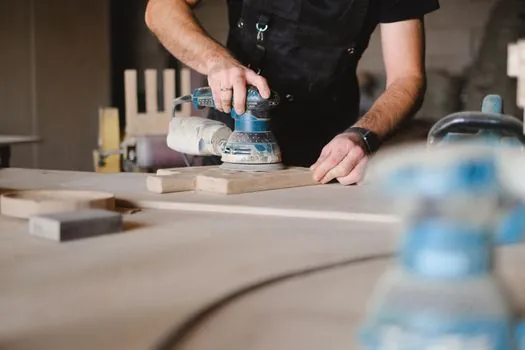
When sanding falls within 1-2 m of an uncharged refrigerant line or a freshly brazed joint, dust class governs tool selection more than grit does. Abrasive dust from galvanized steel is classified as a Type L carcinogen in several EU member states, so on commercial sites the sander must feed a Class M (medium-hazard, 99.9% filtration to 1.0 µm) or Class H (high-hazard) vacuum with an auto-start outlet that energises the vacuum before the sander spindle spins up [S3].
For sites where A2L refrigerants (R-32, R-454B) are present in the working volume, any sanding operation that could produce a spark from an aluminium-oxide belt on a hidden nail head is a credible ignition source: the sander must be rated to ATEX 2014/34/EU category 3 for gas (zone 2) or be prohibited outright in zone 1. The safer pattern is to isolate the brazing/sanding work by time, do all brazing first, vent the area, and then return with a non-sparking nylon abrasive disc. ENERGY STAR V3 ties duct sealing to verified leakage targets (typically ≤ 4 cfm/100 ft² at 25 Pa for the rough-in test), and any spark or impact near a refrigerant line is a rework event that defeats that test [S1].
Grit Progression and Acceptance Criteria for Ductwork Finish
Standard practice on galvanized supply duct after mastic application is a three-stage progression: 80 grit to level the butyl or polyurethane bead, 120 grit to feather the mastic edge, and 150-180 grit on the surrounding metal so the final paint coat keys in. The random-orbit should run at 8,000-10,000 opm for 80 grit and drop to 4,000-6,000 opm at 180 grit to avoid heat tint on the zinc coating, which converts to white rust within 48-72 h at relative humidity above 60% [S3].
Acceptance for downstream certification is visual, not metrological, on most residential sites: a 150-grit scratch pattern fully covered by the first primer coat is the working standard. On Title 24 commercial builds where duct leakage is tested per the procedures referenced in ANSI/ASHRAE Standard 51/AMCA 210 fan-rating airflow measurement, the sanding acceptance criterion is whatever the test rig can resolve, typically leakage differences under 0.5 cfm at 25 Pa, so scratch uniformity matters more than gloss [S2].
Tool-Bag Integration: What the HVAC Tech Actually Carries

The Miracle VRF installation tool list does not enumerate a sander, but it does specify the supporting hardware that frames sander selection: 8/10/12-inch pipe wrenches for refrigerant line work, an adjustable wrench for service valves, a magnetic level for drain-pump and fan-coil mounting, a 1.5-10 mm hex set for service-panel fasteners, and a cordless drill sized to the fastener-shank range on offer [S3]. A sander that cannot share a 12-18 V battery platform with that drill is a workflow penalty, which is why 18 V brushless random-orbit sanders from the same OEM family as the installer's drill dominate HVAC field kits.
For the installer building a kit from scratch, the minimum HVAC-rated sander set is one 125-150 mm random-orbit (5-6 mm orbit, 400-700 W mains or 18 V brushless), one 75 mm inline belt (variable speed, vacuum port), one detail sander for branch take-offs, and one Class M or H vacuum with a 27-32 mm anti-static hose. Lead time for the vacuum-ported sander set is 2-6 weeks ex-stock for mainstream brands and 10-16 weeks for ATEX/IECEx dual-certified units, which is the single biggest planning variable on a commercial refrigeration retrofit.
Failure Modes and When Not to Repair a Sander on Site
Three failure modes account for most in-field sander downtime on HVAC contracts: bearing failure (symptom: rumbling above 6,000 opm, root cause: dust ingestion past a worn seal), brush wear on mains units (symptom: drop in no-load speed below nameplate by more than 15%, root cause: brush length under 6 mm), and pad-face glazing from running a loaded disc for more than 10-15 minutes on galvanized steel (symptom: cut rate collapses, root cause: swarf filling the disc, not a mechanical fault) [S3].
Bearing and brush failures are workshop repairs, not site repairs: opening a sander housing on a duct platform near live electrical or refrigerant work is a decision to escalate, not to fix. Disc glazing is a site fix, swap the disc, re-check the extraction hose for blockage at the cuff, and re-run. If the extraction hose is cracked, the vacuum filter is past its cycle count (typically 50-100 operating hours for Class M fleece), or the ATEX zone rating on the data plate does not match the work area, the tool is out of service for that scope and a replacement is the only correct call.
Track these three signals over the next quarter to plan retooling: lead time on ATEX/IECEx-rated random-orbit sanders, brushless 18 V platform expansion into the HVAC service channel, and any update to ASHRAE 62.2 Section 7.1 selection-and-installation guidance referenced in California Title 24 Chapter 4. For context on grit and hazardous-area choices that overlap with electrical-installation sanding, the sander selection map for electrical work covers ATEX zoning in more depth, and the safety helmet selection guide for construction sites is the adjacent PPE reference for any duct platform work. A different substrate angle, road-surface abrasive selection, is laid out in the sander selection map for road maintenance.
For the relevant spec sheets and selection criteria, see sander, pressure transmitter, and flow meter.