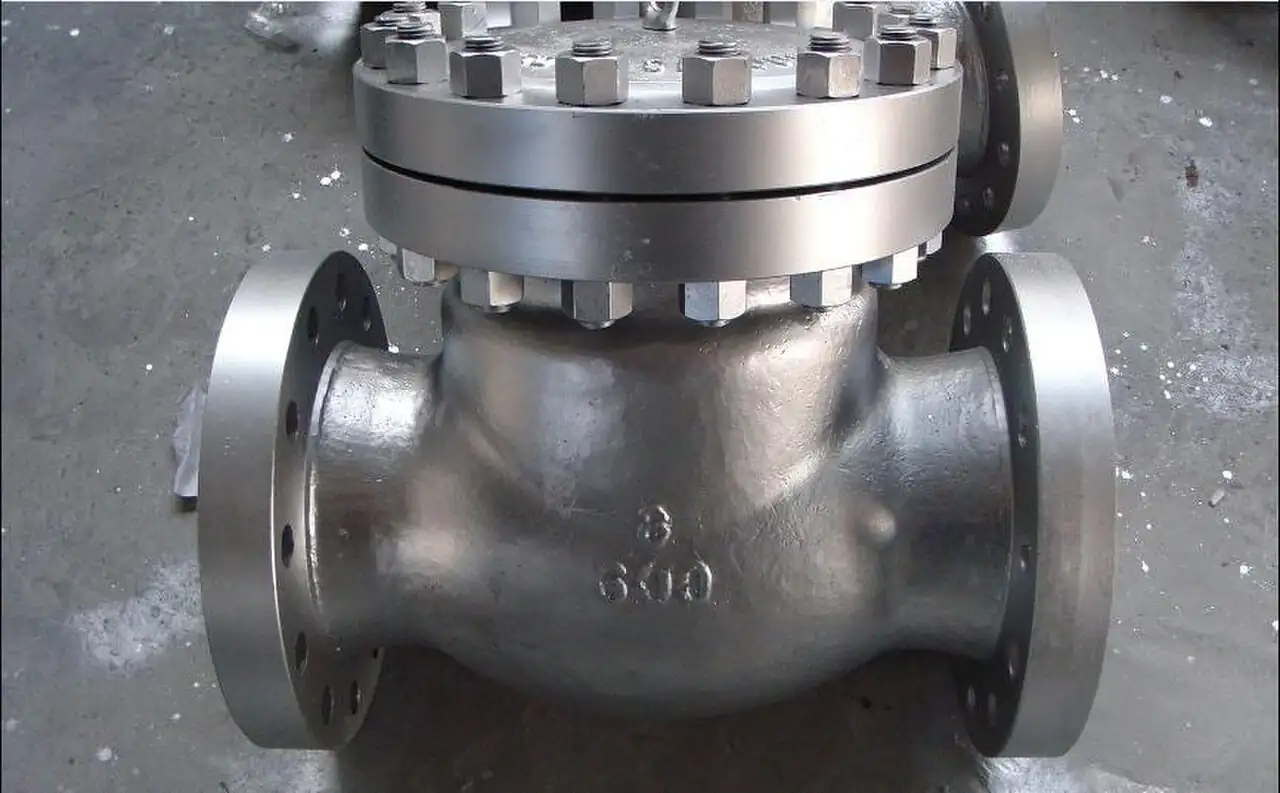
A ball check valve is a one-way valve whose closure member is a free floating ball. There is no hinge, no pin, no stem, and no external lever: forward flow lifts the ball off a tapered seat ring, and when flow stops the ball drops back and seals, driven by its own weight, by line backpressure, and by a light spring in some designs. Two constructions dominate the market, and they barely resemble each other. The plastic true union ball check, in PVC, CPVC, or PVDF with an EPDM or FKM ball or seat, serves chemical dosing and water treatment lines from DN 15 to DN 100. The flanged iron or steel sinking ball style, with a heavy encapsulated ball rolling onto a resilient seat inside an elongated body, serves raw sewage and sludge force mains from DN 50 to DN 600. Catalogs sometimes call the device a sphere check or a true union ball check, and this page treats those names as synonyms.
Procurement engineers meet these valves at municipal lift stations, where the valve sits on the discharge header of a sewage pump or submersible pump and holds the force main full between cycles; on chemical dosing skids, where a spring loaded true union body stops siphoning and back-contamination of the day tank; and at well and wet well suction intakes, where the foot valve variant of the same ball-on-seat principle keeps the pump primed. The decision this page settles is narrow and practical: which construction family fits the fluid, which elastomer survives the chemistry, whether the ball runs gravity or spring assisted, and which orientation the installation can actually give the body. The answer lands as an RFQ line set, size, seat and ball materials, cracking pressure, orientation, and the station hardware around the valve, and every chapter below feeds that line set.
This page treats the ball check valve as a purchasing object: what free ball sealing changes in the numbers, how cracking pressure and Cv read on a datasheet, where true union plastic ends and flanged sinking ball duty begins, and how seat chemistry, orientation, and station hardware combine into a defensible RFQ. It is written for engineers who issue purchase specifications, not for readers who want a brochure summary.
Chapter 1 / 06
What a Ball Check Valve Is and What Is Being Decided
The closure member is the difference, and the word free carries most of the engineering. In a conventional check valve the disc, piston, or plate is attached to something: a hinge pin on a swing pattern, a stem and spring on a lift pattern, a pair of plates on a torsion shaft. The ball check valve releases the closure member entirely. A spheroidal ball, solid or elastomer encapsulated, sits in a tapered seat at the inlet and is centered by body ribs or guides above it. Forward flow lifts the ball along the pipe axis, flow passes around it through the full annular opening, and when the flow decays the ball falls back onto the seat with nothing to bend, bind, or break. The failure inventory of the valve shrinks accordingly: there is no pin to wear oval, no hinge to rag up with fibers, and no spring to fatigue unless the buyer orders one deliberately.
What is actually being decided in this purchase is a construction family first and a valve second. The two families have different fluids, different sizes, different pressure classes, and different failure cultures, and most misapplications trace to buying one family for the duty of the other. The plastic true union body belongs on clean and chemical lines to DN 100 at 10 to 16 bar cold water rating. The flanged ductile iron sinking ball body belongs on raw sewage, sludge, and solids-bearing water from DN 50 to DN 600 at PN10 to PN40. Inside the family the buyer then commits to seat and ball elastomer chemistry, to gravity or spring assisted seating, to an installation orientation the piping can sustain, and to the station hardware that protects the seat for its service life. Each of those commitments is a datasheet row, and each is cheap to get right at RFQ stage and expensive to discover wrong at commissioning.
The name invites one confusion that must be cleared before any specification is written. A ball valve is a quarter-turn isolation valve with a drilled ball, a stem, and an operator, a completely different product that shares one word. The ball check valve has no stem, no operator, and never modulates: it is a flow-sensitive relay with two stable outcomes, open and shut. Within its own check valve family the neighbors are distinguished by their suspension: the swing check valve hangs a disc from a hinge outside the flow path, the dual plate check valve folds two half discs on a torsion pin between flanges, and the piston check valve slides a spring loaded plug along the pipe axis. The free ball competes with all three and wins on ragging and solids, which is exactly why lift station engineers keep specifying it.
Five references organize the datasheet, and a buyer should quote them by name. Shell and seat testing follows MSS SP-61, the valve testing standard behind the hydrostatic acceptance numbers on the factory certificate. Plastic body compounds follow ASTM D1784, whose cell class notation, for example 12454 for a rigid PVC compound, states rigidity, impact strength, tensile strength, and chemical resistance in one code that a quotation can be held to. Potable water contact is certified to NSF/ANSI 61 for both polymer body and elastomer seat. Fitness requirements for industrial plastic check valves are covered by EN ISO 16137. Wastewater check valve acceptance testing on the iron side follows AWWA C508 style practice. A datasheet quoting none of these is a price tag, not a specification.
The RFQ should state the station around the valve, because the valve never works alone. At a lift station the ball check sits on the discharge of the sewage pump or submersible pump, downstream of the isolation gate valve, holding the force main full and preventing backspin of the pump rotor between cycles. The seat survives only if upstream protection exists: a basket strainer on clean lines, a comminutor or grinder upstream on raw sewage, or at minimum a wet well design that settles grit below the suction bell. Supporting plastic true union bodies is a pipe fitting matter, since a misaligned solvent cement joint loads the union nut and cracks the body long before the pressure does. Getting the station onto the RFQ lets one supplier check flange drilling, gasket face, and support spacing in a single pass instead of four arguments at delivery.
Chapter 2 / 06
How the Free Ball Seals and Reseats
Walk the cycle from closed to open and back. At rest the ball rests in the tapered seat, its weight and any spring force pressing the sealing band closed. Forward flow arrives, pressure builds under the ball, and the ball lifts axially once the upward force exceeds ball weight plus spring preload. It rises only a fraction of its own diameter, typically around a quarter, before body guides stop it, and this short stroke is a design feature rather than a limitation: the flow area around the ball opens quickly, and the ball sits in the flow as a bluff body held in stable equilibrium by drag above and weight below. Body ribs or a cage keep the ball from wandering off axis, so it drops back onto the same sealing band every cycle instead of chewing a new one.
Closure is where the free ball earns its reputation for tight shutoff. As the pump stops and flow decays, drag falls away and the ball descends; the instant reverse flow begins, the moving column drives the ball onto the tapered seat and line pressure seats it harder. The seal is pressure energized: the higher the backpressure, the tighter the metal or hard polymer ball presses into its resilient seat. A clean metal ball on an EPDM seat reaches bubble tight shutoff in clean service, and factory acceptance is demonstrated by the seat test of MSS SP-61 at the pressures the certificate states. Some catalogs name the geometry a sphere check, which is the same device described by the shape of the closure member, and the two names should be treated as one product in any specification.
Cracking pressure is the number that decides whether a gravity system works at all. A pure gravity ball, with no spring, opens at almost nothing, typically under 5 mbar, because only the ball weight holds it down; this suits dosing and drain lines where the driving head is small. Spring assisted versions add a light coil spring above the ball and crack at roughly 10 to 30 mbar. The spring exists for two reasons: to hold the ball stable where the body hangs in a vertical line or where turbulence would flutter a free ball, and to keep the ball seated near pulsating sources such as a diaphragm pump discharge, where a gravity ball would rattle on its seat at every stroke. State the required cracking pressure in the RFQ rather than accepting the catalog default, because the wrong spring turns a tight check into a nuisance or a leak.
Slam behavior follows directly from the short stroke and the heavy ball. The ball can close in tens of milliseconds once reverse flow begins, which is exactly what a lift station wants on the discharge of a submersible pump: fast enough to stop the column before the pump spins backward. On long force mains the same speed is a liability, because an abruptly closed check can trigger column separation and a subsequent surge that hammer-tests every joint in the yard. The remedies are system level and belong in the specification: a slow closing bypass around the main check, a surge anticipation or relief valve sized by transient analysis, or controlled pump stopping rather than hard power trips. Buying a larger valve does not soften closure; it only moves the slam to a bigger seat. Where a transient study shows column separation that no bypass can tame, the station needs the spring and dashpot machinery of an axial flow check valve instead, and that conclusion belongs in the surge report, not in the check valve catalog.
Flow capacity reads lower than the neighbors, and the datasheet should be checked per size rather than assumed. Typical catalog patterns for the true union family put Cv near 8 to 12 at DN 25 and near 40 to 60 at DN 50, with maker variation of plus or minus 25 percent, so the quoted Cv table governs. The flanged sinking ball bodies carry larger nominal sizes but present a lower Cv per size than a streamlined wafer check, because the elongated body and the ball in the flow path cost head; that head loss is the price of a closure member that solids cannot jam. Continuous velocity should land between roughly 1 and 2.5 m/s: below that range the ball never fully stabilizes and can flutter, and above it seat wear and turbulence scale faster than the head saving justifies. The valve on the discharge of a centrifugal pump also serves backspin protection, and its closing time belongs in the pump protection argument, not only in the valve datasheet.
Orientation is a physics constraint wearing a piping problem's clothes. A gravity ball needs to fall onto its seat, so the ideal installation is vertical with flow upward; horizontal lines work when the body pattern is designed for them and installed with its arrow level, the guides doing the centering the axis no longer provides. Spring assisted true union designs tolerate any orientation, including downward flow, because the spring returns the ball regardless of gravity. The flanged wastewater sinking ball styles are built for horizontal lines only, since the ball must roll off the seat pocket and clear the passage in the plane the body was cast for. One orientation check on the isometric drawing, made before purchase, prevents the most common field rejection in this product class.
Chapter 3 / 06
Types, Construction, and Duty Boundaries
The plastic true union ball check is the chemical line workhorse. The body splits into three pieces held by two union nuts: unscrew the nuts and the center body lifts out of the line without breaking a single solvent or threaded joint, which is the entire point of the architecture and the source of its name. Materials are PVC for ambient chemical and water duty, CPVC for another 20 to 30 deg C of temperature, and PVDF for aggressive acids, halogens, and ultrapure water. End connections are socket cement, threaded NPT or BSPT, or flanged adaptors, and sizes run DN 15 to DN 100. The ball and seat pair in EPDM for water and dilute chemistry or FKM for oils, fuels, and concentrated acids; several makers offer the ball itself molded in elastomer over a heavy core for gentler seating. Clear PVC bodies exist for visual flow confirmation in dosing skids. Body compounds are specified by ASTM D1784 cell class, and potable applications require NSF/ANSI 61 certification on both polymer and elastomer.
The flanged sinking ball check is the wastewater counterpart. The body is ductile iron, usually epoxy or fusion bonded coated inside and out, elongated along the flow axis with the seat pocket offset so the ball rolls clear of the passage when flow lifts it. The ball is cast iron or steel encapsulated in EPDM, and the seat is a resilient EPDM ring pressed into the body; on raw sewage the resilient pairing passes solids without nicking metal and seals bubble tight on clean water at factory acceptance per MSS SP-61 and AWWA C508 style test practice. Sizes run DN 50 to DN 600, flange drilling PN10, PN16, or PN25 to EN 1092 or CL150 to ASME B16.5, and the class must be checked against the surge envelope of the force main, not just the static head. Every flange joint in a sewage gallery is a future maintenance event, so face-to-face follows the maker pattern and should be confirmed against the spool drawing before the pipe is cut.
The third construction is the foot valve variant, the same ball-on-seat principle installed at the bottom of a suction line instead of in a horizontal run. Hung below a submersible pump in a wet well or on the intake of a vertical turbine, the foot valve holds prime in the suction piping between starts so the pump never runs dry; most patterns integrate a strainer screen around the ball so the valve protects both itself and the pump. The foot valve duty explains why spring loaded and low cracking pressure options exist in the same catalog: a suction foot valve wants near zero cracking pressure, while an inline dosing check on the same skid wants a spring. The two orders differ by one datasheet row, which is why that row belongs on the RFQ.
Boundaries deserve plain statements. A ball check valve is not a safety device and never substitutes for a safety relief valve on any line. It never throttles: flow regulation belongs to a diaphragm valve on chemical lines or a butterfly valve on large water lines, and a check pressed into throttling service will flutter its ball to death against the seat. Plastic bodies derate hard with temperature, with pressure ratings falling steadily above 20 deg C to roughly half around 45 deg C and to unsuitable beyond 60 deg C for PVC, per maker derating tables that the quotation must attach. And on sludge with high solids content, order the full passage sinking ball with no springs and no guides that can bridge, because anything the solids can hang on, they will.
The duty map below consolidates the boundaries into one table a specifier can scan before writing the RFQ; it pairs the classic services with the construction that survives them and the failure the wrong construction produces.
Service
Construction to specify
Construction to avoid, and why
Chemical dosing line, DN 15 to DN 50
True union CPVC or PVDF, spring assisted EPDM or FKM ball, socket ends
Metal iron body: weight and corrosion cost with no benefit on clean chemistry
Potable water contact
PVC or CPVC true union certified to NSF/ANSI 61
Uncertified compound lots, elastomers without a listing
Raw sewage force main, DN 80 and above
Flanged ductile iron sinking ball, EPDM ball and seat, PN16
True union plastic: sized out above DN 100 and unforgiving of ragging
Lift station discharge, DN 50 to DN 150
Sinking ball with surge check on the force main design
Any fast closing check without surge analysis on long mains
Sludge with high solids
Full passage sinking ball, no springs, offset body
Sprung in-line ball: solids bridge the guides and hold the ball open
Well or wet well suction intake
Foot valve variant with integral strainer screen
Bare check without screen: the seat takes the grit the screen should
Fuel or solvent transfer line
PVDF body with FKM ball and seat
EPDM elastomers swell and dissolve in hydrocarbons
Chapter 4 / 06
Key Specification Parameters
The table below decodes the datasheet lines that decide whether a quoted valve matches the service. Each row is purchase defining; the paragraphs after the table explain what to demand and what a weak answer looks like.
Attribute
Typical range or options
What it decides
Nominal size
True union DN 15 to DN 100; flanged sinking ball DN 50 to DN 600
Construction family ceiling, Cv class, and whether the duty is even in the product
Pressure rating
Plastic 10 to 16 bar at 20 deg C, derated with temperature; iron PN10 to PN40 or CL150
Static plus surge head the body and seat must hold, per maker derating table
Cracking pressure
Gravity ball under 5 mbar; spring assisted 10 to 30 mbar
Whether low head systems flow and whether pulsating lines stay seated
Cv, representative
DN 25: 8 to 12; DN 50: 40 to 60; sinking ball lower per size than wafer checks
Head loss at duty flow and the velocity window the ball sees
Ball and seat materials
EPDM or FKM ball and seat; encapsulated iron ball on EPDM seat
Chemical compatibility, seating gentleness, and replacement part policy
Body materials
PVC, CPVC, PVDF per ASTM D1784; ductile iron with epoxy coating
Corrosion envelope, NSF/ANSI 61 eligibility, UV and temperature limits
Temperature envelope
PVC to about 60, CPVC to 80 to 90, PVDF to 100 plus deg C; EPDM minus 30 to 120; FKM minus 15 to 150
The lower of body and elastomer limits, with pressure derating applied
Ends and drilling
Socket, threaded, or flanged plastic; PN10/PN16 or CL150 iron flange
Joint compatibility with existing piping and gasket face finish
Orientation capability
Gravity vertical or horizontal per arrow; spring any position; sinking ball horizontal only
Whether the installed line can actually seat the ball
Certificates
MSS SP-61 test, ASTM D1784 cell class, NSF/ANSI 61, EN ISO 16137
What the factory paper actually proves and what stays a claim
The Cv row deserves its own paragraph because it is where sizing goes wrong in both directions. Manufacturers publish Cv at full open, and a ball check spends its life at duty flow, so the check that matters is the head loss at the operating velocity, with the ball lifted and stable. Size so continuous flow runs between roughly 1 and 2.5 m/s: an oversized ball never fully lifts, wobbles on its guides, and wears the seat band unevenly, while an undersized one charges the system a permanent head loss tax on every liter pumped. During commissioning, a temporary Y strainer upstream of a new plastic check keeps weld bead and pipe scale from engraving the seat on its first week of work, and the same strainer discipline applies to the motive lines of the whole skid.
Elastomer chemistry decides the second half of the valve's life. EPDM is the default for water, sewage, dilute alkalis, and oxidizing biocides, and it is wrong wherever oils, fuels, greases, or non-polar solvents reach it, because it swells and loses its sealing band. FKM serves acids, fuels, and most hydrocarbons but is attacked by ketones, amines, and some hot water duties depending on compound. The polymer and elastomer tables below compress the compatibility argument into the form a specification meeting can argue from; the maker compatibility chart, checked before the RFQ, outranks both.
Material
Temperature envelope
Where it wins
Watch-outs
PVC body
0 to about 60 deg C, pressure derated above 20
Water, dilute acids and alkalis, lowest cost
UV embrittlement outdoors without cover; solvents attack cement joints
CPVC body
0 to about 80 to 90 deg C
Hot water, chlorinated and alkaline chemistry
Higher cost; still derated and still combustible
PVDF body
to about 100 deg C and above per maker
Strong acids, halogens, ultrapure water
Premium price; FKM seat often still the limit
EPDM seat or ball
minus 30 to plus 120 deg C
Sewage, sludge, water, peroxide chemistry
Swell and dissolution in oils, fuels, fats, solvents
FKM seat or ball
minus 15 to plus 150 deg C compound dependent
Acids, fuels, oils, hydrocarbon service
Ketones, amines, some steam and hot water duties
Ductile iron, epoxy coated
body rating to PN40, coating to about 80 deg C
Raw sewage and sludge force mains
Coating damage at installation starts corrosion under the seat pocket
Testing and certificates close the specification. The factory hydrostatic shell and seat test follows MSS SP-61, and the certificate should state the pressures actually applied, not merely the standard's name. Plastic compounds are certified by ASTM D1784 cell class, and the cell class on the certificate of conformity must match the cell class in the quotation, because compound substitution is the quietest way a cheap offer gets cheap. NSF/ANSI 61 listing covers the polymer, the elastomer, and the cement system for potable contact, and EN ISO 16137 states the fitness requirements for industrial plastic check valves that a European buyer can invoke by number. Flange drilling on the iron family follows ASME B16.5 or EN 1092, and every flange order should name the drilling standard, the facing, and the gasket specification in one line so the spool fits on the first attempt.
Chapter 5 / 06
Selection Decision Factors and RFQ Language
The decision sequence below runs as a checklist in a specification meeting, and each step eliminates a class of quotations before any price comparison starts.
Define the fluid honestly, including solids, rags, grit, and chemistry: the fluid picks the construction family, not the budget.
Confirm the size is inside a family: chemical lines to DN 100 go true union, sewage and sludge DN 50 to DN 600 go flanged sinking ball.
Set the temperature envelope including cleaning cycles, then read the polymer and elastomer derating tables before choosing materials.
Decide gravity or spring ball from the installed orientation and the pulsation environment, and state the cracking pressure in the RFQ.
Size on the velocity window, 1 to 2.5 m/s continuous, and check the Cv table at duty flow rather than at full open only.
Plan the surge behavior of the whole station: fast closing checks on long force mains need bypass, surge relief, or controlled stopping.
Specify the station hardware: upstream strainer or comminutor, isolation valve, supports, and access to union nuts or flange bolts.
Fix the evidence: MSS SP-61 test certificate, ASTM D1784 cell class conformity, NSF/ANSI 61 listing where potable, EN ISO 16137 where invoked.
Against neighboring types, the honest comparison runs as follows, and it belongs here in the selection chapter rather than in the page title. The swing check valve is cheaper and simpler in large clean water diameters, and its hinged disc handles clear flows for decades; it loses on ragging, because strings wind the hinge, and its longer disc travel slams harder on pump stop. The dual plate check valve is the compact wafer answer between flanges, lighter and shorter than anything here, but its torsion pin and plate edges are exactly what raw sewage punishes. The piston check valve with its spring loaded plug suits pulsating compressor discharge lines where the flow is clean and the pressure is high; it blocks on solids the free ball would pass. The axial flow check valve is the premium nonslam instrument for high velocity and slam critical stations, at a price several times a sinking ball. The foot valve variant already lives in this family at suction intakes. For isolation, none of these compete: a gate valve or a ball valve blinds the line, a butterfly valve combines isolation with economy on large water lines, and a diaphragm valve throttles chemical flow as no check ever may. Where dosing pulses rather than flows, the diaphragm pump upstream dictates a spring ball on its discharge, and a centrifugal pump discharge needs the backspin and backflow protection this page sells.
The application map below turns that comparison into a table the project file can carry.
Application
Construction to specify
Check before order
Chemical dosing skid, dosing pump discharge
True union CPVC or PVDF, spring assisted FKM or EPDM ball, DN 15 to DN 50
Cracking pressure versus diaphragm pump pulse; compatibility chart signed off
Municipal lift station force main
Ductile iron sinking ball, EPDM ball and seat, DN 80 to DN 300, PN16
Surge study on the main; grinder or comminutor upstream for rag load
Industrial effluent with grit
Sinking ball with stainless trim option, strainer upstream
Grit settling design in the wet well; seat inspection interval
Well point or tank suction
Foot valve variant, low cracking pressure, integral screen
Screen area at least 3 to 4 times pipe area; lift within prime limits
Thick sludge transfer
Full passage sinking ball, no springs, offset body
Solids content versus passage; flushing connection for standstill
Potable water line
NSF/ANSI 61 listed PVC or CPVC true union
Listing covers body, seat, and cement; cell class on certificate
Fuel and solvent offloading
PVDF or metal body with FKM seat
FKM compound versus aromatic content; grounding and bonding
The RFQ block should be written once and reused. A complete block reads: quantity, size, and family, true union plastic or flanged sinking ball; fluid with solids loading, ragging tendency, and chemistry including cleaning agents; minimum and maximum temperature with cycles; static and surge pressure with the derating table attached; cracking pressure and gravity or spring ball; Cv at duty flow from the maker table; body material and ASTM D1784 cell class where plastic; ball and seat elastomer by compound; end connections and flange drilling standard with facing; orientation as installed, vertical upflow, horizontal with arrow, or any position; certificates required, MSS SP-61 test record, NSF/ANSI 61 listing where potable, EN ISO 16137 conformity where invoked, material certificates EN 10204 3.1 for iron bodies; and spares, one spare ball and seat set per valve on sewage duty, treated as consumables from day one. A quotation returned without the Cv table, the derating curve, or the seat material named by compound is incomplete at any price.
Chapter 6 / 06
Installation, Standards, Failure Modes, and Maintenance
Installation quality decides whether the seat reaches its catalog life. Set the body with the flow arrow in the installed direction and the orientation the family demands: vertical upflow for a gravity ball, arrow level for a horizontal plastic body, dead level for a sinking ball whose ball must roll in its cast plane. Give the true union body room: union nuts need a wrench swing and the center body needs to lift out along the pipe axis, so a pipe fitting immediately against each union end with no slack defeats the entire maintenance concept. Plastic lines are supported close to the valve per the maker spacing table, because a sagging solvent joint loads the union seats; plastic flanges are torqued to the maker table with full face gaskets, and an iron fitter's muscle on a PVC flange cracks it on the first pass. Iron flanged joints get their bolts brought up crosswise in stages to the gasket maker's stress, and every flange in a sewage gallery is logged for the next re-torque.
Commissioning practice protects two things: the seat and the pump. Flush the line before first flow, because the first week of a new system carries weld bead, thread sealant, and pipe scale, and a new resilient seat engraves every particle that crosses it; a temporary Y strainer for the flushing period is the cheapest seat insurance available. Exercise the valve by starting and stopping the pump and confirming the ball lifts and reseats, listening for flutter at duty flow. Verify the reverse hold: shut the isolation valve, bleed the downstream side, and confirm the seat holds without weep, which is the field version of the factory seat test. On lift stations, confirm the closing sequence against the force main, that the check shuts before the column reverses through the pump, or the whole backspin argument of chapter 2 needs revisiting with the surge analysis in hand.
Failure modes in service follow a short and predictable list. Seat nicking by debris is the leader: grit and hard particles engrave the resilient band, leakage back through the pump appears first at low differential, and the upstream basket strainer or comminutor is the designed answer. Ball wear comes second: repeated seating wears the ball out of round until it no longer centers on the taper, shown as intermittent leakage that a new ball alone cures, which is why the ball is ordered as a cataloged spare rather than a custom part. Scale builds on plastic seats in hard water until the ball stands off its land; descaling at shutdown restores the seal. UV degrades unpainted PVC bodies outdoors, so cover, wrap, or paint per maker guidance. FKM seats swell when the solvent chart was skipped and a ketone reached the line. And slam damage on force mains shows as seat crushing and body bolt loosening, remedied at the system level with the bypass or surge valve the transient analysis asked for, not by replacing parts into the same duty.
Maintenance intervals scale with duty severity, and the parts are cheap enough to plan honestly. On sewage duty, pull the valve with the annual sewage pump service and inspect ball and seat; keep one spare set per valve and treat the two year seat as normal life. On clean chemical duty, exercise quarterly, check for weep at the union faces and seat, and replace the elastomer pair on condition, with the clear PVC body option letting operators see scale and ball condition without a pull. Wet well work is confined space work: the maintenance plan for the check valve belongs to the lift station plan of the submersible pump, one entry, both machines serviced. Every inspection writes one line into the equipment record, seat condition, ball roundness observed, cracking behavior on stop, and that record is what converts the next RFQ from a guess into a specification.
The standards set the verification frame. MSS SP-61 fixes the hydrostatic shell and seat test behind the factory certificate. ASTM D1784 fixes the cell class language that makes a plastic compound auditable, and NSF/ANSI 61 fixes the potable contact listing on the same components. EN ISO 16137 states industrial plastic check valve fitness where the buyer invokes it, and AWWA C508 style practice governs wastewater check valve acceptance context on the iron side. Face-to-face on the sinking ball family follows the manufacturer pattern, so the spool drawing references the family dimensions rather than an assumed standard value. A specification that cites these by name, and attaches the derating tables and the compatibility charts to the purchase order, moves the burden of proof to the supplier, which is where it belongs.
FAQ
Can a ball check valve be installed in any orientation?
Only spring assisted designs tolerate any orientation. A gravity ball check valve needs vertical upflow so the ball falls onto the seat when flow stops; in horizontal lines the body must sit with the maker flow arrow level so the internal guides do the centering. Flanged sinking ball wastewater styles are built for horizontal lines only. If the piping cannot give the required orientation, order the spring loaded true union version instead of fighting gravity.
What separates a ball check valve from a swing check valve?
The ball check seals with a free floating ball that lifts axially off a tapered seat with no hinge or pin, while the swing check valve pivots a disc on a hinge alongside the flow path. The free ball handles ragging and stringy solids better because nothing wraps a hinge pin, and it closes with a short heavy stroke. The swing check wins on cost in large clean water diameters. Choose on solids content and line size, not on catalog price alone.
What cracking pressure should I expect?
A gravity ball opens at almost nothing, typically under 5 mbar, because only the ball weight holds it seated. Spring assisted versions crack at roughly 10 to 30 mbar, chosen to keep the ball stable in vertical lines or near pulsating sources such as a diaphragm pump discharge. If a gravity system cannot overcome even that head, or if dosing accuracy depends on zero backflow, state the required cracking pressure in the RFQ rather than accepting the catalog default.
PVC, CPVC, or PVDF body for chemical duty?
Match the polymer to temperature and chemistry. PVC suits ambient water and dilute acids to about 60 deg C at derated pressure. CPVC extends to roughly 80 to 90 deg C and resists chlorinated and alkaline media better. PVDF serves strong acids, halogens, and ultrapure duties to about 100 deg C and above. Verify compounds against ASTM D1784 cell classes, require NSF/ANSI 61 certification where the water is potable, and check the elastomer compatibility chart before ordering.
EPDM or FKM seals in a ball check valve?
EPDM excels in water, sewage, dilute alkalis, and oxidizing biocides, roughly minus 30 to plus 120 deg C, but swells in hydrocarbons, oils, and greases. FKM handles acids, fuels, and most oils to about 150 deg C but is attacked by ketones and amines depending on compound. Wastewater and lift station duty is almost always EPDM; solvent and hydrocarbon service is FKM territory. Confirm with the maker compatibility chart before the RFQ.
How do I stop valve slam on a force main?
The short travel and heavy ball close in tens of milliseconds, which suits lift stations but can slam on long force mains when the pump stops. The fixes are system level: a slow closing bypass around the main check, a surge anticipation or relief valve sized by transient analysis, and controlled pump stopping rather than hard trips. A larger check valve does not soften closure; it only moves the slam to a bigger seat. Model the water column before spending on hardware.
Why does my sewage ball check leak after a few years?
Three wear paths dominate. Debris nicks the resilient seat, so fit an upstream basket strainer or comminutor and inspect the seat at the annual pump service. The ball wears out of round from repeated seating and stops centering on the taper; replacement is cheap because the ball is a cataloged part. Scale builds on the seat band in hard water and holds the ball off its land. Order spare balls and seats with the valve; they are consumables, and a two year cycle is normal on raw sewage.