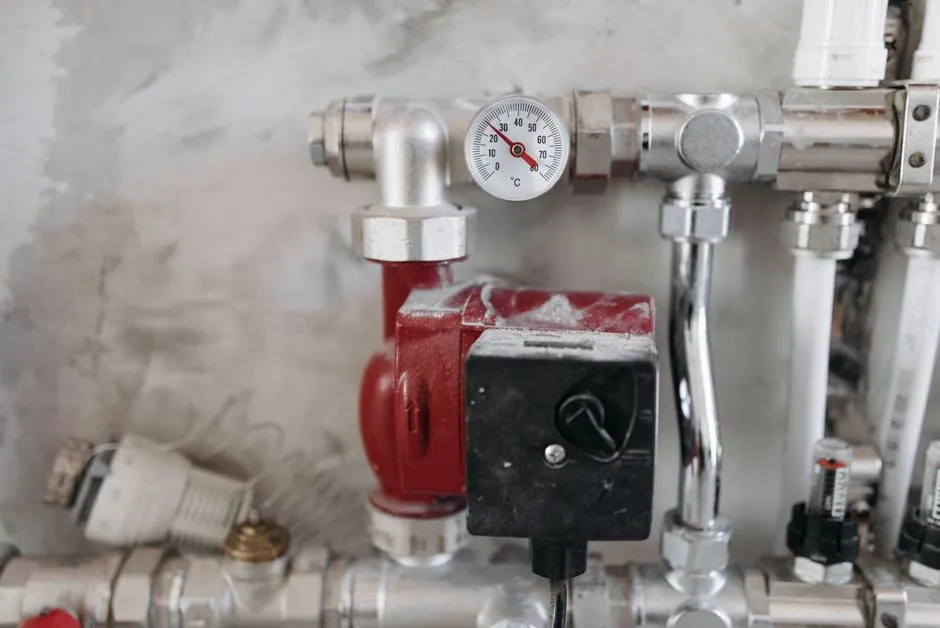
Self-priming pumps span eight structural families, from internal-mixing centrifugal units with ≤8 m re-prime height and 65–75% efficiency to jet ejector designs that prime in 15–30 s per 10 m but only deliver 45–55% efficiency [S3].
Engineered drainage frames reach 8–9 m suction lift, small-frame ZX/BZ household units cap at 4–7 m, and high-end centrifugal self-primers deliver up to 7,000 GPM (≈1,590 m³/h) with heads to 250 ft (76 m) depending on motor power and impeller diameter [S7][S8].
What Counts as a Self-Priming Pump
A self-priming pump is a centrifugal design that evacuates air from the suction line and establishes a liquid seal without a flooded inlet or external priming pump, retaining residual liquid in a recirculation chamber for the next start [S1][S4].
Engineers draw a hard line between wet-priming designs, which need the casing filled before first start, and dry-priming positive-displacement units such as diaphragm and peristaltic pumps that tolerate dry running; Tapflo AODD units self-prime 5 m dry or 8 m wet, while peristaltic designs reach 9.8 m suction in either mode [S4]. Centrifugal self-primers also need an initial 50–70% casing fill and run the impeller at 1450–2900 r/min to build a 0.02–0.05 MPa absolute vacuum in the suction line [S3].
Classification by Gas-Liquid Mixing Method
The four gas-liquid mixing families partition the centrifugal self-priming space by where the air-water foam is generated and how fast the unit primes [S3].
Internal mixing units mix at the impeller inlet, hold suction lift to ≤8 m, deliver 65–75% efficiency, and need 60–120 s to prime over 10 m; external mixing shifts the shear to the impeller outlet, lifting ceiling to ≤9 m, dropping efficiency to 60–70%, and halving prime time to 30–60 s. Water-ring-wheel designs sit between the two at 70–80% efficiency, ≤10 m lift, and 20–40 s priming, but require periodic water replenishment. Jet (ejector) units use a Venturi nozzle for the fastest prime at 15–30 s per 10 m, but efficiency collapses to 45–55% and the nozzle clogs on viscous or gas-heavy streams [S3].
Classification by Application Architecture

Beyond the mixing-mechanism taxonomy, the market splits self-priming pumps into eight application-driven types: centrifugal self-priming, trash/sewage, jet, diaphragm, rotary vane, liquid ring, peripheral side-channel, and piston [S1].
Trash and self-priming sewage variants widen the impeller vane clearances and port openings to pass 50–75 mm solids, which makes them the default for construction dewatering, sewage bypass, flood response, and mining [S6]. Centrifugal self-primers are the workhorse for clean water, irrigation, and light sewage; jet pumps anchor domestic shallow-well supply; diaphragm units handle viscous, corrosive, or solid-laden fluids; rotary vanes cover fuel and lube service; liquid rings compress gas-liquid mixtures in industrial systems; side-channel designs push high-head low-flow duties like boiler feed; and piston units power firefighting and high-pressure cleaning [S1]. Engineers comparing them on the same duty can also use the multistage centrifugal pump selection spec map as a cross-check for high-head applications, since side-channel and multistage geometries trade off on efficiency at low flow.
Spec Bands by Frame Class
Spec bands tighten dramatically with frame size: 0.5 HP household units deliver 35 L/min at 35 m head, agricultural 4-inch diesel-driven sets cover the US farm duty, and large engineered drainage sets span 8–9 m re-prime at much higher flow [S7].
Cast-iron self-priming water pumps cap at 120 m head with 8–12 year average service life; stainless-steel units drop max head slightly to 100 m but stretch service to 10–15 years in chemical and food service; self-priming slurry frames trade head for solids handling at 80 m max and 5–8 year life; portable gasoline self-primers are short-life field tools at 60 m max and 3–5 year service [S5]. Material selection swings the price curve hard: cast-iron housings raise durability and cost, integrated check valves improve prime retention at moderate cost, and stainless shafts and SiC/graphite mechanical seals push price for corrosion or cavitation resistance [S2][S3].
Selection Criteria: A Four-Axis Comparison

The four-axis decision grid for self-priming selection is suction lift, fluid type (clean vs solids-laden vs viscous vs gas-containing), required head and flow, and material compatibility with the service fluid [S1][S3].
On the suction-lift axis, jet and peristaltic units lead at 9–9.8 m, water-ring and external-mixing centrifugal frames reach 9–10 m, internal-mixing centrifugal stops at 8 m, and small-frame household units bottom out at 4–7 m. On the fluid-type axis, diaphragm and piston pumps win for viscous and corrosive service, trash and slurry self-primers win for 50–75 mm solids, and water-ring or external-mixing centrifugal units win for clean-to-lightly-contaminated water. On head and flow, engineered centrifugal self-primers lead at up to 250 ft (76 m) head and 7,000 GPM (≈1,590 m³/h), while jet and peristaltic units are limited to low flow at moderate head [S1][S4][S8]. For installation context and leak-tight service on aggressive chemicals, the magnetic drive pump installation field-proven spec map pairs as a useful reference, because magnetic-drive units and diaphragm self-primers both address the same leak and corrosion risks but through different sealing architectures.
Who Should and Should Not Specify a Self-Priming Pump
Self-priming pumps fit intermittent or variable-suction duties where the pump sits above the source or where air regularly enters the line; construction dewatering, agricultural irrigation, fuel transfer, sewage bypass, and emergency flood response all fall in this lane [S1][S5].
They do not fit continuous high-head boiler-feed service better served by multistage centrifugal or side-channel designs, nor pure high-viscosity or shear-sensitive fluid transfer where positive-displacement gear or screw pumps dominate. Engineers should also reject self-priming for long-run continuous flooded-suction applications where the priming chamber adds hydraulic loss and the slightly lower steady-state efficiency (60–80% versus 75–85% for standard centrifugal in clean service) becomes a real energy penalty [S1][S3].
Limitations and Failure Modes
The recurring failure modes for self-priming pumps are loss of prime after dry runs, nozzle clogging on jet units, mechanical-seal failure from cavitation, and accelerated wear on slurry frames from abrasive solids [S3][S5].
Volute helix angles are tuned to 15°–25°, separation-chamber expansion to 8°–12°, and the liquid return hole sized to 1/4–1/3 of the impeller inlet diameter; deviation from these bands is a common root cause of extended prime times and incomplete air evacuation [S3].
Standards, Sourcing, and Trackable Signals
No single ISO or API standard governs the self-priming category end-to-end; selection is driven by application standards (ANSI/HI for centrifugal pump nomenclature, ISO 5199 for chemical process, ATEX 2014/34/EU for explosive atmospheres) and by the Hydraulic Institute's 2026 guidance on suction-lift verification, which the major OEM field guides now cite [S5].
Trackable signals to watch through 2026 are the Hydraulic Institute's update cycle for re-prime test procedures, the spread of standardized 50–75 mm solid-handling ratings into mid-frame trash pumps, and the growing use of SiC-on-graphite mechanical seals with fluororubber O-rings as the default cavitation-resistant sealing stack on chemical-service self-priming frames [S3][S6].
For the relevant spec sheets and selection criteria, see self priming pump, self aligning bearing, and self cleaning filter.