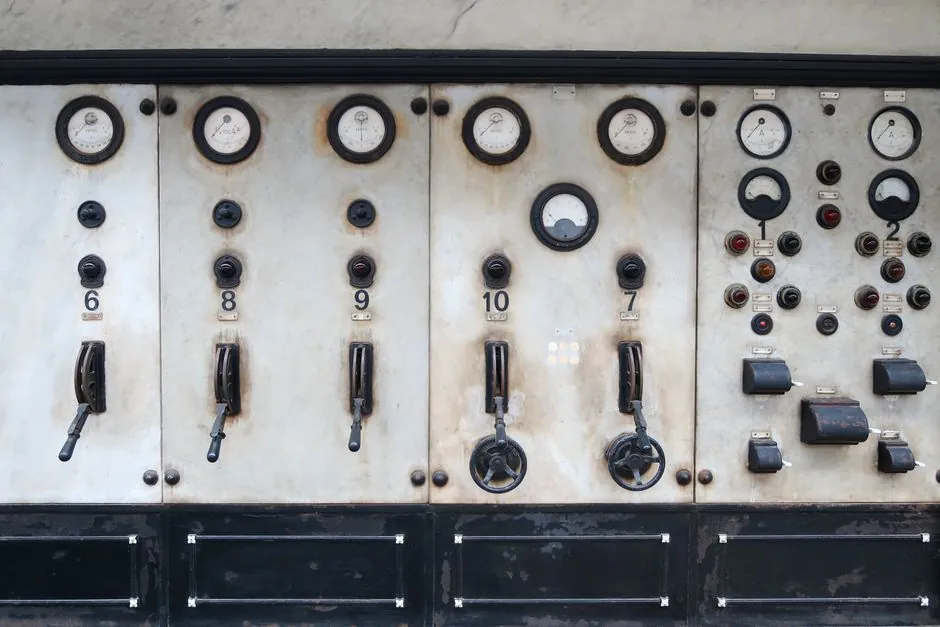
SF6 load break switches (LBS) and vacuum load break switches both clear nominal load current at medium voltage, but the interrupting medium sets hard limits on envelope, maintenance, and end-of-life compliance.
An LBS rated 630 A at 24 kV, governed by IEC 62271-103, must make, carry, and break load current, and must close onto a short circuit, but it cannot interrupt that fault, which is why it is paired with HRC fuses in transformer feeders [S2].
Arc Quenching Physics: Electronegative Gas vs Vacuum Gap
SF6 is an electronegative gas, so when an arc forms, free electrons are captured into immobile negative ions, de-ionising the arc path and extinguishing it within a half-cycle; modern SF6 LBS are built as puffer designs where a piston compresses the gas and blasts it across the contact gap [S3]. Dielectric strength of SF6 runs roughly three times that of air at the same pressure, which is why a 24 kV SF6 interrupter stays compact inside a sealed ring main unit (RMU) [S3].
Vacuum interrupters hold contacts at 10⁻⁶ to 10⁻⁸ torr, so the medium density is too low to sustain an arc; only contact-surface metal vapour sustains the plasma, which collapses at the next current zero, and dielectric strength recovers within microseconds, preventing re-strike [S3]. This fast recovery is the reason vacuum bottles handle frequent switching and high inrush duty such as capacitor banks and transformers.
Switching Capacity: Why an LBS Is Not a Breaker
An LBS breaks load current (typically up to 630 A at 12-24 kV) and closes onto a short circuit up to about 50 kA peak, but its contact speed and arc energy cannot interrupt kilo-ampere faults, so opening it under fault leads to thermal runaway and tank rupture [S2]. A vacuum circuit breaker, by contrast, is built to interrupt full short-circuit current at ratings such as 25 kA, 31.5 kA at the same voltage class, with a stored-energy mechanism that drives contacts apart fast enough.
In practice this split drives the single line diagram: a transformer feeder uses an SF6 LBS or vacuum LBS upstream of HRC fuses for fuse-protected transformer switching, while an incoming or bus-tie bay uses a VCB for full short-circuit interruption. Mis-sizing a VCB inflates project cost by roughly 3x for no protection gain; under-sizing an LBS to a fault-clearing role fails IEC 62271-103 and risks a catastrophic failure [S2].
Selection Criteria: Dielectric, Maintenance, Footprint, Cost
On dielectric, SF6 at filling pressure (~0.5 MPa gauge class for 24 kV) is roughly three times air, while vacuum is the highest known insulating strength at contact gap, so both are over-spec'd for normal MV duty, the differentiator is contact gap and contact life [S3].
On maintenance, SF6 LBS need a pressure gauge, density switch, and periodic gas-tightness checks, and any pressure loss compromises dielectric and arc-quenching performance; vacuum bottles are sealed-for-life, verified with a single dielectric withstand test, and carry no consumable monitoring [S3].
On footprint, SF6 interrupters are still more compact per kV for sealed RMU enclosures, which is why European and Middle Eastern RMU tenders still favour SF6 designs; vacuum bottles have shrunk but still trend slightly larger at the same rating [S3].
On cost, SF6 LBS often wins on initial purchase for 12-24 kV RMU cells, while vacuum LBS carries a slightly higher unit cost but recovers it through zero gas handling, no end-of-life gas recovery, and no SF6 emission reporting.
Environmental and Regulatory Pressure on SF6
SF6 has a GWP of 23,500 over a 100-year horizon, so even sealed-for-life designs carry end-of-life recovery liability and leakage reporting under tightening regional F-gas rules [S3]. Vacuum is inherently benign: no gas, no leakage pathway, no recovery procedure, no GWP inventory, which is why a growing share of new European utility procurement excludes SF6 in the tender specification.
ABB's own installed base of 300,000+ medium-voltage circuit breakers across both technologies confirms the technologies are complementary rather than competing, with SF6 dominant in Europe, Middle East, and North Africa, and vacuum dominant in China, Japan, and the USA [S1]. For load break switch duty specifically, the SF6 RMU heritage in CAPIEL markets and the vacuum LBS push in IEC-driven Asia-Pacific tenders are the two reference points buyers should benchmark against.
Use Case Fit: Where Each Interrupting Medium Wins
Pick SF6 LBS when the design calls for a compact, 3-position interlocked (ON-OFF-EARTH) RMU cell, frequent load transfer under ring network reconfiguration, and existing SF6-handling infrastructure on site; the 3-position interlock physically prevents earthing a live line, which is a hard RMU safety requirement under IEC 62271-103 [S2].
Pick vacuum LBS when the spec excludes SF6, the site is in a region phasing out F-gases, switching frequency is high (capacitor banks, frequent transformer switching), or the operator does not want gas-density monitoring in the maintenance plan; vacuum also suits outdoor pole-top LBS where gas sealing against humidity is harder to guarantee [S3]. For a reference comparison on how sealed-for-life gas systems compare to solid-dielectric alternatives in adjacent equipment, see the medium-voltage VFD spec encyclopedia entry.
Standards, Testing, and What Buyers Should Verify
LBS design and testing is set by IEC 62271-103 (switches) and IEC 62271-105 (switch-fuse combinations); buyers should confirm the certificate covers the specific 3-position interlock sequence and the rated short-circuit making current, not just the load breaking current [S2]. For ring main units the 3-position interlock between switch and earthing switch is mandatory, so the certificate must explicitly cover that mechanical sequence, not just the contacts in isolation.
Vacuum interrupter integrity is verified by a high-voltage withstand test across the open gap (typical 1-minute power-frequency and 1.2/50 µs impulse); SF6 LBS verification adds a gas-density check at the rated filling pressure and a leak-rate test. For adjacent switching decisions where the load is fundamentally different, the load switch application reference covers the full family. When the device sits inside a wider load management cabinet, the electronic load integration considerations are worth a parallel read.
Decision Matrix for 2026 Procurement
On five decision criteria: short-circuit making, load-breaking life, environmental compliance, RMU compactness, and lifetime maintenance cost, the comparison lines up as: SF6 LBS leads on RMU compactness and unit cost, vacuum LBS leads on environmental compliance, lifetime maintenance, and switching frequency endurance, and both are equal on load-breaking at 630 A / 24 kV per IEC 62271-103 [S2][S3].
For a greenfield 24 kV RMU in an F-gas-regulated region, specify vacuum LBS with HRC fuses under IEC 62271-105; for a brownfield 12/24 kV ring network in a region still permitting SF6 with existing gas handling, the SF6 LBS RMU remains the lower-risk, lower-cost drop-in. Watch the next revision of regional F-gas implementing acts and IEC 62271-103 amendment cycles for tightening sealed-for-life leakage thresholds, since these directly raise SF6 LBS lifetime compliance cost.
For related coverage, see Chemical anchor selection for warehouse pallet racking: resin type, substrate, and load.