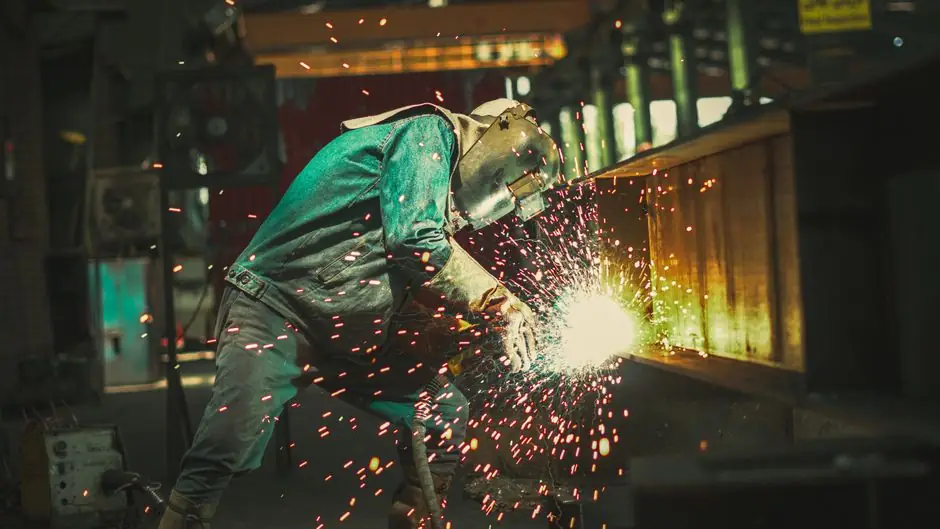
Steel-mill shaft collars must be specified against three load realities at once: roll-neck impact, mill-floor heat, and the descaling-water corrosion that follows; selection therefore starts with holding mechanism and material grade before bore tolerance [S1][S2].
Carbon and stainless steel remain the default body materials for hot-strip, plate, and reheat applications, with zinc-plated carbon steel the most common general-purpose choice and stainless reserved for pickling-line, acid-regeneration, and submerged bearings [S3][S5]. For a definition of the basic component, the shaft collar reference sets out bore, OD, and width geometry used in the comparisons below.
Set-screw vs clamp-style holding under mill shock loads
Set-screw collars carry the lowest holding power because a single screw tip creates point contact, with the screw biting the shaft only when the screw is harder than the shaft itself [S3][S4]. On modern hardened mill drive shafts (typically 4140/4340 through-hardened or induction-hardened to 45-55 HRC), a set-screw bite depth is shallow and the collar is the first component to slip on a roll-neck upset.
Clamp-style collars distribute force around the full shaft circumference: single-split designs already exceed set-screw holding, and double-split units can deliver roughly twice the axial load of an equivalent set-screw collar, which is the reason most OEMs default to two-piece split on coiler, payoff reel, and pinch-roll stands [S3][S4]. Holding force ranking in mill practice is therefore solid set-screw < single-split < double-split < threaded-bore clamp, with threaded-bore collars reserved for the highest axial loads such as downcoiler wrapper rolls.
Material and finish map for hot-strip, plate, and cold-mill cells
Steel collars have the highest holding power and some corrosion resistance, but their mass rules them out where roll balance is critical; the steel grade itself changes both strength and the corrosion envelope [S2]. Carbon steel (typically 12L14, 1018, or 1045) is the economical default for dry, indoor mill stands and is routinely supplied with zinc plating or black-oxide finish, with zinc offering better corrosion protection and black-oxide giving a higher-friction face against the shaft [S3].
Stainless collars (303 for general corrosion, 316 for chloride exposure) are specified at the wet end: pickling-line entry/exit bridles, acid-regeneration pump shafts, and the submerged bearings of continuous galvanizing lines. The mechanical limit of stainless is usually the cap screw, not the body, which is why matching hardware grade to collar grade is non-negotiable on 300-series hardware [S3]. Cast-iron safety set collars in steel or high-strength gray iron appear in heavy-mill safety devices where the collar is intended as a shear element rather than a holding element [S6].
Field-selection checklist for mill maintenance engineers
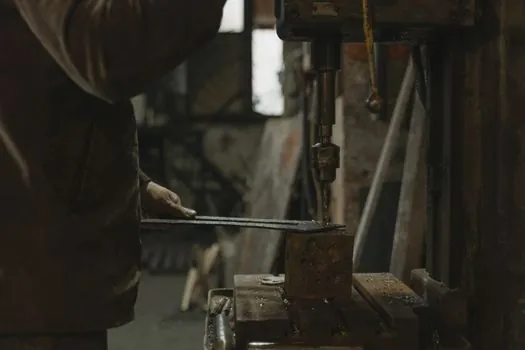
The four questions that drive the SKU on the bench are: confirm shaft diameter and tolerance, identify load magnitude and direction, decide whether repositioning is required, and only then choose between clamp or set-screw style [S4]. Bore diameter should be specified to a known shaft tolerance (commonly g6 or h6 on mill drive shafts); an over-bored collar loses preload and may release under impact, while an under-bored collar will not seat and will distort during tightening [S4].
For a roll-neck where frequent bearing change-out is the norm, a two-piece split clamp with keyway is the pragmatic choice: the collar comes off without disturbing the roll, and a keyway adds positive torque transfer so the collar cannot spin on the shaft. For purely axial stop duty on a coiler mandrel, a one-piece threaded-bore clamp is usually over-specified but eliminates the slip risk that a set-screw would carry. Carbon-steel zinc-plated parts (e.g. 25 mm or 32 mm bore examples in the aftermarket catalog) cover most non-corrosive mill-floor replacements [S5][S7].
Comparison: four common collar styles on mill duty
Solid set-screw in zinc-plated carbon steel is the lowest-cost option, offers the weakest holding, and is best limited to light-duty guards, covers, and encoder mounts away from the roll gap [S3][S5]. Single-split clamp in carbon steel is the mill workhorse for general purpose axial stops, with a clear step up in holding and the ability to be removed and re-installed without shaft damage [S4].
Double-split clamp is the choice for high-shock, high-precision stations such as coiler wrapper rolls and downcoiler side guides, with the trade-off being higher cost and a wider body that must be checked for clearance against the chock. Stainless single- or double-split, typically 303 or 316, is mandatory in pickling, galvanizing, and acid-regeneration cells, paired with stainless cap screws of the same grade to avoid galvanic and strength mismatch [S3]. Where roll balance is critical, aluminum collars can be substituted, but only when the duty is light, because aluminum's lower hardness reduces set-screw bite and overall holding power [S2][S3].
Limitations, failure modes, and standards to verify

The most common mill-floor failure is a set-screw collar spinning on a through-hardened shaft; root cause is almost always a screw softer than the shaft, or a worn set-screw cup that lets the screw ride out under vibration [S3][S4]. Over-tightening a clamp collar distorts the bore and reduces effective contact area, which is why a calibrated torque wrench on the cap screws is treated as a requirement rather than a recommendation in precision mill cells [S4].
For collars used as load-bearing stops on safety-rated equipment, designers typically reference ISO-style shaft-hub fastening guidance and the machine builder's safety-of-machinery documentation, with the collar body and screw grade verified on the same drawing. On shaft extension and keyway geometry, the shaft key reference covers the parallel-key dimensions most two-piece split collars are machined to accept. For adjacent connection hardware such as gear and jaw couplings on the same mill drive train, the comparison logic mirrors jaw coupling selection for textile mills and gear coupling selection for mining drives, where service factor, misalignment envelope, and material grade are the same three decision axes.
Procurement, lead-time, and on-shelf SKUs
Distributor catalogs for industrial shaft collars list fractional bore sizes from 3/16 in through 1 in and beyond, in both zinc-plated carbon steel and plain stainless, with the 1/4 in through 3/4 in range the most heavily stocked [S5]. Pricing on standard fractional set-screw collars in carbon steel sits around USD 1-2 per piece at distributor list, while stainless equivalents run roughly USD 4-8, which is why stainless is typically scoped only to the wet end of the mill [S5].
For robotic or light-precision cells sharing a mill-floor supply room, custom clamping collars (e.g. for FRC-style axles) are a different category and not interchangeable with mill-duty hardware [S8]. Two near-term signals to track: distributor stocking depth on 303/316 two-piece split collars in metric bores (40 mm, 50 mm, 60 mm are the workhorse sizes for European mill rebuilds), and any OEM bulletin updating the recommended cap-screw torque values for two-piece split collars on induction-hardened shafts. Reference pages on shaft fastening and shaft coupling cover the wider hardware context for any collar callout.