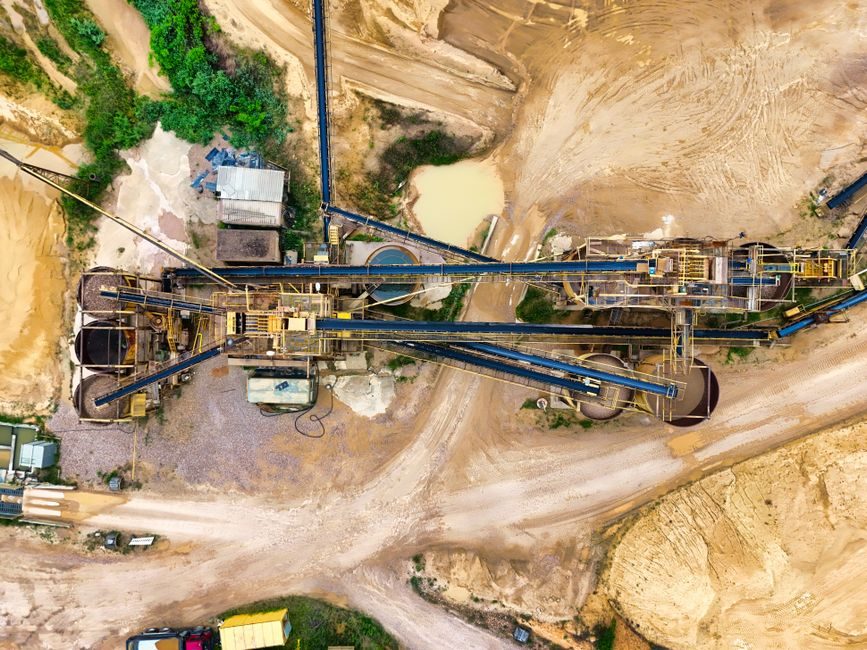
Slewing ring bearings for mining dump trucks, electric rope shovels and rotary blasthole drills sit in the 500-5,000 mm diameter band and are dominated by single-row four-point contact ball (Q-Mnn) and crossed roller (XU-nnn-nnn) constructions with 42CrMo or 50Mn forged rings, with the bulk of OEM/ODM supply concentrated in Luoyang, Xuzhou and Hefei [S6][S9].
Current sourcing reality for a 1-piece MOQ in this category runs US$15.50-35.50 for small-diameter crossed roller light-duty units (Xu160405, Xu080430, Xu300515), and US$365-421 for external-gear four-point contact units in the 010-series ball bearing class, with tier-2 mining sizes stepping into the four-figure USD range per piece [S7][S9].
Mining Use Case and Load Profile
Mining slewing rings run at slow rotational speeds, typically under 5 rpm, while carrying combined axial, radial and overturning moment loads, and the 42CrMo / 50Mn forged ring / raceway combination is the de-facto standard for the 100-400 tonne payload class of haul truck and shovel [S6][S7].
Standard published engineering references define a slewing ring bearing as a thin-section rolling-element bearing that supports a heavy but slow-turning or slow-oscillating load, frequently a horizontal platform such as a crane, swing yarder or wind-turbine nacelle, and the same definition maps directly onto mining shovel house rotation and drill table turntable service [S8]. Compared with tower-crane and crawler-crane slewing rings (where capacity is the gating spec), mining slewing rings are gated by shock-load resistance, contamination sealing and tooth-bending fatigue on the integrated gear, not by static tip-load alone [S8].
For an electric rope shovel in the 20-55 m³ bucket class, the house-bearing diameter lands between 2,500 mm and 3,800 mm; for a 150-360 t mining dump truck, the steering or body-pivot bearing lands in the 1,200-1,800 mm band, which is why the 010-series and 020-series external-gear slewing ring SKUs (e.g. 010.20.200, 011.20.224) appear repeatedly in OEM catalogues [S7][S9].
Construction Types: Four-Point Contact Ball vs Crossed Roller vs Three-Row Roller
For dump-truck body pivot and drill-table slewing, the single-row four-point contact ball design (Q-Mnnn / 010-series) is the most specified because one row carries axial load, radial load and overturning moment simultaneously through the four-point contact geometry, eliminating the need for a separate thrust bearing [S7][S8].
Crossed roller slewing rings (XU series, e.g. Xu160405, Xu080430, Xu300515) are used where higher rigidity and tighter axial runout are required, typically on robotic-arm and small-drill turntables, and they appear in the 150-500 mm OD range with the lowest entry pricing at US$15.50-35.50 per piece on the Chinese ODM spot market [S9]. Three-row roller slewing rings, which add a separate row of axial rollers to the radial/overturning pair, are reserved for shovel and stacker-reclaimer service where axial load dominates, and they are almost never quoted at the US$365 entry tier [S8].
Comparing the three on the four decision criteria that actually drive mining specification: (a) static load capacity per kg of bearing weight is highest in three-row roller, lowest in crossed roller; (b) minimum achievable OD is ~250 mm for four-point contact, ~150 mm for crossed roller, ~800 mm for three-row; (c) gear integration is straightforward on all three, with external gear being the default and internal gear selected when the pinion must stay inside the ring envelope [S7][S8][S9]. For a 100-150 t class truck pivot, four-point contact ball remains the cost-correct answer; for a 20 m³-class shovel house, three-row roller wins on fatigue life despite higher unit cost [S8].
Material, Heat Treatment and Hardness Bands
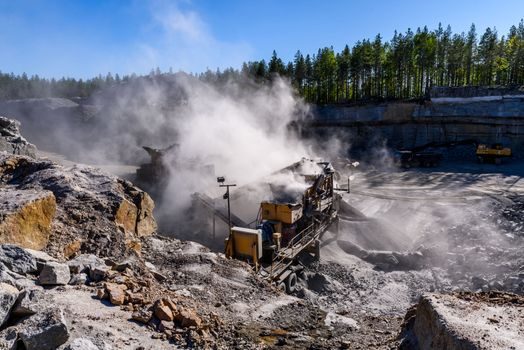
Published OEM profiles from Xuzhou Wanda Slewing Bearing Co. confirm ISO 9001:2008 quality system certification plus compliance with the Chinese engineering standards JG/T66-1999, JG/T67-1999, JG/T68-1999 and JB/T2300-1999 covering slewing ring manufacture and inspection, and the same Chinese standard family is the de-facto baseline audit for export to South America, Africa and the CIS mining belts [S5].
Raceway material is 42CrMo (AISI 4140 equivalent) or 50Mn (a high-manganese structural steel that through-hardens to the case depth required for mining shock loading), with case-hardened raceways typically landing in the 55-62 HRC surface hardness band, while the gear-tooth flanks are induction-hardened separately because the tooth-root bending fatigue mode is different from raceway rolling-contact fatigue [S5][S6]. Chinese OEM catalogues at the 010-series / 011-series level confirm this two-step heat treatment as standard, and KG Bearing India publishes an equivalent "international quality standards" envelope with emphasis on raceway hardness and tooth geometry for heavy-duty applications [S3][S7][S9].
Forging-vs-bar-stock is the next divider: a slewing bearing above 1,500 mm OD is almost always forged ring, below 1,000 mm OD it can be bar-stock ring with cost and lead-time benefit, and this is one of the reasons the Hefei, Luoyang and Xuzhou cluster quotes shorter delivery than European suppliers on the 500-1,200 mm OD sub-class [S4][S6].
Gear Integration: External vs Internal, Module and Tooth Count
External-gear slewing rings dominate the mining catalogue because the pinion can be mounted outside the ring envelope for easier alignment and replacement, and the 010.20.200 and 011.20.224 SKUs at US$365-421 per piece (1-piece MOQ, Luoyang Yujie Industry & Trade) are the most-searched four-point contact external-gear units on Made-in-China in mid-2026 [S7].
Internal-gear slewing rings are specified when the drive pinion must sit inside the ring (a smaller horizontal footprint, common on compact drill tables), at a typical 10-15% price premium over equivalent external-gear geometry due to the additional internal-tooth hobbing and inspection step [S4][S7]. Gear modules for mining service typically run m=6 to m=16 depending on pitch diameter, with surface-hardened flanks and shaved or ground finish on Class 8-9 accuracy per the Chinese engineering standards cited in OEM disclosures [S5].
For a slewing drive assembly — that is, the slewing ring plus a worm or planetary gearbox plus a hydraulic motor in one integrated housing — mining OEM packages add roughly 2-3x the bare-ring cost, and XZWD explicitly markets an "External Gear Ball Crane Use" slewing ring at this combined-assembly tier, confirming that mining turntables are increasingly procured as ring-plus-drive units rather than bare rings [S1].
Sealing, Lubrication and Contamination Control
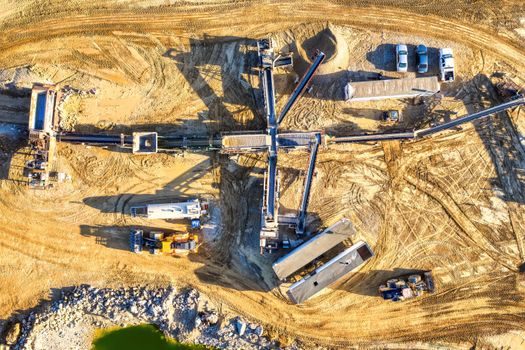
Mining dust, water spray and abrasive fines are the dominant failure drivers, and the published Chinese engineering standards JG/T66-1999 / JG/T67-1999 / JG/T68-1999 require lip seals on both faces plus grease-relief features as a minimum, with higher-tier shovel and drill rings adding a V-ring or cassette face seal on the tooth side [S5].
Grease relubrication intervals on mining service are typically 250-500 operating hours, with the grease-nipple and grease-channel geometry standardized in the same JG/T family, and field experience across the Luoyang / Xuzhou / Hefei cluster converges on lithium-complex EP-2 grease as the baseline fill for ambient-temperature shovel-truck service [S5][S6]. For pit service above 50 °C ambient (deep-pit operations in Australia, Chile, the DRC), synthetic polyurea or calcium-sulfonate greases are the typical spec-up, with relube intervals halved [S3][S5].
The most common contamination-driven failure mode documented in the field is raceway brinelling from particulate ingress past a worn lip seal, not tooth-bending fatigue, which is why KG Bearing India and Aoxuan Bearing both publish "Quality Management" / "Branded Materials" pages that emphasize seal-kit inspection and the use of bar-stock 42CrMo rather than lower-grade alternatives [S3][S4].
Sourcing Geography, MOQ and Lead Time in Mid-2026
The three dominant Chinese OEM/ODM clusters for mining slewing rings are Luoyang (Henan), Xuzhou (Jiangsu) and Hefei (Anhui), with Hefei King Slewing Bearing Technology Co. explicitly marketing proximity to Shanghai Port as a logistics advantage for export to South America, Africa and Southeast Asia mining projects [S6]. Luoyang Jia Wei Bearing Manufacture (2007-established, 101-200 employees) and Luoyang Yujie Industry & Trade (ISO 9001:2015) cover the small and mid-diameter external-gear segment at the US$365-421 per piece, 1-piece MOQ entry tier [S2][S7].
Aoxuan Bearing, operating since 1999, covers the custom-engineered tier with self-owned factory and one-stop cross-roller and four-point contact coverage, and Xuzhou Wanda covers the 200-5,000 mm OD range with explicit ISO 9001:2008 + JG/T66-1999 / JG/T67-1999 / JG/T68-1999 / JB/T2300-1999 certification [S4][S5]. KG Bearing India is the only non-Chinese supplier in the active research set, positioned as "The Global Leader, Continuously Improving Performance" with part-number search and dimension-based search on its public site [S3].
Lead time on standard external-gear four-point contact units in the 010-series / 011-series class is 20-35 days ex-works Luoyang / Xuzhou; custom three-row roller units for shovel house service typically run 60-90 days ex-works including forging, heat treatment, gear cutting and final inspection [S2][S4][S6].
Selection Criteria and Decision Matrix for Mining Specifiers
For a mining dump-truck body-pivot or steering bearing, the specifier should fix four gates first: (1) pitch-circle diameter from the truck or shovel OEM drawing, typically 1,200-1,800 mm for 150-360 t trucks; (2) combined axial + radial + overturning moment from the worst-case loaded-haul envelope; (3) gear module and tooth count, with external gear as the default and internal gear when horizontal envelope is constrained; (4) seal arrangement and grease spec, fixed by ambient temperature and dust load [S3][S4][S5].
Four-point contact ball wins on cost, lead time and gear-integration simplicity for the 1,200-1,800 mm dump-truck band; three-row roller wins on fatigue life for the 2,500-3,800 mm shovel-house band; crossed roller wins on rigidity and runout for sub-500 mm drill-table service [S7][S8][S9]. The 42CrMo / 50Mn raceway with case-hardening to 55-62 HRC, dual lip seals, and ISO 9001 + JG/T66-1999 / JG/T67-1999 / JG/T68-1999 / JB/T2300-1999 certification is the minimum spec to qualify a supplier for mining service in 2026 [S5].
Spotters on the candidate list that align to this scope: Tower Crane Selection: 7 Spec Gates From Tip Load to Wind Class for adjacent crane-house slewing-ring geometry, Spherical Plain Bearing Selection: Load Case, Material Pair and Spec Bands for the link-arm pins that take the radial reaction the slewing ring does not, and Best Crawler Cranes for Aerospace: 2026 Capacity, Pick-Point and Site-Geometry Cut for crawler-crane house-ring sizing as a useful cross-check on the 1-2 m diameter class [S3][S5].