A slewing ring bearing is a large-diameter rolling-element bearing designed to carry combined axial, radial and overturning-moment loads while the inner or outer race rotates slowly relative to the fixed race, with typical applications spanning cranes, excavators, wind turbines and solar trackers [S3].
The buyer's job on 2026 RFQs is to lock five gates in order: load case first, then rolling-element architecture, then gear integration (or none), then diameter and mounting, and finally the maker's documentation trail (ISO 9001, dimensional drawing, gear-cutting evidence) [S2][S5].
Load Case Is the First Gate: Axial, Radial and Moment Must Be Quantified
A slewing ring almost never sees a pure radial or pure axial load. In service the bearing carries the weight of the upper structure (axial), wind overturning on a jib (moment), and side loads from slewing acceleration (radial), all simultaneously [S3]. For solar trackers the dominant load is axial compression plus a small tilting moment, while for crawler-crane upperworks the moment term often dictates the size. Buyers who specify only "static load" tend to under-size the bearing; the working moment at the bolt circle is the figure that drives the raceway diameter.
Crossed-roller designs (Rks. 221310101001 class, 864×668×82 mm, FOB US$ 1,990–2,000/set, MOQ 1 set) handle moderate axial and radial loads with high stiffness because the rollers cross at 90° and span both raceways, but they tolerate less overturning moment per diameter than a triple-row roller design [S1]. Triple-row column slewing rings (S series) place rollers in three independent seat rows, so "each row roller load can be exactly determined" and the format delivers the highest combined load capacity per millimetre of bore among the four mainstream types [S6].
Rolling-Element Architecture: Four Options, Four Load Signatures
Four architectures dominate the 2026 buyer's shortlist: single-row ball, double-row ball, crossed roller, and triple-row roller [S2][S6]. A fifth option, roller/ball combination, sits between single-row ball and crossed-roller on capacity per diameter and is stocked by Shanghai JINB and similar Shanghai-based makers [S2].
Single-row ball slewing rings are the cheapest and lightest, the default for small solar trackers and lightweight man-lifts, and are commonly quoted from the FOB US$ 1–150/piece band visible on 2026 wholesale listings [S1]. Crossed-roller designs trade cost for stiffness and precision, typical in machine-tool rotary tables and small wind turbines, with the 864×668×82 mm class cited above landing in the US$ 1,990–2,000/set range [S1]. Double-row ball sits between the two, while triple-row roller is reserved for the heaviest duty: mining shovels, port cranes, large wind turbines, where the bearing carries the largest combined load envelope per unit of mounting diameter [S6].
Integrated Gear vs No-Gear: Pinion Drive Topology Decision
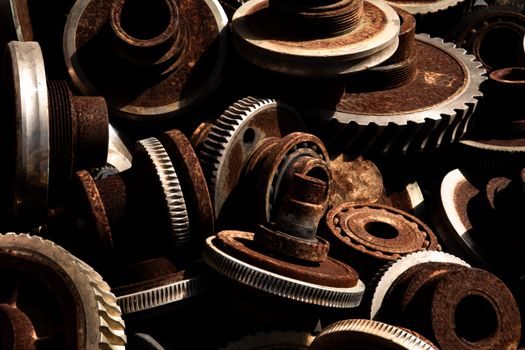
Many slewing rings ship with gear teeth integral to one race — internal gear (teeth cut into the inner bore of the outer race) or external gear (teeth on the outer diameter of the inner race) — so a small pinion on the base structure or on the upper works can drive the platform rotation without a separate slewing ring gear [S3]. The teeth are typically module 4 to module 12 for industrial slewing rings, and the gear quality (DIN 3962 / ISO 1328 class 8 or better) is a separate acceptance gate from the bearing rating.
If the drive architecture is a worm or planetary slewing drive — see the slewing drive encyclopedia entry for the worm-gear topology that bolts directly to a non-geared ring — then the buyer can skip the gear-integration gate entirely and pick a no-tooth bearing. A gear-integrated ring raises FOB roughly 15–30% versus an identical non-geared ring, in line with the price spread visible between the US$ 1,990–2,000 crossed-roller set (geared) and entry-level no-gear ball units at US$ 1–150/piece [S1]. For very large diameters (above 2 m) buyers should confirm whether the gear is cut after heat treatment (post-hardened skiving or grinding) or before, because post-hard cutting is what holds profile accuracy under load.
Diameter, Mounting and Bolt-Circle Geometry
Industrial slewing rings run from roughly 200 mm bore (small medical/CT scanners) to over 5 m bore (rail-mounted stacker-reclaimers and large wind turbines). Mounting is almost universally through-bolts on both races, with hardened washers under each bolt head/nut to distribute clamp load, and a locating spigot (or two) on one race to fix the axial position [S3]. The bolt-circle diameter, the number of bolts, and the bolt size are the three numbers that tie the bearing to the rest of the structure, and they must be confirmed against the maker's outline drawing before any 2026 PO is released.
Inside the section, the rolling-element layout — single row of balls, two rows of balls, crossed rollers, three rows of rollers — sets both the section height and the moment stiffness. Triple-row roller designs have the largest section height for a given bore, which is why they are specified on mining shovels and large port cranes where stiffness and moment capacity dominate over envelope [S6]. Buyers who need to compare housing envelopes across types should ask makers for the H (overall height) and the D1/D2 (inner/outer race diameters) values, not just the bore.
Documentation and Maker Gate: ISO 9001, Capacity and Traceability
The 2026 buyer's documentation gate is narrower than the 2017 baseline. Where 2017-vintage product listings emphasised Business Range and transport packaging, the 2026 listings on Chinese B2B portals and on maker-owned sites now lead with Management System Certification, typically ISO 9001, plus stated annual production capacity in pieces/year [S4][S5]. Xuzhou Xinda Slewing Bearing Co., Ltd., a Jiangsu-based maker registered in 2010, lists ISO 9001 as the headline certification on its 2026 portal entry [S5]. Shanghai JINB, founded earlier and based in Pudong, quotes 50,000 pcs/year capacity on 2017-vintage catalogue pages that remain live in 2026 — a useful baseline for capacity verification [S4].
Beyond ISO 9001, a 2026 quote should also carry: material certificates (42CrMo or 50Mn for rings, GCr15 for rolling elements), heat-treatment record (quench + temper, surface induction hardening on raceways), gear-cutting record when geared, dimensional inspection report, and a run-test record for any triple-row roller unit. The absence of a dimensional inspection report on a 2,000 mm class unit is a red flag regardless of price.
Comparison: Four Slewing-Ring Types Against Four Decision Criteria
The four mainstream slewing ring bearing architectures compare as follows against the criteria that matter on 2026 drawings: load capacity per bore diameter, cost per piece, section height (envelope), and moment stiffness. Single-row ball is cheapest and lowest, with the lowest moment stiffness; double-row ball raises both load and stiffness at moderate cost; crossed-roller delivers the highest moment stiffness per diameter in the small-to-mid bore range (the 864×668×82 mm class above is a typical example) [S1]; triple-row roller carries the highest combined load at the cost of the tallest section and the heaviest unit [S6]. Buyers whose load case is moment-dominated should rank crossed-roller or triple-row first; buyers whose load case is axial-dominated and whose budget is tight should default to single-row ball and accept the lower moment margin.
Failure Modes and Inspection Gates Buyers Should Add to the PO

The four common field-failure modes on slewing rings are: raceway brinelling from bolt over-torque, raceway spalling from overload or poor lubrication, gear-tooth pitting/chipping from misalignment or contamination, and bolt-hole elongation from moment overload. Each maps to an inspection gate on the 2026 PO: bolt torque procedure and torque value, lubrication interval and grease type, gear-tooth contact pattern (if geared) and backlash figure in mm, and bolt-hole wall thickness check on the drawing. [S1]
For solar-tracker and small-wind applications, the 2026 supply market also shows a clear price-tier signal: the US$ 1.00–150.00/piece band on Made-in-China listing page 8 corresponds to single-row ball units in small bores, while the US$ 1,990–2,000/set tier corresponds to mid-bore crossed-roller geared units [S1]. Triangulating the buyer's bore and gear choice against those two bands sets a fast sanity-check on any 2026 quote.
The next node to track is the maker's 2026 catalogue for the exact type under spec: pull the outline drawing, the gear-cutting record (if geared) and the ISO 9001 certificate, and run a side-by-side FOB comparison against at least two alternative makers such as Xuzhou Xinda (ISO 9001, Jiangsu) and Shanghai JINB (Pudong, 50,000 pcs/year baseline) [S4][S5]. Two trackable 2026 signals: the spread between single-row ball and crossed-roller FOB bands on page-8 wholesale listings, and whether a maker publishes a post-hardened gear-cutting record in addition to the basic ISO 9001 certificate.
For related coverage, see Angular Contact Bearing Selection: Contact Angle, Pair Mounting and 2026 Sourcing Specs.