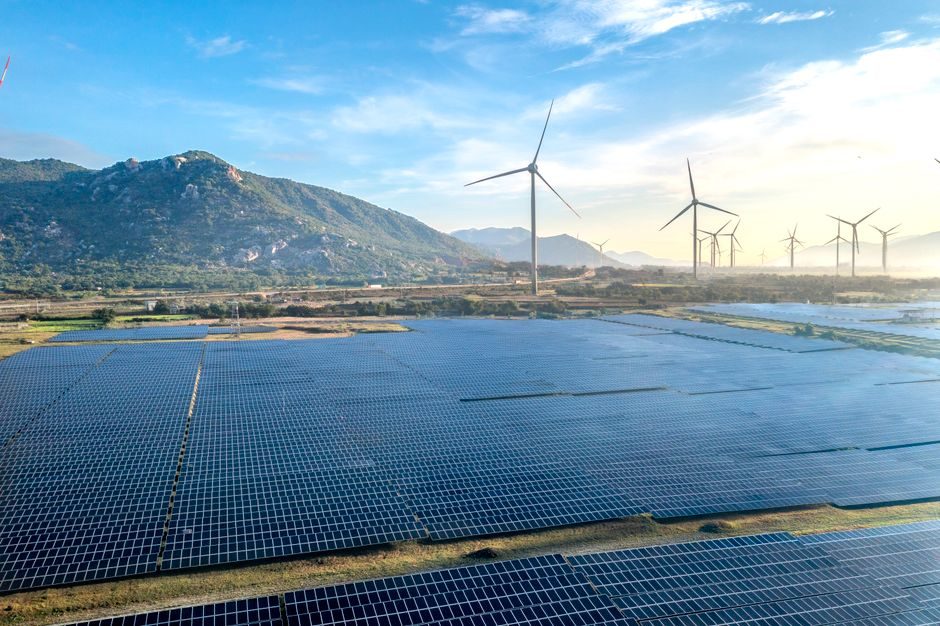
TOPCon M210-N 18BB cells are listed in 2026 channels at roughly $1.00 per piece at MOQ 200,000+ units, with TOPCon module efficiency landing at 23.9–25.7% and monocrystalline cell efficiency at 19.4–20.3% on 156.75 mm wafers from Solartech Energy Corporation (Taiwan) [S3].
The reference datasheet S-156-5 ver.C covers Pmax 4.74–4.935 Wp, Vmpp 0.54–0.552 V, Impp 8.801–8.953 A, Voc 0.642–0.647 V, Isc 9.384–9.425 A, with a temperature coefficient of Pmax at −0.396 %/°C, a 5-busbar silver layout on 0.7 mm pads, aluminium BSF, and silicon-nitride ARC [S3]. Cell thickness sits at 180/200 ±30 µm on a 210 ±0.5 mm diagonal, reflecting the legacy 156.75 mm mono platform that the industry is now moving past [S3].
Mono Cell Spec Envelope: 156.75 mm vs M210-N 18BB
The Solartech S-156-5 ver.C delivers Pmax 4.74–4.935 Wp across nine model bins (194–202) on a 156.75×156.75 mm footprint, with a fill factor spread of 78.89–81.04% and an intensity dependence that holds Voc to 93.1% at 200 W/m² and 99.7% at 900 W/m² [S3]. That intensity curve is the engineering argument for why MPPT window sizing matters more than peak-lab wattage in field strings — the same point echoed in the Solar Inverter 2026 spec guide for inverter pairing. The cell temperature coefficient of Pmax at −0.396 %/°C and Voc at −0.3197 %/°C define the operating envelope; the positive Isc coefficient of 0.0454 %/°C is small enough that thermal derating stays dominated by voltage drop, not current rise [S3].
M210-N 18BB TOPCon moves the wafer diagonal to 210±0.5 mm, thins to 130 µm, and lifts fill factor to 85.67% with cell efficiency in the 23.9–25.7% range — a step-change in watts-per-wafer that has cascaded back into the wafer-cutting, diamond-wire and silver-paste sub-markets [S3]. The 18-busbar topology also cuts silver per ampere versus the 5-busbar 156.75 mm baseline, which is the structural reason silver-paste cost has re-entered procurement spec sheets.
Supply Chain Mapping: Polysilicon, Wafer, Cell, Module
Four layers define the solar cell supply chain in 2026: polysilicon (Siemens-process rod + granular fluidised-bed), mono wafer sawing, cell diffusion/PECVD/printing, and module lamination. The Solartech cell datasheet signals where each gate sits: 156.75 mm pseudo-square mono wafers feed PERC/legacy lines, while M210-N wafers feed TOPCon lines with 130 µm thickness and 18BB silver print [S3]. Each layer carries its own bottleneck — polysilicon spot price cadence, diamond-wire mother-wire availability, silver paste spot price, and glass-backsheet EBIA capacity — and the spec gaps between them show up as the 156.75 mm → 210 mm transition currently reshaping 2026 capex [S3].
Leanness at the cell layer means aligning wafer-supply pull with module-maker order books within a 6–10 week window; the lean-supply framework, as catalogued in industrial reference [S5], treats the supply chain as a network enterprise where non-productive motion (WIP, retool, queue) is removed in five steps. In 2026 cell lines, that translates to MES-tracked diffusion-tube uptime, inline I-V testers at end-of-line, and a binning strategy that maps Vmpp/Impp windows to module power classes, the same data spine that shows up in polyethylene resin smart manufacturing process control architectures.
Decision Criteria: When to Specify TOPCon M210 vs Legacy 156.75 mm Mono
Specify TOPCon M210-N 18BB when the project targets higher watts-per-square-metre, accepts thinner 130 µm wafers (handle-with-care logistics), and pairs with bifacial glass-glass modules — efficiency 23.9–25.7% on a 210×210 mm cell with 85.67% fill factor supports >600 W module power classes [S3]. Specify legacy 156.75 mm mono (S-156-5 ver.C class) when the BOM is cost-driven, the supply chain is regional, and 4.74–4.935 Wp cell output at 19.4–20.3% efficiency meets the system design — the 5-busbar silver/aluminium-BSF architecture is mature, second-sourceable, and 180/200 ±30 µm thickness is forgiving in automated stringers [S3].
Three decision gates separate the two: (1) module efficiency target — TOPCon at 23.9–25.7% beats legacy mono 19.4–20.3% by 4–5 absolute points, (2) wafer thickness and breakage rate — 130 µm versus 180/200 ±30 µm shifts handling protocols, and (3) silver-paste exposure — 18BB versus 5BB changes $/Wp paste cost by a measurable amount, which is why the cell cost stack in 2026 closely tracks electrolyzer cost-stack thinking on materials intensity. Each gate is auditable from the manufacturer datasheet, not from marketing collateral.
Use Cases and Failure Modes
Utility-scale ground-mount with bifacial gain is the dominant 2026 use case for TOPCon M210-N — the higher Voc window pulls more kWh per peak watt under real irradiance curves, and the 130 µm wafer is acceptable when the laminator controls interlayer adhesion. Commercial rooftop with weight constraints generally still favours the legacy 156.75 mm mono platform in glass-backsheet format, where the 4.74–4.935 Wp cell output at 180/200 ±30 µm thickness gives the module maker a more robust mechanical envelope [S3]. Off-grid and small-PV, where inverter pairing determines yield, benefits from the S-156-5 ver.C intensity curve holding Voc to 95% at 300 W/m² — a useful margin for morning/evening cloud-edge operation [S3].
Three failure modes to spec against: (1) PID (potential-induced degradation) on the aluminium-BSF back surface of legacy 156.75 mm cells — the ARC silicon-nitride stack mitigates but does not eliminate; (2) LeTID (light- and elevated-temperature-induced degradation) on PERC lineages, which the 5-busbar silver metallisation partly masks, and (3) wafer microcrack propagation on 130 µm M210 wafers during automated stringer handling, where a single break kills the cell string. None of these are new in 2026, but the move to thinner wafers has reweighted the loss budget toward mechanical-handling controls rather than cell-process controls.
Procurement Signals and Standards Anchors

Three signals a buyer can track in 2026: (a) the M210-N 18BB spot price at MOQ 200,000+ pieces is being reported at $1.00 per piece, which is the contract-renewal benchmark for cell-line orders [S3]; (b) Solartech Energy Corporation (Taiwan, 600 staff, No.51 Dinghu 1st Street, 4th Industrial Park, Gueishan, Taoyuan 333) maintains a public datasheet for the S-156-5 ver.C, giving a stable second-source reference for the 156.75 mm mono platform [S3]; (c) the 5-busbar 0.7 mm silver pad with 1.4 mm soldering-pad geometry remains the interconnection baseline for legacy mono, while 18BB narrows the pad width — a real change in tabber-and-stringer setup that requires supplier qualification [S3].
Two standards anchors to verify before placing 2026 POs: IEC 61215 / IEC 61730 for c-Si module design qualification and safety, and IEC 61853 for power and energy rating under specific irradiance and temperature — both apply to the cell-level numbers shown in the Solartech datasheet. The factory-level gate to confirm is the I-V flash-test binning strategy and how the manufacturer maps cell Vmpp/Impp windows to module power classes, the same auditable pattern used in ABS smart manufacturing data spines. A reliable 2026 supplier will publish Pmax, Voc, Isc and the temperature coefficients of Pmax/Voc/Isc in a single datasheet table — exactly as the S-156-5 ver.C sheet does, with −0.396 %/°C, −0.3197 %/°C and 0.0454 %/°C respectively [S3].
Trackable next nodes: spot-price prints for M210-N 18BB TOPCon cells at 200,000+ piece MOQ, and any second-source datasheet publication matching the S-156-5 ver.C spec envelope (156.75×156.75 mm, 4.74–4.935 Wp, 19.4–20.3% efficiency, 5BB silver, aluminium BSF) — the appearance of a second supplier at the same spec window is the cleanest signal that the 156.75 mm mono platform still has procurement life in 2026 [S3].
For component-level specifications, see load cell, dc power supply, and load cell module.