Solar inverter manufacturing is a commodity-margin electrical-components stage of the PV value chain, with device efficiencies already near practical limits and little room for technical differentiation outside a narrow set of application niches [S2]. The supplier base splits into three operational tiers: pure-play inverter specialists (SMA Solar Technologies, Fronius, Kaco new energy, SolarMax, Steca Katek, Sungrow, Efacec), module manufacturers that vertically integrate into inverter production, and large diversified electrical / electronics companies such as Siemens, Danfoss and GE Energy that extend into solar [S2].
For sourcing and spec teams, that structure means inverter procurement is less about breakthrough technology and more about qualifying second sources, nailing firmware / communication protocols, and locking in warranty-and-service coverage. In the United States, the median total pay for supply chain analysts working in such industrial sourcing roles reached $107,000 per year as of 2025, with manufacturing and wholesale trade services sitting at the higher-paying end of the salary band [S1].
Tier 1: Pure-play inverter specialists and their product focus
Five named pure-play vendors define the dedicated-inverter tier in the public company roster. SMA Solar Technologies (Germany) is the world's largest inverter company with a pure solar focus, covering string and central architectures both with and without storage [S2]. Fronius (Austria) centres on inverters and chargers for e-mobility while retaining a welding business on the side [S2]. Kaco new energy (Germany) and SolarMax (Switzerland) restrict their lines to solar inverters — SolarMax covering both string and central units plus storage [S2]. Steca electronic products (now part of Katek, Germany) supports both solar PV and solar thermal applications, and is cited specifically as a vendor tackling the partial-shading problem where solar modules underperform under non-uniform irradiance [S2].
Sungrow (China) and Efacec (Portugal) extend the pure-play roster with broader packages: Sungrow ships inverters, storage systems and floating-body structures for FPV (floating photovoltaic) plants on water, while Efacec — an electronics and engineering company — supplies inverters into the solar market from its Portuguese base [S2]. For a more granular vendor comparison, the 2026 inverter spec and sourcing guide lays out how these names line up on string-vs-central topology, storage integration and partial-shading mitigation.
Tier 2: Vertically integrated module manufacturers
The second tier consists of solar module manufacturers that have moved downstream into inverter production as a defensive vertical-integration play. Rather than treating inverters as a separate bill of materials, these companies use captive inverter output to differentiate their module warranty packages, control firmware-roadmap timing, and capture additional margin per shipped megawatt [S2]. For an EPC or developer sourcing a multi-MW plant, this creates an all-in procurement option — modules, inverters, and increasingly DC-side wiring and transformer skids supplied from one contract.
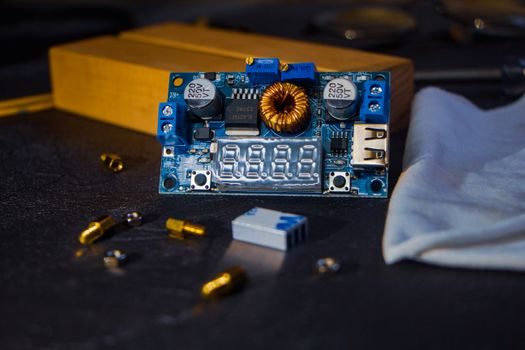
The trade-off is reduced flexibility on second-source qualification: a vertically integrated module vendor's inverter line is typically optimised for that vendor's own module characteristics (Voc windows, bifacial gain curves, Voc-temperature coefficients), so swapping to a third-party inverter may require re-doing the string-sizing calculations and the DC/AC ratio check. In practice, the DC power supply and auxiliary low-voltage rails inside the inverter cabinet are tuned around the parent module line's MPPT voltage window.
Tier 3: Diversified electrical and electronics majors
The third tier is the diversified electrical and electronics majors — Siemens, Danfoss, and GE Energy among them — that treat solar inverters as an adjacent product line to their industrial drives, UPS systems, and grid-tie power-conversion portfolios [S2]. For utility-scale procurement, this tier is typically the default shortlist when grid-code compliance, substation-grade protection relays, and SCADA integration are weighted more heavily than dollars-per-watt. A 1,500 V DC string or central inverter from a diversified vendor will generally ship with a more extensive type-test dossier (IEC 62109, IEEE 1547, country-specific grid codes) than a pure-play vendor of comparable kW rating.
On the components side, the inverters themselves rely on the same switching power supply building blocks (high-frequency IGBT or SiC stages, planar magnetics, DSP control loops) that any industrial drive uses, which is exactly why diversified majors can drop into the market without a fundamental R&D rebuild. The result is a supplier pool where the same IGBT module or gate-driver IC can be cross-qualified across a Siemens, a Danfoss, and a Sungrow design.
Spec differentiators worth sourcing on
Because commodity efficiency is near its ceiling, the meaningful 2026 spec differentiators are application-specific rather than peak-efficiency-driven. Partial-shading mitigation (microinverter and DC-optimiser topologies, plus Steca's module-level electronics approach) is the most cited example of where engineering still has room to move [S2]. Storage integration — hybrid inverters with battery-side DC-DC stages and grid-forming firmware — is a second live differentiator, and one reason SMA and Sungrow both market storage-coupled SKUs alongside their PV-only units [S2].
Other 2026 spec levers worth pulling on a datasheet review: maximum DC input voltage (1,500 V vs 1,100 V architectures for utility-scale), number of independent MPPT inputs, supported communication protocols (Modbus TCP, SunSpec, IEEE 2030.5), IP66 / NEMA 4X enclosure rating for FPV and coastal sites, and grid-support functions (LVRT, HVRT, reactive power at night). When vendors are matched on topology and efficiency, these are the criteria that actually move an inverter from "acceptable" to "specified" on a 2026 bill of materials.
Where the supply chain gets thin
Two thin spots are worth flagging for 2026 procurement. First, pure-play inverter capacity is concentrated in Germany, Austria, Switzerland, China, and Portugal — eight named vendors above — so a region-specific shortage (e.g. a European utility-scale buildout surge) can stretch lead times even when global capacity looks adequate on paper [S2]. Second, the IGBT / SiC power-semiconductor supply that feeds every tier remains a single-region bottleneck for the high-current modules used in central inverters, which is why some EPCs are qualifying parallel inverter vendors that share the same semiconductor supplier.
A third, slower-moving risk is firmware and cybersecurity: as inverters become grid-forming assets under IEEE 1547-2018 and successor grid codes, firmware update cadence, vulnerability-disclosure policy, and signed-firmware support windows are increasingly weighted in vendor selection — a domain where diversified majors with formal PSIRT processes tend to out-resource pure-play vendors.
Cost-stack and analyst-economics context
Inverter and BoS (balance-of-system) electrical components typically represent a single-digit to low-teens percentage of utility-scale PV capex, with the module itself dominating the bill of materials. The Roller Chain price and material band guide is a useful analogue — both are commodity-adjacent components where total cost of ownership is driven more by spec discipline and second-source qualification than by headline unit price. [S1]
On the human side of the supply chain, the US labour market for analysts supporting industrial sourcing in this segment sat at a $107,000 median total pay as of 2025, with manufacturing and wholesale trade services paying above the cross-industry median — relevant for any EPC or IPP building a procurement / sourcing team to handle a 2026 inverter bill of materials [S1].
Trackable 2026 signals: announced capacity additions at Sungrow, SMA, and the module-integrated tier; any new IEC 62109-1/-2 or IEEE 1547 amendment cycles that change grid-support test points; and lead-time movements on 1,500 V central-inverter SKUs into European and Middle-East utility-scale tenders.
For component-level specifications, see chain conveyor.