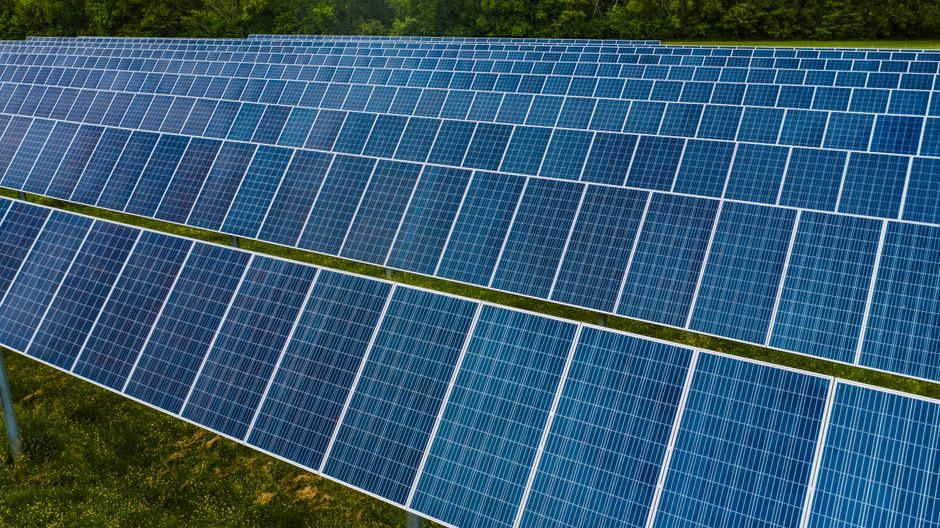
A solar PV module is the visible tip of a five-tier supply chain that starts with metallurgical-grade silicon and ends at the O&M contractor reading SCADA data on a 500 MW plant, with each tier carrying its own cost, certification and lead-time profile [S1].
The upstream side (polysilicon, monocrystalline wafer, PERC/TOPCon/HJT cell) is dominated by China-based producers operating 100,000-tonne-class polysilicon plants and GW-scale wafer and cell fabs; the midstream module step is the most globally fragmented because it is a low-CapEx laminate assembly, while the downstream side (project development, EPC, inverter, tracker, O&M, recycling) is where policy, grid interconnection and capital interact with the hardware [S1][S5].
Upstream Tier 1 — Polysilicon, Ingot and Wafer
Polysilicon is the starting material: Siemens-process trichlorosilane is distilled, reduced, and broken into chunks that are then melted and pulled into monocrystalline ingots via the Czochralski (CZ) method, which is the dominant monocrystalline route for PV-grade wafers [S1]. Mono-c-Si wafers in the M10 (182 mm) and G12 (210 mm) formats are the current volume base, with M10+ half-cut cells dominating residential and commercial rooftops and G12 driving utility-scale power plants [S1].
Resistivity is typically specified in the 0.5-3 Ω·cm range for p-type CZ mono wafers; n-type wafers (used in TOPCon and HJT) require tighter control of oxygen and carbon content, and most Chinese suppliers such as the Yangzhou-based producers now publish datasheets aligned to that higher-purity envelope [S1][S6]. Diamond-wire sawing yields kerf loss in the 50-70 µm range, and current wafer thicknesses sit in the 130-150 µm band for TOPCon, dropping toward 100-120 µm for HJT where the wafer is the mechanical carrier for the cell stack [S1].
Upstream Tier 2 — Cell: PERC, TOPCon, HJT, and BC
Cell architecture has rotated twice in four years: p-type PERC (passivated emitter and rear cell) was the 2018-2022 workhorse at 22.5-23.5% production efficiency, and the technology has been progressively displaced by n-type TOPCon (tunnel oxide passivated contact) reaching 24.5-25.5% on M10 half-cut formats, with HJT/SHJ (silicon heterojunction) pushing 25.0-26.0% on the same footprint and BC (back-contact) variants reporting 25.0-26.5% in limited volume [S1].
Certification-wise, IEC 61215 (design qualification) and IEC 61730 (safety qualification) are the two test standards that any cell-to-module integration must satisfy before the finished module is listed on commercial datasheet portals [S1].
Midstream — Module Lamination: Glass, EVA, Backsheet, Frame, Junction Box
A finished module is a sandwich: 3.2 mm tempered low-iron front glass, two encapsulant layers (EVA or POE) above and below the cell string, a backsheet (fluoro-polymer or glass) on the rear, an anodised 6005-T5 aluminium frame with EPDM edge sealant, and an IP67/IP68 junction box carrying bypass diodes [S1]. Mono-facial glass-glass modules with 2.0 mm front and 2.0 mm rear glass are now the default in utility-scale procurement because the 30-year power-output warranty is supportable only with a symmetric glass stack and PID-resistant encapsulant [S1].
Power ratings cluster in the 550-650 W band for M10 half-cut 144-cell utility modules, 400-460 W for 108-cell commercial formats, and 380-440 W for 120-cell (M6 legacy) residential formats, with bifaciality coefficients typically 70-85% depending on the rear encapsulant and the rear-side optical coupling [S1]. Frame height is a hidden cost driver: 30 mm frames remain the legacy default, 35 mm frames are now specified for tracker projects to clear the clamp interface, and frameless glass-glass modules are sold into snow-load and coastal zones where aluminium creep and galvanic corrosion are concerns [S1].
Downstream — BOS, Inverter, Tracker, Mounting and DC Cabling
The balance-of-system (BOS) tier begins once the module is bolted to a structure: aluminium-extruded mounting rails on rooftop systems, single-axis horizontal trackers on utility plants, string or central inverters converting DC to grid-compliant AC, DC cabling in 1 kV or 1.5 kV PV-rated insulation, and the AC switchgear + step-up transformer chain feeding the point of interconnection [S1]. String inverters in the 100-350 kW range dominate commercial and utility-scale plants above 5 MW because of O&M advantages; central inverters above 3 MW remain specified for very large desert plants where the $/W cost beats availability [S1].
DC string voltage has pushed from 1,000 V to 1,500 V as the industry default, which lowers $/W BOS cost but raises the safety bar: arc-fault detection (AFCI) and rapid shutdown are no longer optional features in the US (UL 6903 territory) and increasingly required in EU tenders [S1]. For the upstream-to-downstream handoff, ENF-style datasheet portals carry the module electrical data (Voc, Isc, Vmpp, Impp, temperature coefficients, bifaciality gain) that the inverter sizing and tracker layout engineer needs to size the string — and a review of the digital panel meter category shows where AC-side metering instrumentation feeds the SCADA stream that the O&M tier relies on [S1].
Downstream — Project Development, EPC, O&M and Recycling
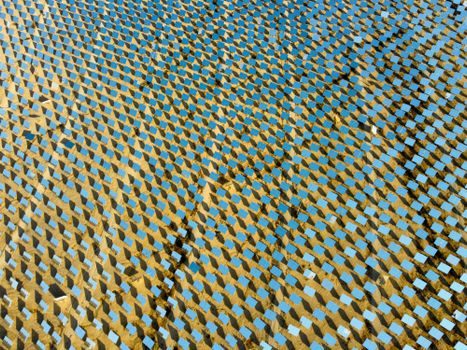
Project development splits into three contractual layers: developer (permits, land lease, PPA, offtake), EPC (procurement, civil, mechanical and electrical installation, commissioning), and O&M (monitoring, module cleaning, vegetation control, inverter and tracker maintenance, warranty claim management) [S1]. LCOE on utility-scale PV in 2024-2026 has settled in the $25-45/MWh band in the sunniest geographies, and the O&M fee structure has compressed to $4-8/kW-year for utility plants and $12-25/kW-year for commercial rooftop portfolios [S1].
Recycling is the newest downstream tier: a module's end-of-life pathway starts when the aluminium frame is removed, the glass delaminated, the EVA thermally cracked, and the silicon cells separated for hydrometallurgical silver and silicon recovery, with current European EPR (extended producer responsibility) schemes pushing for 65-80% mass recovery by 2030 [S1]. China's domestic producers, including the Yangzhou and Zhejiang-based module manufacturers, operate EN 50604 / IEC 61215-aligned lines but most still lack in-house recycling lines, so the recycling tier is currently a separate procurement and logistics chain rather than a captive upstream loop [S6].
Selection Criteria and a Side-by-Side Comparison
For a buyer deciding where in the value chain to invest, the four most useful decision axes are: cost per watt shipped, certification footprint, lead time, and policy exposure — and the comparison is sharper when read against the EV Supply Chain 2026 bottleneck picture, where polysilicon and silver metallisation are shared stress points [S1].
Lead time differs by an order of magnitude: 1-3 months for a stocked module, 4-8 months for a new module production run, 12-18 months for a new cell line, and 24-36 months for a green-field polysilicon plant — a ratio that explains why the Industrial Robot Smart Manufacturing Spec and Buyer Guide for 2026 is so relevant to the cell-and-module tier where stringers and layup robots are the throughput constraint [S1].
Policy exposure is the most volatile axis: US Section 201 tariffs, EU CBAM, and India's ALMM list all change the effective landed cost by 10-40% depending on country of origin, and these three policy levers are why new GW-scale fabs are being sited in the US (IRA-driven), India (ALMM + PLI), and the EU (Net-Zero Industry Act) rather than as brown-field expansions in coastal China [S1].
Constraints, Failure Modes and What a Specifier Watches
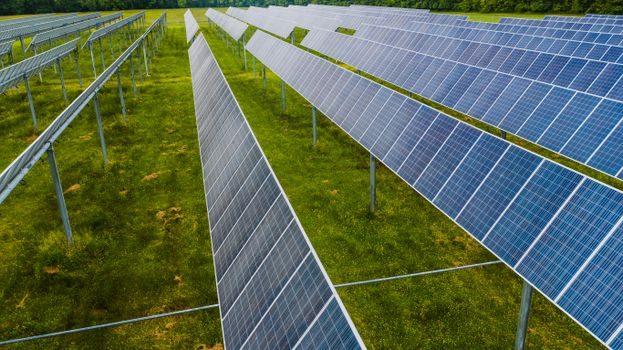
Three failure modes dominate the warranty return data on modern modules: PID (potential-induced degradation) on systems with the array negative grounded and high humidity, LeTID (light- and elevated-temperature-induced degradation) on p-type PERC in hot climates, and snail trails / cell cracks from poor stringer handling — each of which a buyer can mitigate by specifying the right encapsulant, glass, and bill-of-materials up front [S1].
On the upstream side, polysilicon producers are exposed to electricity-price volatility because Siemens-process electricity is roughly 30-40% of cash cost, which is why new Chinese polysilicon plants have been sited in Xinjiang and Inner Mongolia where curtailed coal and wind power set the marginal electricity price [S1]. For the buyer, the actionable filter is the combination of IEC 61215/IEC 61730 certification, a Pmax temperature coefficient in the -0.30 to -0.35 %/K band, an annual degradation ≤ 0.45%, and a 12-year product / 25-30-year power warranty — the same four fields that the HMI panel and fire alarm control panel specification discipline applies to adjacent industrial control procurement [S1].