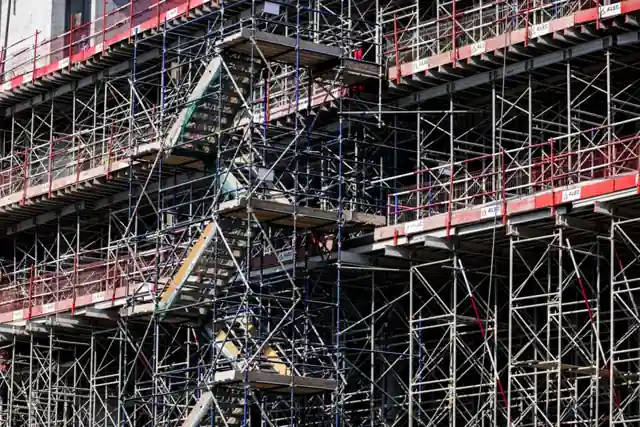
Steel scaffolding systems for steel construction are specified by steel grade, working load class, height-to-base ratio, and heat/spark exposure, with steel tube weight roughly 3x that of aluminum at the same diameter [S4]. For projects above 3.1 m (10 ft), OSHA mandates personal fall arrest systems with harnesses, lanyards, and qualified anchor points, making the scaffold-and-PFAS package a single decision rather than two independent ones [S3].
Buyers in Chinese supply chains typically see Q235 and Q355 grade callouts, while European EN 12811 projects translate these to S235, S275 and S355 equivalents with matching yield-strength logic [S2]. The right grade is the one that matches scaffold design, load requirement, safety standard, project environment and budget, and wrong-grade procurement is a documented cause of inspection rejection, delivery delays and project-owner pushback [S2].
Steel Grade Selection: Q235/Q355 vs S235/S275/S355
Yield strength is the property that drives grade selection, because it marks the stress at which scaffold tubes, ringlock standards, ledgers, braces and planks begin to permanently deform [S2]. Chinese export documentation typically lists Q235 (235 MPa yield class) for light-duty standards and ledgers, and Q355 (355 MPa yield class) for heavily loaded ringlock verticals, shoring props and modular system components [S2]. European EN-aligned projects use the parallel S235 / S275 / S355 family, with the same yield-step logic and similar weldability and hot-dip galvanizing compatibility [S2].
Steel grade should never be checked in isolation; material certificates, weld quality, dimensional tolerance, hot-dip galvanizing thickness, and third-party inspection reports are part of the same acceptance package [S2]. International projects often pin the required material on the drawing itself, so a Q235 submittal against an S355 callout is treated as a non-conformance, not a substitution request [S2]. For procurement teams working the construction tools side of the bill of materials, locking the grade on the PO before galvanizing is the cheapest place to catch the mismatch.
System Type vs Job: Frame, Ringlock, Suspended, Mobile
Frame scaffolding, built from prefabricated welded frames with cross braces, is the default for residential and light commercial facade work, painting and masonry because it assembles fast and costs the least per square metre of face access [S5]. Scaffolding towers and mobile scaffolds (lockable casters) are the right call for indoor fit-out, mechanical-room work and short-duration tasks where crews need to reposition frequently without dismantling [S5].
Suspended and cantilever scaffolding hang from outrigger beams on the roof or kick off from the structure itself, and are specified where ground access is impossible, the facade is too tall for a base-up build, or loads must be kept off a weak slab [S5]. For steel-construction sites, where welding sparks, slag and hot-metal splash are routine, the system must also carry compatibility with non-combustible decks and spark-resistant accessories; the system choice here is a construction machinery and equipment decision as much as a materials one [S3].
Load, Height, and Stability: Numbers That Drive the Calc
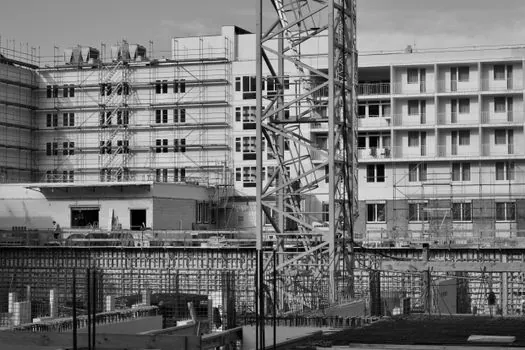
Load-bearing capacity is the first filter: the scaffold must support workers, hand tools, materials staged on the platform, and any temporary loads from erection activity, and exceeding the rated duty class is the most common path to structural failure in the field [S3]. Three structural elements do almost all the work: standards (verticals) sit on square base plates that spread load, ledgers run horizontal between standards, and transoms sit perpendicular to the ledgers to carry the deck [S4].
Stability is controlled by base plates on outriggers or mud sills on uneven ground, regular tying back to the permanent structure, and cross-bracing that resists racking [S3]. For steel construction specifically, the scaffold sees vibration from crane lifts, drift from welding-induced floor movement, and thermal exposure near hot work, so a heavier steel system, roughly 3x the mass of an equivalent aluminum build, is the safer default for the main access deck [S4]. Scaffolds must be tied into the structure regularly to prevent movement or collapse from wind, vibration or shifting loads, and the tie pattern is what separates a calculated build from a hopeful one [S3].
Fall Protection and OSHA: Above 3.1 m, the Package Changes
Fall protection is non-negotiable in metal construction because falls are still the leading cause of fatal injuries on site, and OSHA rules put the threshold at 3.1 m (10 ft) of working height [S3]. Above that height, workers need a personal fall arrest system (PFAS) made up of a full-body harness, a shock-absorbing lanyard or self-retracting lifeline, and a certified anchor point on the structure or scaffold [S3].
Guardrails and toe boards are the passive layer that runs in parallel: top rails and mid rails on every open edge, toe boards at the platform level to keep tools and material from dropping onto crews below [S3]. Anchor and brace the scaffold to the permanent structure on a documented pattern, then add the PFAS, and the build is compliant; skip the anchoring and even a correctly rated tube-and-coupler system can rack under wind or a single lifted load [S3]. Crews erecting and dismantling the scaffold must be trained in the manufacturer sequence, because reverse-order mistakes are a documented source of sudden weight-shift collapses [S3].
Steel Tube, Coupler, and Plank Specs to Lock Down
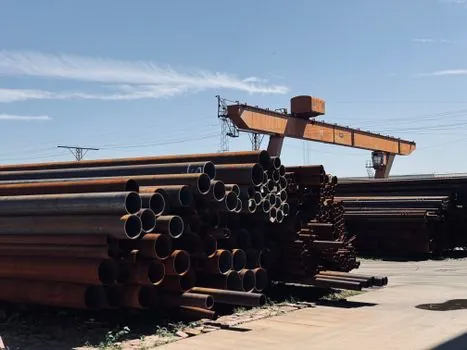
Tube wall and finish are the small print that controls fatigue life: scaffolding tubes are normally hot-rolled steel, with special-application tubes using glass fibre in a nylon matrix for spark or electrical-resistance cases [S4]. Couplers (right-angle, swivel, sleeve) join the tubes and carry the same grade logic as the tubes, so a Q355 ledger on a Q235-spec coupler is a mismatch the inspector will flag [S4].
Boards and decks are the wear surface: steel or aluminum plank thickness determines service life, and hot-dip galvanized steel planks are the default for steel-construction sites because the zinc coat takes weld-spark abuse better than painted mild steel [S7]. Galvanized metal scaffold plank thickness is the first spec to ask the supplier for, because under-thick planks bow under repeated point loads and shorten the whole system's service life [S7]. For a carbon steel plank against an alloy steel coupler in a corrosive coastal or chemical-plant environment, the galvanizing thickness and the grade certificate need to be reviewed together, not separately.
Steel vs Aluminum: When the Weight Penalty Is Worth It
Steel is roughly three times heavier than aluminum at the same tube diameter, and that mass buys higher load capacity, better impact resistance during handling, and longer service life under repeated assembly cycles [S4]. Aluminum wins on portable facade access, rooftop jobs where the structure cannot take a heavy dead load, and rapid repositioning, because the light frame goes up faster and needs smaller cranes or no crane at all [S4].
For steel-construction work specifically, the trade usually comes down to heat and spark exposure: aluminum loses tensile strength at elevated temperatures and is not the default near hot work, so steel scaffolding is the safer call on a steel-erection deck even though it costs more to ship and assemble [S3]. When crews mix tasks, a hybrid is common: aluminum towers for inspection and punch-list work, steel frame or ringlock for the main erection access.
Procurement and Inspection Signals to Track
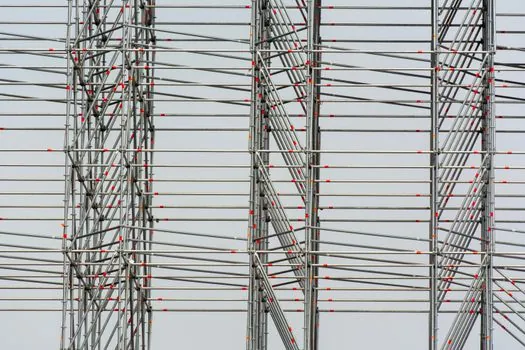
The verifiable next node on any steel scaffolding order is the material certificate (mill cert) tied to each heat number, confirming Q235/Q355 or S235/S275/S355 yield and tensile values, plus the hot-dip galvanizing thickness report on every galvanized component [S2]. Track two signals as the PO moves: the submittal package (drawings, grade certificates, coupler test reports, welding procedure specs) for approval turnaround, and the third-party inspection report for dimensional, weld and coating checks against the drawing [S2]. For related on-site tooling, the spec maps for angle grinders on steel construction and rebar benders on concrete work sit in the same procurement workflow and follow the same grade-and-certificate discipline.