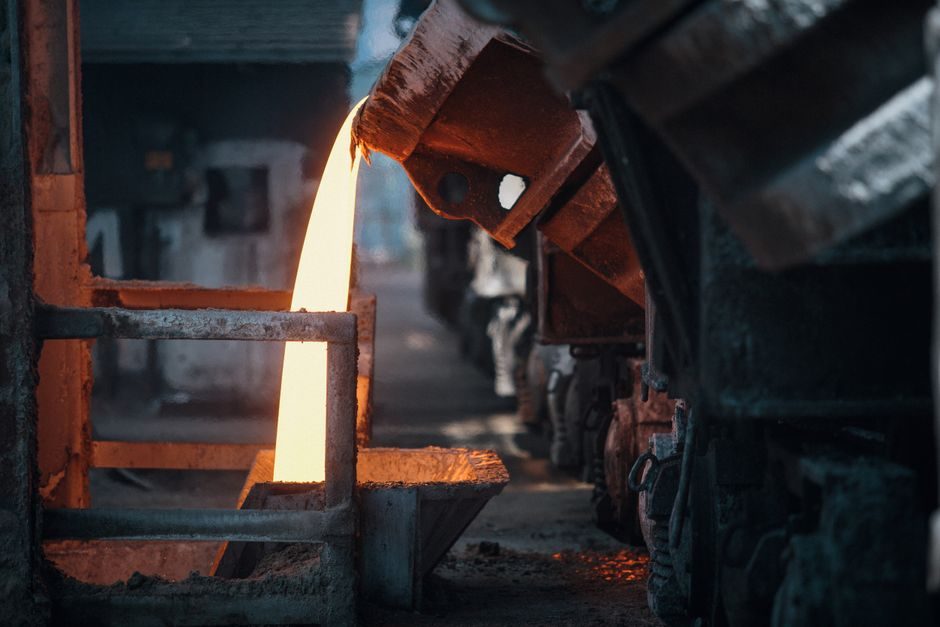
Steel upstream begins with iron ore, coking coal, ferrous scrap, limestone and ferroalloys (FeMn, FeSi, FeCr), and ends at crude stainless, carbon and silicon steel outputs, all of which feed the downstream chain via hot-rolling, cold-rolling, drawing and coating.
Downstream of the mill, the value chain splits into construction-linked long products (rebar, wire rod, beams), tubular goods (welded and seamless pipe, OCTG), flat products (CRC, GI, electrical steel) and engineered items such as steel fiber, steel mesh and stainless-steel fabrications.
Upstream Inputs: Iron Ore, Coking Coal, Scrap and Ferroalloys
The blast-furnace route (BOF) consumes roughly 1.6-1.7 t of iron-ore feed per tonne of crude steel, plus 0.3-0.4 t of coke per tonne, while the EAF route substitutes ferrous scrap and direct-reduced iron for the ore burden and skips the coke oven entirely [S1].
Coking-coal supply, metallurgical-coal blending ratios and scrap availability are the three cost levers that swing blast-furnace and EAF economics week-to-week; manganese and chromium units enter the chain through alloy steel and stainless-steel grades, where a 1% Mn addition shifts the steel into the alloy class under most international steel-grade classification systems.
Mill-Stage Outputs: Slab, Billet, Bloom and Plate
Continuous casting turns liquid steel into slabs (flat-product feedstock), blooms (heavy-section feedstock) and billets (long-product feedstock), and the mill's choice at this step decides the entire downstream route the steel can take. [S1]
Carbon-steel billets typically feed rebar and wire-rod mills, slabs feed hot-strip mills for plate and sheet, and the higher-purity grain-oriented grades feed silicon-steel lamination lines used in transformer cores; the upstream-to-mill cost build-up in BOF plants is dominated by iron-ore and coking-coal purchase contracts, which often run on quarterly benchmark pricing rather than spot [S3].
Downstream Long Products: Rebar, Wire Rod and Sections
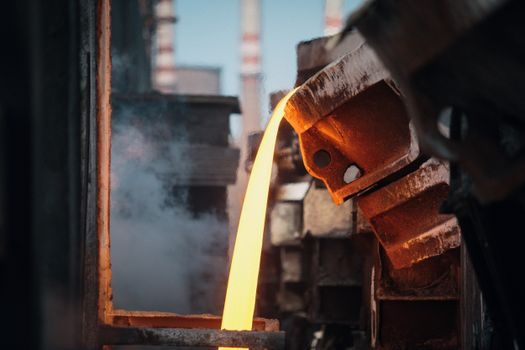
Rebar and wire rod are the largest tonnage pull on billet, with construction demand historically consuming 30-40% of national crude-steel output in China; grade selection runs from HRB400 to HRB600 in the GB 1499.2 system, with seismic and ductility classes (E for elongation, G for Gallipoli seismic spec) attached to the grade number. [S2]
For engineered concrete reinforcement, the rebar stream is increasingly complemented by cold-drawn steel fiber and welded steel mesh sheets, which raise tensile capacity and crack control in slab-on-grade and shotcrete applications; sourcing gates for these engineered products now sit behind the same mills that supply rebar, and the spec bands cluster in the 30-80 mm fiber-length, 0.5-1.0 mm diameter window for hooked-end types anchor on engineered rebar options.
Downstream Tubes and Pipes: Welded, Seamless and OCTG
The tube and pipe branch of downstream steel converts hot-rolled coil and plate into welded (ERW, LSAW, SSAW) and seamless (hot-pierced) products, with standards coverage running from API 5L linepipe, API 5CT casing and tubing, ASTM A53/A106, EN 10217 and GB/T 8163 for pressure service, and GB/T 3091 for low-pressure conveyance. [S3]
Tube China 2023, the international tube and pipe trade fair, was scheduled to run 14-16 June 2023 at the Shanghai New International Expo Centre, co-located with METALLURGY CHINA 2023, with around 500 exhibitors expected to cover welded tubes, seamless tubes, stainless tubes, pipe-fitting and tube-processing machinery [S3][S4].
The trade-fair pairing is structurally important because the upstream tube-and-pipe cluster (slab, billet and hot-rolled coil feeding the pipe mills) and the downstream fabricator cluster (fittings, flanges, valves, heat exchangers) are co-located on the same exhibition floor, which compresses the spec-to-quote loop for buyers.
Upstream-Downstream Linkage: Surcharges, Reshoring and Digital Levers
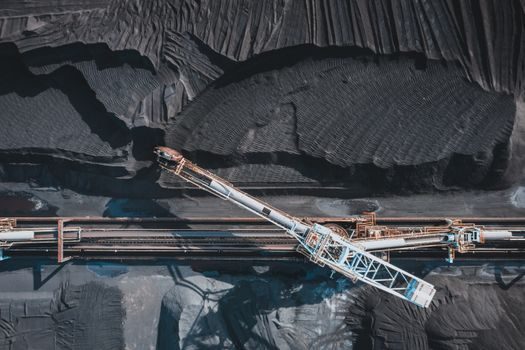
Cost pass-through between upstream inputs and downstream products runs through alloy, scrap, energy and freight surcharges, and these surcharges are typically published by mills on a 1-2 month lag from the underlying commodity move; the EAF-versus-BOF mix on the upstream side flips the surcharge structure almost entirely, since EAF mills run mainly on scrap, electrode and power cost lines, not on iron-ore and coking-coal cost lines [S2].
Reshoring and capacity-rebalancing moves in 2024-2026 have been concentrated in flat and stainless products rather than in long products, and the resulting tonnage shift ripples downstream into the tube, appliance and automotive supply chains that depend on those flat mills for feedstock; the broader supply-chain control-tower question (surcharge timing, agentic-AI ordering, near-shoring of scrap) is tracked at the chain level rather than the mill level, and the data points worth watching on this side of the chain are the surcharge, agentic-AI and reshoring levers published across 2026.
Adjacent Upstream-Downstream: Nickel, Lithium and the Battery-Grade Pull
The steel upstream-downstream framework overlaps with the battery-materials chain at the stainless-steel and nickel-sulphate boundary: laterite ore feeds both nickel pig iron (NPI) for stainless-steel melts and battery-grade nickel sulphate, and the price differential between the two routes sets the tonnage split inside Chinese and Indonesian stainless mills. [S4]
Downstream of the mill, the engineered-product cluster (rebar couplers, steel fibers, welded mesh, cold-formed sections) has its own spec and certification gates that sit on top of the base-grade chemistry, and the rebar-coupler side in particular runs on GB 50010 concrete-code compliance and ISO 15835 mechanical-splice classes; cost-lever reading for the rebar-coupler branch sits behind the diameter, grade and certification levers mapped in the 2026 rebar-coupler pricing guide.
Selection and Sourcing Gates by Downstream Branch
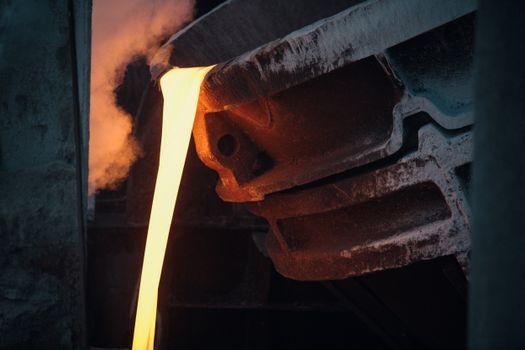
Long-product buyers (rebar, wire rod, sections) should anchor specs to GB 1499.2 / ASTM A615 / ISO 6935-2, demand mill test certificates (MTC) per EN 10204 3.1, and verify elongation and seismic-class conformity; tube buyers should anchor to API 5L / 5CT for oil-and-gas service or ASTM A53/A106 for process piping, with NACE MR0175 sour-service compliance for H2S-bearing duty. [S1]
Flat-product buyers (HR, CR, GI, electrical steel) should anchor to ASTM A1008 / A1011 / EN 10130 / EN 10151, with grain-oriented silicon-steel grades meeting M2-M6 core-loss classes under IEC 60404-8-1, and stainless buyers should anchor to ASTM A240 / EN 10088-2 with the 304/316 austenitic, 430 ferritic and 2205 duplex grades as the baseline comparison set.
Two trackable signals to watch over the second half of 2026 are the next edition of Tube China and METALLURGY CHINA, which historically alternate annually and set the calendar for upstream-to-downstream spec releases, and the monthly scrap and iron-ore reference-price prints, which feed the surcharge columns that downstream tube and rebar mills publish with a 1-2 month lag [S3][S4].