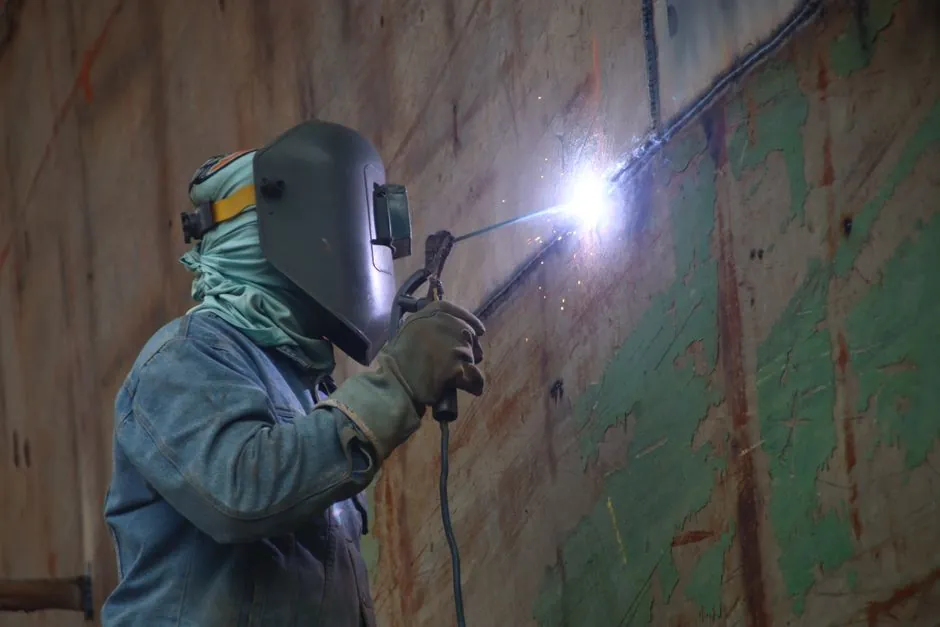
Capacitor-discharge stud welders in the 1-10 mm stud-diameter range dominate landscaping fastener jobs because they weigh under 25 kg, weld in roughly 0.06 seconds per stud, and leave the back side of thin sheet unmarked [S3].
The same single-sided, hole-free fusion process that secures bridge shear connectors also fastens landscape steel without burning through galvanized coatings on planters, edging, and sign frames, with no drilling or leak path introduced into the base metal [S2][S3].
Why CD Stud Welders Fit Landscape Fabrication
CD units complete welds with minimal heat input, which protects thin-gauge and coated substrates that landscape fabricators routinely handle, from 1-2 mm galvanized planter walls to powder-coated sign posts [S2]. A CD gun welds one side only, so the visible face of a trellis, gate panel, or decorative screen stays clean while the stud is anchored from behind, and operators can run a manual cycle up to roughly eight studs per minute [S3].
Stud material options relevant to landscape work include mild steel and stainless steel from domestically sourced bar stock, both of which are commonly listed as weld-stud-compatible alloys by industrial suppliers [S2]. For an outdoor service environment, stainless reduces the touch-up painting cycle that mild-steel studs would otherwise require on visible faces.
When Drawn-Arc Units Beat CD Outdoors
Drawn-arc stud welding is the dependable fastening technique for any size or configuration of stud on a metal workpiece, with penetration sized for structural loads rather than thin-gauge aesthetics [S3]. For landscape projects involving structural anchors, large-diameter tree-guard posts, or base metal at the 0.048 inch (1.2 mm) lower limit, drawn-arc delivers the fusion depth that CD cannot [S3].
Drawn-arc relies on a DC power source, a stud gun, the metal stud, and a disposable ceramic ferrule that contains the molten pool [S3]. The ferrule adds consumable cost and a cleanup step that a CD operator never faces, which is why landscape crews keep the arc gun for anchor bolts and footings, and switch back to CD for visible architectural metalwork. Field-portable drawn-arc units are specifically built for tight, elevated, or high-temperature work zones, which covers most landscape install sites [S2].
Stud Diameter, Base Metal, and Equipment Pairing
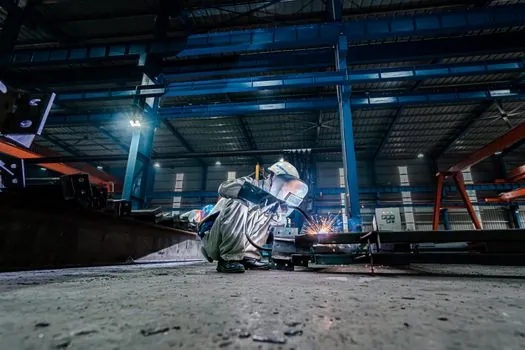
Stud diameter for general stud welding spans 1 to 25 mm, and the matching equipment changes with the upper end of that range [S3]. CD systems cover the 1-10 mm window typically used in landscape metalwork, while drawn-arc covers diameters above that and any application needing shear-connector-grade fusion. Selecting the right stud welder requires matching material type and thickness to ensure compatibility with base metals and the required stud sizes, a step that determines weld quality before the gun is ever picked up [S4].
Comparison of the two main options against four landscape-relevant criteria:
Option 1, CD (capacitor discharge): typical stud diameter 1-10 mm, weld time around 0.06 seconds, base-metal thickness thin-gauge down to about 0.048 inch in light-duty configurations, heat input minimal so coatings stay intact. Option 2, Drawn-arc: typical stud diameter 3-25 mm, weld time longer with controlled arc, base-metal thickness suitable for structural plate and anchor work, heat input higher and a ceramic ferrule is required.
For a landscape crew fabricating corten-steel edging, stainless trellis panels, and sign frames, a single CD unit covers the bulk of the work, while a rented or shared drawn-arc handles the occasional footing or large tree-anchor job.
Process, Power Source, and Consumables
The drawn-arc sequence loads the stud into the chuck, places a ferrule at the tip, plants the gun against the workpiece, lifts on trigger to draw a pilot arc, holds the arc time proportional to the stud's cross-sectional area, then plunges the stud into the molten pool as the lift de-energizes [S3]. A DC power source is mandatory for this arc, which is why inverter-based portable drawn-arc units dominate field work [S3].
Stud welding in general removes the need for drilling, limits potential leak paths in any pressure or fluid-handling component, and preserves the structural integrity of vessels, plates, and fabricated assemblies [S2]. For landscape irrigation headers, water-feature weirs, and pump skids built from thin stainless, that same hole-free property is what makes CD stud welding a clean alternative to through-bolting with rubber gaskets.
Brand and Model Reference Points
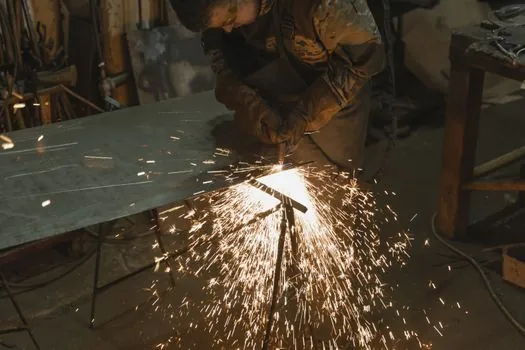
Cruxweld lists the CSD-25 in its 2024 brand roundup as a CD-platform entry, alongside the Nelson Nelweld N800i, Cutlass Pinto, Stud Pro 2500xi, and LYNX4 as named industrial stud-welder models that fabricators benchmark against [S3]. Industrial suppliers such as Delta Stud Weld, IWT, and Tru-Weld continue to be referenced stock lines for both CD and drawn-arc systems, with selection criteria driven by stud material, base-metal gauge, and required weld diameter rather than brand alone [S2][S4].
For a working landscape shop, the practical decision is portable CD versus portable drawn-arc, not a brand pick, because duty cycle, stud diameter range, and base-metal thickness will push the answer one way or the other regardless of label.
Limitations, Failure Modes, and Field Constraints
CD welders lose fusion quality on heavy structural plate, and drawn-arc units burn through anything thinner than about 1.2 mm without precise current trim, so misapplied equipment is the most common failure mode in landscape work where gauge changes job to job [S2][S3]. The ferrule used in drawn-arc also leaves a small ceramic ring that must be chipped off, which adds labor that is not visible on a CD cycle [S3].
Operator-side constraints are similar to other one-sided fastening processes: the welder must have line of sight to the weld zone, surface must be free of heavy mill scale for consistent arc starting, and outdoor wind can blow the shielding from drawn-arc pools if the ferrule is not seated properly. Compact portable units address many of these by allowing the operator to complete welds remotely while keeping accurate fusion and stable output in oil-and-gas, marine, and elevated-position environments, conditions that overlap heavily with arborist and hardscape install sites [S2].
Related reading for crews that pair stud welding with cutting or demolition tools in the same yard is covered in circular saw selection for landscaping and in the drawn-arc versus CD comparison for concrete-anchored landscape hardware. For broader context on welding processes used in structural steel work adjacent to landscape metalwork, the stud welder selection for steel construction spec map covers the drawn-arc end of the range, while general background on the equipment category sits in the stud welder encyclopedia entry.
For teams building a first-time stud-welding kit, the next node is a written weld-procedure sheet that records stud alloy, diameter, base-metal gauge, and current or capacitance setting per stud, because that sheet, not the machine nameplate, is what auditors and site inspectors will ask for on a commercial landscape install. A second trackable signal is a trial run on offcut base metal from the same coil that will be used on site, since galvanized batch and stainless grade both shift arc behavior in ways a spec sheet cannot predict.
The underlying component specifications are covered under arc welder, and tig welder.