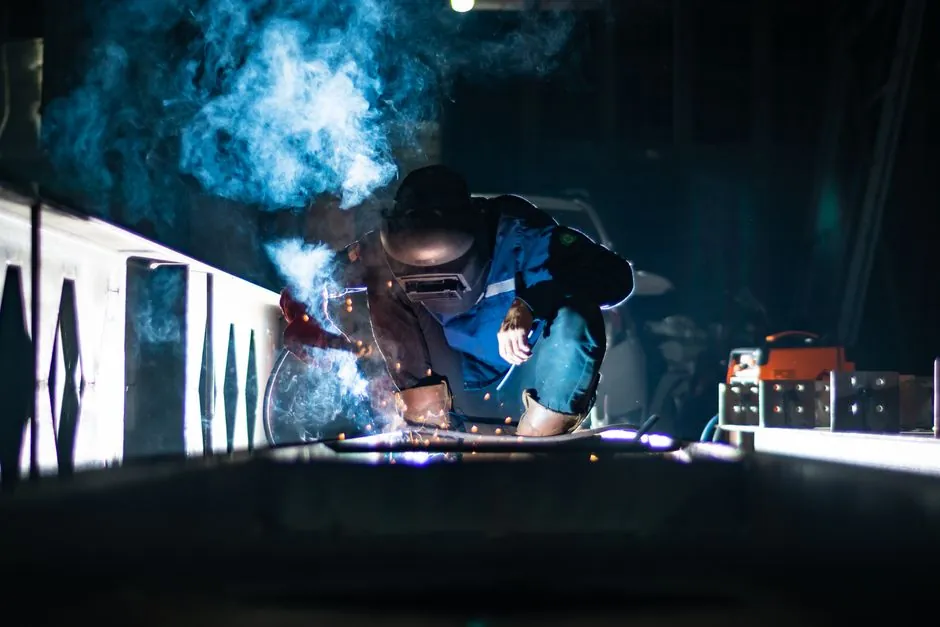
Drawn-arc stud welding completes a weld in under one second, yet generates UV radiation, electrical arc flash, spatter above 3,000°F, and toxic fumes in the same envelope as conventional arc welding, which is why cumulative-shift exposure drives the hazard profile, not cycle time [S3].
The required controls map to five layers: eye and face PPE rated to ANSI Z87.1 with a minimum shade 5 lens, a 35-foot radius cleared of combustibles, forced or natural ventilation per OSHA, fully insulated and grounded welding circuits, and documented operator training. OSHA Standards 1910 Subpart Q (general industry) and 1926 Subpart J (construction) govern these requirements in U.S. job sites, and they apply identically to stud welding despite the short arc time [S3][S2].
Eye, Face, and Body PPE: Shade Numbers and FR Clothing
Auto-darkening helmets that switch in 1/25,000 of a second are specified for fast-cycle stud welding because operators run dozens to hundreds of cycles per shift, and a shade 5 lens is the minimum filter for the drawn-arc process to block UV and IR radiation that causes arc eye within seconds of exposure [S3]. A full face shield is layered over the helmet for spatter defense on high-volume production runs [S3].
Hand and body protection uses fire-resistant gloves and long-sleeved FR jackets, with the rule that workwear cover all exposed skin and stay free of oil or other flammable contaminants; synthetic-blend garments that melt into burns must be avoided [S1]. Welding helmets must meet ANSI Z87.1 and comply with OSHA eye-and-face protection rules to shield the face, forehead, neck, and ears from radiant energy and weld spatter [S1].
35-Foot Combustible Clearance and Fire-Suppression Staging
Stud welding generates spatter at temperatures exceeding 3,000°F, so OSHA-aligned practice clears a 35-foot radius of combustible materials before the first arc is struck, and stages fire extinguishers within immediate reach of the operator [S3]. Gas cylinders used in mixed welding circuits must be kept away from live electrical wires in the stud welding circuit to prevent cylinder-valve damage and uncontrolled release [S2].
Daily cable inspection is the lowest-cost fire and electrical control: operators check the stud welding cable, electrode holder, and coupling devices for damage before every shift, and any damaged component is tagged out and replaced rather than repaired in the field [S2]. Long cable runs common on construction sites must be routed to avoid truck and foot-traffic abrasion that stretches conductors and exposes insulation [S2]. For the broader respirator side of fume control, a working spec reference is laid out in respirator selection matched to hazard, APF, and cartridge.
Electrical Safety: Grounding, Insulation, and Lockout
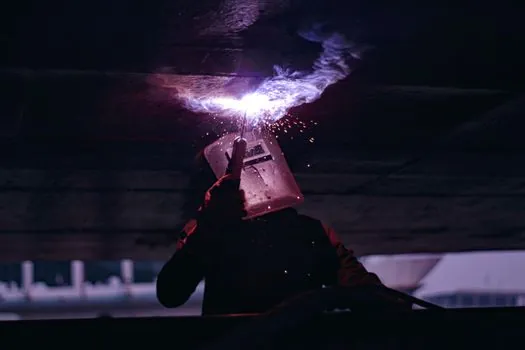
Every stud welding machine needs a verified earth-ground connection before energizing, because a missing ground turns the workpiece and chassis into a parallel path for the welding current and creates a shock hazard the moment an operator contacts both [S2]. All cables in the welding circuit must be fully insulated, and the work surface kept dry; wet conditions and wet PPE are explicitly prohibited in the weld zone [S4][S2].
Lockout-tagout applies to stud welders the same as any capacitor-stored-energy circuit: disconnect and lock out all electrical supplies before troubleshooting or maintenance, and follow the machine manual for stored-energy bleed times specific to the model [S2]. Shock risk in stud welding is dominated by the welding arc and the live secondary circuit, so operators never contact live parts even with gloves on, and never weld while standing on wet surfaces [S2].
Ventilation and Fume Control: Forced vs. Natural
Welding fumes carry vaporized base metal plus contaminants from adjacent cleaning solvents, epoxies, coatings, and paints, so ventilation provisions are mandatory rather than recommended; the choice between forced and natural ventilation depends on the work conditions, the volume of fume generation, and whether the work is in a confined space [S2][S1].
In confined or high-volume enclosed environments, a respirator is layered on top of ventilation because general exhaust alone does not keep the welder's breathing zone below the metal-fume threshold across a full shift [S3][S1]. Operators in oil and gas or petrochemical stud welding need a cartridge logic that matches the specific contaminant mix, which is covered step-by-step in cartridge logic, fit, and the 2026 vendor shortlist for oil and gas. Standards-aligned fume control, including OSHA ventilation rules, is a non-negotiable component of any stud welding safety program [S1].
Material and Process Preconditions Before the First Arc
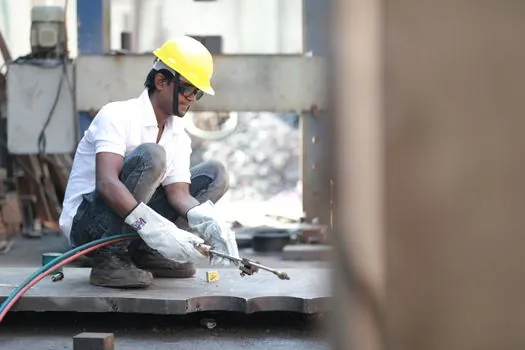
Stud welding requires clean, dry base-metal surfaces because water, oil, and surface contamination compromise weld quality and increase spatter and porosity; welding also performs better under relatively dry atmospheric conditions [S4]. Operators must verify alloy-steel stud and base-metal weldability, confirm that auxiliary materials meet forming specifications, and use calibrated measuring tools (hammers, theodolites, steel rulers, vernier calipers) to set stud location and lift before striking the arc [S4].
Accurate process parameters (current, time, lift, plunge) must be set prior to construction and verified on the first weld of each shift; arbitrary parameter changes mid-run are treated as a procedural violation rather than operator discretion [S4]. For comparison across adjacent fastener-joining processes, including the equipment families involved, the stud welder and arc welder reference pages lay out the equipment-side spec anchors that the PPE and clearance rules above are written against.
Operator Qualification, Training, and Site Controls
Welders must possess sufficient professional theoretical knowledge and practical operational skills before running a stud welding station, and strict safety protection is enforced: safety helmets and safety harnesses are mandatory during elevated stud welding, and arbitrary improper operations are prohibited by site procedure [S4]. Training is documented, refreshed when equipment or process parameters change, and tied to the machine manual issued with each unit [S2].
The two highest-payoff supervisory controls are pre-shift equipment inspection and authority-to-stop: supervisors authorize a halt whenever cable damage, missing grounding, contaminated surfaces, or an unattended 35-foot clearance is observed, and the work does not resume until each item is closed out. Stud welding incidents cluster around ignored pre-shift checks and improvised parameter changes, both of which are administrative rather than engineering failures and respond directly to documented qualification plus stop-work authority. In construction and shipyard contexts where stud welding is run alongside other heavy equipment, the construction machinery and equipment reference page documents adjacent job-site safety layers that the stud welding program must interface with.
Trackable signals to watch over the next quarter: any revision activity on OSHA 1910 Subpart Q or 1926 Subpart J welding/cutting paragraphs, and any updates to ANSI Z87.1 eye-and-face protection shade tables that would shift the minimum shade 5 baseline for drawn-arc stud welding.