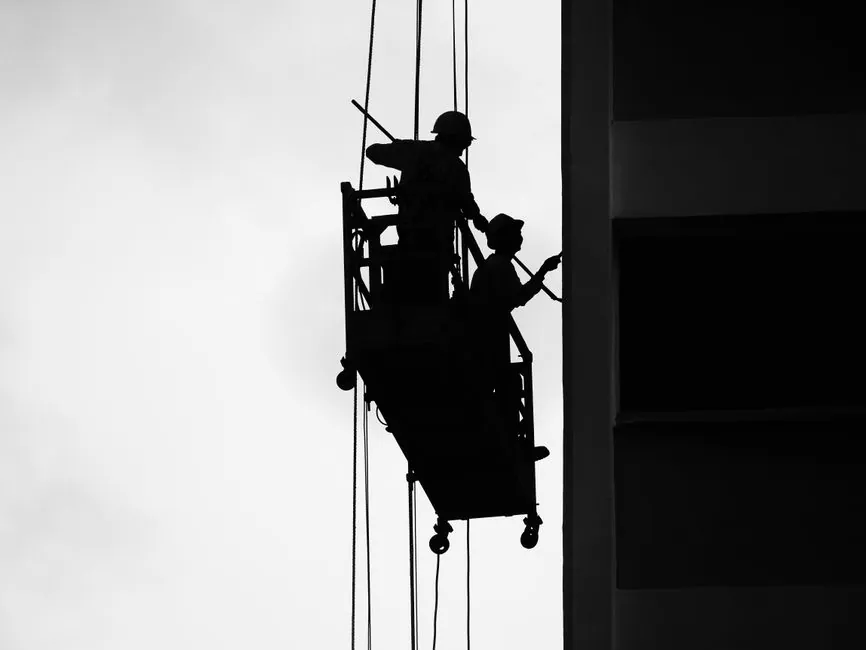
An electric hoist suspended working platform sized to 250–500 kg rated working load, modular 2–6 m deck length, and 1.5–3.0 kW hoist power covers the bulk of exterior cable tray, conduit, and high-bay luminaire work on commercial and light-industrial buildings [S1][S6].
For high-rise applications above 40 m working height, twin-hoist platforms with 5 kW+ class motors, overspeed safety devices, and a secondary wire rope arrest system are the default safe choice, with selection filtered by project scale, façade geometry, and the governing regional standard (OSHA 1910.66, EN 1808, or ISO 16430) [S2][S4][S5].
Working Load, Stability Factor, and Component Strength
OSHA 1910.66(f)(5)(i)(A) requires every suspended unit component, except suspension ropes and guardrail systems, to support without failure at least four times the maximum intended live load applied or transmitted to that component [S4]. The same rule mandates a minimum 1.5 to 1 stability factor against unit upset when suspension points are not at the unit ends, a condition that frequently arises on re-entrant façade corners where cable tray turns meet [S4]. A 2.5 kW single-hoist platform with a 250 kg rated working load, when loaded to that figure, must therefore have every structural member (outrigger, deck beam, hoist bracket) engineered to a 1,000 kg ultimate load, and the platform must be able to remain stable when that 250 kg is applied at any single point on the deck [S4].
Load plates must remain conspicuous and legible; the OSHA rule requires each unit to carry a load rating plate stating unit weight and rated load, painted or anodized against the UV that fades exterior labels on a working platform [S4].
Hoist Power, Speed, and Electric vs Traditional Configuration
Electric suspended platforms in the 1.5–3.0 kW hoist class deliver roughly 8–10 m/min line speed, which is the practical range for cable tray alignment and conduit bending on the building face, while twin-hoist 5 kW+ units reach 9–11 m/min and carry 500–1000 kg of crew and material at heights above 40 m [S1][S6]. The April 2025 selection note from CPTC frames the decision as a two-axis check: project scale (small façade patch versus continuous high-rise run) and working height, with electric units winning on both axes above roughly 20 m because manual or windlass-driven traditional platforms cannot sustain the lift cycle count of a cable-pull shift [S6].
For electrical work the electric hoist also matters because most job-site distribution boards are 230 V single-phase or 400 V three-phase, and the platform hoist must accept the same supply without an on-board diesel generator, which would add 80–150 kg of dead weight and re-trigger the stability factor calculation. Modern units add overload protection, automatic braking, and an emergency stop meeting ISO 16430 and EN 1808, with dual-control redundancy so a ground spotter can override an operator who is in the middle of a cable pull [S1][S2].
Working Height, Suspension Rope, and Secondary Arrest

OSHA 1910.66(f)(5)(iii)(B) requires every single-point suspended working platform to carry a secondary wire rope suspension system that prevents the platform from falling if the primary hoist line fails, and the same logic applies to twin-point platforms even where the rule is more permissive [S4]. Building-anchor spacing, governed by 1910.66(e)(2)(i) and (iii), typically lands at 3–6 m intervals on straight façades, so the platform deck length and roof-rigging geometry must be chosen to keep the platform within the continuously-engaged anchor zone during the entire lift cycle [S4].
For working heights above 60 m, the practical spec moves to 5 kW+ twin-hoist platforms with overspeed governors, rope-angle limit switches, and a 1.5–2.0 m/s² controlled descent rate; below 30 m, a 1.5 kW single-hoist platform with a 6–8 mm galvanized wire rope and 4:1 safety factor on the rope itself is the working baseline for façade cable tray and exterior conduit [S1][S2][S4]. A platform that runs past 80 m working height should be re-checked against wind load, because a 2.5 m/s crosswind creates a 30–60 N horizontal force per square meter of exposed platform area, and that force is not in the static load-plate figure but is in the manufacturer's derating chart [S1][S4].
Guardrails, Toeboards, and Edge Protection on the Working Deck
OSHA 1910.66(f)(5)(i)(G) sets a layered guardrail geometry: a top rail not less than 914 mm (36 in) high rated for a 444 N (100 lbf) downward or outward force, a midrail rated for 333 N (75 lbf), and a toeboard at least 89 mm (3.5 in) tall capable of holding 222 N (50 lbf) in any direction [S4]. Solid toeboards may not have openings greater than 25 mm (1 in) in the greatest dimension, and the gap between toeboard and platform floor may not exceed 13 mm (0.5 in) [S4].
For electrical installation this geometry matters because cable offcuts, knockout slugs, and dropped swarf are common drop hazards; a 100 mm toeboard height plus a closed mesh infill panel prevents a 1 m length of 25 mm conduit from rolling off the inboard edge onto a worker or passer-by below. Reference context on other height-access equipment such as suspended work platforms and the broader aerial work platform category helps frame why suspended units need stricter rigging than scissor lifts. Material infill between the top rail and the platform floor must also reject passage of lifelines, so chain-link above 25 mm square opening is non-compliant even if the structural strength is met [S4][S5].
Standards Map: OSHA 1910.66 vs EN 1808 vs ISO 16430
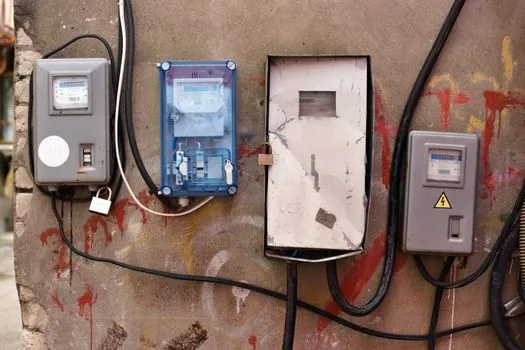
OSHA 1910.66 is the U.S. federal rule and the only one of the three that sets a numerical 1.5:1 stability factor, a 914 mm top-rail height, and a four-times component strength factor for suspended platforms, with every figure expressed in both imperial and SI units [S4]. EN 1808 is the European harmonized standard for suspended access equipment and is the route to CE marking in the EU; it overlaps OSHA on guardrail strength and secondary rope arrest, but adds explicit requirements for wire rope terminations, hoist duty cycle, and control circuit safety [S1].
ISO 16430 is the international standard referenced alongside EN 1808 in manufacturer documentation and is the standard procurement specifications call out when a project crosses jurisdictions, for example a Middle East data-centre build with European-supplied platforms commissioned under U.S.-style EPC documentation [S1]. Canada follows CSA Z271 and CCOHS guidance that maps almost line-for-line to OSHA 1910.66, with a parallel four-times component strength rule and a 1.5:1 stability floor; selection should always start from the most stringent rule that applies at the project site, and then confirm with a third-party test report if the platform will be CE-marked, cUL-listed, or supplied under both regimes [S5].
Selection Workflow and Decision Tree for Electrical Work
The decision flow is: define the working height envelope, sum the live load (crew + tools + staged cable/conduit), pick the deck length (typically 2 m, 4 m, or 6 m modular units to match façade bay spacing), and then confirm hoist power and supply voltage against the site distribution. For a 2–4 storey commercial fit-out at 6–15 m working height, a 250 kg-rated, 2 m deck, 1.5 kW single-hoist platform is the default. For a 10–20 storey hospital or data-centre façade at 30–70 m, a 500 kg-rated, 4–6 m modular twin-hoist platform with overspeed brake and dual control is the minimum. For high-rise above 80 m or for irregular geometry, specify a ZLP-series or equivalent 630 kg+ rated gondola with adjustable suspension geometry and engineered anchor plan [S1][S3][S6].
The selection should always be cross-checked against the related spec tasks that show up on the same site: stud welder selection for electrical installation for cable-tray support welding, steel scaffolding selection for steel construction for the ground-level access and material staging, and infrared line level specs for electrical installation layout for the alignment and inspection of conduit and tray runs that the platform feeds. Reference spec context for suspended ceilings and platform trolleys helps the procurement engineer understand how the suspended platform category differs from permanent ceiling-suspended loads and from ground-trolley-mounted access. When the unit is going onto a building with electrical automation gear in the roof plant, confirm the control cable and hoist motor do not share an EMC band with the building automation bus.
Limitations, Failure Modes, and When NOT to Use a Suspended Platform
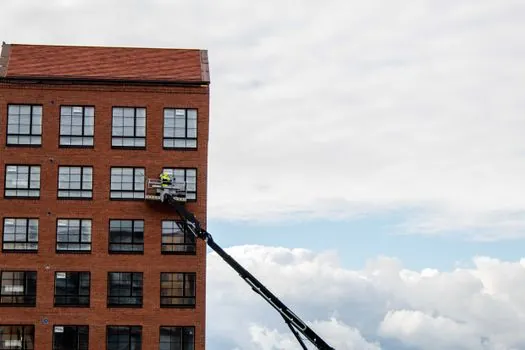
Suspended platforms are not the right tool for indoor electrical work above a fixed ceiling grid, for ground-level conduit runs, or for inspection of energized busbars where the operator must hold a tool against a live part without a fall arrest conflict. They also fail in high wind: most manufacturer derating charts cap operation at 12–15 m/s, and OSHA treats sustained wind above that threshold as a no-go for the shift. Failure modes on real sites trace to: underspecified suspension rope (often 6 mm when 8 mm was structurally required), missing secondary arrest on single-point platforms, guardrail infill with >25 mm openings passing the visual inspection but failing the lifeline-rejection test, and toeboards below 89 mm that allow short conduit offcuts to roll into the void [S4][S5].
A 1910.66 non-compliance that should trigger immediate replacement rather than field repair: any structural member with visible cracking, any hoist with a brake that slips under static load, any wire rope with broken strands above the discard criterion, and any guardrail with permanent set after a 444 N test load.
Track two signals over the next quarter: any revision of EN 1808 that adjusts the secondary rope arrest geometry for single-point platforms, and any update to the OSHA 1910.66 subpart F guidance documents on wire-rope discard criteria for galvanised 6–8 mm rope. Both will shift the spec floor on the next procurement cycle.