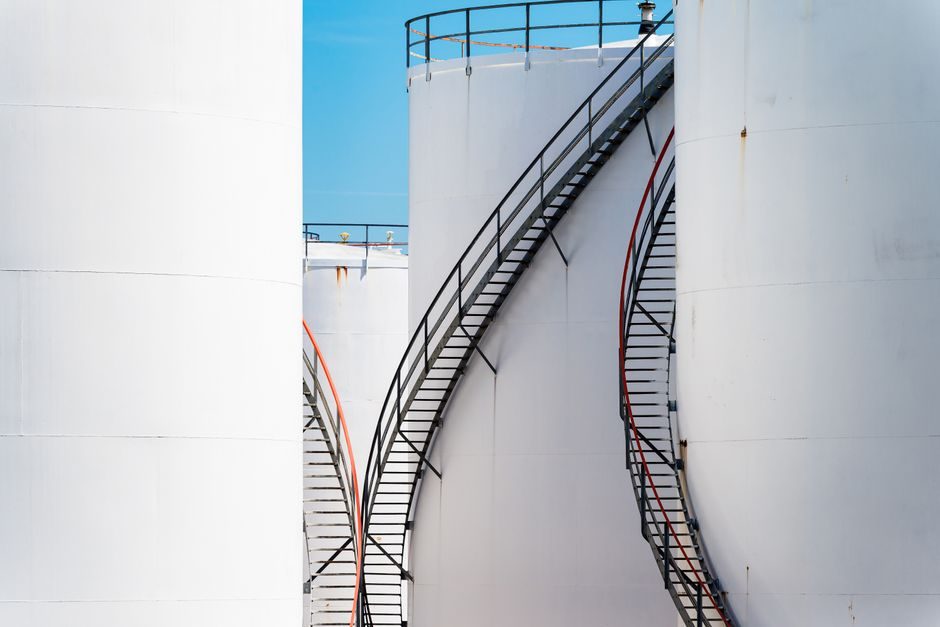
An ISO tank container is a stainless-steel cylindrical vessel mounted inside a CSC-approved frame, normally 20 ft (6,058 × 2,438 × 2,591 mm) with 24,000–26,000 L capacity, classified by the IMO/UN T-code system for the dangerous goods it carries [S5][S2].
Tank containers break down along four axes: frame/footprint, cargo class, internal compartmentalisation, and lining. Each axis carries its own spec language — T1 to T22 for liquids, T50 for refrigerated gases, baffle/multi-compartment for surge control, PE/rubber/PTFE for chemical compatibility [S3][S5].
Frame and Footprint Classifications
The dominant frame is the 20 ft ISO/CSC frame, with the FESCO fleet of T11 (24–26 m³) and T14 (25–26 m³) models operating under the International Convention on Safe Containers and the Customs Convention on Containers [S5]. A swap-body tank is a road/rail-only alternative — no corner castings, lighter, but excluded from ocean stacks [S3].
Beyond 20 ft, the standard catalog extends to 10 ft, 30 ft, 40 ft, and 45 ft footprints; 40 ft units can reach ~72,000 L with the 40 ft fitting platforms rated at 72 t load capacity used in FESCO's heavy-lift fleet [S3][S5]. Offshore tanks add DNV 2.7-1 sling/lifting certification, and pressurised IBCs sit in a separate class entirely [S3].
Cargo Class: T-Codes for Liquids and T50 for Gases
The T-code is a non-negotiable classification axis: T1 = low-hazard liquids, T11 = non-hazardous (FESCO's general chemicals and oil-products class), T14 = higher-density liquids up to ~1.6–1.8 SG, T22 = elevated-temperature or reactive cargoes, and T50 = UN-refrigerated gases at low temperature [S5].
Pressure ratings step in 4-bar bands for the ISO gas family — NTtank's published line lists 34.5 bar, 22 bar, and 15 bar designs for high-purity ammonia and LPG service [S3]. A misclassified T-code is the single most common cause of tank rejections at depot inspection, because the design pressure, venting, and relief hardware all derive from that code.
Internal Structure: Single-Shell, Baffle, and Multi-Compartment
Single-shell tanks are the default: one cylindrical shell, one set of end fittings, simplest cleaning cycle. Baffled tanks add internal transverse plates (typically 2–5) with cut-outs to suppress liquid surge — chosen when a vehicle's slosh dynamics risk handling stability or when a partial-fill move is unavoidable [S3].
Multi-compartment tanks split the same external envelope into 2–4 sealed compartments, allowing a single container to carry two or more segregated products in one move. The trade-off is mechanical: each compartment costs you some volume, the cleaning procedure between cargoes multiplies, and the allowable SG drops [S3]. For hazmat, the choice of baffle vs multi-compartment is not aesthetic — it changes loading, securing, and ADR/IMDG declarations.
Lining Classifications: PE, Rubber, PTFE, Polymer
When the cargo is more aggressive than 304/316 stainless can handle — hydrochloric acid, sulphuric acid, AHF, hydrogen peroxide, sodium — the shell gets a lining. NTtank's published range covers PE lining, rubber lining, PTFE/Teflon lining, and a generic polymer coating, each selected against cargo chemistry and temperature [S3].
As a working rule, PE handles dilute acids/alkalis at moderate temperatures, rubber handles abrasive slurries and HF at lower temperatures, PTFE handles the hottest and most reactive chemistries (HF, AHF, concentrated H₂O₂). A H₂O₂ tank and an AHF tank both ship as lined ISO tanks, but the lining choice, gasket set, and passivation are not interchangeable [S3].
Specialised Variants: Reefer, Heated, Bitumen, Asphalt
Reefer (refrigerated) tank containers carry a chiller unit on the frame and a temperature-controlled cargo envelope, used for food-grade oils, latex, and temperature-sensitive chemicals [S3]. Electrical heating tank containers wrap the shell in heat-tracing and insulation, used when the cargo must stay pumpable above its pour point [S3].
Bitumen and asphalt tank containers are an extreme of the heated family: they require sustained 150–200 °C internal temperatures, must comply with the international container standard, and are built in two structural styles — frame-mounted (easy to stack and hoist) versus angle-support (lower stance, heavier shell). The frame vs angle-support decision is driven by terminal handling equipment and stack loads [S4].
Selection Criteria: Cargo vs Tank vs Cost
A spec engineer picks a tank on four hard criteria: cargo compatibility (chemistry + temperature + SG), regulatory class (T-code, ADR/IMDG, RID), transport mode (ocean stacks demand ISO frame; road-only can take swap-body), and turnaround economics (cleaning time × cost × depot proximity). Storage tank containers for stationary service, like Krampitz's KCD-ISO-HC (13,000–60,000 L, CSC-ISO, flood protection, thermal insulation, earthquake zone 1), add structural and seismic ratings to the matrix [S2].
For a sourcing-side overview of liquid logistic equipment, the tank container page maps footprint, frame, and T-code vocabulary; the IBC tank page covers the pressurised IBC class that sits just below ISO tank capacity. Tank-level metering ties back to the flow meter and pressure transmitter reference pages, while cleaning drives tank cleaning machine and isolation hardware falls under industrial valve specs.
Failure Modes and Constraints
The most common spec-side failure is lining/cargo mismatch: PTFE handles HF and AHF, but not all PTFE linings are equal at high temperature; rubber handles HF but fails above ~80 °C; PE is the cheapest but is attacked by strong oxidisers. The second is over-pressure on T-code mismatch: putting a T1 liquid at elevated temperature into a non-T22 design can rupture the relief set. The third is baffle/multi-compartment confusion: a baffle tank cannot legally carry two different cargoes in one move, while a multi-compartment can [S3].
Operational limits that bite in practice: maximum gross weight typically ~36,000 kg per 20 ft ISO tank, design temperature band roughly −40 °C to +200 °C for the gas/heated family, and periodic hydrostatic test + CSC revalidation cycles at defined intervals. Storage-tank containers in seismic or flood zones add Earthquake Zone 1 (or 1–3) and flood-protection ratings on top of the standard CSC plate [S2].
Sourcing and Standards
Key reference documents are the IMDG Code for ocean/dangerous-goods classification, the CSC (International Convention for Safe Containers) for the frame plate, ADR for European road, RID for rail, and ASME BPVC Section VIII for pressure-vessel design. The T-code set itself is the shorthand that ties the IMDG packing instruction to a tank's design pressure, venting, and relief hardware [S5].
On the manufacturer side, NTtank publishes the broadest public type list (Teflon-lined, hydrochloric-acid, sulphuric-acid, sodium, AHF, H₂O₂, reefer, electrical-heated, multi-compartment, offshore, 10 ft, 34.5/22/15 bar gas) [S3]; Krampitz publishes the stationary/storage-tank-container line (KCD-FL, KCD-ISO-HC, KCD-MA, KCD-ST-HC) with capacity and zoning call-outs [S2]; and TankContainerFinder.com is the long-standing logistics matchmaker for the leasing and one-way move market [S1]. For a related materials-handling trade-off map covering forklift sizing, the rough terrain forklift spec trade-off map is a useful parallel reference when matching a tank container to terminal handling gear.