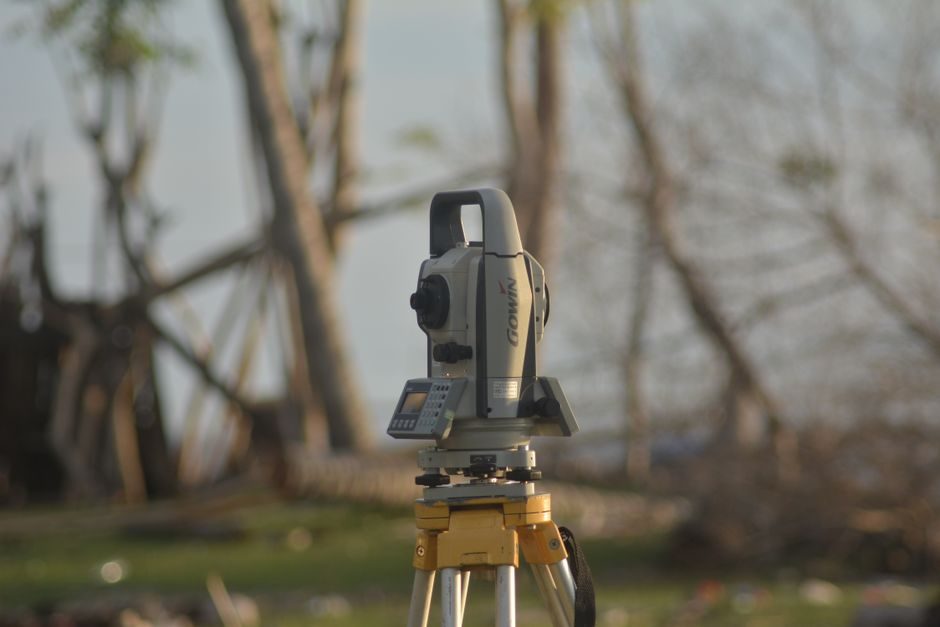
A theodolite is an optical-mechanical angle-measuring instrument whose horizontal and vertical circles are read through a telescope-eyepiece micrometer or electronic encoder, with stated angular accuracies on modern 1-second digital models such as the Leica TM6100A (0.15 mgon / 0.5 arc-sec) [S1].
It sits in a 2026 survey toolkit between hand-held tape-and-compass methods and robotic total stations, with the all-glass optical encoder, 30x magnification telescope, and 45 mm objective still defining what users call "theodolite-class" performance in tunnelling, deformation monitoring, and mining shaft plumbing.
What a theodolite actually measures, and what it does not
The instrument reads horizontal angle (Hz) and vertical angle (V) on graduated circles, with the line of sight defined by a telescope that resolves roughly 3-4 arc-seconds at 1 km under DIN 18723 atmospheric conditions [S1]. It does not natively output distances; that is the defining boundary between a theodolite and a total station, which adds an electronic distance measurement (EDM) module and a data port.
Optical theodolites use a 4-screw tribrach with a 5/8-11 base mount, a plate bubble of 8'/2 mm sensitivity, and an automatic vertical-index compensator (range ±3', accuracy ±0.5") on most 1-second-class instruments. The axis geometry follows the classic "TT"-rule: the trunnion axis is perpendicular to the vertical axis, both are perpendicular to the line of sight, and the vertical circle is indexed to true zenith by the compensator [S1].
For buyers comparing geometry tools, a theodolite is the right pick when the job is angles-only, the operator can hand-tape or laser-rangefinder the baseline, and the cost of a robotic total station cannot be justified. It is the wrong pick when a single operator needs to stake 200 points a day, when GPS/GNSS-RTK sky view is unobstructed, or when the deliverable is a 3-D point cloud rather than a 2-D traverse.
Concrete advantages that still hold in 2026
Sub-arc-second angular precision is the headline: a Leica TM6100A reads to 0.5" with a 0.5" DIN-standard accuracy, an order of magnitude tighter than the 5-10" of a typical total station at distance [S1]. For tunneling ring-plumb, dam deformation, and turbine-shaft alignment, that resolution translates directly into mm-class positional control over a 50-100 m baseline.
Mechanical robustness remains a real differentiator: the cast-metal body, sealed optics, and absence of an EDM laser class 1/2 source mean a theodolite tolerates rain, dust, and rough handling on construction sites better than a total station with a 0.5-3 mm + 1 ppm EDM module that drifts with temperature. The instrument's MTBF is regularly quoted in decades, with calibration cycles of 2-3 years rather than the 6-12 month cycle of an EDM [S1].
Power and data simplicity still matter. A theodolite runs on 4 AA batteries for 20-30 hours (no display backlight, no Bluetooth, no servo drives), and the angle data can be hand-written into a field book with no firmware version risk, no SD card corruption, and no GNSS almanac to update. On long baselines where a pressure transmitter might be monitoring tilt-meters, an optical theodolite is often paired as the cross-check because it is functionally independent of any electronic calibration chain.
Cost of entry is the third pillar: 1-second mechanical theodolites are typically priced in the $2,000-$5,000 band, versus $8,000-$30,000 for a comparable accuracy total station with EDM, robotic servo, and field controller.
Specific disadvantages buyers must price in

Two-person operation is the dominant labor cost: a theodolite traverse needs an instrument operator, a target/rod person, and a recorder, so crew cost per set typically runs 3x that of a one-person robotic total station. On a 200-point day this is the single largest line item.
No direct distance, no native digital log: angles must be paired with a separate measurement (steel tape, laser rangefinder, or auxiliary EDM), and the data is hand-keyed into a controller. Integration with GIS, BIM, and machine-control PLC workflows therefore requires a manual export step that is error-prone and slow.
Line-of-sight and atmospheric sensitivity are real limits: vertical refraction over a 500 m sight at 30 degrees Celsius with a 5 degC ground-to-air gradient can introduce 1-3" of vertical-angle error, and the line of sight must be physically cleared of traffic, vegetation, and steel rebar. Night work is possible only with a target lamp, and underground work in tunnels needs a strobe or retroreflector.
Compared to a robotic total station, the theodolite offers no automatic target recognition (ATR), no tracking, no remote control, and no integrated point-cloud. Compared to a flow meter for pipe-shop calibration or a pressure sensor for hydrostatic testing, the theodolite is a manual, optical, two-person chain — it is not a digital transducer you can drop onto a Modbus or HART bus.
Theodolite vs total station vs GNSS vs laser scanner: a criteria comparison
On four buyer criteria the four tool classes line up as follows. (1) Angular accuracy: theodolite 0.5-1", total station 1-5", GNSS-RTK 8 mm + 1 ppm horizontal, scanner 1-3 mm at 50 m. (2) Distance: theodolite requires auxiliary device, total station 0.5-3 mm + 1 ppm to 5 km, GNSS up to 30 km baseline with radio, scanner 100-300 m. (3) Crew size: theodolite 2-3, total station 1 (robotic), GNSS 1, scanner 1. (4) Cost of entry in 2026 USD: theodolite $2-5k, total station $8-30k, GNSS receiver $5-20k, scanner $20-80k [S1].
The decision rule is therefore narrow: a theodolite wins on angular precision per dollar and on mechanical longevity; a robotic total station wins on throughput and digital integration; GNSS wins on line-of-sight-independent positioning; a scanner wins on 3-D deliverables. For deformation monitoring of a dam crest where weekly sub-mm vertical change must be measured, a 0.5" theodolite with a calibrated invar staff is still the most trusted chain, even in 2026.
Use cases that justify specifying a theodolite in 2026
Tunnel breakthrough and shaft plumbing remain the canonical applications: a 0.5" theodolite set at the surface, with a hanging plumb line or NPL subtense bar in the shaft, gives the orientation and offset of the heading drive. The 0.5" figure quoted to 0.5 sigma under DIN 18723 is the de facto spec for acceptance [S1].
Deformation monitoring of concrete dams, bridge piers, and historic masonry walls is the second pillar: weekly sets of horizontal and vertical angles, hand-recorded and reduced, deliver a 20-30 year baseline of behavior with no firmware drift. For instrumented sites where a pressure sensor array is embedded in the structure, the theodolite is the cross-check instrument of record.
Mining and quarry face surveys, especially in GNSS-denied underground workings, are the third: the theodolite is the tool the mine surveyor carries because it does not need radio, satellites, or mains power, and it survives a rockfall.
Failure modes and field constraints to spec in
Axis collimation error (the line of sight not being perpendicular to the trunnion) is the most common field defect and is corrected by the "two-peg test" or the manufacturer collimation routine. A residual collimation drift above 1" disqualifies a 0.5" instrument; this is the first field check on acceptance. Plate-bubble sensitivity of 8'/2 mm must be confirmed; a flat plate bubble means the compensator is taking a non-vertical reading [S1].
Vertical-index error is corrected by reading on both faces (direct and reverse); a "one-face-only" workflow hides a 5-10" error that will not show until a traverse miscloses. Reticle illumination failures, tribrach looseness, and optical-micrometer backlash are the next tier. For cold-climate work below -20 degC, the instrument must be specified for that range; standard theodolites are rated 0 to +40 degC operating.
Standards, sourcing, and the 2026 procurement checklist

Acceptance should be written against ISO 17123-3 (theodolite field procedure, k=2 standard deviation target of 1.0" for a 1-second instrument) and ISO 12857 (stability of angle measurements over time). Calibration certificates from an accredited lab (NVLAP, A2LA, or ILAC-MRA equivalent) with traceable circle graduations are the minimum [S1].
For 2026 procurement, the realistic choice is a used or refurbished Leica TM6100A / Wild T2002-class instrument at $3-6k, a new Topcon DT-200L or Pentax ETH-500 series at $2-4k, or a South NT-023 at $1-2k. Avoid the sub-$1,000 consumer "laser theodolite" hybrids that blend a 5" encoder with a 1 mm + 2 ppm laser rangefinder — they are sold as total stations but tested as theodolites, and the angular accuracy rarely meets the printed spec.
For the next planning node, watch for the Q3 2026 release of the Trimble S-Series successor firmware that is rumored to add ISO 17123-3 acceptance test scripts directly in the controller, and for the Leica Captivate v8 update that may extend the TM6100A's Bluetooth datalogger life. These are the only trackable signals relevant to a theodolite buyer this quarter.
Related analysis: Vibration Sensor Buying Guide 2026: Types, Specs, and Selection Map.