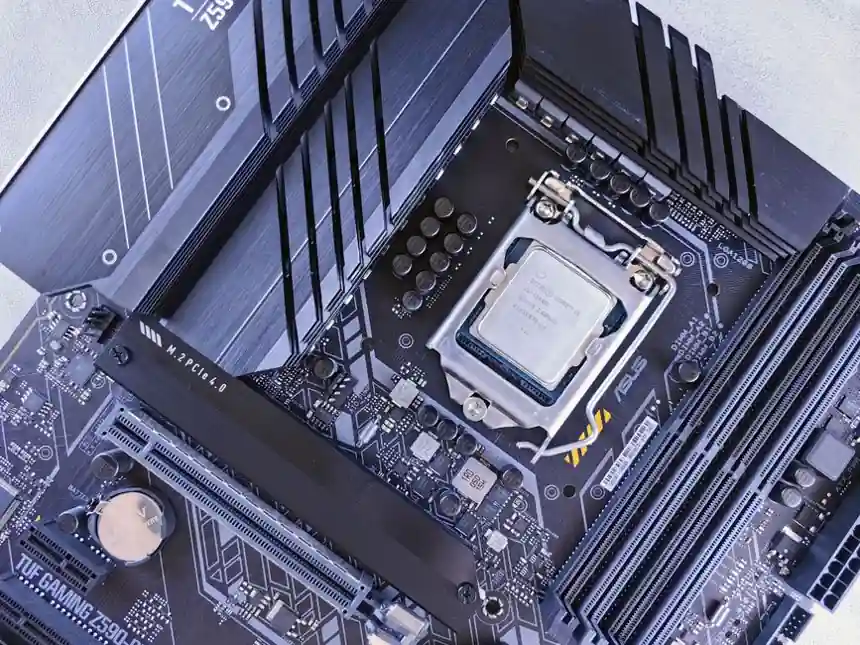
Tier-1 power semiconductor suppliers in 2026 are no longer competing on logic node leadership, they are competing on who can keep AI-grade PMICs, VRMs, and 800 V SiC MOSFETs in stock against a 20-30+ week lead-time backdrop [S1].
The global power semiconductor market was valued at USD 57.41 B in 2026, up from USD 54.94 B in 2025, and is forecast to reach USD 81.70 B by 2034 at a 4.51% CAGR [S2]. Asia Pacific held the largest regional share in 2024, while the discrete segment and the SiC material segment are both projected to grow fastest within that envelope [S2].
Why the 2026 Bottleneck Migrated from Logic to Power Delivery
AI rack power densities scaling past 100 kW, a roughly 10x increase versus traditional enterprise racks, are pulling the constraint out of GPUs and into the power supply chain that feeds them [S1]. The shift toward 48 V rack architectures and 800 V DC bus designs is the physical driver behind the surge in demand for high-current PMICs, DrMOS stages, and high-voltage SiC MOSFETs [S1].
Foundry utilisation for mature power nodes sat between 82% and 88% in late 2025, and any drift past the 90% mark in early 2026 is the trigger point for fresh allocation rounds on power distribution parts [S3]. Because mature-node fabs are the ones running SiC and high-current IGBT lines, the bottleneck is structural, not a one-cycle blip [S3].
Component-Level Risk Matrix for Tier-1 Power ICs
Within a tier-1 supplier's portfolio, risk is no longer uniform: AI-grade PMICs and VRMs sit at the Critical tier, high-voltage SiC MOSFETs at High, high-CV MLCCs at Medium-High, and standard MOSFETs/IGBTs at Low-Medium [S1]. Procurement teams should map each BOM line above 48 V against this matrix before any Q4 2026 commitment [S1].
The 20-30+ week lead-time band flagged in mid-2026 applies specifically to PMICs, VRMs, DrMOS modules, and high-voltage SiC MOSFETs; standard discretes remain broadly bookable inside one quarter [S1]. For plants still specifying 12 V distribution, the migration to 48 V is now procurement-mandated, not optional, because tier-1 suppliers are reallocating legacy capacity toward AI accelerator boards [S1].
The SiC Paradox: Automotive Glut vs Data-Center Deficit
Eight-inch wafer lines are tight while six-inch automotive SiC inventory is loose, producing what sourcing analysts have labelled the SiC Paradox: 6-inch automotive parts are long, 8-inch data-center parts are short [S1]. Tier-1 suppliers with dual-footprint fabs (e.g. Mitsubishi Electric's doubled SiC capex from 130 B JPY to 260 B JPY) are the only ones that can rebalance between the two markets without line-down risk [S2].
For power tool and industrial motor-drive buyers, the practical consequence is that 6-inch SiC stock is buyable, while data-center-grade 1200 V SiC MOSFETs on 8-inch wafers are an allocation product requiring long-term agreements [S1][S2]. Differentiating between these two SiC tracks on the BOM is the single highest-leverage qualification step for the rest of 2026 [S1].
Tier-1 vs Tier-2 Suppliers: Where Each One Wins
Tier-1 power semiconductor suppliers (the integrated device makers running captive fabs on 8-inch SiC and sub-90 nm BCD processes) win on allocation security and 10-year SiC roadmaps, but lose on lead time and price [S1][S2]. Tier-2 and emerging suppliers (Chinese SiC startups, European specialty fabs, and analog-focused IDMs) win on slot availability and 10-20% price gaps, but lose on automotive-grade PPAP documentation and long-term longevity guarantees [S2].
On 2-4 decision criteria, the comparison reads: tier-1 leads on reliability, AEC-Q101/PPAP depth, and SiC wafer control; tier-2 leads on lead time, cost, and minimum order flexibility [S1][S2]. A practical dual-source posture is tier-1 for the long-cycle AI and power meter telemetry backbones, tier-2 for the short-cycle industrial and EV charging builds, see the spec field map in EV Charging Station Process Control: 2026 Spec Field Map for the latter [S1][S2].
Sourcing Tactics for Tier-1 Power Semiconductor Allocations
Three tactics dominate the 2026 procurement playbook: (1) expand the Approved Vendor List to at least one tier-2 per critical PMIC/SiC line, (2) route buffer-stock orders through authorised independent distributors with traceable documentation, and (3) convert spot buys into long-term supply agreements tied to multi-quarter forecasts [S1]. The cost of a 90% utilisation crossing in early 2026 is that any unfirmed forecast loses its slot, regardless of incumbent status [S3].
Counterfeit risk rises in lockstep with allocation pressure, so procurement specifications should require date code, lot trace, and X-ray or decapsulation evidence for any part sourced outside the tier-1 authorised channel [S1]. For harmonic-sensitive VFD plants, the tier-1 SiC choice also dictates the harmonic filter sizing downstream, making the supplier decision an electrical-design decision, not a commercial one [S1].
What Tier-1 Suppliers Are Not the Right Answer For
Tier-1 power semiconductor suppliers are the wrong choice for low-volume prototyping runs under 1,000 units, where NRE fees and MOQs distort unit cost; for any application below 48 V where legacy silicon is over-specified; and for early-stage SiC designs that need rapid wafer iteration, where a tier-2 specialty fab can ship samples in half the time [S1][S2]. They are also the wrong default for consumer-grade volume where gross margin cannot absorb tier-1 ASPs [S2].
By contrast, they remain the right call for any power cable and substation protection path, for automotive traction inverters under AEC-Q101, and for any product whose end customer audits the silicon supply chain back to the wafer [S1][S2]. Use the same risk matrix logic: high-reliability regulated segment, tier-1; cost-driven unregulated segment, tier-2 [S1].
Trackable signals into Q4 2026: tier-1 8-inch SiC capex announcements and any second-half 2026 foundry utilisation print from the major foundry groups, since a slip back below 90% would be the first sign that AI accelerator demand is normalising and the bottleneck is loosening [S1][S3].