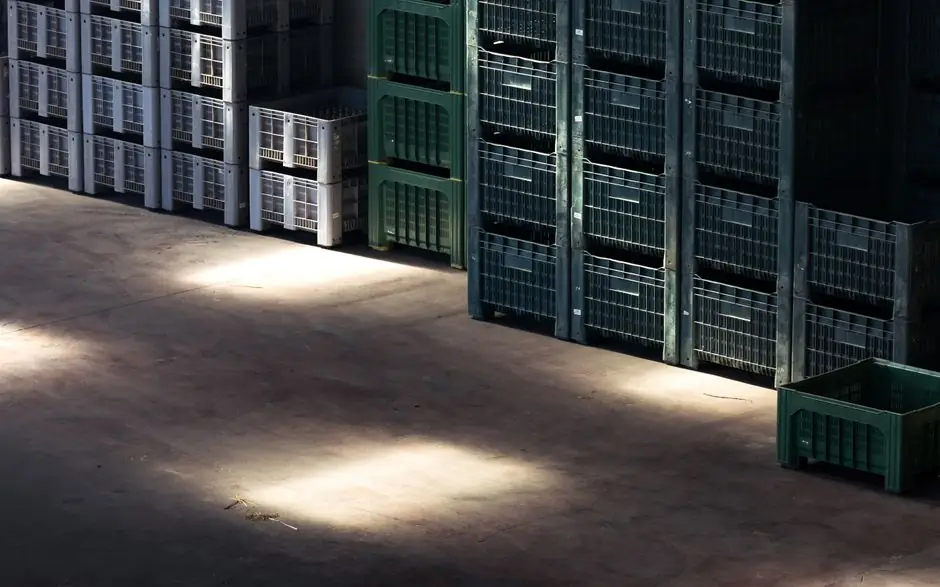
Cold storage warehouses operate continuously between roughly −25°C and +5°C, with door-area defrost cycles swinging to +15°C and localized coil surfaces running colder, and wrapped tin-bronze plain bearings in CuSn8P0.3 (DIN-grade equivalent) or CuSn6.5P0.1 are rated for −100°C to +200°C service [S2]. That window easily envelopes any walk-in freezer, cold-room or blast-freezer application without special low-temperature qualification.
The harder selection problem is not cold survival; tin bronze tolerates it well. The harder problem is matching the alloy family to the part: load-bearing wrapped bushings on conveyor and pallet-handler rollers, C51000/C51900/C52100 phosphor-bronze grades for wear plates and spring contacts, and the C86300 manganese-bronze range where impact dominates [S1][S3][S4]. Specifying "tin bronze" as a single material, the way many purchase orders do, is where projects fail.
Cold-Storage Operating Envelope and Why Tin Bronze Fits
Cold-storage mechanical systems run in three regimes: structural cold (−25°C to +5°C room air), door and anteroom cycling (+5°C to +20°C with condensate), and refrigeration plant (−35°C evaporator surfaces, line temperatures to −40°C on some CO2 transcritical systems). Wrapped tin-bronze FB090/FB092 bushings carry a published operating range of −100°C to +200°C, static load capacity 120 N/mm², dynamic load 40 N/mm², and maximum sliding speed 2.0 m/s, with hardness HB 90–120 in standard condition and HB 120–150 hardened [S2]. The −100°C floor leaves roughly 60°C of margin below any realistic cold-warehouse bushing location, including the evaporator-side conveyor drives commonly retrofitted into automated freezers.
Condensate is the more aggressive threat than the cold itself. Phosphor bronzes (the tin-bronze-plus-phosphorus family) carry "high tin content which improves its strength and corrosion resistance, especially to seawater and chloride environments" [S4], and CuSn8P0.3 / CuSn6.5P0.1 wrapped bearings are explicitly described as "corrosion resistant" and suited to "rough operation" [S2]. In a cold room, door cycles pump humid air across cold steel; the resulting chloride-bearing condensate (worse in coastal ports and in rooms handling packaged seafood or de-iced product) preferentially attacks plain carbon steel and dezincification-susceptible brasses, while the tin-rich alpha phase in CuSn alloys resists it.
Alloy Comparison: C51000 vs C51900 vs C52100 vs Wrought CuSn8P0.3
Tin-bronze selection in a cold-storage warehouse comes down to four families. Wrought phosphor bronze C51000 carries 4.2–5.8% Sn and is positioned for balanced formability, strength and conductivity at roughly 14–18% IACS; C51900 at 5.5–7.0% Sn trades conductivity (around 12–15% IACS) for higher strength and wear; C52100 at 7.0–9.0% Sn is the hardest of the three at roughly 10–13% IACS, the grade picked when spring strength and wear resistance outweigh conductivity [S1]. Wrought tin-bronze strip and bar in the CuSn8P0.3 / CuSn6.5P0.1 form is the workhorse for bushing stock, with tensile strength 450 N/mm², yield 250 N/mm² and thermal conductivity 60 W/(m·K) [S2]. C86300 manganese bronze sits apart, "relatively hard" with high ductility, used where impact dominates rather than sliding wear [S3].
Decision criteria line up clearly. For the wear plates under sliding pallet stops and the spring clips on rack interlocks, C52100 wins on strength; for formed electrical spring contacts on the freezer's door-heater harnesses and sensor housings, C51000 wins on formability and conductivity. For conveyor roller and sprocket shaft bushings inside the cold room, specify wrapped CuSn8P0.3 FB090 (diamond oil pockets) for clean, slow-speed service or FB092 (through-holes) where occasional re-lubrication is acceptable [S2]. For dock-leveler pivots and impact-loaded lifting linkages, C86300 is the better fit [S3]. Density across the family sits near 8.8 g/cm³ and elastic modulus near 110–120 GPa [S1], so structural calculations do not need to be re-run when swapping among the phosphor-bronze trio.
Where Tin Bronze Goes Inside a Cold Storage Facility
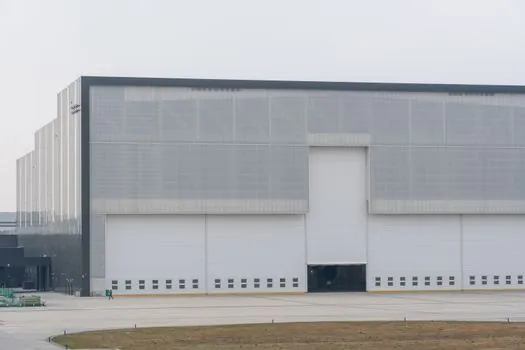
Five subsystem clusters account for nearly all tin-bronze content in a typical cold-storage build. (1) Overhead conveyor and case-handler drives: wrapped FB090 bushings on roller shafts, where the −100°C lower limit and 120 N/mm² static load rating cover both low-temperature ambient and shock during case transfer [S2]. (2) Rack and shuttle interfaces: C52100 wear strips on shuttle-car bogies, where the higher tin content resists galling against steel rails under intermittent lubrication. (3) Door hardware: phosphor-bronze C51000 or C51900 spring elements on inflatable dock-seal switches and door-heater contact assemblies, where the 14–18% IACS conductivity range handles low-current control circuits without contact heating [S1]. (4) Refrigeration plant valve gear: CuSn8P0.3 or CuSn6.5P0.1 valve bushings on the suction and liquid-line valves exposed to refrigerant and oil, where the corrosion resistance of tin bronze outperforms plain brass in the presence of lubricant breakdown products [S2][S4]. (5) Material-handling interfaces adjacent to loading bays: dock-leveler and lift-truck pivot bushings in C86300 manganese bronze for impact and misalignment tolerance [S3].
For automated high-bay cold warehouses in particular, the conveyor and shuttle sub-assemblies drive most of the bronze tonnage, and the AS/RS system selection for warehouse automation guide walks through how bushing choice interacts with shuttle duty cycle and ambient temperature class. For sites where snow-handling loaders feed the dock, the overhead bridge crane selection for snow removal operations piece covers the matching crane-end bushing and sheave spec at the same temperature class.
Limits, Failure Modes and What to Exclude
Tin bronze is not the right answer everywhere, and specifying it blindly is a common cold-storage procurement error. C52100 at 10–13% IACS is too resistive for any conductor carrying more than a few amps; route those duties to copper or high-copper alloys, not to high-tin phosphor bronze [S1]. Wrapped CuSn8P0.3 bushings are dry-film-then-boundary, not fully starved: their published PV ceiling of 2.8 N/mm²·m/s and maximum sliding speed of 2.0 m/s [S2] mean that high-rpm evaporator-shaft applications (above roughly 1900 rpm at small diameters) need rolling-element bearings, not plain bronze. Manganese bronze C86300, while hard and ductile, is not a tin bronze and should not be used as a one-for-one substitute on wear surfaces where the chloride-bearing condensate chemistry points specifically at the tin-rich alpha phase [S3][S4].
Condensate plus intermittent lubrication is the worst combination for any bronze, and "anti-seizure performance" in marine work is described as a separate engineering requirement from "corrosion resistance" [S5]. The practical exclusion list for cold storage: do not use aluminum bronze where ammonia refrigerant leaks are credible (ammonia attacks aluminum bronze), do not use leaded bronzes in food-contact zones, and do not use plain brass in any chloride-condensate area. Pillow block bearing selection for automotive production lines discusses the same boundary-lubrication trade-off in a different setting, and the comparison carries over directly to conveyor drives inside freezers.
Specifying It Right: Standards, Stock Form and Inspection

Order text has to go beyond "tin bronze bushing." Pin the alloy (CuSn8P0.3 or CuSn6.5P0.1 for wrapped stock; C51000, C51900 or C52100 with UNS designation for phosphor-bronze forms; C86300 for manganese-bronze impact parts) [S1][S2][S3]. Pin the product form: wrapped and roll-formed for FB090/FB092 [S2], bar or strip for machined wear plates, sheet for formed spring elements [S1][S6]. Pin the temper (hard, extra-spring, half-hard) and the mechanical-property floor (a C52100 wear plate without a temper callout will arrive in a different condition from lot to lot). Pin the lubricant regime: oil-charged diamond pockets for FB090 versus re-lubricatable through-holes for FB092 [S2]. For electrical spring grades, pin electrical conductivity target, grain direction, and edge condition; per S1, C52100 has lower conductivity than C51000 in exchange for higher spring strength and wear resistance, a trade-off that matters in any low-voltage signal path. For bushings, pin dimensional tolerances against the standard FB-series size range (10×12×10 through the full metric table) and the hardness band HB 90–120 standard, HB 120–150 hardened [S2].
Two signals are worth tracking on the next revision cycle. First, watch whether ammonia/CO2 transcritical refrigeration retrofits continue to push the evaporator-side bushing operating window colder; if the −35°C to −40°C range becomes common at the bushing location rather than the coil surface, the −100°C rating of CuSn8P0.3 still applies but the lubricant viscosity and oil-pocket geometry may need a second look [S2]. Second, watch the standardization work on tin-bronze composition limits; the "5%, 6% and 8%" shorthand maps to C51000, C51900 and C52100 in production practice, but the governing material standard (UNS / EN / GB) controls the actual acceptable composition range, and procurement text that relies on the shorthand alone will accept the wrong material [S1][S6]. Tin bronze reference pages and the related storage rack and storage cage entries are the next place to look for the matching rack and interface specs on the materials-handling side.