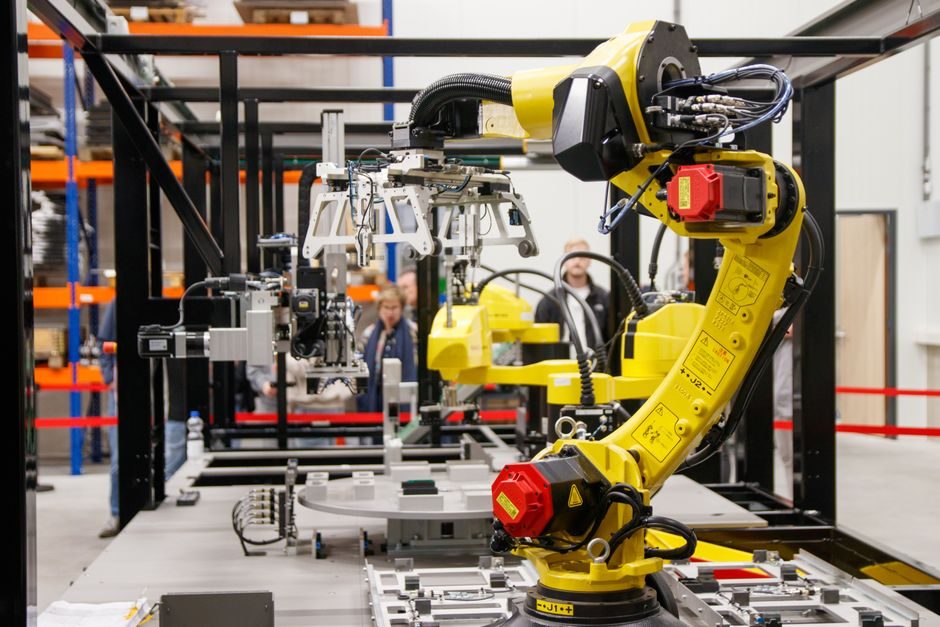
Eight OEMs — ABB, FANUC, KUKA, Yaskawa, Mitsubishi, Universal Robots, Yaskawa/Motoman and Hyundai Robotics — continue to hold the majority of global industrial robot installed base, with Chinese challengers Estun, Inovance, Siasun and Efort pulling double-digit share in payload classes below 20 kg [S3].
For process engineers sourcing 2026 cells, the real decision is rarely brand loyalty; it is repeatability (typically ±0.02 mm on 6-axis arms), payload/reach envelope, controller openness to PLC backplanes, and certified operation in hazardous areas where pressure transmitters and flow meters on the same skid must coexist with the robot's servo drives.
Industrial Arm OEMs: Repeatability, Payload and Controller Openness
ABB IRB and KUKA KR series arms specify repeatability in the ±0.02–0.05 mm band across their 6-axis mid-payload lines, with FANUC's R-2000iC and Yaskawa's Motoman GP series pushing the same envelope while adding IP67 wrist protection for harsh cells [S3]. Universal Robots occupies a separate lane — collaborative arms with force-limited joints, payloads of 3/5/12.5/16/20/30 kg, and repeatability quoted at ±0.03–0.1 mm depending on model tier.
Open controller architectures matter as much as the mechanical envelope: KUKA's KR-C5 and ABB's OmniCore expose EtherCAT, PROFINET and CIP Safety, allowing direct hand-off to third-party servo motors and safety PLCs, while FANUC's R-30iB Plus remains largely proprietary — a real procurement gate for plants standardised on non-FANUC fieldbuses.
Humanoid Platforms: Where the 2026 Money Is Flowing
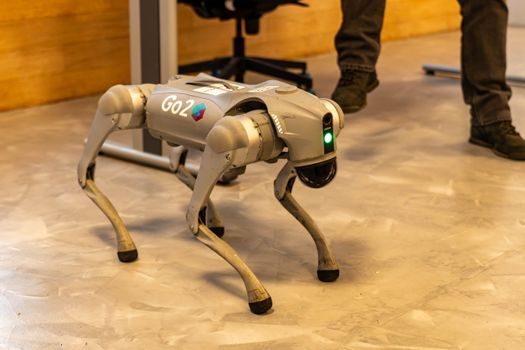
Tesla Optimus, Figure AI 02, Boston Dynamics Atlas (electric, third generation), 1X Neo, Apptronik Apollo, Agility Robotics Digit and Sanctuary Phoenix all shipped or unveiled 2026 production-intent units, with unit counts still in the low thousands per vendor — not millions [S3]. UBTech's Walker S2 and Unitree's H1/G1 also entered pilot deployments in Chinese auto and electronics cells, with the Walker S2 quoted at 1.76 m height and roughly 12 kg payload per arm.
Who humanoid platforms are FOR: research labs, automotive pilot lines running parts-handover trials, and warehousing test beds where AMR fleets already operate. Who they are NOT for — yet — high-throughput welding or painting cells, ATEX zone 1/21 areas, or any process requiring < 0.1 mm positional repeatability at full reach. The 2026 reality is that humanoid torque density, battery cycle life (typically 2–4 hours per swap), and TÜV/SGS functional-safety certification lag what industrial cobots ship with today.
Warehouse AMRs and Mobile Platforms: Kiva-Derived Architecture Splits

Amazon Robotics (the renamed Kiva Systems lineage) still anchors the largest single-vendor installed base, but Symbotic, Locus Robotics, AutoStore, Geek+, GreyOrange, MiR (Mobile Industrial Robots) and Fetch/Zebra each carved distinct lanes by 2026 — cube storage, bin-picking, tote transport, and conveyor-tug respectively [S3].
Selection criteria for a 2026 cell: payload (10–1500 kg bands), navigation stack (SLAM LiDAR vs 2D QR-code vs vision), fleet manager API openness, and CE/UL 3100 or ISO 3691-4 compliance for autonomous industrial trucks. A useful comparison snapshot:
Symbotic — high-density cube, US grocery/CPG focus, capex-heavy, proprietary software stack, throughput quoted in cases-per-hour rather than picks-per-hour.
Locus Robotics — AMRs picking alongside human walkers, lower capex, RaaS (robot-as-a-service) monthly pricing, scales by adding units into the same fleet manager.
Geek+ — Chinese-domestic leader, expanding to EU/NA, picks-and-totes plus moving racks, supports both QR and SLAM navigation.
AutoStore — cube storage pioneer, integrator channel model (no direct sales), capacity sold by bin count and grid footprint.
Chinese Challengers: Estun, Inovance, Siasun, Efort
Estun and Inovance leverage the same servo motor and motion controller supply chain that Chinese 3D-printer and CNC builders use, which is why 2026 list prices for 6-axis 10 kg payload arms from these vendors sit 20–40% below the European equivalents on FOB Ningbo or Shenzhen terms [S3]. Siasun continues to dominate domestic Chinese auto cell integrations, while Efort has carved a niche in the 3C/electronics assembly lane with sub-5 kg scara and 6-axis units.
For sourcing teams the trade-off is concrete: cheaper mechatronics with documented repeatability around ±0.03 mm, versus European/Japanese incumbents offering longer MTBF data, broader hazardous-area certification, and global service networks. See how a sister 2026 spec cut on Robotics Market 2026: Industrial Arms, Warehouse Cells, Harmonic Drives and Linear breaks the harmonic-drive and linear-actuator lanes that feed these same vendors.
Standards, Certification and Safety Gates That Decide the Part
ISO 10218-1 and ISO 10218-2 remain the governing pair for industrial robot safety (manufacturer integration and cell integration respectively), with ISO/TS 15066 covering collaborative-mode power-and-force-limiting thresholds. ISO 13849-1 Performance Level (PL) d or e and IEC 62061 SIL 2/3 are the typical safety-function targets for stop, speed, and separation monitoring circuits. [S1]
For mobile platforms, ISO 3691-4 governs driverless industrial trucks, while UL 3100 and ANSI/RIA R15.08 cover mobile robot safety in the North American market. Hazardous-area deployment of any robot carrying industrial valves actuators or standing near Ex-rated pressure sensors is bound by IEC 60079-series zone definitions and the ATEX 2014/34/EU framework for equipment, plus IECEx for non-EU regions. None of these are optional — a cell that cannot quote the standard number on its risk assessment will fail most end-customer FAT audits.
Who the 2026 Top List Is For — and Who It Is Not
FOR: process engineers writing a 2026 cell RFP who need a defensible shortlist across payload/reach/safety, plus sourcing leads who must justify vendor selection against TCO models spanning capex, service, and energy per cycle. NOT for: investors hunting quarterly robot-order book numbers (the published 2026 vendor list is application-segment, not stock-picking, data) and not for academics asking which humanoid has the best benchmark video. [S2]
A practical shortlist gate for a 2026 RFP: (1) confirm controller protocol support against your PLC standard, (2) demand the manufacturer's published MTBF and service-level response time in writing, (3) verify the robot's safety function package against the actual cell risk assessment, and (4) require a reference cell visit — not a showroom — running a cycle time within 5% of the quoted nominal.
Open-Source Stack and Adjacent Tooling
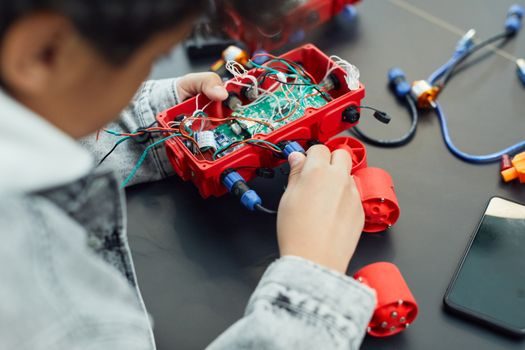
ROS 2 (Robot Operating System, version targeting Humble/Iron/Jazzy/Kilted), MoveIt 2 for motion planning, and the increasingly mature Gazebo Sim fork are the de-facto open-source stack for prototype development in 2026, with Grbl, Smoothieware and TinyG still holding the hobby/CNC lane [S4]. For sensor-fusion work in early prototyping, off-the-shelf LiDAR and IMU drivers remain the lowest-cost path to a working SLAM stack, even where production deployments buy the closed-source commercial equivalent.
Cross-reference a parallel 2026 vendor map on Top AI Chip Companies 2026: Vendors, Architectures and Sourcing Reality — robotics and AI silicon share the same NVIDIA Jetson, Qualcomm RB-series and Apple/Google-edge lanes, and a sourcing decision on the compute board often pre-determines which perception stack the cell can run.
Closing signal to track: the September 2026 IFA Berlin and October 2026 ROSCon will publish the first wave of post-pilot humanoid cell metrics — payload under dynamic balance, mean time between falls, and audited cycle times — which together will move the 2026 "top robotics companies" list from pilot-deployed to production-deployed by the next revision window.