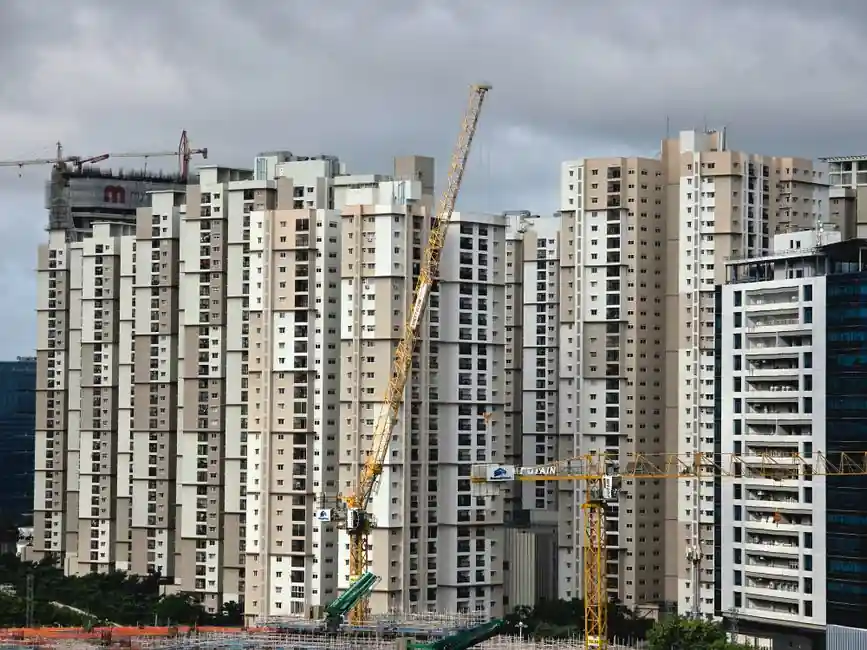
In dense urban builds, the dominant selection question is no longer raw lift capacity, it is how cleanly the machine fits the site envelope: 1.6-12 t maximum load class [S2][S4], 30-70 m jib radius for medium-rise and infrastructure work, and freestanding tower heights of 30-60 m before the first tie-in [S1][S4].
For a procurement engineer comparing 2026 supplier catalogues from Spain, China, and Malaysia, the practical decision set is: hammerhead (flat-top) versus luffing-jib versus self-erecting, modular mast compatibility (L46, L68, L68B), and whether the project can accept used Potain MC200A class machines [S4] or only new ISO 9001:2000-certified units from Shandong manufacturers [S2].
Site Envelope: Jib, Freestanding Height, and Counterfactual Limits
For a typical 25-40 storey residential slab in a coastal megacity, jib length of 50-65 m is now the workhorse band, with the QTZ250(7020) class at 70 m jib and 12 t maximum load listed in 2026 export catalogues [S4]; smaller QTZ40, QTZ50, QTZ63, and QTZ80 models cover 1.6-6 t class jobs with shorter radii of 31.5-56 m [S2].
Freestanding tower height is governed by base ballast plus the first tie-in: Redcrane's small-crane line and internally-climbed D4522 (6 t or 8 t at 45 m jib) [S4] are typical for tight sites where the crane must clear adjacent structures without external bracing; a hammerhead at 30-40 m freestanding is the most common urban configuration [S1].
Type Comparison: Hammerhead, Flat-Top, Luffing-Jib, Self-Erecting
For a procurement decision, four typologies dominate 2026 urban-infra tenders. Hammerhead (cat-head) units remain the cost-per-tonne leader for open sites with no air-rights issues; luffing-jib units (15°-85° luffing range) [S1] solve restricted airspace when adjacent buildings, helipads, or rail corridors block swing radius. Flat-top designs remove the cat-head and tie-rods, allowing overlapping jibs on cramped inner-city plots. Self-erecting models below 1.6 t handle low-rise podium and utilities work with single-day mobilisation [S1].
The cost and lead-time split: QTZ-class new units from Jinan Jihong and HYCM (FOB/CIF/DDU/DDP terms) [S4] lead the price axis, used Potain MC200A with L68 mast sections is the dominant cost-recovery play, and Alimak rack-and-pinion SC200/200 hoists commonly pair with the tower crane for personnel/material movement on the same site [S3][S4]. A practical rule from current supplier guidance: specify a hammerhead if the site has clear 360° swing, switch to luffing the moment two adjacent obstacles exceed 30 m at the jib-tip path, and use self-erecting only for footprint-critical podium phases [S1][S4].
Mast Sections, Modular Compatibility, and Refurb Supply

Mast section standardisation is the hidden cost driver. L68, L68B, and L46 are the three section types that recur across Potain, Comansa, Saez, Liebherr, and Terex-Comedil fleets handled by Spanish refurb specialists [S1]. A 12 t QTZ250(7020) used unit built in 2019 with L68B sections is the typical 2026 resale entry on HYCM's export list [S4]; a 6 t internally-climbed D4522 with 45 m jib is the next step up for inner-shaft climbing cores [S4].
Supply chain geometry has shifted: Redcrane's Spain Manufacturing Division now produces spares and elements for tower cranes shipped to over 40 countries [S1], while Shandong-based OEMs (HYCM, Jinan Jihong) remain the volume source for new units at ISO 9001:2000 quality system certification [S2][S4]. For the procurement engineer, the relevant audit points are: welding procedure traceability, hoist-brake test records, slewing-ring OEM documentation, and FEM 1.001 / EN 14439 design-class matching to the project's load spectrum.
Wind, Tie-Ins, and Urban-Specific Operating Limits
Urban sites are wind-critical because of the Venturi effect between buildings. Operating wind speed limits for tower cranes are typically capped at 20 m/s in service, with storm parking required at 13.9 m/s for most flat-top designs; out-of-service wind limits run 42-55 m/s depending on the configuration. Critical for procurement: confirm the wind-zone class on the nameplate (A, B, or C per EN 14439) matches the project's wind-zone map, not the manufacturer's generic brochure. [S3]
Tie-in spacing to the host structure governs the maximum free-standing height before external bracing is required. The usual envelope is one tie-in every 20-30 m of tower height, with the top tie-in no more than 15 m below the slewing assembly; for internally-climbed units like the D4522, the climbing frame is re-anchored at every 2-3 floor pour cycle [S4]. For high-rise cores, embedded-part selection directly drives the anchor-load design that the crane engineer must verify before erection.
Signalling, Load Monitoring, and Adjacent System Integration
Modern urban tower crane cabins integrate a signal tower light array on the jib tip to flag slew, luff, and travel motions to ground crews and to low-flying helicopter routes in cities with hospital pads. A crane scale on the hook block is now standard for load moment limiting (LMI) and for invoicing on rental contracts; a 6 t internally-climbed D4522 with a 45 m jib and LMI integration is typical in 2026 export configurations [S4].
For multi-crane sites (jib overlap zones), anti-collision systems are mandatory; the relevant reference architecture is the FEM 1.001 load-spectrum framework combined with EN 14439 safety requirements.
What Tower Crane Selection Is NOT For
Tower cranes are the wrong pick for very short-duration lifting (a mobile crane is faster to mobilise), for track-bound heavy-lift cycles on linear infrastructure (a gantry crane or crawler crane is the right answer), and for agricultural or remote rural sites with low daily cycle counts where a smaller self-erecting unit, or a towable loader crane, is more cost-effective, see the agricultural-build spec map at tower crane selection for agricultural builds. For inner-city greenfield high-rise, a hammerhead or flat-top is the default; for confined brownfield podium work, a luffing-jib; for very tight footprint phases, a self-erecting. [S1]
Procurement Checklist and Trackable Signals

For a 2026 urban-infra tower-crane RFQ, the minimum verified data points to capture are: FEM 1.001 / EN 14439 design class on the nameplate; ISO 9001:2000 or successor quality system certificate from the OEM; L68/L68B/L46 mast-section compatibility; LMI with crane-scale hook-block integration; jib length and tip-load chart at the actual operating radius; freestanding height and tie-in pattern; out-of-service wind limit; slewing-ring OEM and recent refurb records (if used). [S2]
Trackable signals over the next 6-12 months: the conversion of Redcrane's Spain Manufacturing Division output into more EU-stocked spare parts for Liebherr, Comansa, and Potain fleets [S1]; the next ISO 9001 revision cycle (the current 2000-issue Shandong certificate is two revisions behind) and how Shandong OEMs migrate [S2]; the broader rollout of Alimak SC200/200 rack-and-pinion hoists paired with new tower-crane deliveries in Malaysia and the Middle East, where Techkon's TES group is active [S3]. For the full tower crane product reference, cross-check these data points against the spec map.