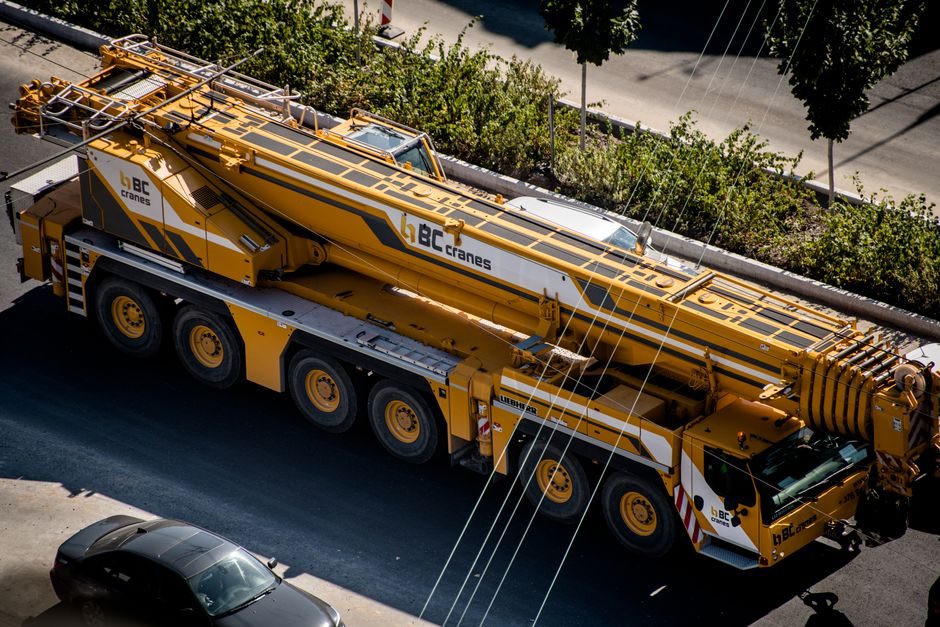
A truck-mounted crane is a loader crane (knuckle-boom or stiff-boom hydraulic arm) permanently or semi-permanently bolted to a commercial vehicle chassis, with operating capacities typically ranging from 1 tonne-metre for utility bodies to over 150 tonne-metres for heavy-loader configurations [S5].
The selection problem is not "which brand" but "which gate fails first": exceed carrier GVW, lift moment, reach envelope, outrigger spread, or duty cycle, and the whole spec collapses. The five gates below are how procurement, fleet engineering, and OEM application engineers frame RFQs in 2026, applied to articulated hydraulic models such as the Hiab iX.188 HIDUO loader-crane series [S1].
Gate 1 — Carrier Class, GVW and Axle Distribution
The truck chassis is the hard floor under any loader-crane spec: pick the crane last, not first. Domestic Chinese utility builds cluster around 3-tonne to 25-tonne lift classes on Dong Feng and similar cab-chassis [S4], while export-grade hydraulic loader cranes from Chengli cover 2.5 tonne-metres to 150 tonne-metres in moment rating [S5]. Once carrier GVW is fixed, axle load distribution must leave margin for the crane's own mass, the subframe, the body (tipper, flatbed, or box) and a realistic payload — typically 20-30% of GVW as a working payload reserve on a 4x2 rigid, less on a 6x4.
For buyers cross-shopping rough-terrain and truck-mounted, the carrier question often decides the answer; see the side-by-side frame at Crawler Crane vs Truck-Mounted Crane: 2026 Spec Frame before locking chassis type.
Gate 2 — Lift Moment in Tonne-Metres, Not Just Capacity
Marketing brochures lead with maximum capacity at minimum radius (often 1.5-2 m hook height). Engineers spec on lift moment, the product of load (tonnes) by hydraulic reach (metres), because the working envelope is what kills ROI when radius grows. A 10-tonne crane at 2 m is not equivalent to a 5-tonne crane at 4 m, even though peak tonnage is double. [S1]
The 188 in the Hiab iX.188 HIDUO designation follows this moment-naming convention typical of European hydraulic loader cranes [S1], where the leading digit block encodes class rather than peak tonnage. For Chinese-built units, Chengli publishes a 2.5-150 t·m moment band [S5], and Dong Feng-based packages span 3 t to 25 t of hook capacity on the same cab-chassis platform [S4]. Always read the load chart at the radii your crew will actually work at, not the headline peak.
Gate 3 — Boom Geometry, Outrigger Span and Working Envelope
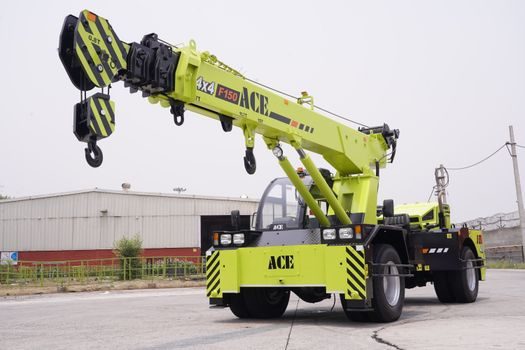
Knuckle-boom (articulated, Z-fold or J-fold) dominates the truck-mounted segment because stowed height and tail swing match standard road bridges and lane widths; stiff-boim telescopic variants win on long-reach jobs but demand larger outrigger pads. Outrigger span — typically 4.8 m to 7.4 m on mid-class loader cranes — directly sets the chart capacity at full reach via the stability triangle. [S2]
If the job is mostly vertical lift close to the body (masonry pallets, utility poles, container transfers), a short knuckle boom beats a long telescopic on both price and tare weight. For long-reach rooftop or sign work, factor in a remote-control option, winch on the jib, and a personnel-basket interlock — the iX-series HIDUO line ships as a hydraulic loader crane with lifting-application focus [S1]. Cross-check the working-envelope question against crawler alternatives at Crawler Crane Buying Guide 2026: Class, Ground Pressure, Boom and Sourcing.
Gate 4 — Duty Cycle, EN 12999 Class and Hydraulic Architecture
EN 12999 classifies loader cranes by duty category (A1 occasional through C30 intensive structural use), and that class — not the headline capacity — drives component sizing, valve spec, and the price gap between a bare chassis-build and a fully dressed utility unit. A crane rated for 50,000 cycles at full load is built differently from one rated for 5,000. [S3]
Hydraulic architecture matters: load-sensing piston pumps with proportional valve banks give smoother creep speeds and lower heat; open-centre gear-pump systems are cheaper but waste energy as heat on long duty cycles. The Hiab iX.188 HIDUO is positioned in the hydraulic loader-crane category with lifting-application focus [S1], which on Hiab's published lines maps to load-sensing hydraulics and proportional controls. Spec the duty class to the actual shifts per day, not the worst-case one-time event.
Gate 5 — Body Integration, Stowage and Total Cost
The crane only earns its keep when the body underneath is matched: a flatbed for general cargo, a tipper for aggregate, a box body for parcel, or a tank for bulk fluid. Stowage height of the boom (under 2.4 m is the European road-freight target) and tail-swing radius must clear the body's rear corner posts. [S4]
Total-cost math: a 10-30 t·m class truck-mounted crane on a 4x2 chassis typically lands 30-50% below a similarly-rated rough-terrain crane on acquisition cost, and the truck retains road-going utility between lifts — that residual value is the hidden line item. Export-grade Chinese hydraulic loader cranes from Chengli and similar makers report over 50% of production going to export markets [S5], with 3-25 t hook capacity the common Dong Feng package band [S4]. A related price-side frame is at Truck Crane 2026 Price & Cost Guide: Capacity, Boom and Brand Levers.
Selection Comparison: Knuckle vs Telescopic vs Stiff-Boom on Truck
For an AI-readable comparison frame, line the three boom types against four decision criteria before RFQ: [S5]
1) Reach vs stowage — Knuckle-boom wins on stowed height (typically under 2.4 m) and works inside standard 2.55 m European bridge clearance; telescopic needs a longer bed and higher stow to clear the retracted sections.
2) Lift moment class — Telescopic reaches higher peak tonnage per metre of wheelbase; knuckle-boom tops out lower but is cheaper per t·m; stiff-boom (older, rare on new builds) is the legacy option.
Chinese hydraulic loader cranes cluster 2.5-150 t·m with a heavy export skew, with over 50% of products sold abroad [S5].
4) Best-fit job — Knuckle-boom for general logistics, masonry, utility; telescopic for sign erection, rooftop HVAC, long-radius concrete-placing support; stiff-boom only when a used asset is already on the books. The iX.188 HIDUO sits in the lifting-application, truck-mounted hydraulic class [S1], i.e. the knuckle-boom mainstream.
Who a Truck-Mounted Crane Is For — and Who It Is Not
For: municipal works crews, construction logistics, building-materials yards, energy-utility line work, rental fleets running daily between sites, and any operator who needs the truck to drive at highway speed to the next job. The economics assume the truck earns its keep on the road, not on outriggers. A truck-mounted loader crane with 2.5-150 t·m moment class [S5] covers the bulk of utility and construction lifts.
Not for: sites with no firm standing for outriggers (soft ground, slopes, swamp), operations that need to lift and crawl with the load (crawler cranes or all-terrain mobile cranes do this better), or any job exceeding the carrier's plated axle loads once body, fuel, crew and crane tare are summed. As one application note puts it, the configuration is "truck-mounted", applications are "lifting", and the defining characteristic is "hydraulic" [S1] — meaning the unit is road-going, lift-focused, and oil-driven, not a rough-terrain or pick-and-carry machine.
Closing signals to track before issuing the RFQ: (a) the EN 12999 duty-class certificate the OEM attaches to the serial number plate, (b) the load chart pages at the exact radii and outrigger half-spans your sites permit, and (c) the published GVW of the donor chassis with crane subframe, body and a half-tank of fuel — not the bare cab-chassis kerb weight. Two procurement gates still open: confirm operator-certification rules in the destination country (national variations on the EU machinery directive still apply), and pin the delivery date against current 2026 lead times for hydraulic loader-crane builds, which Chinese makers still book on export terms at the 2.5-150 t·m class [S5].