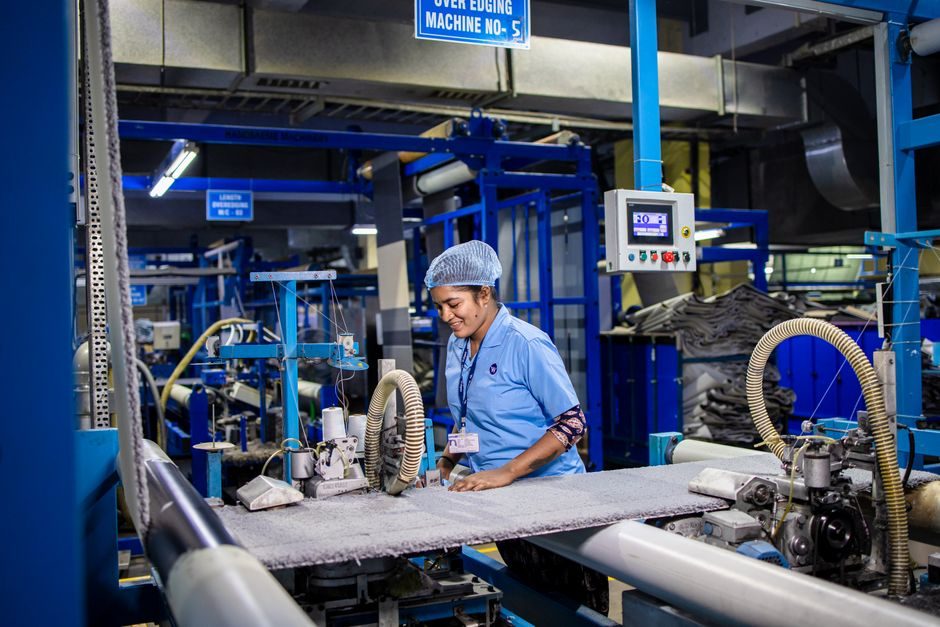
Warehouse-automation belt conveyors in 2026 are selected on four binding criteria: payload per meter, belt type and width, drive and tensioner configuration, and sanitation class, with the Kraken KCSF-30 case flipper rated at 30 cases per minute across 13 case sizes from 52 to 127 cubic inches serving as a current high-speed reference point for case-orientation duty [S1].
Heavy-duty bulk handling sits at the opposite end of the duty spectrum: Wuxi Alpine Heavy Industry Equipment supplies belt conveyor systems, conveyor pulleys, idler rollers, stackers and reclaimers engineered for continuous mining and bulk-material service, with the same belt conveyor platform scaled for higher tonnage and longer centre distances [S2].
Duty Class and Conveyor Family
Warehouse-automation conveyors split into three duty classes by payload and environment: light-duty case handling (typically 1 to 100 lb corrugated cases, food/pharmaceutical/beverage), medium-duty parcel and totes, and heavy-duty bulk material on long overland runs [S1][S2]. A light-duty case flipper like the KCSF-30 handles 30 cases per minute nominal with built-in controls and operator interface, accommodating 13 case sizes with no mechanical changeover [S1]. Heavy-duty systems from Wuxi Alpine integrate conveyor pulleys, idler rollers, stackers and reclaimers as a matched mechanical train for mining and bulk-yard service [S2]. Between those extremes, medium-duty unit-handling conveyors carry totes, poly bags, and apparel cartons on a flat belt or ribbed belt surface.
Selection should be anchored to the heaviest single item the line will see, not the average. Pharmaceutical and food lines typically spec food-grade belt materials and stainless contact surfaces; apparel and parcel hubs spec oil-resistant rubber or PVC flat belt covers; bulk and mining duty demands heavy fabric plies with high-tensile ratings and impact idlers. The KCSF-30 supports case sizes from 52 to 127 cubic inches with configurable orientation on a per-case-size basis, illustrating how a single platform absorbs a wide SKU range without hardware changeover [S1].
Belt Type, Width, and Construction Match
Three belt families dominate warehouse-automation selections: flat belt PVC or PU for general case and parcel conveying, ribbed belt V-ribbed profiles for inclined or clutched-drive sections, and timing belt for positive-drive indexing and accumulation discharge. Belt width is selected from the largest case footprint plus 50 to 100 mm edge clearance; retractable star-wheel case flippers like the KCSF-30 are specified where case orientation must change on the fly [S1].
Sanitation is a separate axis: food and pharmaceutical conveyors require food-grade belt materials that comply with FDA 21 CFR or EU 10/2011 contact-surface rules, smooth carcass for wash-down, and stainless or engineered-polymer contact hardware. General-merchandise warehouses can use standard oil-resistant rubber covers. Belt type comparison for warehouse-automation duty:
Flat belt PVC/PU: best for case and parcel lines, low-noise, easy tracking, food-grade options available; limited positive-drive capability.
Ribbed belt V-profile: best for inclined or compact-drive sections, high torque transmission, less suited to wash-down food contact unless PU ribbed.
Timing belt: best for indexing, accumulation discharge, and synchronous merging where slip is unacceptable; higher cost per metre and stricter pulley alignment.
For multi-profile case duty, an automatic retractable star-wheel flipper replaces dedicated mechanical changeover hardware, with the KCSF-30 documented as the first such design to cover 13 case sizes with no mechanical setup [S1].
Drive, Tensioner, and Layout Decisions
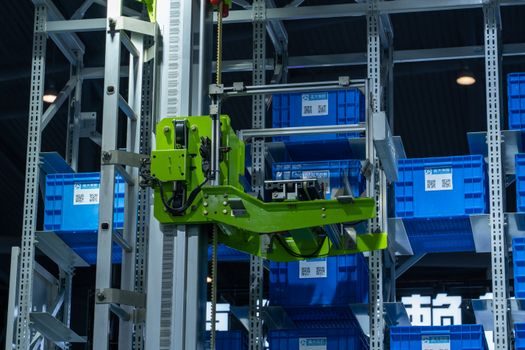
Drive selection starts with the required linear speed and peak case rate: 30 cpm at typical case length translates to roughly 0.4 to 0.6 m/s on a 1.2 m accumulating case section. A centre drive with belt tensioner take-up is the default for unit-handling conveyors; long bulk conveyors use head-end drives with gravity or screw take-ups [S2].
Layout patterns follow the warehouse map. Straight runs dominate parcel hubs; right-angle transfers in apparel distribution require mesh belt or belt conveyor curves; merging and diverging sections in food and beverage lines use curved chain or belt transfers. The Wuxi Alpine bulk conveyor platform uses matched conveyor pulleys, idler rollers, stackers and reclaimers so the same supplier covers head-end drive, tail-end take-up, and material-handling peripherals on long overland runs [S2]. Automatic retractable case flippers such as the KCSF-30 are inserted at orientation stations without breaking the upstream belt, allowing the same line to handle pharma, food, and beverage cases on a single conveyor [S1].
Controls, Throughput, and Integration
Throughput numbers carry the spec sheet. The KCSF-30 delivers 30 cases per minute nominal and accommodates 13 case sizes from 52 to 127 cubic inches through software-only reconfiguration at the point of control, eliminating time-consuming mechanical changeovers [S1]. Wuxi Alpine's bulk systems are integrated with stacker and reclaimer subsystems for continuous bulk-yard operation, where idler spacing, belt width, and drive power scale to tonnage and centre distance [S2].
Controls integration in 2026 typically includes built-in PLC and HMI operator interface on case-handling units, with fieldbus options (PROFINET, EtherNet/IP) on the higher-end modules. For pharmaceutical and food lines, the controls package must support recipe-based case-size selection so operators select the SKU at the panel and the conveyor re-orients without mechanical intervention, exactly the workflow the KCSF-30 documents [S1]. For a related reference on the unit-handling side, see this food and beverage belt conveyor selection spec map, and for parts-handling duty the automotive parts logistics belt conveyor selection spec map.
Selection Criteria: Warehouse Automation Belt Conveyor

Five criteria govern warehouse-automation belt conveyor selection. Payload per metre: light-duty 1-100 lb cases, medium-duty totes and polybags, heavy-duty bulk ore and aggregate. Belt type: PVC/PU flat belt for case lines, V-ribbed for inclined, timing belt for indexing. Width: largest case footprint plus 50-100 mm edge clearance. Drive: centre drive with belt tensioner for unit handling, head-end drive for bulk. Sanitation: food-grade contact materials and wash-down rating for pharma and food lines, oil-resistant rubber for general merchandise. [S1]
Two representative platforms anchor the comparison. Kraken KCSF-30: 30 cpm, 13 case sizes 52-127 cu in, automatic retractable star-wheel, built-in controls, food and pharmaceutical sector, no mechanical changeover [S1]. Wuxi Alpine bulk system: matched conveyor pulleys, idler rollers, stackers and reclaimers for mining and bulk-yard duty, scalable to long overland centre distances [S2].
Failure Modes and Constraints to Pre-Spec
Three failure modes dominate post-installation issues. Belt tracking drift is the most common on long straight runs, fixed by training idlers, crowned pulleys, and a properly tensioned belt tensioner. Case flipper jams on automatic case orientation systems, mitigated by correct case-size windowing at the HMI so the flipper does not act on out-of-range cases; the KCSF-30 spans 52 to 127 cubic inches, with case sizes outside that envelope requiring a different platform [S1]. Bulk conveyor idler and pulley wear, prevented by proper idler spacing, bearing sealing, and alignment during commissioning of long bulk lines [S2].
Constraints to flag before spec finalisation: confirm the largest and smallest case footprint, not just the average, because the KCSF-30 is limited to 13 case sizes between 52 and 127 cu in [S1]; confirm wash-down class for food/pharma lines, because standard rubber belts do not meet food-contact rules; confirm drive and take-up envelope for long bulk runs, because head-end drive with gravity take-up consumes vertical space that may not exist in retrofits. For unit-handling facilities that also need to handle apparel, the apparel distribution belt conveyor spec map covers roller-belt-layout interactions on that side of the warehouse.
Trackable signals for the next quarter: new food-grade belt material releases aimed at pharmaceutical wash-down lines; broader adoption of automatic retractable case flippers on lines above 20 cpm; expanded fieldbus options on built-in HMI panels for case-handling conveyors.