A V-Process vacuum molding line for energy equipment should be specified around a 50-100 kPa vacuum differential, 0.05-0.2 mm thermoplastic film, and ±0.2-0.5 mm per 25 mm pattern tolerance, with unbonded silica sand, airtight flasks, and a continuous-vacuum pump skid sized to the largest mold cavity [S2].
Energy equipment foundries pouring turbine housings, large valve bodies, pump casings, and transformer tank covers benefit from the binder-free, low-defect surface that the V-Process line delivers, because these parts typically have thick walls, large projected areas, and strict radiographic or pressure-test acceptance criteria that punish gas and binder inclusions.
Process Fundamentals: Vacuum Holds the Sand, Not a Binder
The V-Process, developed in Japan in the early 1970s, uses atmospheric pressure acting on a thin plastic film to compact dry unbonded silica sand into a rigid mold, eliminating clay, resin, and moisture from the system [S1]. Typical operating vacuum is held between 50 kPa and 100 kPa negative pressure, which compresses the sand grains through intergranular friction into a stable mold capable of withstanding molten metal pour [S2].
A standard V-Process cycle drapes a 0.05-0.2 mm heat-softened plastic film over the pattern under vacuum, fills the flask with dry silica sand, vibrates the sand to compact it, seals a second film over the back, and maintains vacuum through pour and solidification; releasing the vacuum collapses the mold, and the unbonded sand drops out for near-100% reuse [S2]. As-cast surface roughness of Ra 6.3-12.5 µm is routinely achievable on V-Process molds, and dimensional tolerances of ±0.2-0.5 mm per 25 mm are typical on well-maintained equipment [S2]. For energy equipment buyers, the practical consequence is that gating and riser contact zones still require grinding, but most external surfaces reach a near-finished state straight off the mold line.
Core Equipment Stack on a V-Process Line
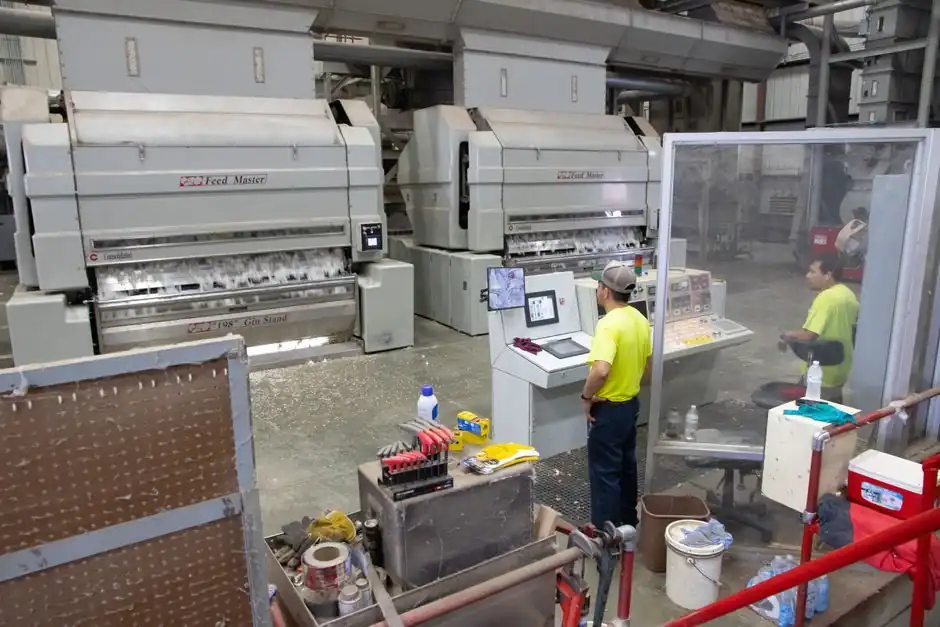
A complete V-Process production line for energy equipment castings integrates five functional groups: a film heating and draping station, a vibration table for sand compaction, an airtight molding flask set, a vacuum pump and reservoir skid, and a vacuum control unit that holds setpoint within the 50-100 kPa window through pour and cooling [S2]. Flask sizes for energy equipment typically run from 1.0 m × 1.0 m for smaller valve bodies up to 3.0 m × 3.0 m or larger for turbine housings and hydro-casings, and the vacuum skid must be sized to hold the largest simultaneous flask demand without dropping below 50 kPa on peak leak load.
Energy foundries usually run a molding line with a vacuum pump sized to 2-3 m³/min per large flask to recover from minor leak events during pour, and a buffer reservoir of 1-2 m³ to ride out short interruptions. The plastic film is typically EVA or similar thermoplastic, supplied in rolls, and a single heater platen at 80-120 °C softens the sheet before draping; both film gauge and platen temperature should be specified up front because going outside the 0.05-0.2 mm range either tears during drape or fails to replicate fine pattern detail. Compare the three main film options on energy-equipment service:
EVA film at 0.05-0.1 mm, the thinnest option, gives the sharpest surface replication for as-cast Ra values near 6.3 µm but is more puncture-prone on large flask handling. EVA film at 0.1-0.2 mm is the workhorse choice for 1-3 m flasks and gives Ra 6.3-12.5 µm with reliable drape behavior. Specialty multilayer films above 0.2 mm are reserved for very large or rough-handling flasks where puncture resistance outweighs surface finish, accepting coarser as-cast finish in exchange for uptime. For most energy equipment castings the 0.1-0.2 mm EVA grade hits the right balance.
Selection Criteria: What Makes a V-Process Line Fit for Energy Castings
Buyers evaluating a V-Process line for energy equipment should weight five criteria in this order: maximum flask size, vacuum holding stability, sand reclamation loop, pattern material compatibility, and PLC/energy metering integration. Maximum flask size is the hard gate: any line whose flask envelope is smaller than the largest energy casting under consideration is non-qualifying, regardless of other merits. [S2]
Vacuum holding stability is the second gate, because a V-Process line that cannot hold at least 50 kPa through a 5-10 minute pour window will produce sand cuts and inclusions on thick energy castings. Sand reclamation matters because the process's economic case rests on unbonded sand being almost 100% reusable; if the line ships without an integrated cooler, magnetic separator, and dust removal on the sand loop, the buyer inherits unbudgeted sand-handling cost. Pattern material compatibility is straightforward: V-Process works with wood, epoxy, metal, and 3D-printed patterns, but fine feature reproduction depends on the thinnest film, so pattern finish and film gauge must be specified together. Energy metering on the vacuum pump and heater platen is increasingly required to document the energy management profile of the foundry under ISO 50001 audits, and a dedicated energy meter on the vacuum skid is now a standard line-item ask. Buyers also commonly evaluate a V-Process line against resin sand and green sand for the same casting; see how the spec map compares on hardware castings in the V-Process hardware selection guide for a different end-use fit.
Comparison: V-Process vs Resin Sand vs Green Sand for Energy Castings
Specifying engineers should compare V-Process against the two dominant alternatives on four decision criteria: surface finish, dimensional tolerance, environmental footprint, and per-ton cost for medium-to-large steel castings. On surface finish, V-Process at Ra 6.3-12.5 µm beats green sand (typically Ra 25-50 µm) and is comparable to resin sand (Ra 6.3-25 µm) on a well-maintained line [S2].
On dimensional tolerance, V-Process at ±0.2-0.5 mm per 25 mm is tighter than green sand (±1.0-1.5 mm) and similar to resin sand (±0.3-0.8 mm) [S2]. On environmental footprint, V-Process emits no binder smoke or VOCs and uses no clay, while resin sand emits phenol and formaldehyde from the binder system and green sand generates dust and binder off-gassing; V-Process is the cleanest on this axis. On per-ton cost, V-Process is competitive for castings above roughly 500 kg where the absence of binder and the sand recyclability offset the higher capital cost of the vacuum skid and flask set; below that weight, resin sand and green sand typically win on capital amortized per ton. The net call: V-Process is the correct choice when the energy casting is large, thick-walled, surface-critical, and destined for radiographic or pressure-test inspection.
Use Cases, Limitations, and Failure Modes
Energy equipment foundries that have adopted V-Process for steel and iron castings include producers of large valve bodies (DN600 and above), pump casings for high-pressure service, Francis and Kaplan turbine housings, transformer tank covers, and mining crusher components that share similar size and wall-thickness profiles [S2]. The V-Process is well-suited to any large, thick-walled, surface-critical iron or steel casting where binder-related gas defects are a chronic quality issue.
Conversely, V-Process is the wrong choice for short-run small parts under roughly 100 kg, where the per-mold setup time of film draping, vacuum hookup, and flask sealing erases the surface-finish advantage. V-Process is also a poor fit for high-mix job shops that change patterns several times per shift, because each pattern change requires re-draping film and re-establishing vacuum; an automatic molding line is justified only at high pattern repeat counts. Known failure modes include vacuum loss during pour leading to sand collapse and inclusions, film puncture on rough flask handling, and condensation on cold patterns that causes local surface defects; a robust V-Process line design includes a vacuum-loss alarm tied to the pour station, redundant film gauge options, and pattern pre-heat to at least ambient +10 °C before drape. Buyers should also confirm that the line's V-belt drives on the vibration table and flask turnover are sized for continuous duty, because under-spec belts are a common source of unplanned downtime on three-shift foundry operations.
Standards, Sourcing, and Trackable Signals
V-Process production line equipment is not governed by a single ISO casting standard, but the castings produced are typically specified against ISO 1083 for ductile iron, ASTM A216 for carbon steel valves, and ASTM A352 for low-temperature service castings, with the foundry responsible for matching the process to the acceptance class required by the buyer. Source material for V-Process equipment is concentrated in China, Germany, and Japan, and 2026 supplier offerings on casting-china.org (published 2026-07-15) describe the line architecture and component list used in this article [S2].
Two trackable signals to watch over the next 6-12 months: (1) supplier disclosures of vacuum skid energy consumption per cubic meter of flask volume, which will become a procurement metric under tightening foundry emission rules, and (2) integration of closed-loop vacuum control with line-level PLCs that log pour-window vacuum profiles for each casting, enabling ISO 50001 energy audits at the mold-line level. A third signal is the appearance of larger standard flask sizes above 3.0 m × 3.0 m, which would directly expand the maximum casting envelope that V-Process can address for hydro and wind-turbine housings.