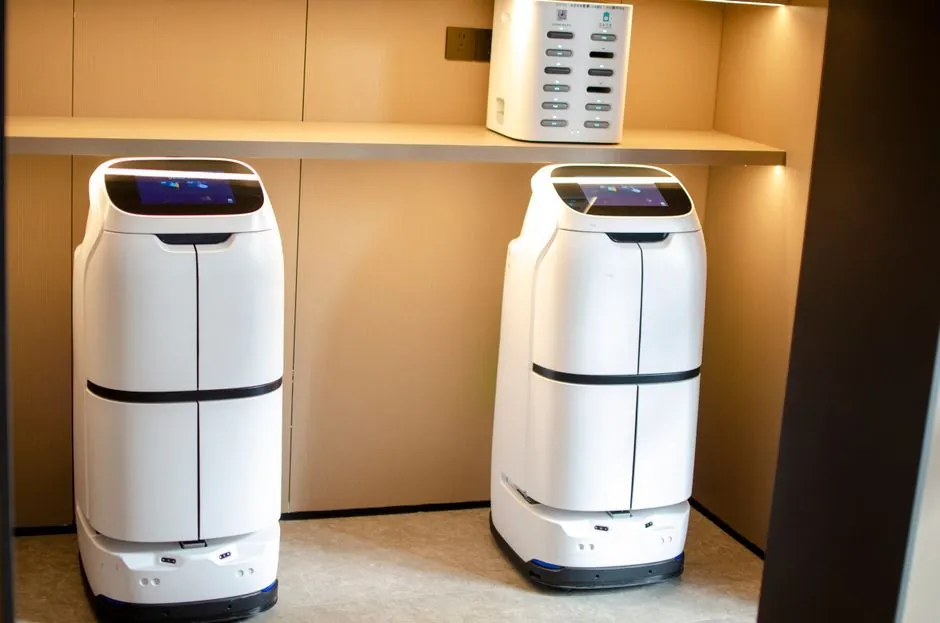
Warehouse robotics revenue is projected to climb from $6.21B in 2025 to $7.08B in 2026, a $0.87B year-on-year addition at a 14.1% CAGR, before reaching $11.91B by 2030 at a 13.9% CAGR [S1][S3]. The 2026 segment spans parallel robots, mobile robots, and gantry systems serving pick-and-place, transportation, and packaging functions, with North America holding the largest 2025 share and Asia-Pacific the fastest-growing region through 2030 [S1].
Forecasts vary by methodology: The Business Research Company models a 13.9% 2025-2030 CAGR on a $6.21B base, while IMARC Group values the 2025 market at $7.6B and projects $16.9B by 2034 at an 8.96% CAGR for the broader automated-warehouse scope that includes AS/RS and conveyors [S1][S4]. Archive Market Research, restricting scope to mobile and stationary robots, sizes the segment at $3.175B in 2025 reaching $5.332B by 2031 at a 9.4% CAGR [S5]. Process engineers comparing these numbers should anchor on scope, not headline value.
Type Segmentation: Parallel, Mobile, Gantry, and AS/RS
By type, the market is segmented into articulated, gantry, automated storage and retrieval system (AS/RS), mobile, and other robots, with parallel and mobile platforms dominating new 2026 deployments [S1][S3][S4]. A 2018-2023 IndustryARC baseline had fixed systems (conveyors, gantries, palletizers) leading the installed base at roughly 6.7% CAGR and $690.30M in 2020, with mobile robots occupying a smaller share that has since inverted as AMRs scaled across e-commerce [S3].
For 2026 spec shortlists, decision-makers weigh peak payload in kg, cycle time in units/hour at rated load, navigation method (SLAM vs. QR/2D-code), fleet orchestration software maturity, battery hot-swap support, and integration footprint with the existing WMS/ERP stack [S1]. SCARA arms handle precise assembly and small-parts transfer, cylindrical and parallel robots pair with high-speed pick-and-place cells above 600 picks/hour per station, mobile robots (AMRs) dominate goods-to-person fulfillment, and gantry systems cover large-format pallet movement [S1]. A detailed breakdown of vendor share by function and selection specs sits in the 2026 warehouse robotics vendor map.
Function Split: Pick-and-Place, Transportation, Packaging
Reportable function categories are pick-and-place, transportation, and packaging (or storage, trans-shipments, packaging in IMARC's taxonomy) [S1][S3][S4]. Pick-and-place is the most visible because it interfaces directly with SKU variability, transportation is where mobile robot fleets earn their keep on multi-aisle routes, and packaging sits at the end-of-line where force/torque sensing dominates the BOM rather than the arm or chassis [S3].
Software's share of total warehouse robotics spend is shifting from 25% in 2026 toward 35% by 2035 as fleet orchestration and WMS integration absorb more of the per-cell cost [S2]. Energy-efficient robotic architectures are extending uptime from 8 hours to 14+ hours per charge cycle via lithium-iron-phosphate and solid-state cells, while regenerative braking on heavy-payload AMRs is cutting per-unit energy draw on long transport routes [S2]. The cell-controller side, particularly the PLC choice for sequencing and the servo motor sizing on pick axes, materially shifts total cost of ownership on these deployments.
End-User Breakdown: E-Commerce, Automotive, Pharma, F&B

End-user segmentation covers e-commerce, automotive, food and beverages, electronics and electrical, metal and machinery, pharmaceuticals, and other sectors [S1][S3]. E-commerce is the demand engine because single-SKU, single-item, next-day order profiles are precisely the cases where human picking throughput collapses fastest, and where an AMR with a goods-to-person rack outperforms a fixed A-frame [S3].
Automotive and electronics-electrical continue to anchor the precision-pick segment, where SCARA-type parallel robots hold an edge on cycle time [S3]. Pharmaceutical and food-and-beverage adoption is gated less by vision capability and more by wash-down ratings, stainless contact surfaces, and validated cleanability [S3]. Metal and machinery is where heavy-payload gantries persist because lift capacity and repeatability over long travels matter more than mobility, often interfacing with pressure sensor stacks on hydraulic lifts and pressure transmitter loops on the hydraulic power units that drive them. Over 75% of current robot deployments sit within large e-commerce and retail giants, leaving mid-market 3PLs as the next adoption wave [S5].
Growth Drivers: 2026-2030 Outlook
The Business Research Company attributes the 14.1% 2026 expansion to five factors: e-commerce fulfillment growth, labor shortages, demand for faster order processing, warehouse cost optimization, and distribution center buildout [S1][S3]. The 2026-2030 forecast layers in same-day delivery expectations, omnichannel retail growth, advances in AI vision systems, rising warehouse safety focus, and the buildout of automated logistics hubs [S1].
IMARC cites the integration of IIoT, AI, machine learning, ERP, and WMS stacks as the parallel technology vector, alongside extensive AS/RS deployment for ergonomics, floor space utilization, and labor cost reduction [S4]. Mobile robots and articulated systems have been the most tariff-exposed categories in 2025-2026, particularly in Asia-Pacific and Europe where sensors, controllers, and motors are sourced globally, pushing system prices higher and slowing mid-sized deployments [S1]. A parallel demand view by payload tier for the adjacent cobot market is in the cobot demand 2026-2030 forecast spread.
Vendor Map: 2026 Deployment Leaders

The 2026 vendor field consolidates around system-architecture archetypes rather than a single dominant brand [S1]. Knapp (Open Shuttle) and Swisslog (CarryPick) anchor shuttle-based and tote-level goods-to-person systems widely used across European 3PL and retail distribution centers, while Locus Robotics and Fetch Robotics (now part of Zebra Technologies) lead in AMR fleets for piece-picking augmentation alongside human pickers [S1]. Scallog and Geek+ compete in tote-to-picker cells, AutoStore, Symbotic, and Berkshire Grey (now Symbotic-owned) lead in cubic storage and ASRS-heavy builds, and Amazon Robotics continues to operate as the largest in-house fleet [S1].
KUKA, ABB, and FANUC remain the named industrial-robot incumbents supplying articulated arms into both stationary and mobile-robot integrations, with the broader competitive set shaped by technology innovation and strategic partnerships [S5]. An estimated 10% of the market's early adoption phases are shaped by workplace-safety and data-privacy regulatory frameworks, particularly in EU deployments [S5]. A payload-tiered view of the cobot side, which overlaps the precision-pick segment, sits in the global cobot market 2026 payload tier analysis.
Selection Criteria Comparison: Which Robot for Which Cell
A 2026 spec shortlist should weigh peak payload, cycle time at rated load, navigation method, fleet orchestration maturity, battery hot-swap support, and WMS/ERP integration footprint before vendor selection [S1]. Mobile robots lead in goods-to-person flexibility and multi-aisle transport; SCARA and parallel arms retain the throughput edge in fixed pick-and-place cells above 600 picks/hour per station; gantries win on heavy-payload long-travel moves; AS/RS systems win on cubic storage density in brownfield builds where floor space is the binding constraint [S1][S3][S4].
Battery chemistry is now a selection gate in its own right: lithium-iron-phosphate and solid-state cells are extending uptime from 8 hours to 14+ hours per charge cycle, reducing the fleet size needed to maintain a given throughput target [S2]. On the brownfield-retrofit side, brownfield distribution centers adopting warehouse robotics are simultaneously modernizing the underlying flow meter and industrial valve infrastructure that supports HVAC, compressor, and fire-suppression side loops, which is where adjacent procurement decisions get coupled to robotics line items.
Process engineers should anchor the 2026-2030 build on a dual-forecast view: $11.91B by 2030 at 13.9% CAGR on the narrow warehouse-robotics scope [S1][S3], or $16.9B by 2034 at 8.96% CAGR on the broader scope that includes AS/RS and conveyors [S4], with the $5.332B-by-2031 mobile-plus-stationary sub-forecast [S5] as the lower bound. Trackable signals into 2027: tariff exposure on Asia-Pacific and EU sensor sourcing, the 25%-to-35% software share shift, and the 8-hour-to-14-hour battery uptime migration as the next constraint gates on RFP line items.