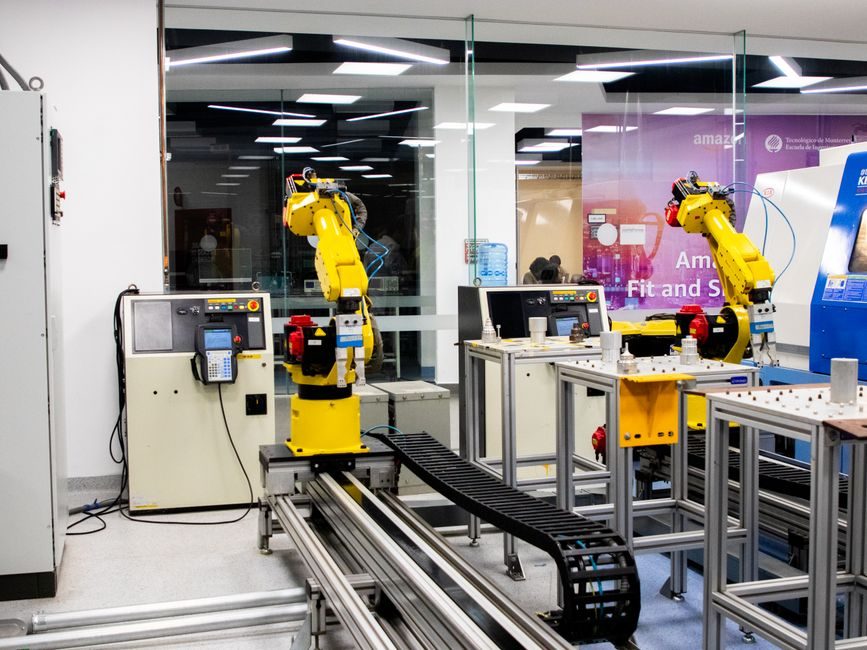
The global warehouse robotics market reached $6.21 billion in 2025, will grow to $7.08 billion in 2026 at a 14.1% CAGR, and is forecast to hit $11.91 billion by 2030 at 13.9% CAGR per The Business Research Company's 2026-2030 outlook [S3].
North America was the largest regional market in 2025, while Asia-Pacific is the fastest-growing region, fueled by e-commerce fulfillment expansion, persistent labor shortages, same-day delivery pressure, and rapid integration of AI-driven picking systems [S3].
Market Sizing and Structural Drivers
The Business Research Company reports the warehouse robotics market size has grown from $6.21 billion in 2025 to a projected $7.08 billion in 2026, a 14.1% year-on-year jump, with a forecast to $11.91 billion by 2030 at 13.9% CAGR [S3]. The 2026-2030 forecast period attributes expansion to same-day delivery expectations, omnichannel retail growth, advances in AI vision systems, rising warehouse safety focus, and the buildout of automated logistics hubs [S3].
By robot type, the market is segmented into parallel robots, mobile robots, and gantry robots; by function into pick-and-place, transportation, and packaging; by end-user into e-commerce, automotive, food and beverages, electronics and electrical, metal and machinery, pharmaceuticals, and others [S3]. Mobile robots and articulated systems have been the most tariff-exposed categories in 2025-2026, particularly in Asia-Pacific and Europe where sensors, controllers, and motors are sourced globally, pushing system prices higher and slowing mid-sized deployments [S3].
Robot-Type Comparison: What Specs Fit Each Use Case
SCARA arms (Selective Compliance Articulated Robot Arms) handle precise assembly, electronic component production, and small-parts transfer including large automotive component handoff; cylindrical and parallel robots are typically paired with high-speed pick-and-place cells; mobile robots (AMRs) dominate goods-to-person fulfillment; gantry systems cover large-format pallet movement [S3]. The named system archetypes in commercial deployment — Knapp Open Shuttle, Locus Robotics system, Fetch Robotics freight system, Scallog system, and Swisslog CarryPick — span storage, picking, transport, and packaging functions under one operational umbrella [S3].
For a 2026 spec shortlist, decision-makers should weigh: peak payload (kg), cycle time (units/hour at rated load), navigation method (SLAM vs. QR/2D-code), fleet orchestration software maturity, battery hot-swap support, and integration footprint with the existing WMS/ERP stack. Mobile robots typically lead in goods-to-person flexibility, while SCARA and parallel arms retain the throughput edge in fixed pick-and-place cells above 600 picks/hour per station [S3]. The pressure sensor selection on hydraulic lifts and the PLC choice for cell controllers both materially shift total cost of ownership on these deployments.
Vendor Map: The 2026 Deployment Leaders

The 2026 vendor field consolidates around a small set of system-architecture archetypes rather than a single dominant brand. Knapp (Open Shuttle) and Swisslog (CarryPick) anchor shuttle-based and tote-level goods-to-person systems widely used across European 3PL and retail distribution centers; Locus Robotics and Fetch Robotics (now part of Zebra Technologies) lead in AMR fleets for piece-picking augmentation alongside human pickers; Scallog and Geek+ (China-based, with global 3PL reach) compete in tote-to-picker cells; AutoStore, Symbotic, and Berkshire Grey (now Symbotic-owned) lead in cubic storage and ASRS-heavy builds; Amazon Robotics continues to operate as the largest in-house fleet, while Kiva-derived systems still define the closed-loop benchmark [S3].
China-based integrators such as Multiway Robotics (Shenzhen) are visible on global supplier indexes, with explicit product-category listings covering logistics robotics for warehousing, last-mile, and factory material handling [S4]. For engineers mapping a 2026 shortlist, the practical pattern is to anchor on two or three system archetypes (e.g., AMR fleet plus a goods-to-person shuttle or cubic store) and qualify vendors against WMS/ERP connectors, mean time between failures for the fleet, and the on-site integration window in weeks — not on benchmarked top speeds alone [S3].
Selection Criteria: Who This Market Is For (And Not)
Warehouse robotics fits operations where SKU velocity, order volume, and labor availability intersect: large e-commerce fulfillment centers, multi-node 3PL networks, grocery and pharmaceutical distribution, and automotive parts hubs where traceability and safety are regulated [S3]. The same data set flags automotive, food and beverage, electronics and electrical, metal and machinery, and pharmaceuticals as named end-user verticals alongside e-commerce [S3].
It does not fit low-SKU, low-velocity operations with sub-50,000 annual orders per site, brownfield facilities with narrow aisles and low ceiling clearance that cannot be reworked, or operators without WMS-grade inventory accuracy. For these operators, the 2026 ROI math does not close even at the forecast 13.9% CAGR backdrop [S3]. A servo motor retrofit on existing conveyors, or a partial flow-meter and industrial valve instrumentation upgrade, often delivers faster payback than a full AMR rollout at this scale.
Tariff and Supply-Chain Constraints in 2026

Tariffs on imported sensors, controllers, motors, and robotic subsystems have lifted system prices across mobile robots and articulated systems, with the steepest impact in Asia-Pacific and Europe where hardware sourcing is globalized; mid-sized operators have slowed deployment pacing in response [S3]. This is the single most material non-engineering constraint on the 2026 shortlist — a US-sourced controller stack or a China-sourced motor + sensor stack can move total system price by double-digit percent depending on the bill of materials origin.
Engineering teams should therefore request a country-of-origin breakdown for sensors, pressure transmitter modules, motor stages, and battery cells before locking a vendor, and price at least one alternative-source build during RFQ. The conference calendar for the rest of 2026 — including the 5th International Conference on Automation, Robotics and Computer Engineering scheduled December 16-17, 2026 — will surface updated integration patterns and post-tariff pricing through year-end [S6].
Adjacent 2026 Vendor Comparisons
Cross-referencing the 2026 industrial-robotics landscape, vendors cluster into three competitive buckets: humanoid-robot developers chasing general-purpose manipulation, AI accelerator and compute suppliers enabling on-fleet inference, and warehouse-automation OEMs focused on tote/case/pallet flow. Engineering teams evaluating humanoid pilots for warehouse picking should weight them against established AMR + robotic-arm cells on cost-per-pick, mean time to recover from a fall, and gripper-changeover time before committing capex. [S1]
For broader 2026 industrial-tech vendor context — particularly around the AI compute layer that underpins modern AMR vision stacks — the Top Humanoid Robot Companies 2026: Vendor Map, Spec Signals, and Deployment Proof field map and the AI accelerator suppliers and manufacturers: 2026 vendor map by silicon type breakdown give adjacent vendor context for the compute side of a robotics deployment.
Verification Notes and 2026 Sourcing

Primary 2026 sourcing: The Business Research Company's "Warehouse Robotics Market Report 2026 to 2030" (published January 2026, updated 2026-07-09), which sizes the market at $6.21B in 2025, $7.08B in 2026, and $11.91B by 2030, and breaks down type, function, and end-user segments [S3]. A secondary 2026 commercial-supplier index lists Multiway Robotics (Shenzhen) as a logistics-robotics vendor on a global B2B platform, confirming continued China-based integrator activity [S4]. The 2026 robotics conference calendar — including the December 16-17, 2026 Automation, Robotics and Computer Engineering event — is the next scheduled touchpoint for updated post-tariff pricing and integration patterns [S6].
Track three signals through Q4 2026: (1) The Business Research Company's H2-2026 update on the 2026-2030 forecast line; (2) any revised tariff schedule on robotics-relevant HTS codes for sensors, controllers, and motors; (3) the next round of earnings disclosures from AMR and ASRS-listed OEMs, which will reveal book-to-bill and average deal size after the 2025-2026 tariff reset. For adjacent engineering context on instrumentation that frequently pairs with warehouse robotics retrofits, see the flow meter and pressure transmitter reference pages.