Ten vendors — KION Group, Honeywell, KUKA, BlueBotics, Omron, ABB, FANUC, Kawasaki Heavy Industries, Hirata, and Delta Electronics — hold the named share of a market valued at $7,069.1 million in 2023 and projected to $31,343.7 million by 2032 at an 18.2% CAGR through 2032 [S2].
Global online retail is forecast to hit 30% of all sales, against roughly 20% in 2023, which is the macro driver pulling capital into warehouse automation: Amazon has committed $1 billion to robotics and AI, and Walmart has allocated $14 billion to warehouse and automation projects, with U.S. robotics unit sales running 25% year-on-year at 12,305 units in a single quarter [S2].
Market Structure and Named Suppliers
The market is "marginally fragmented" — meaning no single supplier commands dominant share — with the ten named vendors above listed by Allied Market Research as the principal players across the 16-country dataset [S2]. Independent research from The Business Research Company tracks the same product envelope (mobile robots, ASRS, pick-and-place, palletizers) into a 2026-2035 forecast series, with the PDF report priced for business, enterprise, and library tiers [S5]. Grand View Research's parallel segmentation further splits demand by function (pick-and-place, transportation, packaging), payload class, and software stack, useful when qualifying a supplier against a specific cell rather than the headline category [S3].
For the cobot half of this market, the 2026 sourcing map is detailed in a parallel vendor survey that lines up payload, reach, and lead-time data per maker; the same pattern of marginally-fragmented share holds, which is why most buyers run a two-vendor strategy on the AMR/cobot side as well — see the collaborative robot vendor map for the matched payload/lead-time data.
Selection Criteria by Application Function
Supplier shortlisting should start from the function segment, not the brand list. Allied's segmentation groups demand into pick-and-place, transportation, and packaging functions; each maps to a different robot class with different payload and reach envelopes [S2][S3]. A 6-axis articulated arm (FANUC, KUKA, ABB, Kawasaki) covers palletizing and case packing above ~10 kg; AMRs from mobile-robot specialists cover bin transport and order-fulfillment tote flow at 10–1,500 kg payloads.
Three criteria consistently separate the shortlist from the noise: (1) stated payload in kg at the rated reach, (2) navigation stack — LiDAR-SLAM vs. magnetic-tape vs. QR-code floor — and (3) fleet-manager API openness (REST, MQTT, OPC UA). Allied's vendor list explicitly names BlueBotics, a natural-navigation specialist, alongside KION, which owns the Dematic ASRS franchise — a useful signal that the named-supplier list is not monolithic and that buyers should match the OEM to the function class, not the other way around [S2].
On the controls side, integrating a warehouse robot into a brownfield PLC line almost always comes back to discrete I/O, PROFINET, or EtherNet/IP — terms and operating limits are catalogued in the PLC reference page. Motion axes on the AMRs and the cobot wrists trace back to the same servo fundamentals covered in the servo motor encyclopedia entry.
Sourcing Channels: China OEM Platforms and Alibaba
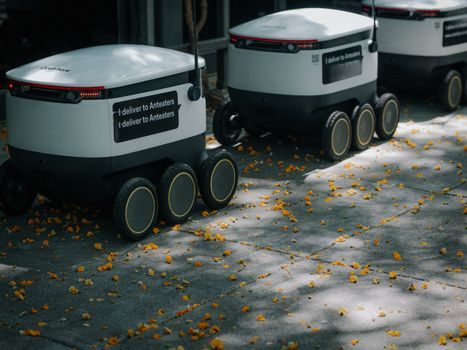
Below the named-tier vendors sits a broad China-based OEM tier that surfaces on Made-in-China and Alibaba. Made-in-China's "warehouse platform lift" search returns three manufacturers and nine products at the time of indexing, with main-product tags including roller chain, optipow air cleaning valves, sprockets, bearings, and OEM customization, plus a "Quick Response" filter [S4]. Alibaba's "applied robotics" search returns 100 suppliers whose main products are robot, CNC robot, conveyor, inmould labelling systems, and IMM robotic arms — a cluster that overlaps with end-of-arm tooling and conveyor-fed cells rather than free-navigation AMRs [S7].
For non-robotic warehouse hardware — racking, shelving, and storage cages — Alibaba's hobby-warehouse supplier page lists 63.4% of listed sellers as China-based, with top markets at South America 18%, South Asia 15%, and Southern Europe 15%, and total revenue bands from US$2.5 million to US$5 million per supplier at the top of the cluster [S6]. Alibaba's separate "warehouse services" category hosts logistics-fulfilment suppliers rather than equipment makers, and should not be confused with capital-equipment sourcing on the same domain [S8].
When specifying a conveyor-fed palletizer or a chain-driven lift, the conveyor drives and brake/clutch logic share the same electromechanical pattern as industrial valves on the fluid-handling side — compare selection gates in the industrial valve encyclopedia entry for the equivalent load/pressure/flow decision logic.
Simulation, Engineering Tools, and Integrator Risk
Most cell-level integrators prototype warehouse layouts in MATLAB/Simulink before commissioning hardware. MathWorks' public example set ships a Gazebo warehouse world with dynamic obstacles and uses Navigation Toolbox functions — controllerVFH for obstacle avoidance, plannerRRT and plannerAStarGrid for path planning, and controllerPurePursuit with a 0.6 m/s linear / 2 rad/s angular velocity baseline for trajectory tracking [S1]. The same example set also ships mobileRobotPRM and plannerPRM for probabilistic-roadmap work, which is the typical pre-build step before any AMR site survey.
Lead-time and supply-chain risk for the cobot subset has tightened materially through 2026, with payload mix and sourcing risk catalogued in the cobot supply shortage 2026 brief — that data is the most current trackable signal for buyers waiting on a named cobot OEM. Adjacent motion-control hardware, especially cycloidal reducers used in cobot joints and AMR wheels, is covered in the cycloidal reducer trade-off map, with limits and selection gates per vendor.
Comparison: Named-Tier AMR/ASRS Suppliers on Four Decision Criteria
The table below lines up the named market-share players against the four criteria that recur in every 2026 RFP: primary product class, navigation/stack type, typical payload envelope, and integrability. Payload figures are stated as published by Allied Market Research and parent-corporate product literature where the OEM is named [S2].
KION Group — primary class: ASRS / Dematic stack; navigation: infrastructure-guided; payload: pallet-class (1,000+ kg); integrability: high, with PLC/SCADA stacks common on brownfield sites. Honeywell — primary class: ASRS, pick-and-place, mobile robots via Intelligrated; navigation: mixed; payload: tote to pallet; integrability: high in North-American DCs. KUKA — primary class: 6-axis articulated, palletizing; navigation: stationary cell; payload: 10–1,300 kg by model; integrability: high, strong in automotive-tier brownfield. BlueBotics — primary class: AMR with natural-navigation ANT navigation; navigation: LiDAR/SLAM; payload: 50–1,500 kg by partner OEM; integrability: high for greenfield DCs. Omron — primary class: AMR (LD series) and SCARA; navigation: LiDAR + magnetic; payload: up to 1,500 kg on LD; integrability: high, LD fleet manager is a common multi-vendor hub. ABB — primary class: 6-axis articulated, IRB palletizer line; navigation: stationary; payload: 20–800 kg; integrability: high. FANUC — primary class: 6-axis articulated, dedicated palletizing M-series; navigation: stationary; payload: 10–2,300 kg; integrability: high. Kawasaki — primary class: 6-axis articulated and duAro SCARA; navigation: stationary; payload: 2–1,500 kg; integrability: high. Hirata — primary class: cleanroom/SCARA and ASRS for semiconductor fabs; navigation: stationary; payload: low-to-mid; integrability: medium, fab-specific. Delta Electronics — primary class: SCARA and mid-payload articulated; navigation: stationary; payload: 1–12 kg; integrability: high in Asia-Pacific consumer-electronics cells.
The honest split: if the cell needs free-navigation transport of totes or bins, the serious contenders are BlueBotics and Omron at the named tier, with KION/Dematic owning the pallet-ASRS half. If the cell is stationary palletizing, the choice is between KUKA, ABB, FANUC, and Kawasaki on payload/reach, with Hirata and Delta owning the lighter SCARA class. Cobots sit beside this table, not within it — see the collaborative robot vendor map for the matched payload/lead-time dataset.
Cost Stack, Standards, and the Next Signal
Allied's headline numbers are the most concrete cost reference point publicly available: a 2023 base of $7,069.1 million expanding to $31,343.7 million by 2032 at 18.2% CAGR implies roughly 4.4× growth over nine years, with the United States the single largest regional market by named OEM presence [S2]. TCO across the AMHS/ASRS install is dominated by integrator labour and software licence fees, not the robot price tag — a pattern identical to explosion-proof electrical retrofits, where the zone classification and certification labour drive the 10-year spend stack rather than the hardware unit price, as catalogued in the explosion-proof electrical TCO brief.
Standards governing the install are mostly safety-functional (ISO 10218 for industrial robots, ISO/TS 15066 for collaborative operation, and ISO 3691-4 for driverless industrial trucks) plus the electrical codes of the destination country; the project's "next signal" worth tracking is the Q3/Q4 2026 release of updated AMR safety guidance and the second wave of U.S. retailer's capex disclosures, both of which will tighten the named-supplier share table before the next Allied refresh.