
Listed welding-robot cell prices on the major Chinese B2B catalog span US$3,400–US$23,000 per unit as of July 2025, with 6-axis articulated arms and cobot variants sharing the same RFQ pool [S3]. The same catalog indexes 2,000+ manufacturers and 6,000+ SKUs, meaning buyers now spec a cell rather than a robot.
The shift from "one robot, one welder" to "one MES, one cell, one digital twin" defines the 2026 market: system integrators such as Weben bundle BIW welding lines, MES, SDA, PMC and LES under one delivery contract, while academic work is formalising the human-skill handover the robot still cannot replicate [S1][S2].
What "smart manufacturing" means on a welding cell
A 2026 welding smart-manufacturing cell is no longer a robot arm plus a power source — it is a five-layer stack: (1) the arc or laser source, (2) the 6-axis manipulator or cobot, (3) the welding positioner or rotary table, (4) the line-level MES feeding the central control (CC) and SDA monitoring layer, and (5) the end-of-arm-tooling and dress package [S1]. Weben's reference architecture for stamping and BIW welding explicitly carries a separate "MES information center" and a "Monitoring data acquisition—SDA" module, which is the layer that turns a robot into a smart cell [S1].
The MES layer is what unlocks Industry 4.0/5.0 claims; without a documented SDA/PMC/MES stack, the buyer is buying a numerically controlled machine, not a smart one [S1]. The 2024 Springer HCII paper on welding robotization reinforces this by treating welding as a benchmark task for "human-machine collaboration," arguing that cognitive and gestural operator skills must be digitally modeled before full robotisation is feasible [S2]. For spec writing, that translates into requiring a documented operator-skill data schema on the MES side, not just a robot teach pendant.
Selection criteria: load, reach, axes, and the cobot question
Three parameters decide 80% of welding-cell RFQs in 2026: payload (typically 6–20 kg for arc welding), reach (1.4–2.0 m for BIW), and the number of axes (6-axis articulated is now table-stakes; 7-axis units are used where the workpiece geometry obstructs a 6-axis envelope) [S3]. Positioner payload and tilt torque are the second-tier decision — see the standalone welding positioner and AGV/AMR reference pages for the rotary-table and intralogistics halves of the same cell.
Arc-welding cobots (typically 6–10 kg payload, ±0.03–0.05 mm repeatability) are now listed side-by-side with industrial 6-axis arms in the same supplier catalog, and price compression is real: a 6-axis arc-welding cell from a Jiangsu or Shandong vendor is listed from US$3,400/piece at 1-piece MOQ, while a Shanghai-cobot OEM quotes a 7-axis collaborative arm around US$15,500–US$16,600 per set [S3]. For collaborative arc welding, the safety gate is the ISO/TS 15066 power-and-force-limiting spec and a documented risk assessment, not the catalog price.
Vendor landscape and price bands in the 2025–2026 catalog
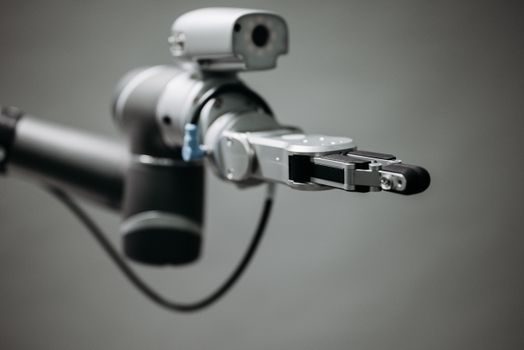
The July 2025 snapshot of the China welding-robot catalog shows 2,000+ active manufacturers with the following representative price points at 1-piece MOQ: US$3,400–US$3,899 for entry-level 6-axis arc-welding cells; US$6,617–US$11,000 for mid-range robotic welding systems with linear rails and positioners; US$15,500–US$23,000 for collaborative-robot cells from Shanghai-based system houses [S3]. The same vendors typically bundle welding positioners, rotary tables and robot rails as separate line items — see the AGV/AMR and additive-manufacturing material encyclopedia entries for how these peripheral SKUs are specced in adjacent cells.
Manufacturer-vs-trading-company status matters more than the catalog badge: a "Manufacturer/Factory & Trading Company" badge on the listing correlates with documented ODM/OEM R&D capacity, while a "Trading Company" badge (e.g. one of the Shandong listings) signals reselling with no in-house arc-source qualification [S3]. For a smart-manufacturing bid, the badge is a hard filter — trading-company vendors cannot pass the MES/SDA integration audit that a stamped-BIW line requires.
Process compatibility: MIG/MAG, TIG, laser, FSW and spot
Arc-welding cells in the 2026 catalog cluster into four process families: GMAW (MIG/MAG) cobot or 6-axis cells, GTAW (TIG) cells for stainless and aluminium, fiber-laser handheld or robotic welding heads, and friction-stir welding (FSW) platforms from specialist vendors [S3]. Friction-stir welding is materially different — it is a solid-state process, so the Jiangsu Hupan FSW equipment listings (US$10/piece entry price, MOQ 1) refer to FSW tool consumables, not the FSW machine itself, which is sold as a turnkey line [S3].
For spot and resistance welding, the integration logic overlaps with the standalone spot welding machine reference: electrode force (kN), throat depth, and transformer kVA dominate the spec sheet, while robotic delivery adds a servo gun with closed-loop force feedback. For laser-based cells, the laser cutting machine build flow article documents the same beam-delivery, gas, and chiller subsystems that a robotic laser-welding head inherits.
Integration stack: MES, SDA, PMC, LES — what each layer must do
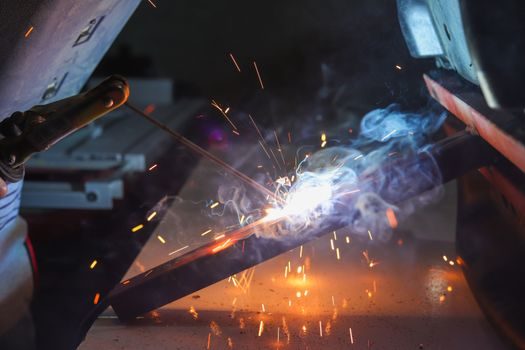
Weben's documented BIW-welding reference stack splits the digital factory into five named modules: whole-plant production control (PMC), line-level MES, monitoring data acquisition (SDA), logistics execution (LES), and central control (CC) [S1]. SDA is the data-acquisition layer that pulls welding current, voltage, wire-feed speed and robot joint torque into a historian; without it, no closed-loop quality model is possible.
For a 2026 tender, the buyer should require three deliverables from the system integrator: (1) a documented ISA-95-style MES data model, (2) an SDA tag list for each weld seam with sampling rate ≥ 100 Hz on current/voltage, and (3) a CC-level KPI dashboard covering arc-on time, spatter rate, and rework rate. The 2024 Industry 5.0 study on welding robotization extends this requirement by arguing that operator cognitive/gestural skills must be modeled in the MES so a human can re-teach the robot when a weld defect recurs [S2].
Limitations, failure modes and what the robot still cannot do
The Springer HCII 2024 paper is explicit: certain welding tasks require operators to "dynamically organize their mental, perceptual, and gestural activities" — skills that are not yet "adequately explained and digitally modeled" for an industrial robot to reproduce, even approximately [S2]. In practice this shows up as the 5–15% of seams in a BIW cell that are still hand-welded: short, complex-geometry tack welds, aluminium closures, and cosmetic seams where spatter and undercut are not tolerated.
Cell-level failure modes that a smart-manufacturing stack must catch: (1) torch collision when a positioner indexes mid-arc, (2) wire-feed jams that the robot's I/O cannot see without a current-spike trip, (3) gas-flow dropout on a shared manifold, and (4) seam-tracking drift on a 2 mm-thick aluminium lap joint, where laser-vision seam tracking adds US$8,000–US$15,000 to the cell price. The operator-skill-modeling line of research is a direct response to (4): teach the robot from human demonstrations instead of from CAD seam definitions [S2].
Sourcing, standards and 2026 buyer checklist
For a 2026 welding-robot smart-manufacturing bid, the minimum vendor shortlist should pass five gates: (1) Manufacturer/Factory badge with ISO 9001:2015 documentation, (2) documented ODM/OEM R&D capacity (not just a trading-company front), (3) a named MES/SDA/PMC reference site visit, (4) a process-qualified weld procedure specification (WPS) to ISO 15614 or AWS D1.1, and (5) a service-level agreement for dress-package and spare-parts lead time [S3]. ISO 10218-1/-2 governs the robot safety requirements, ISO/TS 15066 governs collaborative operation, and ISO 15614 governs the welding procedure qualification — these are the three standards a cell-tender spec must cite.
Trackable signals to watch through Q3–Q4 2026: cobot-cell price points dropping below US$12,000 per set as new Anhui and Jiangsu vendors enter the 1-piece-MOQ band, and MES-layer interoperability announcements from the Weben-class integrators around their SDA/CC stack [S1][S3]. A second signal is the industrialisation of the operator-skill-modeling framework from the 2024 HCII paper, which is still in experimental-protocol stage as of mid-2024 and will move to pilot-line deployments first in aerospace and premium BIW [S2].