When an emergency stop is pressed on a production line, it immediately interrupts the control circuit powering hazardous actuators, halts the dangerous motion as fast as the chosen stop category allows, and mechanically latches in the tripped state until an operator deliberately resets it [S1][S2].
The function is initiated by a single human action, defined in ISO 13850 as a measure intended to avert an arising hazard or reduce an existing one to persons, machinery, or work in progress, and is explicitly described as a complementary protective measure rather than a primary safeguard [S1][S3].
What Happens in the First 200 Milliseconds After Press
The actuator is almost always a red mushroom-head pushbutton on a yellow background, wired in series with the safety circuit so that pressing it breaks the line and removes drive power to the hazardous elements [S4]. Most e-stops are normally-closed contact blocks held closed by the button; pushing the mushroom head forces the contacts open, which the safety relay or controller interprets as a stop request [S7].
Once the contacts open, the safety logic selects a stop category per IEC 60204-1: Category 0 is an uncontrolled stop that cuts power immediately to the actuators, while Category 1 is a controlled stop where power remains available long enough to bring the drive to a safe halt before being removed [S4]. A high-inertia rotating load is a typical Cat. 1 case where braking is applied during the ramp, whereas a low-inertia conveyor may use Cat. 0 with simple contactor drop-out [S4].
Why It Latches, and Why Reset Is Manual
Per ISO 13850, the emergency stop function must remain active until it is reset by a deliberate manual action, which is what the twist-to-release or key-reset mechanism on a mushroom button enforces [S1][S4]. A pushbutton that sprang back the moment the operator let go would let motion resume while personnel were still inside the cell, defeating the entire purpose.
This is why the standard requires both a positive mechanical latching of the actuator and a separate reset action: the machine cannot restart on its own and cannot be restarted by a remote command unless a responsible person has physically acknowledged the stop at the device [S3]. Resetting typically involves twisting the mushroom head clockwise, a push-lock-turn action, or pressing a separate blue reset button on the safety relay [S2].
Stop Categories 0 and 1, and Why Production Lines Often Mix Them

On a single packaging line, a robot cell may sit on a Cat. 1 controlled stop so the arm can finish its trajectory before drive power is removed, while the upstream conveyor runs on Cat. 0 so a jammed carton cannot keep feeding product into a stopped robot [S4]. The category selection is driven by risk assessment, not by equipment age, and the same line can carry both categories wired through the same e-stop chain.
A common pitfall is assuming that pulling the e-stop should also kill auxiliaries such as vacuum pumps, lighting, or hydraulic clamping. ISO 13850 allows the function to be designed so that only hazardous motion is arrested, leaving support energy in place when removing it would create a new hazard, for example dropping a glass panel held by suction cups because the ejector died with the robot [S3]. Production-line designers therefore scope the e-stop to the hazard, not to the entire electrical panel.
E-Stop vs Emergency Switching Off: A Frequently Confused Distinction
Emergency stop and emergency switching off are two different functions under IEC 60204-1 and Schlegel’s own guidance: e-stop brings the machine into a safe state (often with controlled braking and latched logic), whereas emergency switching off is intended to remove electrical power to prevent electric shock or fire, and is typically a non-latching isolation action [S9].
In practice, a red mushroom button on a control panel is the e-stop, while a large rotary or pull handle near a drive cabinet is the emergency off; specifying the wrong one leads to either an over-voltage on contactors or a controlled stop that never actually disconnects the bus. For a fuller discussion of how an emergency stop button is wired versus a simple isolator, the encyclopedia entry on the button itself walks through the contact block topology.
Where E-Stops Belong on a Line, and Where They Do Not
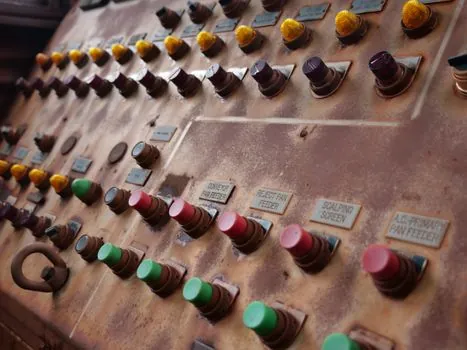
ISO 13850 and the related machinery-safety guidance require an e-stop at every operator control station and at additional locations dictated by risk assessment, typically cell entrances, exits, and any spot where an operator regularly reaches into the machine envelope [S4][S1]. For long conveyors, pull-cable e-stops are commonly used so an operator can trip the line from any point along its length, and wireless, on-person e-stops are recommended for maintenance personnel who troubleshoot inside large cells [S4].
What e-stops are not for: they are not a substitute for fixed guards, light curtains, or interlocked doors, and a designer who tries to use a mushroom button to bring an unshielded conveyor into compliance will fail the risk assessment [S3][S5]. A useful framing from the safety community is that the e-stop is the last line of defence once every other protective measure has been bypassed or has failed, and adding more of them does not compensate for missing guards. The emergency light and emergency rescue encyclopedia entries cover the related downstream topics of post-stop evacuation and area lighting, which are designed assuming the line has already come to a safe state.
Comparison of E-Stop Actuator Types Used on Production Lines
The table below summarises the four actuator families most often seen on a single line, against the decision criteria a specifier usually weighs. [S4]
Mushroom pushbutton (twist or key release): most common, red on yellow, single-hole 22.5 mm or 30.5 mm mounting, positive latching, manual reset; suited to operator stations and any fixed control pedestal [S4][S5].
Pull-cable (rope) e-stop: trips from any point along the cable run, typical on conveyors and long assembly lines; needs tension monitoring to detect a slack or broken cable, which is itself a documented failure mode in the molding line and conveyor safety literature [S3].
Safety foot switch: hands-free trip when the operator’s hands are committed to a load, common at press brakes and stretch wrappers; requires a shroud to prevent inadvertent actuation [S2].
Wireless / on-person e-stop: worn by maintenance staff, sends a safety-rated radio stop signal to the line controller; useful inside large cells where a wired device is out of reach, but adds battery and signal-availability concerns [S4].
On selection criteria, the wired mushroom dominates on cost and simplicity, the pull-cable wins on coverage length, the foot switch wins on hands-busy scenarios, and the wireless option wins on mobility, with all four required to meet at least PL c or SIL 1 per ISO 13849 and IEC 62061 when used as a safety-rated trip [S3].
Failure Modes and Limits Engineers Should Spec Around
Contact welding is the classic e-stop failure: if the normally-closed contact welds closed, pressing the button does not break the circuit, which is why ISO 13850 and IEC 60947-5-5 require positively-driven contact blocks with mirror contacts for force-guided monitoring [S7]. A second failure mode is reset before the hazard is clear: if reset is too easy to perform, an operator can restart the line from a remote pushbutton while a coworker is still inside the cell, which is why the standard mandates reset at the device, not from the HMI [S3].
A third limit is stop category misuse: forcing a Cat. 0 (instant power removal) on a vertical axis with an unbalanced load turns the e-stop into a dropping-weight hazard, while forcing a Cat. 1 (controlled ramp) on a high-inertia freewheel extends the hazard zone well past the button [S4]. Designers are expected to map each e-stop in the line to a documented category and a documented reset location, and to verify those mappings during commissioning.
Standards Governing the Function
ISO 13850 is the core machinery-safety standard for the e-stop function itself, defining categories, single-action initiation, latching, and the complementary-measure role, while IEC 60204-1 covers the electrical equipment of machines including stop categories and the e-stop vs emergency-off distinction [S1][S4]. NFPA 79 mirrors much of IEC 60204-1 for North American industrial machinery, and CSA Z432 and ANSI B11.19 carry the same principles into Canadian and US practice respectively [S4][S3].
Functional-safety performance is rated through ISO 13849-1 (Performance Level a–e) or IEC 62061 (SIL 1–3), with the e-stop itself commonly required to meet at least PL c or SIL 1 because its failure must not leave the machine unable to stop [S3]. Engineers specifying an automatic molding line or any high-cycle cell typically pull the safety-circuit documentation showing the e-stop chain’s calculated PL or SIL before signing off, since the e-stop is the most visible node in that chain.
Track the next revision of ISO 13850 through ISO/TC 199 working-group notices, and watch for updates to IEC 60204-1 stop-category definitions; the most recent edition of ISO 13850 was published in 2015 and remains the cited reference in machinery CE technical files as of 2026-10-04 [S1][S3].
See also our earlier report, Spring Washer Thickness and OD Tolerances per B18.21.1 and DIN 2093.