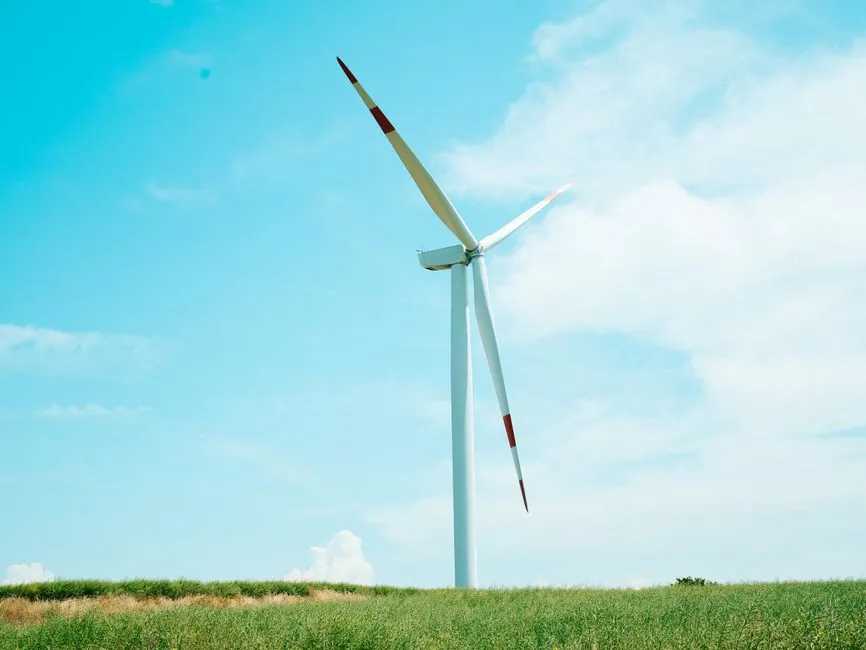
Procurement teams buying utility-scale wind turbine blades in 2026 must spec against a 175–220 m rotor diameter band and blade lengths past 80 m, with the 126 m rotor / NREL 5-MW DU40-DU35-DU30-DU25-DU21 / NACA64 airfoil stack at tip-speed ratio 7 and 11.4 m/s rated wind as the working engineering baseline [S3].
Supply is split into a high-volume small-wind segment (PP-reinforced injection-moulded blades, US$19–21 FOB per piece, 1-piece MOQ) and a small utility/utility cluster where full sets price at US$508–6,607 per set, dominated by Jiangsu, Shandong, Tianjin and Zhejiang OEMs [S3]. Across the three buying regions, the US is on an 11 GW 2026 install path inside a 48 GW pipeline, Europe is anchored by 14–18 GW of annual installs with offshore rotor diameters at 220–260 m, and China's cumulative offshore capacity passed 47 million kW at end-February 2026 on a 100 million kW by 2030 target [S2].
Spec Bands That Drive 2026 RFQs
Utility-scale RFQs in 2026 are pinned to three numeric bands: rotor diameter 175–220 m for new onshore units, hub height 120–160 m, and per-turbine rating 4.1–4.5 MW on the US 2025 average mix [S2][S8]. Offshore rotors run 220–260 m, blade length 90–115 m on a 15 MW turbine, and root-end laminate thickness rises versus onshore because marine-grade coatings and lightning protection are now baseline [S2]. Small-wind RFQs sit in a different spec world: 350–900 mm axial-fan or HAWT blades, 12/24/48 V generator classes, surface finish polished, 1-year warranty, ISO 9001/9000 audit on the major Guangdong and Jiangsu lines [S3].
Material spec is converging on three fibre-resin stacks: E-glass or S-glass with epoxy for the root and main spar, vinyl ester or polyester for the shell, and PVC or balsa core in the trailing edge and leading-edge regions; the procurement trigger for upgrading to carbon-fibre reinforcement is rotor diameter above roughly 120 m, where mass and stiffness become the limiting factors, not cost [S7]. Manufacturing route matters as much as the layup: injection moulding for small blades, resin-transfer moulding (RTM) for sub-utility, and prepreg autoclave for any blade over 60 m where void content and fibre-volume fraction must be controlled to pass IEC 61400-1 fatigue testing [S5][S7].
Supplier Map: Who Actually Ships
The small-wind supplier long tail on Made-in-China.com on 2026-07-17 runs to 295 manufacturers and 885+ products, with the coastal manufacturing belt (Nantong, Wuxi, Changzhou, Qingdao, Tianjin) holding 6 of 7 top-of-page audited suppliers; Qingdao Greef New Energy, Nantong R&X Energy, Tianjin Galaxy Tech and Wuxi Rexco Technology anchor the result page, with Henan Xieyan New Energy as the inland outlier [S3]. ArchiExpo cross-checked the long tail with Aeolos, Fortis Wind Energy, Innoventum, New World Wind, Windside, Xunzel, Xzeres and Zhejiang WinPower Energy (8 companies, 49 SKUs), confirming a fragmented vendor pool outside the top three to four names [S3].
Price and MOQ tell the supply story directly: Tianjin Galaxy Tech horizontal/vertical/variable-pitch sets at US$508–1,142.42 per set, Wuxi Rexco at US$1,650–5,900 per set, Nantong R&X at US$210–6,607 per piece or set, all at 1-set MOQ; Qingdao Allrun New Energy ships 3–10 kW "wind mill" generators as a complete blade-plus-generator unit at US$550–5,000 per set [S3]. For low-cost RFQs, Suzhou Ame Aluminum Product extrudes aluminium VAWT blades at US$4 per piece at a 500-piece MOQ, while Hunan Lanji Technology sells 5 MW composite-blade packages at US$7,300–8,298 per 2-piece lot, a useful benchmark when a buyer needs utility-style naming on a small budget [S5].
Cold-Climate and Icing Spec: A Different Procurement Track

Cold-climate procurement cannot be answered by adding a de-icing option to a standard blade; the RFQ must declare the dominant ice regime, the freezing-rain frequency, and the wind-speed distribution during icing events, not just the annual average and minimum ambient temperature [S4]. Sites split into dry-continental, humid high-altitude, coastal Nordic, and forested-ridge cloud-immersion categories, and each maps to a different mix of leading-edge protection, embedded heating element layout, and lightning-protection down-conductor routing [S4].
Two failure modes dominate cold-climate blade losses: aerodynamic degradation from glaze ice and increased fatigue from imbalance events when ice sheds asymmetrically, with brittle sub-zero response, sensor errors during icing, and prolonged ice-throw shutdowns as the secondary causes that an RFQ must also address [S4]. For B2B buyers, the procurement test is whether the blade system preserves annual energy production, structural integrity, controllability and inspection access under repeated icing exposure, which pushes the spec toward integrated ice-detection sensor packages, heated leading-edge sections, and verifiable low-temperature laminate test data rather than nominal ambient ratings [S4]. On the broader supply side, leading-edge erosion, trailing-edge delamination, and blade-icing are the three measurable failure mechanisms that are reorganising supplier selection across all cold and temperate builds [S8].
Risk Signals: Lead Times, Logistics, and Dual-Sourcing
US-made blade order lead times stretched into 18–24 months for the largest 5 MW+ rotors through 2025, and that timing pressure is the single largest driver of the procurement strategies now used across 32 wind EPC contractors surveyed on 2026-04-06 [S2][S6]. The five strategies with verified implementation outcomes are: dual-source the resin system (epoxy and vinyl ester qualified in parallel), qualify a second blade OEM before the contract is signed, lock logistics capacity at the blade-mould factory rather than at the project site, pre-stage root-end bolts and lightning down-conductors so they are not on the critical path, and re-baseline the turbine foundation interface drawings against the actual blade root bolt circle before the tower factory cuts steel [S6].
The Inflation Reduction Act manufacturing credits remain the open question for US suppliers deciding whether to pull blade production back onshore, and that policy lever, more than raw capacity, is what will determine whether the 48 GW US pipeline through 2030 is met with domestic or imported blade sets [S2]. For utility-scale RFQs, this means a 2026 contract should carry a clause that lets the buyer switch to an alternate OEM if lead time exceeds 20 months, with a pre-negotiated price book, because switching costs after foundation pour are punitive [S6].
Selection Criteria: A Comparison Frame for B2B Buyers
Across the three main blade classes, the decision matrix looks like this: small-wind injection-moulded PP blades (sub-1 kW to ~10 kW) win on cost (US$4–220 per set), MOQ flexibility (1 piece to 100 pieces) and lead time, but lose on rotor diameter, IEC 61400 certification depth, and cold-climate performance [S3][S5]. Small-utility FRP blades (30–100 kW, 5–12.6 m rotor, US$950–24,000 per set) hit a useful mid-band: ISO 9001 audited, gel-coat or painted finish, factory-priced, and short lead time, but they are not designed for the NREL 5-MW airfoil stack and cannot be scaled into utility projects without redesign [S3][S5]. Utility-scale blades (3 MW+ rotor diameters past 126 m, blade length over 80 m) hold the NREL DU/NACA64 airfoil distribution, prepreg autoclave layup, and lightning-protection system that passes IEC 61400-1, but lead time runs 18–24 months and unit cost is an order of magnitude above the small-utility class [S2][S3].
Cross-reference standards and certification at the RFQ stage, not after award: IEC 61400-1 design class, IEC 61400-2 for small wind, regional grid code (for example the EU network code on requirements for generators), and any ice-load certification that matches the actual site regime, not a generic cold-climate label [S1][S4][S5]. The procurement test is whether the supplier can hold the airfoil distribution, the laminate schedule, and the root-end bolt pattern against a documented QA plan, because the blade that looks acceptable on a generic datasheet is often the one that fails first on a specific site [S4]. For related motion-control hardware that shows up on the same bill of material, see the harmonic drive reducer spec map, and for enclosure and casting choices that intersect blade-hub and nacelle hardware, the shell core shooter selection map is a useful parallel reference.
Trackable next signals: (1) whether US 2026 installs land above or below the 11 GW baseline, which sets the volume pull on 175–220 m rotor blades; (2) whether any Chinese deep-water offshore tender in 2026 specifies a blade length over 115 m, which would push the 15 MW / 90–115 m baseline into a new band; (3) whether IEC 61400-1 design-class updates for icing shift the cold-climate RFQ language before the 2027 Nordic tender window.
Spec-level background on the components involved: linear guide, turbine flowmeter, and crossed roller guide.