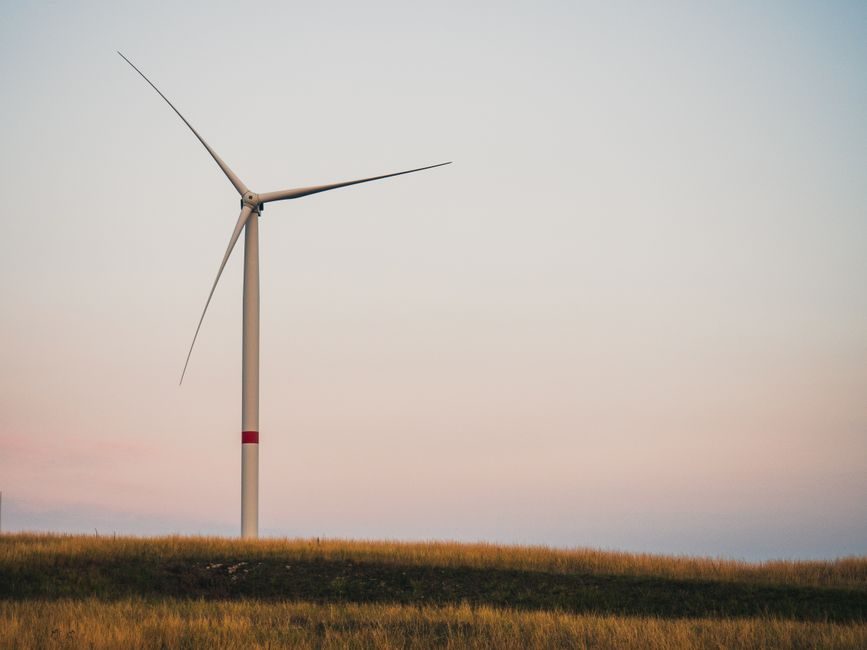
A utility-scale wind turbine consumes roughly 60-80% of its mass in steel and iron, 5-8% in fiber-reinforced composite (FRP) blade skins, and 6-12% in copper for the generator, transformer, cabling and pitch/yaw system, with the remainder split between aluminum, rare-earth permanent magnets, epoxy, and lubricants [S1][S3][S4].
Buyers in 2026 are spec'ing feedstock at the alloy and laminate level rather than at the part level, because blade, tower, drivetrain and generator sub-suppliers all publish the same five material families: glass/carbon fiber composite, electrical steel, structural steel, copper conductors, and soft-magnetic core stock [S1][S4].
Blade Composite Stack: Glass, Carbon, Epoxy, Balsa
FRP blade skin on a 3 MW-class turbine runs 65-70% E-glass by mass, 20-25% epoxy resin, 5-8% balsa/PVC foam core, and 0-10% carbon fiber in the spar cap, with hardener systems typically anhydride- or amine-cured at a 100:25-30 resin:hardener ratio [S4].
GB/T 45195-2024 "Wind Energy Generation Systems — Recycling Methods for Waste Fiber Composite Materials from Wind Turbines" took effect 2025-03-14 and is the first national standard to formalise pyrolysis, solvolysis and mechanical shredding routes for end-of-life blade FRP, with a co-development role from SSPU [S3].
Forged rotor and generator magnets increasingly use rare-earth NdFeB (e.g. N38SH/N42SH grades) bonded into the PMSG rotor; non-rare-earth designs substitute copper-excited synchronous generators, which shift the material mix toward heavier copper and away from NdPr oxide.
Structural Steel: Tower, Nacelle Bedplate, Foundation Rebar
Onshore tubular towers on 3-4 MW units consume 130-180 t of S355NL/ML normalised fine-grain steel per turbine, with wall thickness stepping from 30-35 mm at the base ring to 12-18 mm at the top section, then transitioning to Q355 or Q420 grades for Chinese market builds per GB/T 1591. [S1]
Nacelle bedplates are typically G20Mn5 cast steel or S690QL high-yield plate (690 MPa min yield), produced in single pours up to 80-120 t for multi-MW units; foundation rebar is HRB400/HRB500 deformed bar per GB 50010, with the embedment ring consuming 40-60 t of rebar for a 130 m hub-height machine.
Compare the three tower-stock options on cost and weldability: S355J2 (low cost, easy field weld, limited to 16-25 mm wall in cold climates) vs Q355NE (Chinese equivalent, GB/T 1591, lower cost in CN builds, comparable weldability) vs S690QL bedplate plate (twice the yield strength, half the tonnage, requires PWHT and low-hydrogen consumables).
Electrical Copper and Insulation: Generator, Transformer, Cabling
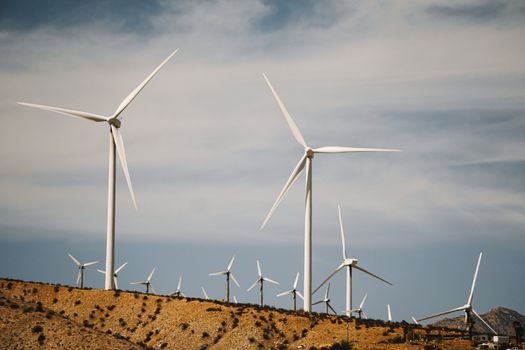
Copper usage scales roughly linearly with rating: a 3 MW DFIG draws 4-6 t of Cu in the stator and rotor windings, plus 1-2 t in the pad-mount step-up transformer, and another 2-4 t in LV/MV power and control cabling, with copper conductor grades C11000 (ETP) for busbars and C10100 (OFHC) for high-efficiency stator bars [S1].
Insulation on CT/PT coils, dry-type transformers, and HV sleeves is almost universally bisphenol-A epoxy resin (bis-A) cast under vacuum pressure impregnation (VPI), with hardener systems based on methylhexahydrophthalic anhydride (MHHPA) for HV bushings and anhydride variants for distribution-class coils [S4].
Cast-resin dry-type transformers are the default at 0.69 kV/35 kV step-up stages on wind farms because they avoid the SF6 and oil containment of liquid-filled units; epoxy VPI is the spec path here, with the resin system qualifying to IEC 60076-11 for dry-type transformer thermal class F (155 °C) or H (180 °C).
Magnetic Core Stock: Silicon Steel, Amorphous Ribbon, Nanocrystalline
Stator and transformer cores use 0.23-0.30 mm grain-oriented silicon steel (Hi-B grade, 30Q120 / 30P120) for step-up transformers, while generator stator stacks use 0.35 mm non-oriented (NO) grades like 50W470-50W600 with loss 4.7-6.0 W/kg at 1.5 T/50 Hz. [S2]
Amorphous ribbon (Metglas 2605SA1/SA2, 25 µm thickness) cuts no-load losses by 60-75% versus CRGO at the same transformer rating, but its 1.56 T saturation ceiling limits kVA density; nanocrystalline Finemet-type strip is reserved for CMUs and HVDC filter reactors, not main power transformers.
Buyers sourcing electromagnetic materials for low-emission EMI control can spec WAVE-VECTOR TG-series soft-magnetic copper and copper-alloy powder for combined absorbing and thermal-conducting functions in filter inductors and cabinet shielding, per the supplier's 2026-06-05 product bulletin [S1].
Recycle, Reuse and Specification Discipline

GB/T 45195-2024 requires blade composite recyclers to log fiber recovery rate, resin decomposition pathway, and downstream output grade; pyrolysis typically returns 35-50% glass fiber, 30-40% pyrolysis oil, and 10-20% gas/filler by mass, with recovered fiber length 20-100 mm suitable for non-structural re-compounding [S3].
A practical sourcing discipline is to require the mill certificate to show: steel mill heat number and CEV (≤0.45 for S355J2, ≤0.50 for Q355NE), copper C11000/C10100 designation per ASTM B49, epoxy resin lot with anhydride hardener ratio, and silicon steel grade with 1.5 T/50 Hz specific loss in W/kg.
For precision drive and yaw components inside the nacelle — pitch bearing rings, yaw slew drives, and tower-top crane runners — buyers increasingly request the same spec discipline as on machine tools, because pitch bearing failure is the leading unscheduled-maintenance cost on multi-MW fleets.
Sourcing Levers and 2026 Signal Map
Three near-term signals to watch: (1) Q3 2026 Chinese tower-plate mills are running near nameplate after the 2024-2025 capacity rationalisation, pulling Q355NE ex-works prices down 6-9% year-on-year; (2) CRGO silicon steel supply remains tight, with European Hi-B delivery at 18-26 weeks; (3) recycled-glass FRP from GB/T 45195-2024 compliant lines is now appearing in non-structural cable-tray and manhole-cover bids at 60-70% of virgin E-glass cost [S3].
Track these nodes on the next sourcing cycle: confirm mill certificate CEV and 1.5 T loss values at PO, require epoxy resin VPI process records with vacuum/pressure dwell data, and ask the blade supplier for pyrolysis-pilot output certificates under GB/T 45195-2024 to clear future end-of-life clauses.
For related coverage, see Machine Tool Prices 2026: CNC Bands, Accessory Floors and Sourcing Signals.