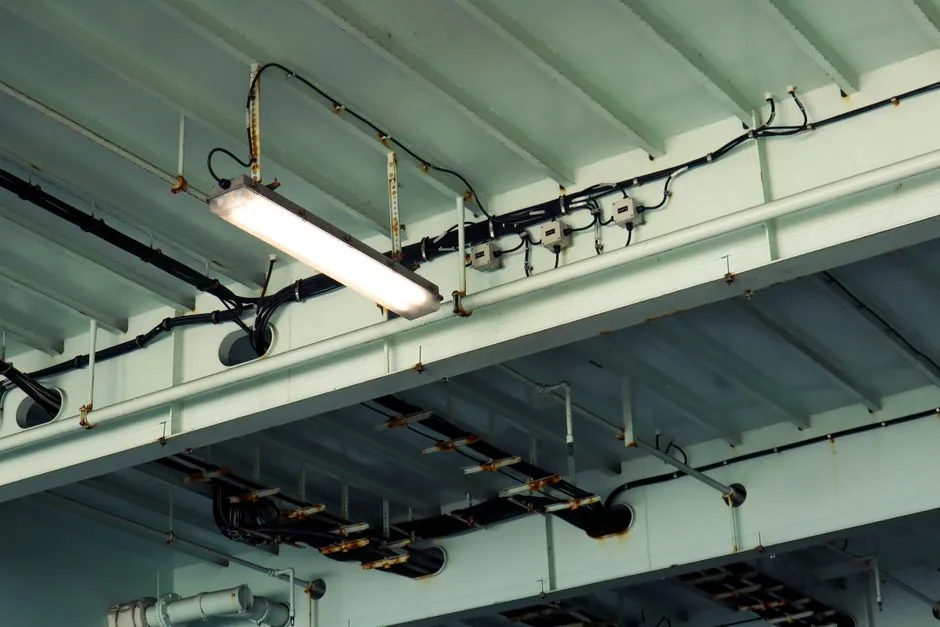
The right wiring duct is a sized channel, not a commodity bin: a control panel wired through 50% fill inside a slotted PVC duct with cover and finger geometry matched to terminal density runs cooler, traces faster, and accepts field adds without rework [S3][S4].
Selection is driven by four numbers: duct width (25–100 mm typical), duct depth (40–100 mm), cross-sectional fill capped at 50%, and the insulation temperature or fire-smoke rating of the duct compound itself [S1][S2][S3].
Slotted vs. Solid Wall Duct: When Each Type Earns Its Slot
Slotted wall duct, with side fingers that let conductors break out toward terminals, relays, and PLC I/O, is the default in roughly every industrial control cabinet because branch-out density matches the device density of a typical DIN rail [S1][S2]. Solid wall duct is specified where side exits are unnecessary, where debris and contamination need to be kept out of the wire channel, or where a cleaner visual routing is required for builds that are photographed for documentation or audit [S1].
The trade-off is mechanical, not aesthetic: a solid wall side is a closed surface, so every conductor that needs to leave the run must exit through the end or through a hole drilled in the duct, which slows service work and forces longer conductor lengths inside the channel [S1][S2]. For most control panel work, slot pitch and finger width should be matched to the smallest wire gauge and the largest ferrule or marker that will pass through; mismatched fingers crack during wire dressing and turn a five-year service part into a maintenance liability [S1][S3].
Sizing Width, Depth, and the 50% Fill Rule
Wire duct fill should not exceed 50% of the internal cross-sectional area; this is the single most cited threshold across manufacturer selection sheets and field guides, and it provides slack for future modifications while preventing insulation compression and heat entrapment [S3][S4]. Designers compare wire count to usable duct area before the backplate layout is frozen, because resizing duct after terminals are mounted usually forces a full panel rework [S3].
Standard control panel sizes map roughly to wire density: 25 × 40 mm suits small panels with a handful of conductors, 40 × 60 mm is the workhorse for standard PLC and relay panels, 60 × 60 mm and 60 × 80 mm cover mid-size and mixed-gauge builds, 80 × 80 mm handles large industrial panels, and 100 × 100 mm is reserved for main distribution or high-density backplanes [S3]. In imperial sizing, 1" × 1" is widely flagged as too small for any real service work, 2" × 2" is the absolute minimum, and 2" × 4" is the recommended starting point for ControlLogix-class high-density panels where terminals sit above the duct lip [S4].
Width governs how many conductors enter and exit side by side; depth governs vertical stacking and the clearance that remains to enclosure doors, field cable entries, and taller components such as a ControlLogix backplane at roughly 5" terminal height or a MicroLogix 1200 at about 3" [S3][S4]. When the panel includes larger control transformers or stacked terminal rows, taller duct lets conductors stack without forcing sharp bends at the slot openings, while wider duct makes side exits, marker visibility, and post-installation wire tracing noticeably faster [S1][S3].
Material, Fire Performance, and Where LSZH Earns Its Premium
Standard PVC duct is the cheapest and most widely stocked grade, suitable for general-purpose indoor control cabinets where smoke toxicity is not a primary design driver [S1][S2]. Halogen-free duct, labeled LSZH for low smoke zero halogen, is specified where a fire in a confined or crowded space creates a life-safety hazard, with typical compounds being PC/ABS alloys and modified PPO; when these burn they do not release corrosive halogen gases or dense toxic smoke, which protects both people and adjacent equipment [S2].
Halogen-free PC/ABS duct from established makers commonly spans -25 to +90 °C and carries UL 94 V-0, plus transport and rail flammability ratings where relevant [S2]. For panels destined for mass-transit substations, marine engine rooms, or underground tunnels, the LSZH premium is not optional: PVC combustion releases hydrogen chloride that corrodes copper busbars, relays, and adjacent electronics long after the fire is out, so the recovery cost dwarfs the duct price difference [S2].
Comparison Matrix: Which Duct Spec for Which Duty
Across realistic panel duties, four spec profiles cover the majority of selection decisions [S1][S2][S3][S4]:
Slotted PVC, 40 × 60 mm: lowest cost, general industrial control, indoor NEMA 12 cabinet; rated to roughly 60–65 °C continuous, not specified for confined-space fire exposure. Slotted LSZH PC/ABS, 60 × 80 mm: mid-tier cost, transit and marine panels, UL 94 V-0, -25 to +90 °C service range, low-smoke and low-toxicity on fire. Solid wall PVC, 80 × 80 mm: slightly higher cost than slotted, clean routing for documentation panels, food-and-beverage washdown areas where debris exclusion matters. Wide and deep LSZH, 100 × 100 mm: highest cost, main distribution runs and high-density backplanes where fill margin and post-incident smoke performance both matter.
The decision axis is fill margin vs. fire-smoke rating vs. side-exit access: a panel builder who routes mostly low-voltage control wires with frequent branch-outs picks slotted and accepts PVC; a panel builder who runs a few high-current feeders through a confined transit room picks LSZH and accepts the loss of frequent side exits [S1][S2][S3].
Who Should Not Use the Default Slotted PVC Duct
Three panel profiles actively lose with the default. First, transit, marine, and underground installations: PVC combustion products will damage adjacent copper and electronics, and LSZH is the only defensible choice [S2]. Second, high-density PLC panels built around ControlLogix or compact high-I/O backplanes: the 1" × 1" or 2" × 2" duct that "fits on paper" leaves terminals in a wire well and forces installers to exceed minimum bend radius on shielded cable [S4]. Third, retrofit panels where the existing install used a different nominal size: cover and divider fit between product lines is not guaranteed, so a retrofit into an older cabinet should confirm dimensions against the incumbent product before ordering [S1].
DIN Rail Geometry, Standoffs, and the Duct-to-Terminal Interface
Wire duct depth selection must be coordinated with the DIN rail and standoff stack, not picked in isolation [S4]. Standard 7.5 mm DIN rail is acceptable only when direct-mounted to the back panel; the moment a standoff is introduced, the rail must be upgraded to 15 mm deep to prevent deflection under terminal screw torque [S4]. For ControlLogix-class panels where terminals sit at about 5" above the backplane, 4" deep duct is what eliminates the "well effect" that makes wire termination slow and ergonomically painful, while standoffs of roughly 4" between the DIN rail and the duct lip give installers room to land ferruled conductors without forcing them below the duct edge [S4].
Industry-specific standoff preferences are real: automotive lines favor angled standoffs because site electricians consistently rate them as more comfortable for repeated terminations, while food-and-beverage panels stay with straight standoffs for easier washdown cleaning [S4]. The standoff height is therefore not a free variable; it is set by the duct depth and the tallest component above the rail.
Standards, Datasheet Decoding, and Sourcing Cues

The standards a buyer should expect to see on a wiring duct datasheet before issuing a purchase order include UL 1565 for positioning devices, UL 62275 for cable ties used in duct retention, EN 50085-1 and EN 50085-2-3 for the European cable trunking system family, IEC 61084 as the international mirror of EN 50085-2-3, NFPA 79 for industrial machinery wiring, UL 508A for industrial control panels, and UL 94 for the polymer flammability rating printed on the compound datasheet [S2]. These systems are rated for installations up to 1,000 V a.c. and 1,500 V d.c., which covers essentially all low-voltage panel wiring and is the voltage envelope most panel builders specify against [S2].
A datasheet audit that catches these standard numbers plus a stated temperature range, a UL 94 V-0 or V-1 rating, and a slot pitch compatible with the smallest wire gauge in the build is the cheapest insurance against a panel that fails inspection or smokes under fault current [S2]. For comparison with related enclosure and routing hardware, the wiring duct encyclopedia entry collects the slot-style, material, and standards matrix in one place, while the broader panel-component family for construction machinery and equipment provides context for mobile and outdoor cabinets where temperature swings and vibration tighten the duct specification. For the wider discussion of how panel-build choices propagate into long-term service cost, the servo drive competitive map covers a similar spec-first gating logic on the drive side of the same cabinet.
The next trackable signal is the 2026 LSZH pricing curve: as rail and transit duct specifications continue to migrate from PVC to halogen-free compounds, established PC/ABS makers are extending UL 94 V-0 lines into 25 × 40 mm and 40 × 60 mm cross-sections, which closes the size gap that has historically forced small-format panels to accept PVC. Panel builders should watch for stocked LSZH in the 25–40 mm width range from at least two independent suppliers before re-baselining transit and marine panel bills of materials.
Spec-level background on the components involved: linear guide.