
Worm gear reducers are right-angle speed reducers whose meshing geometry gives a single-stage reduction ratio from 5:1 up to 100:1, with output torque bands typically spanning 5 Nm to over 10 kNm on standard industrial units [S1][S2][S3][S4].
The format is defined by a steel case-hardened worm driving a bronze worm wheel, mounted in a cast aluminium, grey cast iron, or stainless housing — the same skeleton underlies the NMRV, S, I/MI, HTTW, and MS-CH-Q families listed in current OEM catalogues [S1][S2][S3][S4][S5].
Classification by Shaft Orientation: Right-Angle vs Coaxial
Right-angle worm units are the dominant architecture, with the worm axis perpendicular to the output shaft; AUMA multi-turn actuators built on this geometry push torque above 10 kNm for valve duty, while S-series and HTTW units cover 200-1000 Nm and 20-166 Nm respectively [S6][S1][S3]. Coaxial worm reducers, by contrast, place input and output on the same axis — the NMRV-063 from Ocean Industry is a representative unit at 0.06-0.75 kW with a 200-500 Nm output torque band, typically chosen where the through-shaft has to clear a confined machine frame [S4]. For a structured comparison of competing gearbox geometries, see the worm reducer encyclopedia entry and the helical gear reducer classification.
Classification by Shaft Configuration: Solid, Hollow, and Flange
Hollow-shaft worm units (HTTW, MS-CH-Q, AUMA SA multi-turn) are specified when the driven shaft slides directly into the reducer bore, eliminating a coupling and shortening the overall footprint; the HTTW range exposes 1-5 Nm through 1-2 kNm across nine torque bands at gear ratios 5:1 to 100:1 [S3][S5][S6]. Solid-shaft output with foot or flange mounting is the alternative when the reducer sits on a baseplate or bolted to an IEC standard motor face — the I/MI modular series offers seven mounting variants including foot, flange, and combined [S2]. A worked gearbox alignment procedure that complements these choices is documented in pre-commissioning tolerance and alignment practice.
Classification by Housing Material and Corrosion Rating
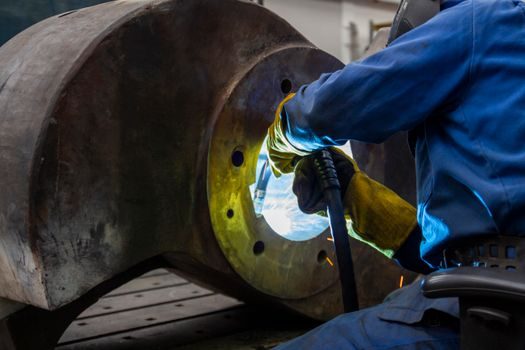
Housing material drives both thermal mass and corrosion class: die-cast aluminium is the lightweight norm for HTTW, NMRV, and standard S-series sizes 37-97, keeping the mass low but limiting continuous-duty dissipation [S3][S1][S4]. Grey cast iron or cast steel housings appear in the I/MI modular line, rated for harsh long-term industrial environments with up to 1,400 rpm input [S2]. Stainless-steel worm units (MS-CH-Q from MSF-Vathauer) carry ATEX certification and are specified for chemical, food, and outdoor valve drives where a standard aluminium housing would fail [S5]. The worm itself is consistently case-hardened and ground steel, paired with a centrifugally cast bronze worm wheel — the material pairing that defines the worm gear reducer working principle across manufacturers.
Torque and Power Bands: Where Each Family Sits
Power band is the most useful first-cut differentiator: the S series from RICHMAN covers 0.12-37 kW (0.16-50.31 hp) and 200-1000 Nm, the I/MI modular line runs to 2-5 kNm, the NMRV-063 is a low-power 0.06-0.75 kW unit, the HTTW occupies 0.33-16.5 kW (0.45-22.43 hp), and AUMA multi-turn exceeds 10 kNm [S1][S2][S3][S4][S6]. The HTTW catalogue publishes an output torque envelope of 12-166 Nm at up to 4 kW with ratios 5:1 to 100:1, a useful working range for stepper and servo gear motors in compact machinery [S3]. A cross-geometry torque-density comparison against planetary units is mapped in the planetary reducer trade-off reference.
Efficiency, Self-Locking, and Heat Rejection Limits
Single-stage worm mesh efficiency is published at 50-70% in the HTTW range because sliding friction dominates the contact, while the S-series — which adds a helical pre-stage — pushes efficiency above 90% by using the worm pair only as the final reduction [S3][S1]. The S-series also retains the self-locking characteristic: reverse driving is prevented by the low helix angle of the worm, a property used on conveyors, hoists, and inclined belt drives where back-driven motion is a safety hazard [S1]. The I/MI modular family is rated for 1,400 rpm input maximum and offers seven mechanical variants, giving specifiers room to trade efficiency, mounting, and duty cycle within one BOM [S2]. Continued thermal design matters: at high reduction ratios the worm mesh rejects more heat per kilowatt than a parallel-shaft helical gear reducer of equivalent rating.
Mounting Standards, Lubrication, and ATEX
Mounting positions are published as M1-M6 across S-series housings, with combined foot-and-flange options for IEC-standard motor adaptation on sizes 37 through 97 [S1]. Permanent synthetic long-life oil lubrication is standard on HTTW worm gearboxes, removing the scheduled oil-change interval on intermittent duty [S3]. ATEX-rated stainless MS-CH-Q units are explicitly listed for pump, wheel, and valve drive applications where a standard aluminium housing cannot be used [S5]. The same modular logic — motor face, foot, flange, hollow-shaft, ATEX — recurs in the competing cycloidal reducer format for higher shock-load service.
Selection Criteria: Matching Family to Application
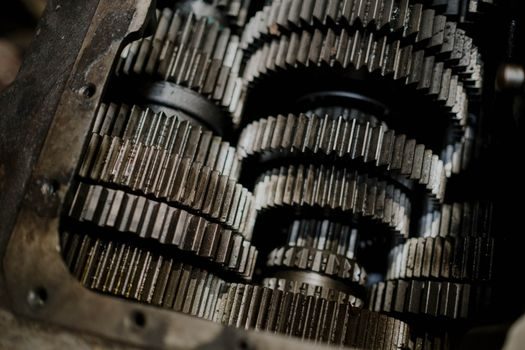
For compact servo and stepper drives needing ratios 5:1 to 100:1 with output 12-166 Nm, the HTTW hollow-shaft family is the standard pick [S3]. For general transmission with self-locking, where 0.12-37 kW and right-angle foot/flange mounting are needed, the S-series helical-worm hybrid with 90%+ efficiency is the right call [S1]. For modular, heavy industrial drive service up to 1,400 rpm input and 2-5 kNm torque, the I/MI series with seven mounting variants is the typical European OEM choice [S2]. For low-power coaxial through-shaft applications at 0.06-0.75 kW, the NMRV-063 family remains the reference unit [S4]. For stainless, ATEX, valve or pump service in chemical and food plants, MS-CH-Q is the controlled specification [S5]. For valve multi-turn actuation beyond 10 kNm — butterfly and large ball valves in confined spaces — AUMA's worm-driven SA multi-turn actuator is the established platform [S6].
The next data point to watch is whether the I/MI modular line publishes a verified efficiency curve in its 2026 catalogue update — that figure, alongside an updated 1,400 rpm thermal rating, is what the European heavy-industrial spec base is currently requesting. A second trackable signal is ATEX coverage on the Chinese NMRV-063 family; current product copy is silent on certification class, which limits its use in Zone 1 European plant retrofits without further vendor data [S4].