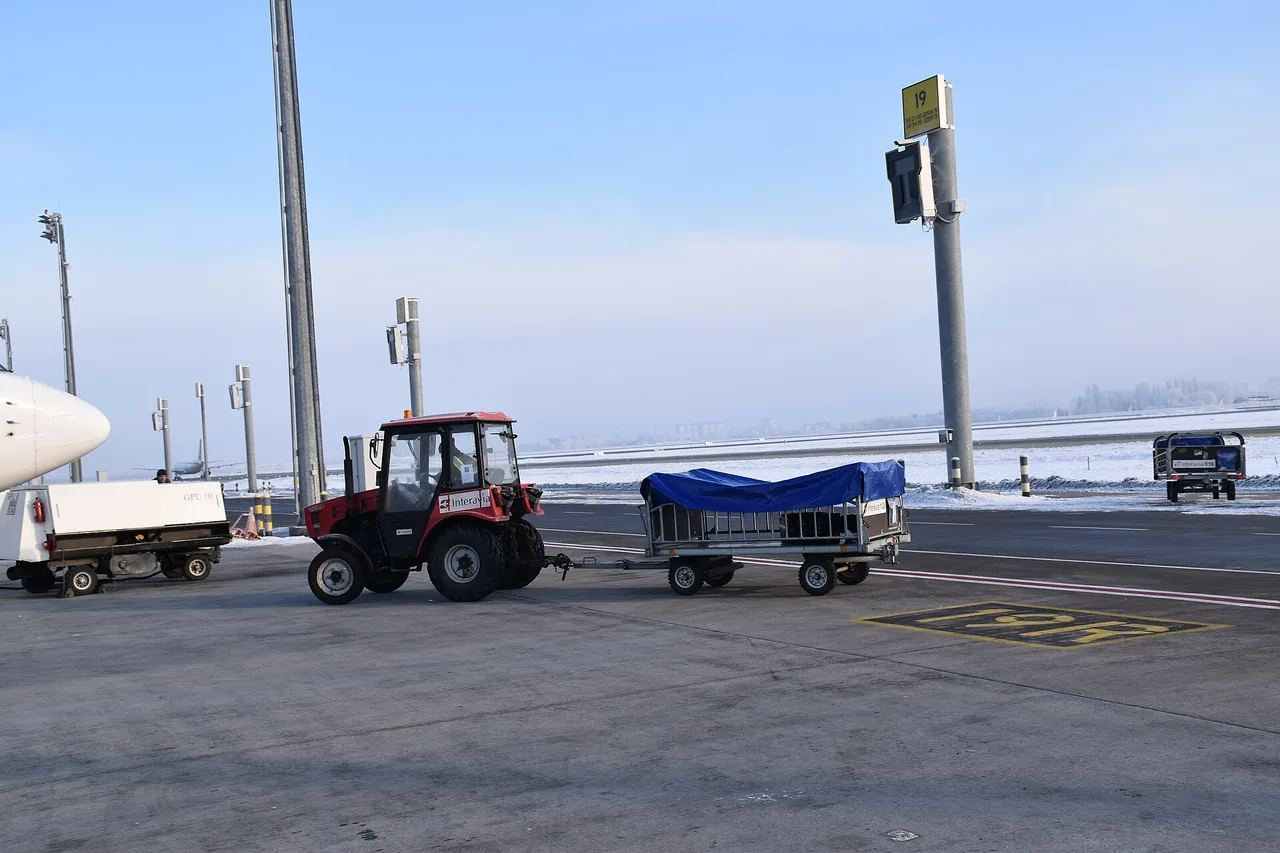
An aircraft baggage tug is a low-profile tow tractor, also called a baggage tractor, that pulls baggage carts and cargo dollies between the terminal and the aircraft stand on an airport apron. It carries no load of its own. Its whole output is tractive force at a hitch, delivered by a short-wheelbase vehicle built for constant stop-and-go work by drivers who board and step off many times a shift. A low floor, a tight turning radius, a hitch at each end and a diesel, gasoline or LPG engine or an electric traction drive define the type. The type also has fixed limits: it tows airport ground support equipment only, carries no passengers on the towed carts and is neither suitable nor legal on public roads.
Sizes and ratings follow from that duty. Electric units of one range weigh 3,500 to 4,500 kg (7,716 to 9,921 lb), and a diesel tug of the same weight class reaches 30 kN (6,700 lb) of drawbar pull, the pull a tug can hold at its hitch. Lighter electric models rate about 4,000 lb (1,814 kg). Laden speed is limited to about 10 km/h (6 mph), and airports add their own limits near aircraft, where a train moves at walking pace. The purchase is therefore decided by the train the tug must pull, the powertrain that fits the airport's fuel or charging setup, and the safety equipment that the airport and the labor rules require.
The purchase of an aircraft baggage tug is decided by five numbers and one rule. The numbers are the drawbar pull against the weight and the slope of the train, the towing capacity, the laden and unladen speeds, the turning radius and the battery or fuel energy for a shift. The rule is the airport's: how many carts may be towed, how long the train may be and how fast it may move near aircraft. A tug that passes both tests is then chosen for its operator station, its brakes and hitches, its charging routine and its safety equipment.
Chapter 1 / 06
What an Aircraft Baggage Tug Is and How It Works
An aircraft baggage tug is a self-propelled tow tractor that moves trains of baggage carts and cargo dollies on the airside of an airport. Its run starts where bags come off the belt conveyor inside the terminal or where a loaded container leaves the cargo shed, and it ends at an aircraft parked on a stand. One maker's manuals draw the line tightly: the tractor is built to tow airport ground support equipment only, up to its towing capacity and to the limits set by the airport, and it may pull cargo dollies, baggage carts, refuse carts, water service carts, fuel carts, lavatory service carts and gas bottle carts. Nobody may ride on the towed equipment. The vehicle belongs to the family of special purpose motor vehicles.
The working principle is the conversion of engine or motor torque into pull at a hitch. The engine or the traction motor turns a rear drive axle through a transmission and a differential, the tires grip the pavement, and the axle reaction becomes a horizontal force on the first cart. The useful part of that force, after the tug has moved itself, is the drawbar pull. It has to cover three loads at once: the rolling resistance of every axle in the train, the weight component on a slope, and the force to accelerate the mass from rest. Because the drive axle carries a large share of the service weight, tire grip sets a ceiling on the pull before the motor or engine reaches its own limit.
The architecture follows from the duty. A steel chassis carries a low operator station, with or without a cab, a battery or engine compartment placed for weight distribution, the axles and two hitches. On the electric model the battery sits mid-wheelbase, which adds stability; on the diesel the rear axle is leaf-sprung. The diesel unit has an independent front suspension: a trailing arm on each side with coil springs, a double-action shock absorber and a rubber bump stop. Both manuals give a minimum ground clearance of 108 mm (4.25 in) and a towing coupler height of 305 mm (12.0 in). Those low figures, a wheelbase of about 1.6 m (63 in) and a rear hitch worked from the driver's seat are what let a train bend around an aircraft stand.
On an engine-driven tug the powertrain is conventional. One diesel model has a four-cylinder turbocharged engine of 2,482 cc rated at 55.4 kW (74.3 hp) at 2,300 rpm, with peak torque of 300 Nm (221 lbf ft) at 1,500 rpm. A three-speed forward and two-speed reverse automatic transmission with a torque converter sends power through a propeller shaft to the differential. The driver selects the low gear whenever the tug is towing, needs maximum force or is on a gradient, and uses the high gear only for unladen travel on level ground. Both manuals forbid selecting neutral or switching the tug off on a downhill. The fuel tank holds 60 L, and the engine is allowed to idle for at least 3 minutes before it takes a train.
An electric tug replaces the engine with a battery, a controller and a motor. One lead-acid design runs on an 80 V, 660 Ah battery weighing 1,700 kg (3,748 lb), a 23 kW AC motor that drives the rear axle, and a separate 2.5 kW motor for the hydraulic pump of the power steering. The traction controller is an inverter of the variable speed drive kind: it uses field-oriented control of the motor and carries two microprocessors, the second of which monitors the first. A main contactor closes to connect the battery when the start switch is turned, and the same controller drives the coil of an electromagnetic brake. Another maker couples a 30 hp (22 kW) AC motor directly to the rear axle, and a newer range fits a controller with a peak rating of 900 A and a programmable top speed.
What happens on the apron is a cycle rather than a journey. The tug backs or creeps up to a cart, the towing pin in the rear hitch is raised or lowered by a lever from the driver's seat or by a handle from beside the rear, the coupling is tested, and the train pulls away at low speed. It crosses service roads at the speed the airport allows, slows to walking pace inside the aircraft limit line, stops clear of engines and wing tips, unhitches, and returns empty at its unladen speed. Creep buttons at the left rear of the electric model, beside a second emergency stop button, let a person standing at the hitch inch the tug forward or back into coupling position. Brakes, hitches and parking brakes therefore dominate the daily checks.
Chapter 2 / 06
Aircraft Baggage Tug Types and Structural Variants
Powertrain splits the family into engine tugs and electric tugs. Engine units burn diesel, as the largest model described here does, or gasoline, as one maker's gasoline unit does, or liquefied petroleum gas, which the United States powered industrial truck rule treats as its own LP and LPS types alongside the diesel and gasoline types; the LPS type adds safeguards to the exhaust, fuel and electrical systems. Electric tugs come with a flooded lead-acid battery or with a lithium-ion pack, and one maker offers both chemistries on an 80 V system. The engine tug refuels in minutes and works in deep cold with a cab that has a heater; the electric tug needs a charger and a charging routine, but adds no exhaust at the stand.
The operator station divides tugs into cabbed and open types. A cab has a windscreen with wipers, side doors, a rear view mirror and a heater with defroster, and it raises overall height from 1,229 mm (48 in) on the open chassis to 1,982 mm (78.0 in) on one cabbed electric model and 2,134 mm (84.0 in) on the diesel with its beacon; a newer electric range lists 2,116 mm (83 in) with the cab. Its lamps and light fittings include LED headlights, indicators, tail lights and a rear work light. An open tug is a bare chassis with a seat, a steering wheel and a beacon; it leaves the driver in weather, de-icing spray and engine noise. One maker sets the seat at the rear for reach to the hitch.
Size and braking equipment separate light from heavy units. Light electric tugs rate around 4,000 to 5,000 lb (1,814 to 2,267 kg) of drawbar pull, and the 5,000 lbf model of one range stops on four-wheel disc brakes; the heavier electric model of that range rates 6,000 lbf (25 kN) and combines front disc brakes with rear drum brakes. The diesel unit tops the scale at 30 kN (6,700 lb) of drawbar pull, with a foot brake on all four wheels fed from one master cylinder and a separate drum parking brake on the rear axle. Towing capacity, the weight of train a maker allows, is listed at 25 t and 32 t for the two electric sizes.
Operator protection is built from small items. The electric model carries an emergency stop switch on the dash and a second button at the rear, either of which shuts off the power from the battery. Its traction controller will not move the tug unless the direction switch, the seat switch and the interlock inputs are made, so the tug cannot be driven from the ground. The diesel dash shows a fastened seat belt and an operator present; the electric dash shows the seat switch. A cab gives the driver a steel shell and a place to anchor a belt. Rollover is listed with uncommanded movement, distracted driving and malfunction among the hazards of tug operation in airline industry guidance published in 2013.
The boundary against neighboring equipment is drawn by what a machine does with its force. An aircraft pushback tractor moves the aircraft itself by its nose gear; a baggage tug never touches an aircraft. An airfreight conveyor truck lifts bags to the aircraft door on a belt and tows nothing. A forklift, a reach truck or a pallet stacker lifts a load on forks, and an electric pallet truck or a manual pallet jack carries it on its own frame; a baggage tug carries nothing but its driver and pulls. A platform trolley is pushed by hand inside a building, while a baggage cart has tires, its own brake and a tongue that hitches. The tug is not a passenger vehicle, and it is barred from public roads.
Chapter 3 / 06
Aircraft Baggage Tug Key Specifications and Standards
A tug datasheet is short, and nearly every line is one of the parameters in the table below. Dimensions are given with and without the cab, because the cab changes the height by more than half a meter and decides whether the tug may pass under an aircraft wing. Weight appears as service weight, the tug ready to work but without a driver or train, and it matters twice: it is the ballast that gives the drive tires their grip, and it is the load that a floor, a lift or a ship must carry. Performance is stated as drawbar pull, towing capacity, laden and unladen speed, gradeability and turning radius. Electrical data cover voltage, capacity and motor power; tire data cover size, ply rating and pressure.
Standards reach a baggage tug from two directions. The labor rule for powered industrial trucks in the United States, 29 CFR 1910.178, covers tractors powered by electric motors or internal combustion engines, so it applies to a baggage tug in part. Its paragraphs on operator training and evaluation, on battery charging areas, on taking an unsafe truck out of service and on examining trucks at least daily apply directly; its paragraphs on masts, forks and elevators have no counterpart on a tug. The airside vehicle rules of Los Angeles International Airport, revised in 2025, limit speed to 10 mph on the apron outside the aircraft limit line and to 3 mph or walking speed inside it, require amber beacons, a lighted rotating beacon in the movement area and working lights.
Three figures on the datasheet deserve a question. A drawbar pull printed without its test condition says nothing about grip: the figure is a maximum, and wet, iced or de-icing-fluid-covered concrete reduces what the tires can deliver. A speed without the word laden is the unladen figure, and the laden figure is a fraction of it, 10 km/h (6 mph) against 25 to 32 km/h (16 to 20 mph) on the models described here. A temperature range belongs to a configuration: one diesel unit is rated from -30 to +50 degrees Celsius (-22 to +122 degrees Fahrenheit) with its cab, a lead-acid electric tug from -20 to +50 degrees Celsius (-4 to +122 degrees Fahrenheit), and its battery performs best above 0 degrees Celsius (32 degrees Fahrenheit).
Parameter
Typical range or value
What it decides
Service weight
3,500 to 4,500 kg (7,716 to 9,921 lb)
Tire grip and floor loading
Drawbar pull
20 to 30 kN (4,500 to 6,700 lbf)
Train weight, slope and acceleration
Towing capacity
25 to 32 t
Train weight allowed
Top speed, unladen
25 to 32 km/h (16 to 20 mph)
Empty return time
Top speed, laden
10 km/h (6 mph)
Cycle time with carts
Minimum turning radius
2,950 to 3,250 mm (116 to 128 in)
Room to maneuver
Overall length
3,000 to 3,468 mm (118 to 136.5 in)
Total train length
Height with cab
1,982 to 2,134 mm (78 to 84 in)
Clearance under wings
Towing coupler height
305 mm (12.0 in)
Match to the cart fleet
Gradeability, unladen
30 %
Ramps between apron levels
Tire pressure
60 to 100 psi (4.14 to 6.89 bar)
Grip, load rating, tire wear
Chapter 4 / 06
Aircraft Baggage Tug Selection and Duty Calculations
Selecting a tug is a short calculation followed by a list of site conditions. The calculation sizes the pull, the speed and the energy against the train the airport wants moved. The conditions decide the powertrain, the operator station and the equipment that must be on the vehicle.
The first calculation is the drawbar pull the duty needs. It is the train mass multiplied by the sum of three fractions: rolling resistance, which for rubber tires on concrete is typically 1 to 2 percent of the weight; the gradient, written as a decimal; and an acceleration term, the change in velocity divided by the time allowed and by gravitational acceleration. A 25 t train therefore absorbs about 2.5 kN for every 1 percent of grade and rolling resistance taken together, so a tug rated at 20 kN has enough margin for a level haul and very little for a ramp. Towing capacity, 25 t on the smaller electric size, is the maker's limit on the train weight itself and is never to be exceeded.
The second check is grip. A tug cannot pull harder than the load on its drive tires multiplied by the friction between rubber and pavement, so the greater the share of service weight on the drive axle, the more of the motor's torque reaches the hitch. That is why the battery sits mid-wheelbase on the electric model and why tire pressure is held within a narrow band, 75 psi plus or minus 3 psi on the front tires of the diesel. The same limit explains the unladen gradeability figure of 30 percent: it is the slope the empty tug can climb, not the slope it can pull a train up. On ice, snow or a film of de-icing fluid the available friction falls sharply.
The third calculation is cycle time, which sets how many tugs a peak hour needs. Laden speed is held near 10 km/h (6 mph) by the vehicle and cut further by airport limits, 10 mph on the apron outside the aircraft limit line and 3 mph or walking speed inside it at one large hub. A haul of 1 km at the laden limit takes about 6 minutes each way before hitching, waiting and loading are counted, and a driver who serves a stand twice in a turnaround spends more time stopped than moving. Shortening the run by staging carts near the stands, or adding a tug to the route, usually buys more than a faster vehicle would.
The fourth calculation is energy. The 80 V, 660 Ah lead-acid battery of one design holds about 53 kWh nominal, of which only part can be spent before the voltage falls to the controller's undervoltage cutback and the tug must be recharged. Its manual orders a full recharge after every day of use and warns that a battery left discharged for more than 24 hours loses capacity. The recharge takes 8 to 12 hours, so a single-shift operation charges overnight and a round-the-clock operation needs a second battery or a spare tug. A diesel tug instead needs its 60 L tank filled and a fuel store on the airport; its running cost is fuel and engine maintenance rather than battery replacement.
The site conditions then narrow the list. An airport with a charging room and a rule against running engines unnecessarily points to electric tugs; a cold climate with no charging points points to a diesel with a cab heater. The number of carts allowed, five at the airport cited, fixes the train weight and therefore the tug size. The turning radius must suit the service road corners, and the turning circle of one electric range, 138 in (3,503 mm), is a figure to lay over the airport's route plan. The options list comes last: a backup alarm, additional lights, hitch configurations, a door mirror, wipers, doors and a heater are listed as options rather than standard equipment by one maker, and what the airport demands belongs in the order.
Decision factor
What to state or compare
Why it changes the choice
Train and cart count
Full train weight; carts and length the airport allows
Fixes towing capacity and pull class
Route profile
Length, slopes, corners, surface
Sets the pull and the turning radius
Powertrain
Diesel, gasoline, LPG, lead-acid or lithium electric
Aircraft Baggage Tug Installation, Maintenance, and Failure Modes
A baggage tug has no fixed installation. Its care is a daily routine that every driver repeats, a weekly and monthly schedule that the workshop keeps, and a small set of failure modes that the routine is meant to catch before the tug reaches an aircraft.
The daily routine starts before the engine or motor does. The labor rule requires a truck to be examined before it is placed in service, at least daily and after every shift on a round-the-clock operation, and to be taken out of service if anything affects safety. Maker schedules and an airline industry fact sheet from 2013 agree on the content: a walk-around for damage, loose parts and foreign object debris; every lamp and the beacon working; both hitches sound, each cart's tow bar then pulled sharply upward to prove the coupling will not open; tire condition and pressure; wheel nut tightness; fluid levels and leaks; and the horn. Only then is the tug moved a few meters and the foot brake and the parking brake tested before it goes near an aircraft.
The battery routine is what an electric tug adds. Its manual requires a full recharge after every day of use, through a main power connector that is unplugged from the tug and connected to the charger cable only with the charger switched off. Charging releases hydrogen, and the manual warns of an explosion risk once hydrogen reaches 4 percent of the air, so the compartment cover stays raised, the vent cap stays slightly open, the area is ventilated, the workshop keeps a fire extinguisher for electrical fires, and nobody smokes within 3 m (10 feet). A full charge takes 8 to 12 hours. Wearing safety glasses, a technician waters the flooded cells with distilled or deionized water after charging, never before, and runs an equalizing charge once a week to limit sulfation.
The workshop schedule covers the systems that stop and steer. On both the diesel and the electric model, wheel nuts are checked from weekly onward, at 210 Nm (155 ft/lbs) at the front and 420 Nm (310 ft/lbs) at the rear, and tire pressures are read at the same intervals. Brake fluid level is checked weekly, brake shoes are inspected and adjusted, and the brake fluid is replaced yearly, at 1,000 hours on the diesel and 1,200 hours on the electric. Parking brake cables are inspected for damage and slack. Power steering oil is renewed every six months. A wheel that shakes or turns hard points first to tire pressure, then to a leaking oil seal, a chafed industrial hose or a worn hub bearing.
The engine tug adds a fluid, belt and filter schedule. The diesel manual asks for engine oil, coolant, brake fluid, steering oil, axle oil and fuel to be checked and topped up on the schedule, for the fan belt and the alternator belt, standard or Poly-V, to be checked, adjusted and renewed, the Poly-V belt being a ribbed belt, and for the air filter cartridge to be cleaned and renewed. Coolant is replaced yearly, and coolant hoses have a maximum life of five years. Before the cold season the cooling system is drained, flushed and refilled with antifreeze, and the engine oil is changed to a grade suited to the coming season. A lithium-based grease goes to the steering and suspension points of the schedule. The airport cited forbids running engines unnecessarily, so the tug is shut off whenever it waits.
The environment decides how fast a tug ages. Cold narrows the choice: the diesel with its cab is rated from -30 to +50 degrees Celsius (-22 to +122 degrees Fahrenheit), the lead-acid electric tug from -20 to +50 degrees Celsius (-4 to +122 degrees Fahrenheit), with its battery at its best above freezing. Heat is carried away from the motor controller through thermal joint compound into its mounting plate. Apron corrosion comes from water, road dirt and aircraft de-icing and cleaning fluids; the manuals allow washing with water and a degreaser or a mild detergent, but forbid caustic agents and aircraft cleaning agents, and ask that significant rust be ground off, coated, primed and painted. None of the makers described here publish a sound level; a reading at the driver's ear, taken with a sound level meter, is a value to request.
Symptom or service item
Likely cause
Action
Tug creeps at start
Gear not in neutral, parking brake released, bypassed seat switch
Start in neutral, brake set; never alter factory settings
Train comes uncoupled
Hitch pin worn or not locked, yoke fatigued
Pull-test each coupling; inspect hitch and yoke
Cart tips in a turn
Excess speed on a corner, abrupt steering
Slow before corners; avoid sharp turns
Electric tug will not move
Blown main fuse, open contactor, undervoltage cutback, missing interlock input
Read the fault code; test fuse, contactor and battery with a digital multimeter
Battery left discharged, corroded busbars, sulfated cells
Recharge daily; clean busbars; equalize weekly
Rust, chafed wiring, old hose
De-icing fluid, road grime, age
Wash with approved agents, treat rust, renew hoses by five years
Chapter 6 / 06
Aircraft Baggage Tug Applications and Procurement Checks
Aircraft baggage tugs work wherever bags or air cargo have to move on the ground between two points of an airport. Airlines and ground handlers run them from the baggage make-up area to narrow-body and wide-body stands, in trains of up to five carts where the airport allows that many. Cargo handlers pull container dollies, limited to four at the airport cited, between a freight shed and the aircraft side. The same tug moves service carts for water, lavatory draining and gas bottles, in weather from snow and ice to summer heat. The duty is cycles rather than distance: short hauls, frequent coupling, long periods parked or idling at the stand, and drivers who change with every shift.
Cost and lead time follow from four choices. The first is the battery: a lithium-ion pack against a lead-acid pack of the same voltage, and it changes what is spent on the battery and on its care over the life of the tug. The second is the charger and the electrical supply for it. The third is the operator station and the options, since a cab with heater, door mirror, wipers and doors, a backup alarm, additional lights and special hitch configurations are listed as options by one maker. The fourth is the service arrangement: battery watering and equalizing, daily checks and spare parts decide the yearly cost, and a tug that waits for a part is not towing.
Acceptance and training close the purchase. On receipt, the buyer checks that the packaging is removed, that every loose component and fastener is accounted for and that fluids are at their levels, and then has the daily and weekly maintenance checks done before the first trip. One diesel manual asks for a transmission oil change after 100 hours of use. A tug with its train can be weighed on a truck scale to confirm the service weight that was bid, and the drawbar pull can be verified with a dynamometer. Drivers must be trained on the vehicle they will drive; the labor rule requires an evaluation of each operator at least once every three years, and the airport cited requires at least 8 hours of supervised driving, 2 hours of it in darkness.
What a buyer must state and ask for fits on one sheet. State the train: the number and type of carts or dollies, their loaded weight, the couplings and the towing coupler height, and the airport's limit on cart numbers and train length. State the route: its length, slopes, surface, tightest corner and speed limits. State the duty: hours per day, shifts, distance per shift and turnaround times. State the climate: lowest and highest apron temperature, snow, ice and de-icing fluid. State the power: the fuel allowed on the apron, or the charger location, its supply and the hours available for charging. Then ask the supplier for the drawbar pull and the towing capacity with their test conditions, the laden and unladen speeds, the turning radius, the service weight, the operating temperature range, the brake and tire equipment, the battery chemistry, capacity and charge time, the safety equipment fitted as standard, the rollover protection that the cab or canopy gives, the maintenance schedule, and the operator training and spare parts that come with the delivery.
FAQ
What is an aircraft baggage tug and what does it do?
A baggage tug is a small tractor that pulls a train of baggage carts or cargo dollies from the terminal area to a parked aircraft and back. It has no load platform: all it does is pull. An engine or an electric motor drives the rear axle, the tires find grip on the pavement, and the force arrives at the first cart through a tow hitch. Because the driver stops, couples and climbs down many times in a shift, the vehicle is low, short between the axles and able to turn in a small circle. It works inside airports only: it may tow ground support equipment and never carries people on the carts.
What types of baggage tug are there?
Tugs are grouped by powertrain and by operator station. Engine tugs run on diesel, gasoline or liquefied petroleum gas; a typical diesel unit is rated at 30 kN (6,700 lb) of drawbar pull. Electric tugs use a lead-acid battery or a lithium-ion pack at about 80 V. A tug has either a cab with windscreen, doors, heater and wipers, which raises its height from about 48 in (1,229 mm) to between 78 and 84 in (1,982 to 2,134 mm), or an open chassis. Light electric models rate around 4,000 to 5,000 lb (1,814 to 2,267 kg) of drawbar pull.
Which specifications matter most on a baggage tug?
Four specifications decide whether a tug can do the job. Drawbar pull, typically 20 to 30 kN (about 4,500 to 6,700 lbf), is the pull at the hitch and must exceed the loads of a full train. Towing capacity, 25 to 32 t, is the maker's limit on train weight. Speed comes in two figures: 25 to 32 km/h (16 to 20 mph) unladen and about 10 km/h (6 mph) laden. The minimum turning radius, 2,950 to 3,250 mm (116 to 128 in), decides whether a train can use the airport's service roads. Buyers also check the towing coupler height, usually 305 mm (12.0 in), to match the cart fleet.
How do I choose the right size of baggage tug?
Start with the train, not the tug. Add the weight of the carts or dollies the airport allows, five baggage carts or four container dollies at one large hub, and keep the total under the tug's towing capacity. Then calculate the pull needed: train weight times rolling resistance, grade and acceleration added together, remembering that a 25 t train absorbs about 2.5 kN for every 1 percent of grade and resistance. Match the turning radius and the train length to the route. Finish with the site: fuel or charging facilities, climate, cab or open station, and the safety equipment the airport requires.
How is an electric baggage tug charged and maintained?
An electric tug with a lead-acid battery is charged overnight. The charger is switched off before the tractor's power connector is pulled and plugged into the charger cable, because a live connector can spark in the hydrogen that charging releases; the battery cover and vent caps stay open, and a full charge takes 8 to 12 hours. A pack left empty for more than 24 hours loses capacity. Once the charge is finished the cells are topped up with distilled water, the terminal posts are checked and greased, and a weekly equalizing charge reverses sulfation. The rest is a daily walk-around of tires, lamps, beacon, hitches and leaks.
What drives the cost and lead time of a baggage tug?
Price and delivery time are moved by four things. The battery comes first: lithium-ion and lead-acid packs of the same voltage differ in what they cost to buy and in the attention they need in service. Second is the charger together with the electrical supply that feeds it, which belongs to the building budget as much as to the vehicle budget. Third is the specification: heated cabs, door mirror, wipers, doors, reverse alarms, extra lamps and nonstandard hitches are optional extras, and the bigger, stronger tug is the dearer one. Fourth is what comes after delivery: driver training, battery watering, the periodic service and a stock of spare parts.
What safety rules and standards apply to baggage tugs?
In the United States the labor rule for powered industrial trucks, 29 CFR 1910.178, covers tugs as electric or engine-driven tractors: it requires trained operators, an examination at least daily, removal of unsafe trucks from service and safe battery charging areas. Airports add their own airside vehicle rules. At Los Angeles International Airport these hold speed to 10 mph on the apron and to walking pace, 3 mph, near aircraft, ask for amber beacons and working lights, cap a train at five carts and 85 feet (25.9 m), and demand positive lock couplings. Drivers stay seated and belted where a belt is fitted, park with the parking brake set and chock a tug left running.