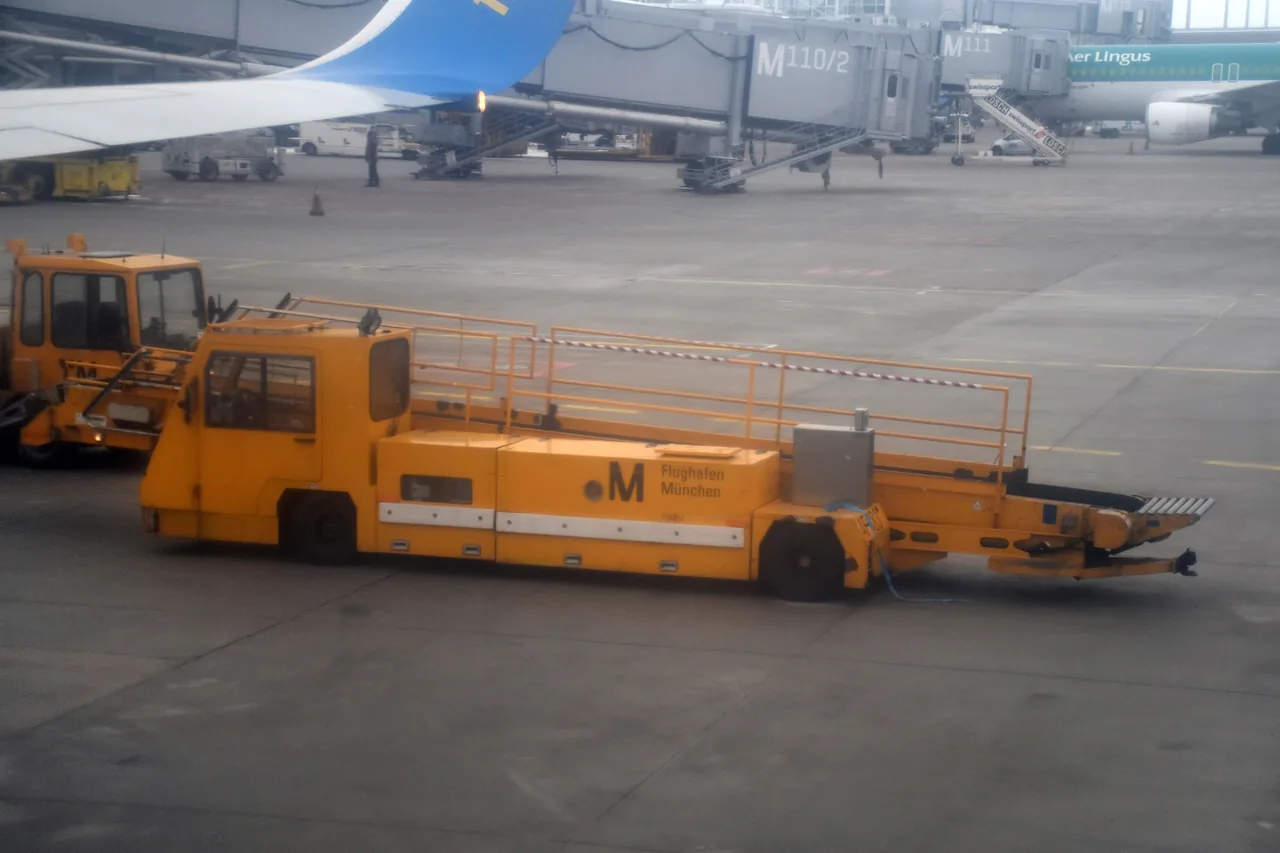
An airfreight conveyor truck, called a belt loader on almost every apron, is a self-propelled airport vehicle that carries a belt conveyor to the sill of an aircraft hold. Its working part is a boom whose height and angle are set hydraulically, so that bags and bulk cargo travel from a baggage cart up into the hold, or back down out of it. The user manual written for one battery model states the job plainly: the vehicle transfers passenger baggage and other light cargo from baggage carts and cargo dollies to the baggage and cargo holds on aircraft. The boom is lowered to a near horizontal position whenever the vehicle moves between stands, and on arrival it is raised again to the door.
This page treats the vehicle as a purchasing object. The chapters that follow define the machine and its working parts, sort the drive and structural variants, set out the parameters that recur on datasheets, carry the selection arithmetic, and end with daily checks, periodic maintenance, failure modes and the wording of a purchase order. The figures come from two builder documents, a specification sheet for an engine and battery model range and a long user manual for a battery model, from a narrow-body airport planning manual, and from published rules: airside guidance of the United Kingdom Civil Aviation Authority, the occupational rules of OSHA and the nonroad engine emission rule of the United States Environmental Protection Agency. A few ranges taken from general practice are marked as typical.
Four things decide a belt loader purchase. First the reach: the front height of the boom must cover the sill heights of the holds the fleet serves, on level ground, with the bumper clear of the aircraft. Second the duty cycle, which chooses between a diesel or LPG engine and a battery, and behind the battery a charging plan. Third the stopping and holding chain: emergency stops at three stations, a parking brake interlock and a reverse alarm. Fourth the support package, meaning maintenance intervals, local stock of belts and filter elements, and the operator training records an auditor will ask to see.
Chapter 1 / 06
What an Airfreight Conveyor Truck Is and How It Works
An airfreight conveyor truck is a four-wheel vehicle built around one long inclined belt conveyor. It drives to the aircraft under its own power, parks at the cargo door, and raises the front of its belt to the height of the hold sill while the rear stays low enough for a loader to lift bags on by hand. The hold floor is not at one height: it differs between narrow-body and wide-body types and shifts as an aircraft is loaded or unloaded, so the boom is set again on every stand rather than fixed once. The same belt runs in both directions, which is why one vehicle loads an outbound flight and empties an inbound one.
Raising the two ends of the belt separately is the principle that makes the machine fit the door. The battery model described in the user manual has a front height range of 970 to 4570 mm (38.1 to 179.9 in) and a rear height range of 560 to 1680 mm (22 to 66.1 in), with a maximum belt angle of 29 degrees. Set low at the back and high at the front, the belt is a steep ramp that ends almost level at the sill, so a bag neither strikes the door frame nor slides back onto the loader. The specification sheet in the sources uses the same idea: two hydraulic cylinders raise and lower both the front and the rear of the conveyor boom.
The parts list is short. A welded steel chassis carries a drive axle at the rear and a steering axle at the front. The belt frame is a welded U-channel steel structure in which a rubber belt runs over rollers and plates, driven by a hydraulic motor at the rear end. Guide wheels and adjustment assemblies at the front roller and at the tail keep the belt tracking and tight, the duty a belt tensioner performs on a fixed belt conveyor. A collapsible handrail on the right side and front and rear flaps on the left keep bags and people from falling off. At the head, a rubber bumper and two proximity sensors stand between the vehicle and the aircraft skin.
A loading cycle follows a fixed sequence. The driver parks, presses the foot brake, engages the parking brake and returns the direction selector switch to neutral. The last approach is made on idle with the parking brake released and a foot resting on the brake pedal, which gives a creep speed of no more than 2.5 mph (4 km/h). With the parking brake set again, the boom is aligned with the door and the belt is started from a control box at either end: forward to move bags toward the aircraft, reverse to bring them back, and stop before changing direction. The belt runs at 0.2 to 0.5 m/s (0.66 to 1.64 ft/s) and carries up to 1000 kg (2204 lb), with 400 kg (882 lb) as the largest single item.
Oil pressure does the lifting, the steering and the belt drive. An engine-driven pump, or on battery models a hydraulic power unit with an electric motor, draws oil from the tank through a suction filter; the manual's circuit lists a gear pump, a priority valve and a hydraulic valve block with solenoid-operated spools. The specification sheet gives system pressure as 1,500 psi max, which is 10.3 MPa, and places a return-line filter with a condition indicator in the circuit. Each lift frame is moved by a single-acting hydraulic cylinder with its base on the chassis, and a hydraulic motor turns the belt. The steering unit sends oil to a hydraulic cylinder on the front axle, which is why the steering goes heavy when pressure is lost.
Controls are arranged so that the machine cannot do two dangerous things at once. A throttle select switch in the driver's compartment chooses between driving and working the belt, and interlocks prevent the vehicle from driving while the conveyor runs. The conveyor runs only with the parking brake engaged, the belt and the lift cannot work at the same time, the belt frame can be raised or lowered only from the cab, and every exposed control is rainproof, a point that is written on a specification as an IP enclosure rating. An audible alarm sounds whenever reverse gear is selected. Emergency stops sit at three points, one emergency stop button at each end of the belt frame and one in the driver's compartment; pressing any of them shuts down the whole vehicle, belt, lift and drive together.
Chapter 2 / 06
Airfreight Conveyor Truck Types and Structural Variants
Drive type is the first split. The engine and battery model range in the specification sheet offers a gas engine that runs on petrol or LPG and delivers 69 hp (51.5 kW), a diesel of 49 hp (36.5 kW), and two battery versions. The gas engine is the one to examine for apron air quality and refueling discipline, and the battery versions are the ones that need a charging plan. On the electric models a 7.8 kW ac motor drives the axle through an electronic controller, and a second motor of 5.8 kW drives the pump. The lead-acid pack is an 80 V battery of 300 to 440 Ah. The lithium pack is 200 to 300 Ah at 80 to 96 V and is the lighter of the two, at 7,300 to 7,700 lb against 8,700 lb (3,946 kg).
Size class follows the holds served. A standard machine reaches a maximum baggage loading height of 4560 mm (179.5 in) above flat, level ground and a minimum of 1100 mm (43.3 in), which covers the lower decks of narrow-body aircraft and the bulk holds of small regional types. Longer machines extend the same layout toward the lower decks of wide-body aircraft, whose sills sit higher. Machines built for main-deck freighter doors are container and pallet loaders, a different vehicle with a platform instead of a belt. Belt width barely changes across the class: 600 mm (23.6 in) on the battery model and 610 mm (24 in) on the engine and battery range, with a conveyor length of 7,468 mm (294 in) and a frame 34 in (864 mm) wide overall.
Structural variants differ in how the boom is held and where the driver sits. On both machines used here the front and the rear of the belt frame are raised by separate lift frames, each moved by one single-acting cylinder with its base fixed to the chassis and its rod attached to the frame. The frame is lowered by releasing the oil, so the system can be lowered without power. The specification sheet offers the driver an open seat or a cab: the vehicle is 59 in (1,499 mm) high without the cab and 85 in (2,159 mm) with it. With the belt frame at 25 degrees, the battery model stands 2200 mm (86.6 in) tall to the top of its cab.
Running gear follows the apron rather than the road. The engine and battery range is built with its axles solid-mounted, which means no suspension, and the battery model keeps a low center of gravity. The wheelbase is 2990 mm (117.7 in) on the battery model and 2,794 mm (110 in) on the engine and battery range, whose drive shaft runs through a universal joint to a limited-slip rear axle. Ground clearance is 150 mm (5.9 in) and 191 mm (7.5 in) respectively. The specification sheet quotes an outside turning radius of 8,230 mm (324 in) for a vehicle 7,620 mm (300 in) long. The battery model runs on air-filled tires inflated to 5 bar (72.5 psi); solid tires are a common option where flat tires from apron debris are a problem.
Brake and steering arrangements vary with the drive. The engine and battery range has a dual-circuit brake system with a booster and disc brakes at every wheel; its parking brake is a cable-operated caliper mounted at the transmission, and on the electric versions it is a spring-applied brake on the electric motor, released electromagnetically, an electromagnetic brake that holds when the power is off. The battery model in the manual has a four-wheel service brake with a vacuum valve and a handbrake lever that pulls a cable to the rear axle brakes. Steering is hydrostatic on one range, an orbitrol-controlled hydraulic cylinder on the front axle, and plain power steering on the other, a steering unit below the dash sending oil to the same kind of cylinder.
Boundaries are best drawn by what stands next to the vehicle on the apron. The belt conveyor of a factory or of an airport baggage system is a fixed machine whose frame is bolted to the floor; this product carries a short belt conveyor on a vehicle, so the stationary machine is a different purchase. It is not a forklift and not an electric pallet truck: it carries bags up an incline on a belt, it lifts no load on forks, and it has no mast. The raised boom carries baggage, never people, so it is not an aerial work platform either. Between a towed baggage cart at its tail and the open cargo door at its head, the belt loader is the only powered link between the two.
Chapter 3 / 06
Airfreight Conveyor Truck Key Specifications and Standards
The datasheet of a belt loader is one page, and nearly every line on it appears in the table below with a value printed in one of the two builder documents. Geometry gives belt width, belt length, the front and rear height ranges and the maximum belt angle. Capacity gives the distributed load the belt may carry and the largest single item. The pressure circuit gives the system pressure, 1,500 psi max on the engine and battery range. The drive section gives engine power or battery voltage and capacity, and the chassis section gives weight, ground clearance and tire pressure. Belt speed is stated in two ways: 0.2 to 0.5 m/s (0.66 to 1.64 ft/s) in the manual and 13.7 to 27.4 m/min (45 to 90 ft/min) on the sheet, almost the same band.
Three of these lines deserve a question when they arrive without their basis. The height range is stated on flat, level ground: on a sloping stand the reach at the sill falls by whatever the low wheels lose, and the manual repeats the condition for both its maximum and its minimum loading height. The distributed load is not the single-item limit, since a belt rated for 1000 kg (2204 lb) still stops at one bag of 400 kg (882 lb). Belt speed is a range with a minimum for a reason: the speed knob must be returned to its minimum position after every loading or unloading operation, because the next crew cannot see what speed was left set.
Three layers of rules apply. The product standard in Europe is EN 12312-3, the part of the aircraft ground support equipment series that covers conveyor belt vehicles; it rests on EN 1915-1 for the basic safety requirements and on EN 1915-2 for stability and strength requirements, calculations and test methods, which is where the raised-boom case is proved. In the United States, SAE ARP1247 states general requirements for aircraft ground support equipment. The oil circuit follows ISO 4413, the general rules for designing and safeguarding oil power systems and their components. Each interlock on such a machine works as a safety interlock switch: typically a limit switch or a proximity sensor reports the parking brake position to the controller, a PLC in most builds. The CE marking on a datasheet is a safety certification claim, to be backed by the declaration of conformity itself.
Parameter
Typical value
What it decides
Belt width
600 to 610 mm (23.6 to 24 in)
Largest bag or carton that rides without overhanging the edge
Front (head) height
970 to 4570 mm (38.1 to 179.9 in)
Which hold sills the boom can reach
Rear (tail) height
560 to 1680 mm (22 to 66.1 in)
Lift height for the loader feeding the belt
Maximum belt angle
29 degrees
Steepest ramp a bag will ride without sliding back
Belt speed
0.2 to 0.5 m/s (0.66 to 1.64 ft/s)
Loading rate and the impact of a bag at the head
Distributed load on the belt
907 to 1000 kg (2,000 to 2,204 lb)
How heavy a queue of bags may be
Largest single item
400 kg (882 lb)
Whether heavy freight needs another type of loader
Climbing gradient
15%
Ramps the vehicle may take with the belt frame lowered
Tire pressure
5 bar (72.5 psi)
Steering effort, braking and the height of the belt
System pressure
10.3 MPa (1,500 psi) max
Lift force available and the pressure rating of every hose
Battery
80 V, 300 to 440 Ah lead-acid; 200 to 300 Ah at 80 to 96 V lithium
Turns per charge and the rating of the charger
Operating temperature
-30 to +50 degrees Celsius (-22 to +122 degrees Fahrenheit)
Oil grade and battery heating for the climate
Operating weight
3,175 to 3,946 kg (7,000 to 8,700 lb)
Apron loading and the size of the towing vehicle
Chapter 4 / 06
Airfreight Conveyor Truck Selection and Duty Calculations
Selection starts from the fleet served and ends with a charging or refueling plan. The paragraphs below take the five inputs a buyer numbers before asking for quotations: sill reach, bag flow per turn, stand slope and wind, drive energy, and the noise and emission limits that apply at the airport.
Reach is decided first and is geometric. Narrow-body lower-deck holds have sills that sit typically around 2.5 to 4 m above the apron, wide-body lower decks around 4.5 to 5.5 m, and main-deck freighter and upper-deck doors higher again, all working ranges from practice. The buyer lists the aircraft types the station serves, takes each hold sill height from the airframer's airport planning document, and checks the loader's maximum loading height against the highest of them. The door sets the largest item: one narrow-body planning manual gives a forward cargo door clear opening of 1.30 x 1.22 m (51 x 48 in). The sill itself is not a support: United Kingdom guidance names buffers among the protection devices for surfaces that interface with the aircraft, and damage to a door sill, which can cause depressurization, must be reported.
Flow per turn is the second calculation and uses only datasheet numbers. Bag throughput equals belt speed multiplied by the bags that fit on each meter of belt, and the speed is adjustable between 0.2 and 0.5 m/s; at the top setting a bag rides the full belt length of 7,468 mm (294 in) in about 15 seconds. The belt holds a queue whose total mass is capped at the distributed load, in practice a few dozen bags at typical checked-bag weights. A wide-body lower deck with a sill above the maximum of 4560 mm (179.5 in) needs a taller boom, or it accepts that the last rows are stacked by hand from a lower belt end.
Slope and wind set the limits that a datasheet hides. The 15% gradient is what the vehicle can climb with its belt frame lowered; it says nothing about raising the boom. Loading heights are quoted on flat, level ground, the parking routine asks for level ground, and the powered industrial truck rule, 29 CFR 1910.178, requires wheels to be blocked whenever a truck is parked on an incline. An inclinometer reading of the stand is therefore a real input, and so is the gust. Wind acts on a raised boom as a sail: United Kingdom airside guidance asks for parking brakes on all vehicles and equipment and for non-essential equipment to be removed to a protected area as wind speeds rise. Each aerodrome's procedures fix the speed, read from an anemometer or the airport weather station, at which loading stops and booms come down.
Drive energy is the fourth calculation, and for a battery model it is arithmetic on the nameplate. Stored energy is voltage multiplied by ampere-hours: the 80 V lead-acid pack of 300 to 440 Ah holds roughly 24 to 35 kWh, and the lithium pack of 200 to 300 Ah at 80 to 96 V holds roughly 16 to 29 kWh. The buyer divides the energy a turn consumes into that figure to get turns per charge. Charging follows the pattern of any battery yard machine: a charger matched to the chemistry, a power distribution box with one protected outlet per charge point, and an electricity meter at each bay so that energy cost can be charged to the fleet. Battery voltage and temperature are recorded and checked from week to week, as the manual asks.
Emission and noise limits constrain the engine options and the working day. The diesel in the specification sheet is certified to EPA Tier 4F; it is rated at 36.5 kW (49 hp), just under the 37 kW line, and for that band the United States nonroad diesel rule, 40 CFR Part 1039, prints Tier 4 limits of 0.03 g/kW-hr for particulate matter and 4.7 g/kW-hr for oxides of nitrogen plus non-methane hydrocarbons. Noise has a legal shape as well: the occupational noise rule, 29 CFR 1910.95, permits an 8 hour exposure of 90 dBA, starts a hearing conservation program at an 8 hour average of 85 decibels on the A scale, and so puts hearing protector use and a periodic survey with a sound level meter into the depot routine.
Factor
What to establish
How it is checked
Sill reach
Highest and lowest hold sills the station serves
Maximum and minimum loading height read against the fleet list, on level ground
Bag flow per turn
Bags per minute the loading team must move
Belt speed and belt length against the queue the belt can hold
Stand slope and wind
Gradient of the stands and the site's wind limit
Inclinometer reading; boom lowered and parking brake set once the limit is reached
Drive
Shifts per day and access to fuel or charge points
Engine power or battery voltage and ampere-hours against the turns per charge
Aircraft protection
Clearance to the fuselage and the driver's sight lines
Bumper and proximity sensors at the head, emergency stops at three stations, tested daily
Brakes and tires
Service brakes on four wheels and a parking brake on the rear axle or motor
Brake test, pressure and tread in the walk-around
Emission rule
The engine stage the airport and the state require
Certificate printed for the engine's power band under the rule in force
Noise
Operator and stand exposure over a shift
Threshold from a survey with a sound level meter; engine cover kept closed
Chapter 5 / 06
Airfreight Conveyor Truck Maintenance and Typical Failure Modes
Almost every belt loader fault shows up first as a slow turn: a belt that will not start, a boom that will not lift, or a vehicle that will not move off the stand. The order below follows the user manual, daily checks first, then the scheduled work, then the faults a depot meets most often.
Walk around the vehicle with the belt frame fully lowered: body, belt, bumper, proximity sensors, lights and beacon all sound.
Check the tires for cuts and tread depth, the pressure against the label, and the wheel nuts for tightness.
Switch on, let the self-test of 3 to 4 seconds finish, and read the return filter pressure gauge: green only is serviceable.
Test both brakes, the steering, the reverse alarm and the belt in both directions, then every emergency stop button.
Daily checks are short and mostly visual. The manual schedules a walk-around inspection that tightens any loose fasteners, checks that warning labels are present and readable, and confirms that the beacon works, with an explicit instruction not to use a belt loader with an unserviceable beacon. The return filter gauge is read at the start of every shift before the vehicle is used, because a restricted return filter starves the circuit long before anyone notices a loss of lift. Tire condition is checked against the legal minimum tread depth, the condition of the conveyor belt is on the same list, and a damaged belt must be repaired before the vehicle goes back to work. The dead-man function is the seat switch: the manual lists an untriggered seat switch among the reasons the pump motor will not run, so nothing lifts or runs without a driver in the seat.
Scheduled work follows hours and months together. The manual's table runs daily, weekly and monthly, then in steps of 3 months (250 hrs), 6 months (500 hrs) and 12 months (1000 hrs), with a tolerance of plus or minus 10%. The oil is changed every 12 months, a job for which the manual asks for oil amounting to 1.5 times the capacity of the circuit. High-pressure industrial hose assemblies are replaced every six years, and every hose attached to a replaced component goes with them. The belt needs tracking and tension: the guide wheels, the front roller adjustment and the tightening support are what keep it centered, and a belt that drifts to one side is corrected there. Grease and oil are the two industrial lubricant consumables, going to the roller bearing seats of the lift frames and to the pins of each hydraulic cylinder.
Pressure-circuit failures follow a short list. The troubleshooting table of the manual names four causes for a loss of system pressure: overflow valve failure, air leaking into the oil inlet line, insufficient oil in the tank, and a damaged pump. A belt frame that will not raise or lower is traced to a solenoid that is not energized or a spool that is stuck; a belt that does not run, to motor damage. Leaks start where tubes are joined: a ferrule joint leaks when the pipe was not inserted to the end, when the nut is loose, when the tube is scratched or out of round, or when the tube is too hard. For every leaking hose the manual gives one rule, that the hose must be replaced, and the vehicle stays out of service until it has been.
On battery models the faults are electrical. The instrument display reports a motor over-temperature when coolant is low or when the cooling pump and fan are not running, and its alarm is set above 90 degrees Celsius. A main contactor that does not pull in leaves the circuit without its pre-charge; the manual's remedy is to switch off, wait about 10 seconds for the capacitors to discharge, and switch on again. Other entries cover an encoder fault, a loose controller connector, and a traction current that is measured with a clamp meter. Wear completes the picture: tires lose pressure, parking brake cables stretch, brake shoes go out of adjustment, and the scheduled table lists the fan belt and alternator belt of engine-driven versions for a tightness check.
Parking and storage are part of maintenance on an apron. The boom is lowered, the parking brake is set, the direction switch is left in neutral, and the vehicle stands on level ground; the truck rule adds that an unattended truck must have its load-engaging means fully lowered, its controls neutralized, its power off and its brakes set. For storage the manual asks for a battery check once a month and a full charge whenever voltage has dropped, because a battery kept at low charge is damaged. In cold weather the oil grade changes: one grade is specified for use at and above -20 degrees Celsius (-4 degrees Fahrenheit), another at and above -40 degrees Celsius (-40 degrees Fahrenheit), and condensation in a partly filled tank turns the oil acidic and corrosive.
Item or symptom
Cause or wear mechanism
Action and interval
Return filter gauge in yellow or red
Filter element restricted or blocked
Clean or replace the element before the vehicle is used; read the gauge at each shift start
Belt drifts or slips
Tension and tracking lost at the guide wheels or front roller
Adjust the take-up assemblies; repair a damaged belt before use
Loss of system pressure
Relief valve, air at the oil inlet, low oil, or a damaged pump
Diagnose from the troubleshooting table; top up the oil or replace the part
Belt frame will not raise or lower
Solenoid not energized or spool stuck
Check the interlocks, then the solenoid and the hydraulic valve
Oil at a tube joint
Ferrule nut loose or pipe not inserted to the end
Re-make the joint; replace any leaking high-pressure hose
Long brake pedal or weak parking brake
Level low in the brake circuit; cable stretched
Check level, adjust pedal free stroke and the parking brake cable
Battery voltage falls early
Battery run or stored at low charge
Charge after discharge; record voltage and temperature each week
Main contactor will not close
Pre-charge not completed at switch-on
Switch off, wait about 10 seconds, switch on again
Chapter 6 / 06
Airfreight Conveyor Truck Applications and Procurement Checks
Belt loaders work wherever loose baggage and bulk cargo are moved by hand into a lower-deck hold: short-haul and long-haul passenger turns at contact stands and at remote stands, and the bulk compartments of freighter aircraft whose pallets ride on the main deck. They form the last link of the outbound chain. A bag leaves the conveyor sorting line, is built into a towed cart beside the roller conveyor of the make-up area, and reaches the aircraft behind a tug; the belt loader takes it from the cart to the sill. Night, winter and turnaround pressure shape the duty as much as the aircraft does: lights and a working beacon are conditions of use, and cold changes the oil grade and the behavior of a battery.
Fleet management is where the airport's rules meet the vehicle. United Kingdom airside guidance leaves the airside speed limits to the aerodrome operator, makes it responsible for telling operators the maximum height, width and length of vehicles allowed airside, and expects ground support equipment to stay parked in the equipment areas until an aircraft has arrived, with the stand clear of all obstructions. Vehicles holding an airside permit must show flashing yellow obstruction lights. Equipment must be maintained in a safe condition and inspected by a competent person, with the record kept until the next inspection and longer if it feeds a trend. An hour meter on every vehicle turns those intervals into a schedule a depot can run.
Training is part of the specification. The powered industrial truck rule, 29 CFR 1910.178, covers specialized industrial trucks powered by electric motors or internal combustion engines, and requires that an operator complete formal instruction, practical training and a workplace evaluation before operating. The same rule forbids anyone to stand or pass under the elevated portion of a truck, which the belt loader manual repeats for a raised belt frame. Apron work also strains backs: the United Kingdom guidance records that baggage handling causes more manual handling problems than any other apron activity and asks for conveyors at a suitable height, so the tail height range is an ergonomic figure as much as a geometric one. Maintenance work has its own limits in the user manual: compressed air for cleaning is held to 0.7 bar (10 psi), with safety glasses and safety gloves worn.
A purchase order for a belt loader should state and ask for the following. State the aircraft types and hold sills to be served, with the required maximum and minimum loading heights and the boom height range that covers them. State the largest item and the distributed load, the belt width and belt speed range, and that the belt must run in both directions from control boxes at both ends. State the drive: engine fuel and the emission stage to be certified for the engine's power band, or battery chemistry, voltage and ampere-hours, together with the charger and the charging bays. Ask for the brake layout and the type of parking brake, the steering type, and the tire type and pressure. Ask for the full list of interlocks and emergency stops, the reverse alarm, the beacon, the bumper and proximity sensors at the belt head, and the guard rails and side flaps. Ask for the maintenance schedule with intervals in hours and months, the stability test reference under EN 1915-2, the declaration of conformity behind the CE marking, and the operator training material. State the wind limit procedure for the operator handbook as well.
FAQ
How does an airfreight conveyor truck work?
It is a self-propelled chassis carrying a belt conveyor whose two ends are raised and lowered separately by hydraulic cylinders. The driver parks at the door with the parking brake set, leaves the tail low for the loaders and sets the head at the sill height, then runs the belt from a control box at either end. Bags ride up the incline into the hold, and reversing the belt brings them down. The belt moves at 0.2 to 0.5 m/s (0.66 to 1.64 ft/s) and tilts to as much as 29 degrees. Interlocks stop the vehicle from driving while the belt runs, and stop the belt unless the parking brake is engaged.
What types of belt loader are there?
Machines are classed first by drive and then by size. The drive is a diesel engine, a gas engine, a lead-acid battery or a lithium battery; one model range lists 49 hp (36.5 kW) for the diesel and 69 hp (51.5 kW) for the gas engine, with an 80 V battery pack on the electric versions. By size, a standard machine reaches 4560 mm (179.5 in) for narrow-body lower decks, while taller machines serve wide-body lower decks. The driver has an open seat or a cab, which raises the height from 59 in (1,499 mm) to 85 in (2,159 mm). Machines for main-deck freighter doors are container and pallet loaders, not belt loaders.
Which specifications matter most on a belt loader?
Reach and capacity come first. Look at the front and rear height ranges, the maximum belt angle and the maximum loading height, which one manual states as 4560 mm (179.5 in). Read belt width, around 600 mm (23.6 in), belt speed and the distributed load, up to 1000 kg (2204 lb) with 400 kg (882 lb) as the limit on a single item. On the chassis, check the travel speed of about 25 km/h (15.5 mph), the climbing gradient of 15% and the tire pressure. On the drive, check engine power or battery voltage and ampere-hours, and on the oil circuit the system pressure of 1,500 psi (10.3 MPa).
How do I choose the right belt loader for an airport?
Start from the fleet: list every hold sill the station serves and pick a maximum loading height above the highest of them. Then estimate bags per turn; belt speed and the length of belt available for a queue set the rate. Match the drive to the day: engine models refuel in minutes but must meet the emission rule for their power band, while battery models need a charger and a charging bay. Check the stands for slope and the site for its wind limit, since the boom is lowered and the vehicle parked once the limit is reached. Finally weigh support: spare belts, filter elements and hoses held locally, and a depot trained on the interlocks.
What maintenance does a belt loader need?
A daily walk-around and a scheduled service. Each day the operator checks lights and the beacon, the proximity sensors at the belt head, tire pressure and condition, the belt surface, the oil level and the return filter gauge, which must read green; then tests both brakes, the steering and every emergency stop. Scheduled work runs in steps of 3 months or 250 hours, 6 months or 500 hours and 12 months or 1000 hours. The oil is changed every 12 months and high-pressure hoses are replaced every six years. Belt tension and tracking are corrected at the guide wheels and the front roller adjustment. Battery voltage and temperature are recorded weekly and checked against earlier readings.
What drives the cost and lead time of a belt loader?
No prices are given here, but the drivers are clear. The drive is the largest variable: a certified diesel with its aftertreatment, a gas engine, a lead-acid battery pack or a lithium pack each carry a different bill, and battery models add chargers and bay works. Reach comes next, because a taller boom needs a heavier frame and a larger stability margin. Options add cost and time: a cab instead of an open seat, solid tires, anti-collision sensing and special livery. Lead time lengthens when the airport asks for a stability test report, a declaration of conformity or operator training material with the first vehicle, and when replacement belts, filter elements and hoses are to be stocked at delivery.
What safety devices and standards apply to belt loaders?
The core devices are emergency stops at each end of the belt frame and in the driver's compartment, interlocks that stop driving and belt motion from happening together, an audible reverse alarm, a beacon, guard rails and side flaps, and a bumper with proximity sensors at the head. For standards, the product standard in Europe is EN 12312-3 on conveyor belt vehicles, with EN 1915-1 and EN 1915-2 beneath it, and in the United States SAE ARP1247 covers ground support equipment. Workplace law adds the truck rule, 29 CFR 1910.178, the machine guarding rule, 29 CFR 1910.212, and the noise rule, 29 CFR 1910.95. Engine models must also meet the emission rule for their power band.