A chlorine dioxide generator is a skid-mounted chemical system that produces chlorine dioxide solution on site, by reacting precursor chemicals under controlled conditions, and doses it into water for disinfection, biofilm control, taste and odor control, or selective oxidation of manganese and iron. The dominant chemistry reacts sodium chlorite with either chlorine gas or hydrochloric acid; capacity classes run from a few grams per hour as ClO2, serving a building or a small network, to several kilograms per hour, serving municipal plants and industrial cooling systems. Because concentrated ClO2 cannot be stored or transported safely, generation at the point of use is not a convenience but the only industrial practice, and the machine is bought as a chemical plant in miniature: metering, reaction, dosing, safety, and monitoring.
Procurement engineers meet this equipment wherever chlorine chemistry underperforms or its byproducts face limits: hospital and hotel water systems controlling Legionella, food and beverage plants washing produce and CIP circuits, municipal plants managing taste and odor and manganese, cooling towers fighting biofilm, and oilfield water systems treating sulfide. The decision this page settles is narrow and practical: which precursor route fits the site's chemical logistics and purity targets, what capacity and conversion efficiency the guarantee should carry, which materials and interlocks the machine needs because ClO2 attacks nearly everything organic, and how residual and byproduct monitoring, chlorite and chlorate, complete the purchase so the dosing system meets its permit rather than merely its setpoint.
This page treats the on-site chlorine dioxide generator as a purchasing object: what each precursor chemistry actually yields in product purity and byproducts, how capacity and conversion efficiency are guaranteed, why materials compatibility decides the skid's decade, how interlocks and leak detection make an oxidizer plant safe to operate, and what residual and byproduct monitoring closes the loop with the regulator. It is written for engineers who sign chemical purchase orders and compliance reports, not for readers who want a brochure summary.
Chapter 1 / 06
What a Chlorine Dioxide Generator Is and What Is Being Decided
The machine is a reaction skid wearing dosing clothing. Precursor chemicals, sodium chlorite solution almost always, plus chlorine gas or hydrochloric acid, sometimes sodium hypochlorite as the chlorine source, are metered by precision pumps into a reaction chamber or injection assembly where chlorine dioxide forms in dilute solution, typically 1 to 3 g per liter at the point of generation for modern vacuum-fed units, higher for some pressurized loop designs. The product stream is carried immediately into the treated water through a static mixer or diffuser, because storage of even dilute ClO2 invites decomposition and gas accumulation. Every unit, from a 5 g/h wall-mounted cabinet to a 20 kg/h municipal train, is therefore a complete chemical process: storage and day tanks, metering pumps with calibration, reaction zone with residence time and temperature sensitivity, product injection, ventilation and gas detection, interlocks, and controls that document what was dosed.
What is being decided in this purchase is a chemistry route plus a safety case plus a compliance instrument. The chemistry route, chlorite with chlorine gas, chlorite with acid, or three-chemical variants, sets product purity, chlorite and chlorate byproduct loading, precursor logistics, and hazard class of the site. The safety case, enclosure ventilation, ClO2 gas detection, automatic shutoff interlocks, and chemical segregation, is inseparable from the machine because the product and some precursors are oxidizers handled continuously. The compliance instrument is the monitoring package: residual ClO2 at the point of compliance, and chlorite and chlorate in distribution where the drinking water rules cap them. A generator quoted without the monitoring and interlock scope is a pump skid, not a disinfection system.
Chlorine dioxide earns its dosing over chlorine chemistry for specific, checkable reasons. As a dissolved gas it penetrates biofilm and kills attached bacteria that free chlorine, a stronger but bulkier oxidizer, cannot reach; cooling towers and hospital networks buy it for that. It does not chlorinate organics, so it forms none of the regulated trihalomethanes and haloacetic acids that chlorine forms on humic waters; municipal plants facing those limits buy it for that. And it oxidizes soluble manganese and iron to filterable forms and destroys taste and odor compounds, phenolics and sulfides, at doses chlorine cannot economically match; well water plants buy it for that. Against it stand the byproducts it does form, chlorite above all, which drinking water rules cap at 1.0 mg per liter with a residual disinfectant maximum of 0.8 mg per liter as ClO2, and those numbers, not preference, frame the dose envelope in every RFQ.
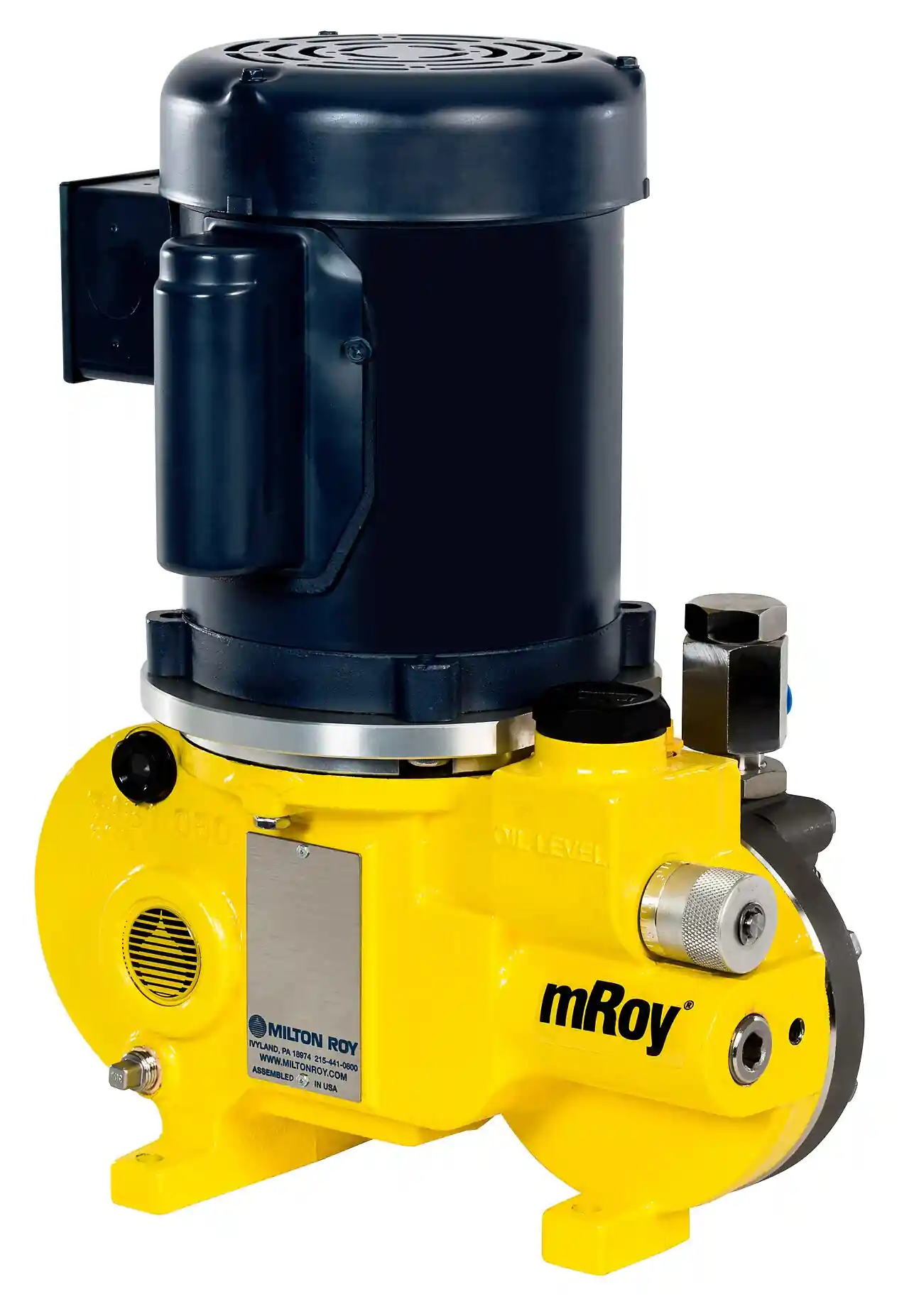
The equipment's neighbors define it by contrast. An ozone generator makes a different oxidizer by corona discharge, with higher equipment cost, no residual persistence, and superior micro-pollutant oxidation; a uv sterilizer inactivates organisms with photons and adds no chemistry at all, leaving no residual; and neither of them is a chlorine dioxide machine, though all three appear side by side in advanced treatment trains, sometimes as sequential barriers. The residual chlorine analyzer is not a generator but the monitor that reads chlorine-family residuals, ClO2 among them with the right reagents, at the compliance point. The metering pump is a component of this skid, the workhorse shown in the lead image, and the static mixer is how the product meets the process stream. This page covers the generation system as a whole; those component leaves carry their own depth.
Scale and market shape follow capacity. Small cabinet units, 5 to 50 g/h as ClO2, serve buildings, food plants, and small networks, and are bought nearly as catalog products with installation engineering. Mid-range skids, 50 to 500 g/h, serve district plants, large hospitals, and industrial loops, engineered per site chemical logistics. Large municipal and industrial trains, 0.5 to 20 kg/h and above, are engineered packages with their own chemical unloading, storage rooms, ventilation design, and compliance monitoring, purchased like any process unit with a specification and a performance test. The RFQ discipline in chapter 5 scales accordingly, but the chemistry, materials, and safety content applies at every size.
Chapter 2 / 06
How the Chemistry Sets Purity and Byproducts
The two-chemical chlorite-chlorine route is the quality benchmark. Chlorine gas, or hypochlorite and acid generating chlorine in situ, reacts with excess chlorine over sodium chlorite at mildly acidic pH; modern vacuum units run the reaction under a chlorine surplus in a packed or multi-pass reactor, and well-executed designs convert 92 to over 95 percent of chlorite with product purity above 95 percent ClO2 by weight of oxidant produced. The chlorine surplus drives the equilibrium toward ClO2 and away from unreacted chlorite, so the product stream carries little chlorite into the water, which matters because chlorite is the regulated byproduct the plant will measure in distribution.
The chlorite-acid route trades logistics for byproduct load. Hydrochloric acid with sodium chlorite is chemically simpler, no gas chlorine handling at all, and often the choice where chlorine gas storage is politically or technically unwelcome; the price is a slower, equilibrium-limited reaction that leaves more unconverted chlorite in the product and produces a higher chlorate fraction at high concentrations unless the design manages concentration and residence carefully. Three-chemical systems, chlorite, hypochlorite, and acid, generate the chlorine on the skid and land between the two: gas-free chlorine handling with conversion performance near the gas route when well engineered. The honest specification question for any route is not the name but the numbers: guaranteed conversion efficiency, product purity, and the chlorite and chlorate mass per kilogram of ClO2 generated, stated at design dose and at turndown.
Concentration discipline is the safety physics of the machine. Chlorine dioxide gas in air is hazardous from low percent levels and its solutions decompose, with light, heat, and high concentration as accelerants, back to chlorite and chlorate while evolving gas. Generator practice therefore keeps product concentration at or below roughly 3 g per liter, often 1 to 2, and either injects immediately into a flowing main or stores briefly in day tanks designed against gas accumulation, vented through scrubbers to atmosphere-safe levels. Reaction chambers are sized for residence measured in seconds to a few minutes, not hours, and the whole product path is protected against no-flow conditions, because a stagnant, concentrated ClO2 leg is how generators become incidents. This is why capacity classes are quoted as grams of ClO2 per hour, not tank volume: the machine is a flow reactor, and everything about its engineering follows from refusing to accumulate its product.
Byproduct arithmetic is a compliance budget the plant must live inside. Each kilogram of ClO2 dosed carries with it some fraction of unconverted chlorite and some chlorate from side reactions and decomposition; at a 1.0 mg per liter dose with 95 percent purity and 5 percent chlorite carry-through, the plant spends roughly 0.05 mg per liter of its 1.0 mg per liter chlorite allowance before the water even leaves the plant, and ClO2 decay in distribution converts more of the residual to chlorite downstream. Drinking water rules in the United States, under the Stage 1 and Stage 2 Disinfectants and Disinfection Byproducts Rules, cap chlorite at 1.0 mg per liter as a maximum contaminant level and ClO2 residual at a 0.8 mg per liter maximum residual disinfectant level; other jurisdictions run equivalent or stricter numbers. The generator purchase, the dose strategy, and the monitoring plan are one decision made three times, and chapter 5's RFQ block reflects that by demanding byproduct yield data at the operating point, not at the brochure point.
Oxidant demand and dose control turn chemistry into process. Raw water consumes ClO2 on contact with reduced species, iron, manganese, sulfide, organics, so the required generator capacity is sized as: demand at the point of application, plus the residual target at the compliance point, times flow, with a margin for peaks. Typical applications dose 0.2 to 1.5 mg per liter in drinking water service, 0.5 to 2 in cooling and biofilm control pulses, higher on raw manganese and sulfide duty, and control strategies run from fixed flow-paced dosing to residual-trimmed loops, a residual or ORP signal, read by the residual chlorine analyzer or an orp meter at a downstream point, adjusting the precursor feed. The dosing pump hardware, the same metering pump class the water treatment industry uses everywhere, executes the control decision, and its turndown quality decides how well the loop performs at night flows.
Materials close the chemistry argument. ClO2 attacks elastomers and most plastics by oxidation, with rates scaling with concentration and temperature; acceptable wetted materials across the skid are PVDF, PTFE, and certain high-grade stainless and titanium, while PVC, CPVC, and many polyolefins serve only in dilute zones with vendor endorsement, and natural rubber families fail outright. Gaskets and diaphragms are PTFE or perfluoroelastomer by default. The failure mode of ignoring this is not subtle: a PVC product line embrittles and cracks within months on concentrated service, and the crack is a ClO2 release. Materials compatibility lists, per wetted component, belong in the specification as data, not as a general assurance.
Chapter 3 / 06
Types, Construction, and Duty Boundaries
The vacuum-driven two-chemical generator is the modern municipal standard. A water motive stream through an eductor draws chlorine gas from its source and sodium chlorite solution simultaneously into the reaction zone under vacuum, so any leak draws air inward rather than releasing chemical outward; product concentration is fixed by the dilution water flow, and the reaction completes in a chamber or product line before injection. Vacuum units occupy the 50 g/h to multi-kg/h range, tolerate chlorine gas logistics, and pair naturally with remote chlorine gas feed installations of the kind waterworks already operate. Their purity performance is the benchmark, and their failure mode is graceful: loss of motive water drops production to zero rather than accumulating concentrated product.
Positive displacement skids, pump-driven two-chemical and three-chemical units, cover the rest of the market. Diaphragm metering pumps, one per precursor, dose into a reaction tee or small reactor; controls pace the pumps against water flow or residual feedback; and the product enters the main through an injector or a static mixer. These builds serve the small and mid ranges, 5 to 500 g/h, take acid or hypochlorite logistics without gas handling, and scale down to wall-hung cabinets serving a single building hot water loop for Legionella control. Their discipline is calibration and turndown: two pumps drift apart and the stoichiometry drifts with them, so flow proportioning, calibration columns, and pump interlocks that stop everything if either feed stops are standard scope.
Capacity classes are a purchasing language worth using precisely. A building-scale unit, 5 to 20 g/h, treats a few cubic meters per hour at disinfection doses or a recirculating loop in pulse mode. A small network or food plant takes 20 to 100 g/h. District and industrial cooling services take 100 to 1,000 g/h. Municipal trains run 1 to 20-plus kg/h with duplicated reaction trains, duty-standby precursor pumping, and full compliance monitoring. The RFQ should size the machine at the peak demand with stated turndown, not at the average, because a generator that cannot reach the peak dose spends the plant's day out of compliance at the worst hour, and a generator with poor turndown overdoses at night.
Construction scope divides into chemical storage, generation, injection, and safety zones. Storage: chlorite day tanks and bulk, chlorine gas cylinders or drums or ton containers by scale, acid tanks, each segregated per code, with containment and ventilation. Generation: the skid proper, reactors, vacuum eductors or pump heads, materials per chapter 2, with sampling ports before injection. Injection: the carrier water assembly, backflow protection, and the static mixer or diffuser in the main, sized so the product disperses before any low-flow pocket. Safety: enclosure ventilation with ClO2 gas detection interlocked to shut precursor feeds, ambient monitors at storage, emergency stop hardware, and scrubbing or vent dilution for the reaction zone exhaust. Each zone has its own standards shadow, and the package vendor's scope statement should draw these lines on a drawing, not in prose.
Duty boundaries, stated bluntly. A ClO2 generator is not an ozone system: ozone buys superior oxidation of micro-pollutants and viruses at higher capital and zero residual, ClO2 buys biofilm penetration and a persistent residual at lower capital, and advanced plants run both as sequential barriers with different jobs. It is not a uv sterilizer: UV adds no chemicals and no residual, and a network needing a distribution residual needs a chemical residual to go with photons. It is not a hypochlorite or gas chlorine feeder: those dose a different oxidant whose byproducts, the trihalomethane family, are exactly what often drives the ClO2 purchase. And it is not a commodity chemical feed skid: the product cannot be stored, so the machine is always a reactor, and buying it as a pump package without the reaction, safety, and byproduct engineering is how sites acquire an incident. The table below compresses the duty map.
Service
Construction to specify
Boundary to respect
Hospital or hotel Legionella control
Wall cabinet 5 to 50 g/h, acid-chlorite, loop residual control
Hot water system materials compatibility with oxidant
Food plant washing and CIP
50 to 200 g/h skid, three-chemical, food-grade precursors
Rinse residual targets and chlorite accounting
Municipal well field, manganese duty
100 g/h to 1 kg/h vacuum unit, flow paced
Oxidant demand spike sizing; filter run monitoring
Surface water taste and odor program
Vacuum two-chemical, residual-trimmed dosing
Chlorite allowance across distribution, not just at plant
Cooling tower biofilm control
100 to 500 g/h, pulse dosing, tower materials review
Not a potable machine; different monitoring regime
Micro-pollutant oxidation, trace organics
Ozone generation system instead
ClO2 does not mineralize trace organics like ozone
Chapter 4 / 06
Key Specification Parameters
The datasheet rows below decide whether a quoted generator matches the application. Each row is a purchase defining parameter; the paragraphs after the table explain what to demand and what a weak answer looks like.
Attribute
Typical range or options
What it decides
Production capacity as ClO2
5 g/h to 20 kg/h by class
Peak dose coverage and turndown quality
Precursor route
Chlorite plus Cl2 gas; chlorite plus acid; three-chemical
Purity, byproduct load, and site chemical logistics
Conversion efficiency, guaranteed
90 to 97 percent of chlorite
Chemical cost and chlorite carry-through
Product purity as ClO2
90 to over 95 percent of oxidant
Byproduct mass and disinfection credit
Product concentration
1 to 3 g/L at generation
Decomposition and materials stress in the product path
Turndown of dosing train
10:1 minimum quality; proportional control range
Night-flow and pulse dosing performance
Materials, wetted
PVDF, PTFE, 316L, titanium; endorsed dilute zones only
Decade of leak-free operation against an oxidizer
Safety package
Ventilation, ClO2 gas detection, interlocks, emergency stop
Permit-to-operate and incident behavior
Control strategy
Flow paced; residual or ORP trimmed; remote telemetry
Dose stability and compliance documentation
Monitoring, compliance
Residual ClO2 analyzer; chlorite and chlorate sampling
Enforceability of dose and byproduct limits
Utilities
Carrier water, power, motive water pressure, drain and vent
Installation cost beyond the skid price
Precursor consumption per kg ClO2
1.34 kg NaClO2 per kg ClO2 stoichiometric on the Cl2 route; about 1.68 on the acid route
Operating cost and storage sizing arithmetic
The conversion and purity rows are where competing chemistries reveal themselves. Demand guaranteed conversion efficiency and product purity at the design operating point, plus byproduct yield, grams of chlorite and chlorate per kilogram of ClO2, and reject any answer quoted only at ideal conditions. A 5 percent purity difference on a 2 kg per day program is 100 grams per day of byproduct budget spent before the water leaves the building, and on a chlorite-capped distribution system that is the difference between compliance and a notice. Vendors who publish these curves are the vendors whose curves survive commissioning.
The capacity row must be read with the demand arithmetic attached: peak water flow times peak dose equals required grams per hour, with demand-side consumption, iron, manganese, sulfide, organics, added before the residual target. Turndown is the companion number: a unit sized for a 1,200 g/h summer peak that cannot dose cleanly below 200 g/h will overdose every winter night and spend byproduct allowance doing it. The control row closes the loop, and the honest options are flow pacing with manual residual verification on small units, and residual- or ORP-trimmed pacing, read by a downstream residual chlorine analyzer or orp meter, on anything with a compliance story to tell.
The materials and safety rows are the decade rows. The parallel table below compresses wetted-material practice; the rule under it is one sentence: anything organic in a concentrated ClO2 stream is a scheduled failure, so the specification lists materials per component, tank, line, valve, seal, gasket, and pump head, and the vendor certifies them for the concentration and temperature actually served. The safety package, ventilation sized for the room, ClO2 gas detection with alarm and automatic feed shutoff interlocks, chemical segregation, and emergency stop, is not an accessory tier; it is the machine's license to exist on the site, and the RFQ treats it as a named scope with acceptance tests.
Skid zone and service
Materials to specify
Watch items
Concentrated product path, 1 to 3 g/L
PVDF or PTFE tubing, 316L or titanium wetted metal
No PVC, CPVC, or commodity elastomers anywhere here
Chlorite crystallization at injectors; flush design
Reaction chamber and ejectors
PVDF, PTFE, ceramic, or glass-lined parts
Residence time at turndown; clean-in-place access
Dilute injection zone in main
316L injector and static mixer, endorsed plastics
Mixer materials certified for continuous oxidant
Gaskets, diaphragms, seals
PTFE or perfluoroelastomer throughout
EPDM and rubber families fail; verify every spare kit
Storage tanks and day tanks
PVDF or endorsed HDPE per chemical, secondary containment
Vent handling and sun shielding for chlorite
The monitoring row turns chemistry into a permit instrument. Residual ClO2 at the compliance point, read continuously or on the sampling schedule the rule requires, with chlorite and chlorate verified by the analytical program, a laboratory or online water analyzer regime with proper sample conditioning, is what the regulator audits; the generator's own flow totals are what the operator audits. Both belong in the purchase, because a dosing system without a measurement story is a compliance argument the plant will lose quietly, one sampling round at a time.
Chapter 5 / 06
Selection Decision Factors and RFQ Language
The decision sequence runs as a checklist, and each step eliminates a class of quotations before price comparison begins.
Write the demand basis: peak flow, peak dose, and the oxidant demand of the water at its worst season, iron, manganese, sulfide, organics, because capacity is bought for the peak, not the mean.
Check the byproduct budget: chlorite allowance at the compliance point against expected ClO2 decay, and cap the dose strategy inside it before choosing hardware.
Choose the precursor route on logistics and purity together: gas chlorine where it is already permitted, acid-chlorite where gas is unwelcome with eyes open about chlorite carry-through, three-chemical where the balance pays.
Size capacity and turndown as a pair: peak grams per hour with a 10:1 or better dosing band, so night flows do not overdose.
Fix the control strategy: flow pacing with verification on small systems, residual- or ORP-trimmed loops where compliance is continuous.
Fix materials per component from the compatibility table, and make the vendor certify the list against served concentration and temperature.
Fix the safety case: ventilation, gas detection with feed-shutoff interlocks, segregation, containment, and emergency stop, with acceptance tests named.
Fix the monitoring and records: residual instrumentation, chlorite and chlorate sampling regime, and the data historian the permit will one day ask about.
Against the neighboring disinfection technologies, the comparison a specifier actually runs is the following, and it belongs here rather than in the page title. Against chlorine gas and hypochlorite feeding, ClO2 wins on biofilm penetration, THM avoidance, and manganese and sulfide selectivity, and loses on chemical cost per kilogram of oxidant and on the chlorite byproduct budget; plants frequently run ClO2 as the primary and a small chlorine residual for the network tail. Against the ozone generator, ozone wins virus credit and micro-pollutant oxidation and leaves no residual, at higher capital and operating cost; ClO2 is the residual oxidant and the biofilm tool; the two coexist as barriers, not rivals. Against the uv sterilizer, photons add no chemistry and no byproducts but no residual either; ClO2 is what a network carries into distribution when UV treats at the plant. Choose the barrier train the water's problems demand, not the machine a supplier has on promotion.
The application map below turns those choices into a table the project file can carry into bid evaluation.
Application
Construction to specify
Check before order
Hospital hot water Legionella program
Cabinet unit, 10 to 50 g/h, acid-chlorite, loop trim
Building materials audit; return-loop residual sensor
Municipal well field, Fe and Mn
Vacuum unit 0.1 to 1 kg/h, flow paced, filtration downstream
Demand spikes; filtered residual carry target
Surface plant, taste and odor season
Vacuum train 1 kg/h plus, residual trimmed
Chlorite across distribution at maximum residence
Bottling and food process water
Three-chemical 50 to 200 g/h, food-grade precursors
Rinse residual limits; audit trail for hygiene standards
Cooling tower biofilm program
200 to 500 g/h pulse unit, tower materials review
Fill and wood compatibility; cycle of concentration effects
The RFQ block should be written once and reused. A complete block reads: peak water flow and dose with demand basis; required capacity in g or kg per hour as ClO2 with minimum turndown; precursor route with chemical specifications and storage volumes; guaranteed conversion efficiency, product purity, and byproduct yield at the operating point; product concentration and residence design; wetted materials list per component with certification; dosing train detail, metering pump class, calibration provisions, interlock on feed loss; control strategy and instrumentation, residual analyzer or orp meter, flow signal, telemetry; safety package, ventilation rates, ClO2 gas detection with setpoints and interlocks, containment, emergency stop; monitoring scope, residual, chlorite, chlorate, sampling ports; utilities, carrier water quality and pressure, power, drains and vents; enclosure and area classification; acceptance test protocol, capacity, purity, byproduct at operating point; and documentation, materials certificates, interlock test records, and the operating data pack. A quotation returned without byproduct yield or interlock scope is incomplete at any price.
Chapter 6 / 06
Installation, Standards, Failure Modes, and Maintenance
Installation is chemical plant engineering at small scale. The skid sits in a ventilated room or enclosure with chemical storage segregated per the fire and building code treatment of oxidizers and acids; chlorite storage is shaded and cool, because heat and sunlight degrade it and crystallization at low temperature blocks feed lines; chlorine gas logistics, where the route uses them, follow the gas room practice the water industry has written down for a century. Carrier water quality and pressure are verified against the design, because vacuum units depend on motive flow and pump-driven units depend on dilution; product lines run short, sloped, and drainable, with no dead legs where dilute ClO2 can sit and concentrate; and the injection point sits in a zone of guaranteed mixing, a static mixer or a turbulent main, so the dose disperses immediately. Ventilation interlocks are proven by test: release a trace at the detector, watch the feeds stop.
Commissioning is a chemistry proof, not just a loop check. Precursor feeds are calibrated, drawdown columns against pump stroke, at working viscosity; the generator is run at design and at turndown, with product samples analyzed for ClO2 concentration, chlorite, and chlorate, and the results compared against the guaranteed conversion and purity; the control loop is exercised across the flow range; and the residual instrument at the compliance point is calibrated against a reference method. The acceptance record, capacity, purity, byproduct at two operating points, plus interlock test signatures, is the document both parties will consult for the next decade, so it is written then, not reconstructed later.
The standards frame is regulatory and chemical. In the United States the EPA Stage 1 and Stage 2 Disinfectants and Disinfection Byproducts Rules set the chlorite MCL at 1.0 mg per liter and the ClO2 MRDL at 0.8 mg per liter, with the plain-language compliance guidance published for operators; other jurisdictions run equivalent numbers under their own drinking water frameworks, and food service adds hygiene standards on chemical purity and materials. Precursor quality, sodium chlorite solution strength and purity, is a purchase specification line because it feeds directly into byproduct arithmetic. Machine-level certification regimes for generator equipment exist in several markets and evolve; where a site is subject to one, the applicability and version are confirmed with the authority having jurisdiction rather than assumed from vendor literature, and the quotation cites the certification by name if it is claimed. Chemical storage and handling answer to fire codes and oxidizer classifications; ventilation and gas detection answer to industrial hygiene exposure limits for ClO2.
Failure modes follow a short, predictable list. Feed ratio drift, the classic on multi-pump skids: pumps drift, a check valve weeps, chlorite feeds excess, purity falls, and chlorite in distribution rises; the guards are ratio interlocks, calibration discipline, and the byproduct sampling that catches what the skid does not see. Chlorite crystallization at injectors and in day tank outlets, especially at cold ambient: heat tracing or dilution, and filters on the suction side. Decomposition events in stagnant product legs: design out dead legs, protect against no-flow with pressure or flow switches that stop precursors, and vent product system high points safely. Materials failures, embrittled plastic, swollen elastomer, always at the concentration zone someone economized on: the per-component materials list is the cure; the spare parts kit should be checked against it, because the wrong spare gasket is the same failure with a fresh date. Gas detection or ventilation loss: the interlock should stop generation, and the alarm should reach someone, which is a staffing and telemetry line in the purchase. Analyzer drift on the compliance residual: scheduled calibration against reference method, or the plant quietly doses against a lie.
Maintenance economics are calibration and cleanliness. Weekly: verify pump calibration by drawdown or scale, check injector and check-valve condition, read the gas detector self-test. Monthly: clean chlorite strainers and injectors, verify interlock response, calibrate the residual analyzer against reference. Quarterly: full byproduct sampling round, chlorite and chlorate at the compliance points, trended against dose; materials inspection walk of product lines for the embrittlement signature, crazing and color change in plastics. Annually: full skid overhaul, seals, diaphragms, gaskets from the certified kit, reactor inspection, ventilation and detection functional test with records. A generator with a clean calibration log and a five-year byproduct trend is a machine whose next RFQ can be written from its own life data, which is how a purchasing file gets smarter instead of just older.
FAQ
Why generate chlorine dioxide on site instead of buying it?
Because concentrated ClO2 cannot be stored or transported as a chemical product: it decomposes explosively above threshold concentrations in gas and accumulates pressure in solution. Industrial practice therefore generates it continuously at dilute concentration, 1 to 3 g per liter, immediately before dosing. The generator is not a convenience choice but the only industrial form the chemistry allows, which is why the purchase is really a small chemical plant with dosing attached.
Which precursor route should I choose?
Choose on logistics and purity together. The chlorite plus chlorine gas route gives the best conversion, above 95 percent, and lowest chlorite carry-through, and suits sites that already handle gas chlorine. The chlorite plus acid route removes gas handling entirely but carries more unconverted chlorite into the water. Three-chemical systems generate chlorine on the skid and land near gas-route purity without gas storage. Demand guaranteed conversion, purity, and byproduct yield at your operating point from whichever route you shortlist.
How do I size the generator capacity?
Size for the peak, not the mean: peak water flow times peak dose, with the water's oxidant demand, iron, manganese, sulfide, organics, added before the residual target. Typical doses run 0.2 to 1.5 mg per liter in drinking water service and higher on manganese and sulfide duty. Buy the capacity with turndown, 10:1 or better, because a unit that cannot dose cleanly at night flows will overdose and spend your byproduct budget doing it.
What are the chlorite and chlorate limits I must live within?
Under the U.S. EPA Stage 1 and Stage 2 Disinfectants and Disinfection Byproducts Rules, chlorite is capped at 1.0 mg per liter and the chlorine dioxide residual at a maximum residual disinfectant level of 0.8 mg per liter; other jurisdictions run equivalent or stricter numbers. The working consequence is a byproduct budget: every kilogram of ClO2 dosed carries some chlorite with it, ClO2 decay in distribution converts more, and the dose strategy plus the generator's purity performance decide whether the plant stays inside that budget at maximum residence.
What wetted materials survive chlorine dioxide service?
PVDF, PTFE, 316L stainless, and titanium across the concentrated product path, with PTFE or perfluoroelastomer gaskets, diaphragms, and seals everywhere. PVC and CPVC serve only in dilute, vendor-endorsed zones; EPDM and natural rubber families fail outright. The specification lists materials per component, tank, line, valve, seal, pump head, and the vendor certifies the list against the concentration and temperature actually served, because a wrong spare gasket rebuilds the same failure with a fresh date.
What safety features are non-negotiable on the skid?
Enclosure ventilation sized for the room, continuous ClO2 gas detection with alarms and automatic precursor feed shutoff interlocks, chemical segregation and secondary containment per oxidizer and acid codes, emergency stop hardware, and safe venting of the reaction zone. On vacuum units the vacuum itself is a safety feature, drawing leaks inward. The safety package is the machine's license to exist on the site, and it is bought with named acceptance tests, not as an accessory tier.
Can a ClO2 generator replace ozone or UV in my treatment train?
Only within its chemistry. ClO2 is a biofilm penetrator and a persistent residual oxidant that avoids THM formation and knocks down manganese and sulfide; ozone is the stronger oxidant for viruses and trace organics but leaves no residual; UV adds no chemicals but also no residual. Advanced plants run them as sequential barriers with different jobs, ClO2 for residual and biofilm, ozone or UV at the plant barrier. Define which problem you are buying against, and the train orders itself.