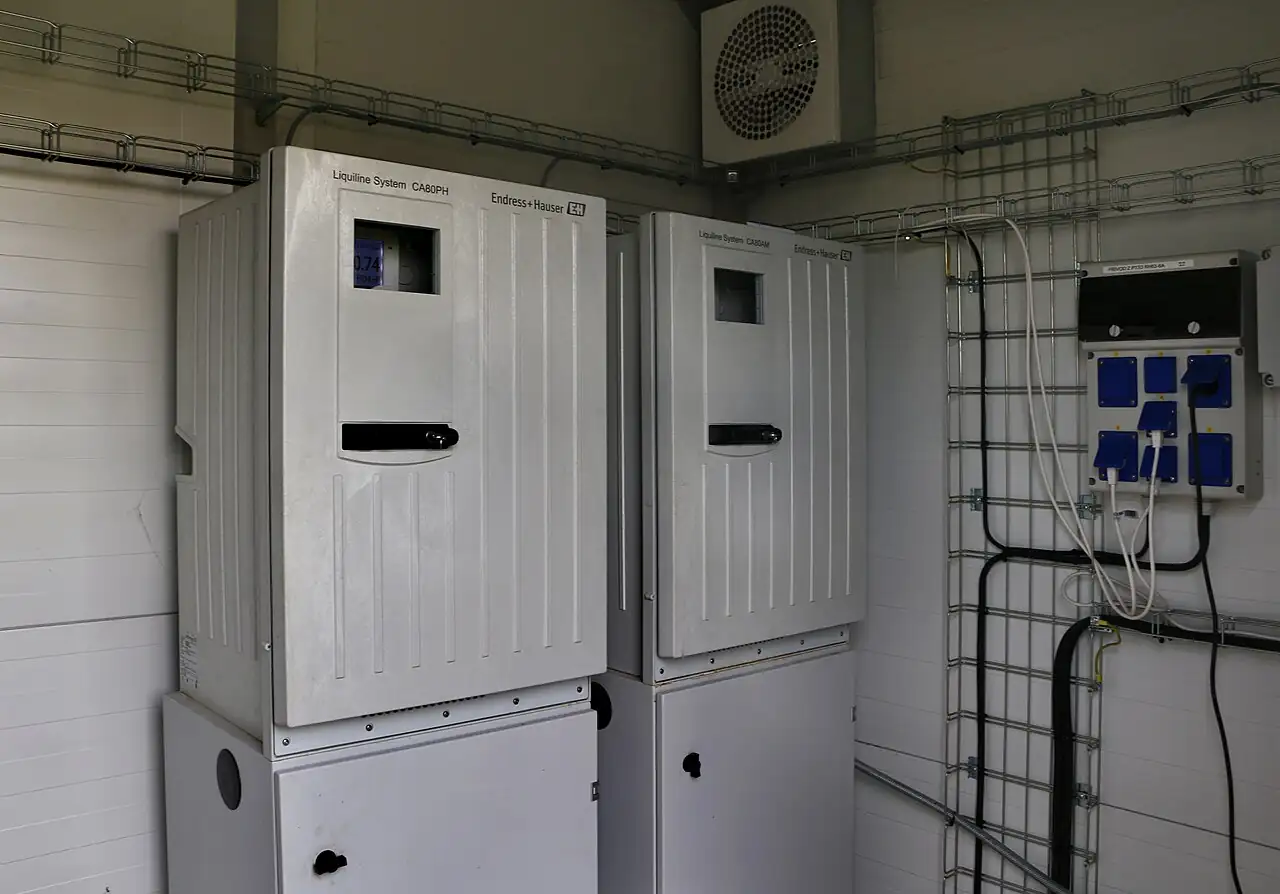
An ozone generator is the process machine that manufactures ozone, O3, on site from a feed gas of dried air or oxygen, most commonly by corona discharge: a dielectric-barrier gap across which a high alternating voltage forms a silent plasma that converts a fraction of the oxygen molecules into ozone. The product gas, typically 1 to 12 percent ozone by weight in oxygen or up to about 3 to 4 percent from air, is diffused into water in a contactor where the ozone oxidizes and disinfects, and the unabsorbed gas leaving the contactor is destroyed in a thermal or catalytic destruct unit before venting. Outputs span from a few grams per hour for a small pharmaceutical loop to hundreds of kilograms per hour for a municipal drinking water plant, and the machine is bought together with its feed gas system, contactor, and monitoring, because none of those parts works alone.
Procurement engineers meet this generator in drinking water and wastewater disinfection, in reuse and advanced oxidation trains targeting trace organics and micropollutants, in bottled and process water polishing, and in industrial oxidation duties from bleaching to odor control. The decision this page settles is narrow and practical: which generation principle fits the scale, air or oxygen feed, how much production in grams or kilograms per hour at what concentration the duty actually needs, what contacting and residual control the process requires, and how destruct, materials, and monitoring are specified so the installed system holds its permit. The answer lands as an RFQ line set: duty and dose, production and concentration, feed gas, cooling, contactor, destruct, and analyzers. Every chapter below feeds that line set so the oxidant system is bought on process data, not on a brochure photograph.
This page treats the ozone generator as a purchasing object: what corona discharge, ultraviolet, and electrolytic generation each deliver in practice, how feed gas quality fixes the machine's life, how dose, contact time, and residual are turned into production figures, and how destruct, materials, and instrumentation combine into a defensible RFQ. It is written for engineers who issue purchase specifications, not for readers who want a brochure summary.
Chapter 1 / 06
What an Ozone Generator Is and What Is Being Decided
Ozone is a powerful and short lived oxidant. It is not stored and trucked like chlorine: its half life in water is minutes and in pipework it decays into oxygen, so every ozone system is also a manufacturing plant, and the generator is that plant's core machine. In water treatment the molecule does two jobs at once, disinfection and oxidation. As a disinfectant it inactivates bacteria, viruses, and parasites such as cryptosporidium that resist chlorination, which is why surface water utilities adopted it after the cryptosporidium outbreaks reshaped disinfection regulation. As an oxidant it breaks color, taste and odor compounds, converts iron and manganese to filterable forms, and in advanced oxidation mode, ozone plus peroxide or ozone plus ultraviolet, it generates hydroxyl radicals that attack trace organics and micropollutants, the duty that has pushed ozone into reuse and contaminant specific trains.
What is actually being decided in this purchase is the size of an on site oxidant factory. The buyer commits to a production rate, a concentration, a feed gas plant, and a contacting arrangement, and every one of those decisions is irreversible once the concrete is poured. Production in grams per hour is fixed by the water flow and the applied dose, for example 1,000 cubic meters per hour at 2 milligrams per liter asks for 2 kilograms per hour of ozone plus transfer losses; concentration fixes the transfer efficiency and the contactor hydraulics; feed gas fixes the operating cost, with oxygen fed systems producing higher concentration from smaller machines but carrying the oxygen plant or liquid oxygen supply behind them. A generator bought only on nameplate output will arrive mismated to the contactor; a system bought without its monitoring will never prove the disinfection credit it was purchased for.
The plant context matters because the generator never works alone and its neighbors must not be confused with it. Upstream, the feed gas plant: dried air from a compressor train with an air dryer and filtration, or oxygen from on site generation, related in equipment class to a nitrogen generator in the sense that both separate or prepare gas from air, though the products and physics differ entirely. In the water train, an industrial filter or precision-filter stage removes particulates that would scatter ultraviolet or consume oxidant, a static-mixer or dedicated contactor distributes the ozone, and a centrifugal pump moves water through the loop. Downstream, the monitoring layer: a residual chlorine analyzer on the finished water where chlorination follows ozone for residual maintenance, an online water analyzer for the general quality record, and on the gas side an ambient ozone monitor for operator safety. The generator is one machine in that chain, and the RFQ that treats it as an appliance buys the weakest link in the chain at the highest price.
Standards and references organize the datasheet. In the United States, the Environmental Protection Agency's ozone disinfection guidance and its wastewater technology fact sheet set the accepted dose, residual, and contact time framework for disinfection credit; drinking water practice under the surface water treatment rules uses CT values, disinfectant concentration times contact time, to log inactivation credit, and ozone's CT tables are part of that machinery. International practice leans on the German DVGW worksheets for ozonation and on national drinking water codes. Industrial oxygen and ozone equipment carries pressure equipment conformity for the gas side, electrical conformity for the high voltage supply, and occupational exposure limits for ambient ozone, commonly below 0.1 parts per million in workplace air, which the destruct unit and ambient monitor exist to enforce. A datasheet that names no disinfection framework is a price tag, not a specification.
The RFQ should also name the water, because water quality fixes the dose. Ultraviolet transmittance and ozone demand of the raw water determine how much of the applied dose survives to disinfect: a humic rich surface water with high demand may need two to three times the dose of a clean groundwater for the same credit. Specify the water analyses alongside the flow: total organic carbon measured by a toc analyzer where the plant runs one, chemical oxygen demand by a cod analyzer on wastewater duties, ph meter and orp meter values, turbidity from a turbidity meter, hardness from a hardness analyzer where scaling is a risk, a conductivity meter and oil in water analyzer record where reuse waters are monitored, and dissolved oxygen meter readings where the train integrates redox chemistry. Those lines convert a brochure quote into an engineered offer, and the suppliers who engage with them are the suppliers worth shortlisting.
Chapter 2 / 06
How Corona Discharge Produces Ozone
The corona discharge generator is a plasma machine at heart. Inside a dielectric barrier arrangement, one electrode carries a high alternating voltage, tens of kilohertz at several thousand volts from a power supply, a glass or ceramic dielectric layer covers one electrode, and a narrow discharge gap, a fraction of a millimeter to a couple of millimeters, separates it from the other. Electrons accelerated across the gap split oxygen molecules, and the atoms attach to other oxygen molecules to form ozone. Only a fraction of the feed converts per pass, which is why the product is a mixture, a working concentration, rather than pure ozone, and why the industry quotes both production, grams of ozone per hour, and concentration, percent by weight, as a pair: the same machine can trade one against the other along its power curve.
Feed gas quality is the machine's life support. The plasma is sustained by oxygen but destroyed by moisture and poisoned by hydrocarbons and particulates: dew point above roughly minus 60 degrees centigrade lets nitric acid form in the gap, corroding electrodes and dielectrics, and dust scars the dielectric coating. Air fed systems therefore carry a full drying train, refrigerated plus desiccant stages, with dew point monitoring on the feed line, and oxygen fed systems inherit the purity of their source, on site pressure swing or vacuum swing units or liquid oxygen vaporized on demand. Cooling removes the waste heat, because most of the electrical input becomes heat rather than ozone: small generators cool with air, and essentially all industrial units above a few hundred grams per hour use water cooling, chilled in a closed loop, and the cooling water quality appears in the O and M manual for a reason.
The electrical layer deserves the buyer's attention because it is where efficiency lives and where failures concentrate. Modern generators use high frequency inverters, insulated gate bipolar transistors driving ferrite transformers, with power factor and soft start behavior that matter on a plant's electrical balance. Specific energy consumption, kilowatt hours per kilogram of ozone produced, is the honest comparator between offers: air fed generation sits at roughly 15 to 25 kilowatt hours per kilogram including air preparation, oxygen fed at roughly 8 to 12 with an oxygen penalty behind it, and the trade between them is decided by scale, utilization, and local power and oxygen prices rather than by any universal rule. Ask for the energy figure at the quoted concentration and cooling water temperature, because a number quoted at best case conditions will not survive the load curve.
From gas to water, the transfer step decides how much manufactured ozone actually works. Fine bubble diffusers in a depth of several meters, side stream injection with a static mixer, or dedicated turbine contactors dissolve the ozone into the water, and the contactor's hydraulic design fixes the contact time that the disinfection credit multiplies against the residual. Transfer efficiency depends directly on concentration: 12 percent by weight oxygen fed gas transfers efficiently in compact contactors, while 2 percent air fed gas needs more volume and more diffuser care for the same transfer. Off gas leaves the top of the contactor carrying the untransferred ozone and must pass a destruct unit, heater plus catalyst, before venting, both because venting ozone is illegal in most jurisdictions at meaningful concentration and because the destruct protects the operators whose exposure limit sits in the tenths of a part per million.
Two verification numbers decide whether the installed system performs. The first is the dissolved residual profile through the contactor, measured online, which is the direct evidence of dose delivered and the input to CT credit arithmetic; the second is the ambient ozone level in the generator room, monitored continuously with alarms, which is the direct evidence that the machine and its destruct are tight. Both numbers pay for their instruments within the first year of operation, the first in chemical and energy savings and the second the first time a gasket weeps.
Chapter 3 / 06
Generation Types, Feed Gas, and Construction
Three generation principles cover the market, and they do not compete on equal terms. Corona discharge is the industrial workhorse described in chapter 2, scalable from grams to hundreds of kilograms per hour, and the only realistic choice above a few hundred grams per hour. Ultraviolet generation at the 185 nanometer line makes weak ozone concentrations in air directly, without feed preparation, and serves small odor control and storage applications at the scale of a few grams per hour, where its simplicity beats corona's plumbing. Electrolytic generation makes ozone directly in water from a diamond or lead dioxide anode, producing a dissolved stream with no gas handling at all, and serves ultra pure loops, pharmaceutical points of use, and small high purity duties. The selection chapter returns to this table, but the short form is: corona for water treatment plants, ultraviolet for odor niches, electrolytic for pure water points of use.
Within corona machines, construction separates along the dielectric and electrode architecture. Plate generators stack flat dielectric plates between electrodes in a pressure vessel, offering large surface area, straightforward module replacement, and dominance in the large municipal class. Tube generators run the discharge inside ceramic or glass tubes, with high mechanical robustness and a long history in industrial duty; both architectures reach the same concentrations, and the choice between them follows maintenance philosophy and footprint more than performance. The power supply, cooling circuit, and gas preparation train are skid mounted around the generator cell, and a complete oxygen fed system occupies a room with a liquid oxygen tank or an oxygen generator outside it, a compressed air and drying train, and a cooling plant: the generator is the expensive heart, but the body around it is half the capital.
Materials make or destroy ozone systems. Ozone attacks nearly everything organic that is not specified for it: seals and gaskets must be perfluoroelastomer or PTFE classes, piping on the gas side stainless steel of adequate grade, and contactor linings selected for ozone resistance where coatings are used. A single wrong gasket in the product gas line will fail, leak ozone to ambient, and shut the plant, and the failure will be found by the ambient monitor, which is the instrument that pays for itself. Water side materials follow the same discipline, with stainless steel contactors common at municipal scale and reinforced plastic at small scale where its ozone resistance is certified. The RFQ should demand a materials declaration for every wetted and gas-path component, not a general ozone compatibility claim.
The duty map below consolidates the principle and feed choice into one table a specifier can scan before writing the RFQ; it pairs common duties with the generation and feed arrangement that serves them.
Duty
Suitable arrangement
Notes on the choice
Municipal drinking water disinfection, kilograms per hour
Corona, oxygen fed, plate or tube, water cooled
High concentration transfer; CT credit monitoring required
Wastreuse or reuse advanced oxidation train
Corona, oxygen fed, peroxide or ultraviolet hybrid
Micropollutant targeting; destruct on all vents
Bottled and process water polishing
Corona, oxygen or enriched air, tens to hundreds g/h
Residual monitoring before filling or use
Small odor control, storage rooms
Ultraviolet generator in air, no feed plant
Grams per hour class; ambient monitoring still applies
Pharmaceutical ultra pure point of use
Electrolytic cell directly in water
No gas handling; low total production, high purity
Iron and manganese oxidation before filtration
Corona, air or oxygen fed per energy study
Lower dose than disinfection; filtration following
Boundaries are worth stating bluntly. The generator is not a disinfection system by itself: dose, contactor, and monitoring complete the function, and a CT credit belongs to the train, not the machine. It is not a chlorination substitute at the ends of the network, because ozone leaves no persistent residual, and most plants finish with a chlorine based residual maintained through distribution, watched by a residual chlorine analyzer. It is not a nitrogen or industrial gas machine: a nitrogen generator on the same site serves blanketing and inerting duties and shares nothing but the air source with an ozone plant. And it is not a laboratory ozonator dragged into plant duty: glass laboratory cells at atmospheric pressure belong in the laboratory, and their use at plant scale is how projects learn the word pressure rating.
Chapter 4 / 06
Key Specification Parameters
The table below decodes the datasheet lines that decide whether a quoted generator matches the duty. Each row is a purchase defining parameter; the paragraphs after the table explain what to demand and what a weak answer looks like.
Attribute
Typical range or options
What it decides
Rated production
5 g/h to 200+ kg/h ozone
Machine size, power supply class, room layout
Working concentration
1 to 4 percent air fed; 6 to 12 percent oxygen fed by weight
Transfer efficiency, contactor size, gas handling
Feed gas
Dried air, on site oxygen, or liquid oxygen
Energy per kilogram, support plant, operating cost
Feed dew point
Minus 60 deg C or drier required
Dielectric and electrode life, nitric acid risk
Specific energy
Roughly 8 to 12 kWh/kg oxygen fed; 15 to 25 kWh/kg air fed
Lifetime operating cost; compare at quoted concentration
Cooling
Air cooled small units; water cooled industrial
Heat rejection route, chilled water demand
Contactor type
Fine bubble diffusers, side stream injection, turbine
Transfer efficiency, contact time, hydraulics
Destruct unit
Thermal or thermal catalytic on off gas
Vent compliance and operator exposure control
Residual and off-gas monitoring
Dissolved ozone analyzers, ambient ozone monitors
Dose control, CT credit, safety record
Materials
Stainless gas path, PTFE or perfluoro seals, certified linings
Corrosion and leak integrity of the ozone path
Power supply
High frequency inverter, soft start, power factor
Electrical compatibility and efficiency at load
Regulatory frame
EPA disinfection guidance, DVGW worksheets, local code
Disinfection credit route and acceptance testing
The production and concentration pair deserves its own paragraph because it is the row most often misquoted. Nameplate production at maximum concentration flatters the machine the way full-open Cv flatters a control valve: the plant operates across a load curve, and the honest comparison point is production at the required concentration and the site's cooling water temperature. Concentration fixes transfer: at 10 percent by weight, side stream injection dissolves ozone compactly, while at 2 percent, diffuser depth and contactor volume carry the duty. Ask every offer to state production, concentration, specific energy, and cooling water flow as a consistent set at two operating points, turndown and design, and treat any offer that quotes one number from the set alone as unevaluated.
The feed gas row is the economics. Air feed trades higher specific energy for a simpler site: a compressed air train with dryers, no oxygen supply, and lower capital. Oxygen feed trades an oxygen plant or liquid oxygen logistics for lower energy, higher concentration, and usually a smaller contactor. The crossover sits in the hundreds of grams per hour and moves with local power and oxygen pricing, and a two page energy study at the site's real prices beats any supplier's rule of thumb. The table below compresses the feed gas logic into the form a specification meeting can argue from.
Feed arrangement
Concentration class
Where it earns its cost
Dried air feed
1 to 4 percent by weight
Tens to low hundreds g/h; sites avoiding oxygen supply
On site oxygen generation
6 to 12 percent by weight
Mid to large plants with steady load and power advantage
Liquid oxygen vaporized
6 to 12 percent by weight
Peak shaving, small plants, logistics driven sites
Enriched air, partial
3 to 6 percent by weight
Upgrades balancing energy and simplicity
Electrolytic in water
Dissolved, no gas phase
Ultra pure and pharmaceutical point of use
The monitoring rows close the specification. Dissolved ozone residual analyzers on the contactor outlets are the process evidence, and their signal closes the loop that trims power against demand, saving energy in exactly the way a well tuned loop always does. Ambient ozone monitors in the generator room and at the destruct vent are the safety evidence, and the destruct itself, heater and catalyst in a stainless shell, is the compliance device that keeps the vent below its permitted concentration. Gas quality instrumentation, dew point on feed, ozone in product gas by ultraviolet photometer, completes the picture. The quotation that prices the cell and leaves the instruments as an exercise is not a complete quotation.
Chapter 5 / 06
Selection Decision Factors and RFQ Language
The decision sequence is short enough to run as a checklist in a specification meeting, and each step eliminates a class of quotations before price comparisons begin.
Fix the duty first: disinfection credit with its CT framework, oxidation of a named contaminant, or both; the framework names the monitoring and the acceptance test.
Fix the water: flow profile, demand, ultraviolet transmittance, and the analyses listed in chapter 1, because dose follows water, and water follows season.
Compute applied dose and transfer allowance, then production: flow times dose divided by transfer efficiency, with margin for demand spikes.
Choose the generation principle against scale: corona above a few hundred grams per hour, ultraviolet only in small odor niches, electrolytic at pure water points of use.
Run the feed gas economics at local prices: air versus on site oxygen versus liquid oxygen, including dryers, oxygen plant, and energy per kilogram at the quoted concentration.
Set the contactor and transfer route: diffusers, side stream injection with a static-mixer, or turbine, sized for the contact time the credit arithmetic needs.
Specify destruct and venting: thermal or catalytic unit, vent stack height, ambient monitoring with alarm levels, and the room ventilation philosophy.
Freeze the materials declaration: gas path, seals, wetted parts, and contactor lining, each named, not generally claimed.
Fix the evidence package: performance test at two operating points, energy verification, residual profile during commissioning, and the disinfection framework documentation.
Against neighboring disinfection and oxidation options the comparison a specifier actually needs runs as follows, and it belongs in this selection chapter rather than in the page title. Chlorination is cheap, persistent, and measured by a residual chlorine analyzer, and it remains the distribution residual of choice, but it forms disinfection byproducts and struggles against cryptosporidium; ozone earns its capital where byproduct limits are tight or parasites drive the credit. Ultraviolet disinfection, the sister technology treated on its own page as a UV sterilizer, inactivates without adding chemistry, occupies a small footprint, and pairs naturally with ozone in advanced oxidation trains, but it leaves no residual either and its efficacy hangs on transmittance and lamp maintenance. Advanced oxidation, ozone with peroxide or with ultraviolet, extends ozone into trace organics and micropollutant duty. Filtration upstream, whether an industrial-filter stage or membrane plant, protects transfer and reduces demand. Choose the chemistry the water asks for, and let the dose arithmetic, not the supplier's stock list, decide the machine size.
The application map below turns that logic into a table the project file can carry.
Application
Construction to specify
Check before order
Surface water drinking plant, parasite credit
Corona oxygen fed, multi chamber contactor, CT monitoring
Cryptosporidium CT table values and residual profile
Wastewater reuse, micropollutants
Corona plus peroxide or ultraviolet AOP train
Off gas destruct on every vent; matrix quenching allowance
Bottled water line
Tens to hundreds g/h corona, air or oxygen per study
Residual decay before filling; materials certificates
The RFQ block should be written once and reused. A complete block reads: duty and regulatory framework; water analyses and flow profile with seasonality; required applied dose and residual target with contact time; computed ozone production at design and turndown with concentration stated; generation principle and feed arrangement with dew point and purity requirements; specific energy at both points with cooling water temperature and flow; contactor type and transfer basis; destruct unit class and vent arrangement; dissolved residual, product gas, and ambient monitoring instruments with ranges and alarms; materials declaration for the full ozone path; electrical supply characteristics and inverter details; ambient conditions and enclosure class; and the acceptance test protocol, production and energy at two points, residual profile, and ambient leak survey. A quotation returned without the paired production and concentration at both points or without the materials declaration is incomplete at any price.
Chapter 6 / 06
Installation, Standards, Failure Modes, and Maintenance
Installation quality decides whether the generator reaches its design life. House the machine in a ventilated room with the ambient ozone monitor mounted where operators breathe, not where the drafts are convenient; route the product gas line in stainless steel with ozone rated seals, sloped and supported so no low point collects condensate against the dielectrics; and give the cooling circuit its own quality specification, because fouled cooling water is a slow death for generator efficiency. The feed train gets its dew point instrument where it can be read, and the liquid oxygen or oxygen generator yard follows its own code distances. Emergency stops, ventilation interlocks, and door switches that kill the high voltage before a person reaches it are the difference between a compliant room and an incident report.
Commissioning practice protects the credit. Verify production against the acceptance test before the water is ozonated in earnest, log the residual profile across the contactor at several flows, and tune the power loop against demand so the analyzer actually trims the machine. Calibrate the dissolved ozone analyzers against their reference method, and the ambient monitors against their span gas. Walk the room with a portable detector during the first weeks, because gaskets reveal themselves when hot and pressurized. File the CT arithmetic with its measured residuals, not its design residuals: the difference is what an auditor will find.
The standards set the verification frame. Disinfection practice follows the EPA guidance documents cited in the sources and the national drinking water code that adopts them; German DVGW worksheets govern much international ozonation equipment practice; pressure and electrical conformity apply to the gas and power systems; and occupational exposure limits for ambient ozone drive the destruct and monitoring design. Materials in potable service carry the local drinking water approvals, and a declared ozone compatibility for every wetted polymer is the minimum acceptable materials documentation. A specification that cites these by name transfers the burden of proof to the supplier, which is where it belongs.
Failure modes in service follow a short and predictable list. Dielectric failure: moisture or dust incursion, or a cooling failure, cracks a plate or tube and the production drops while the power draw stays; the residual analyzer sees it first as a falling residual. Backflow of water into the generator, the classic catastrophe, is prevented by check valve and vacuum break arrangements on the injection train, and the cost of the prevention hardware is trivial against the generator it protects. Cooling degradation: scaled or fouled heat exchange surfaces raise discharge temperatures, cut efficiency, and age dielectrics; the energy trend catches it months before the failure. Seal and gasket weeps: ozone finds every generic elastomer, and the ambient monitor catches what the nose cannot. Destruct catalyst exhaustion: the vent concentration creeps up, the monitor alarms, and the catalyst changeout is the fix. Analyzer drift: uncalibrated residual instruments slowly misreport the dose, and a quarterly calibration discipline keeps the CT record honest.
Maintenance intervals scale with utilization. A municipal plant services dielectrics at multi year intervals with running hours as the driver, changes air filter and dryer desiccant on schedule, calibrates analyzers quarterly, and tests ambient monitors with the same discipline. Smaller industrial units follow the same pattern compressed. Every intervention produces numbers, production at known power, residual profile, dew point, and ambient readings, and those numbers are the real condition monitor for the system. None of these checks costs a tenth of one failed disinfection audit, and every one of them feeds the next RFQ with plant-specific evidence, which is how a purchasing file gets smarter instead of just older.
FAQ
How much ozone production does my water flow actually need?
Multiply design flow by applied dose, then divide by transfer efficiency and add a demand margin. One thousand cubic meters per hour at a dose of 2 milligrams per liter needs 2 kilograms per hour of transferred ozone, so with about 90 percent transfer the generator must produce roughly 2.2 kilograms per hour, more if the water carries a high instantaneous demand. Seasonal demand swings belong in the same arithmetic: a machine sized only for the annual average will fail its worst week.
Should I choose air feed or oxygen feed?
Run the energy and logistics arithmetic at your own prices. Air feed is simpler on site but consumes roughly 15 to 25 kilowatt hours per kilogram including drying; oxygen feed runs near 8 to 12 but requires an oxygen generator or liquid oxygen supply. The crossover typically sits in the hundreds of grams per hour of production. High concentration oxygen fed gas also transfers more efficiently, shrinking the contactor, which matters where concrete volume is expensive.
What concentration should the generator produce?
Concentration and production trade along the machine's power curve, so specify them as a pair. Oxygen fed industrial machines commonly run 6 to 12 percent ozone by weight, air fed machines 1 to 4 percent. Higher concentration dissolves more readily in compact contactors and lowers the off gas burden; lower concentration can suit simple diffuser contacting at small scale. Demand the production figure at the concentration you will actually operate, not at the catalogue maximum.
Why is feed gas drying so critical?
Moisture in the discharge gap forms nitric acid, which corrodes electrodes and attacks dielectric coatings, and it derates ozone output at the same time. Industrial practice requires a dew point of minus 60 degrees centigrade or drier ahead of the generator, with an instrument to prove it. Most premature dielectric failures trace to dryer failure or maintenance, which is why the drying train and its dew point monitoring belong in the purchase package, not in a later retrofit.
What does the destruct unit do and is it mandatory?
Off gas from the contactor carries the ozone that did not dissolve, and venting it directly is both a permit problem and an operator exposure problem, with workplace limits commonly below 0.1 parts per million. The destruct unit heats the off gas, usually with a catalyst, converting ozone back to oxygen before the vent. Practical systems treat destruct as part of the machine, and the ambient ozone monitor that verifies it is the cheapest insurance in the room.
How is ozone dose verified for disinfection credit?
Through the residual and contact time arithmetic of the applicable framework, measured online rather than assumed. Dissolved ozone analyzers along the contactor give the residual profile, the contactor hydraulics give the time at that residual, and the product, CT, is compared against the inactivation tables of the EPA guidance or the adopting national code. The commissioning file should contain measured profiles at several flows, because an auditor checks the record, and the record is only as good as the analyzer calibration behind it.
Can ozone replace chlorine completely?
Not through the distribution network. Ozone is a superb primary disinfectant and oxidant, but it decays in minutes and leaves no persistent residual to protect stored and piped water, so plants that ozonate almost always finish with a chlorine based residual for the distribution system, monitored by a residual chlorine analyzer. The two chemicals do different jobs at different points in the train, and specifying both deliberately is normal practice, not redundancy.