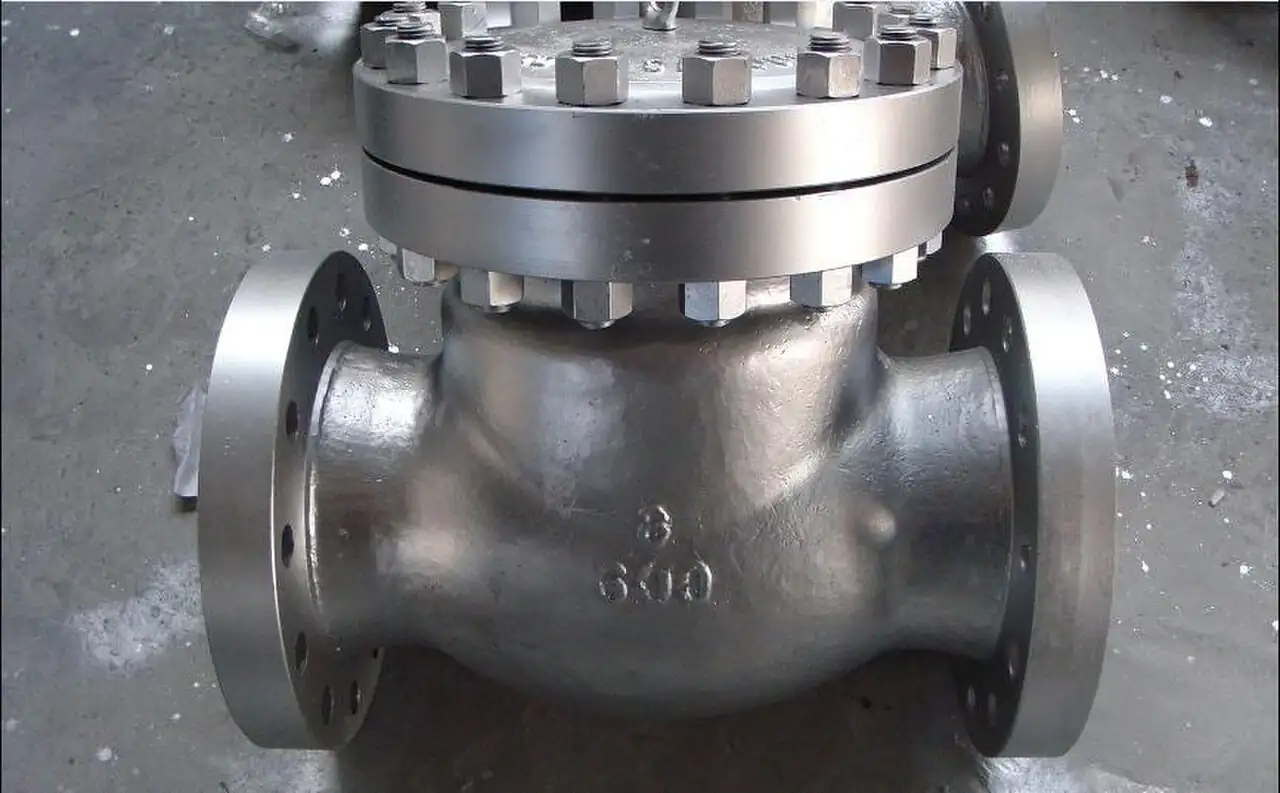
A foot valve is a check valve with a strainer screen built into the same fitting, installed at the bottom, submerged end of a pump suction line. Its single job is to hold the water column in the suction pipe when the pump stops, so the pump keeps its prime and restarts without a priming apparatus. The check element inside, a swing disc, a spring assisted poppet, or a ball, opens to flow on the suction stroke and closes on stop, and the screen keeps stones, leaves, and rag from following the water into the impeller. Sizes run from DN 40 to DN 600 in bronze, cast iron, PVC and related plastics, and stainless steel, with flanged, threaded, or plain ends.
Procurement engineers meet foot valves on well and river intakes for irrigation, on fire pump drafts, on sump and tank suction lines for process and cooling water, and on chemical transfer where a plastic build carries the duty. The decision this page settles is narrow and hydraulic: whether the installation needs a submerged inlet check at all, which internal construction survives the debris and the fluid, how much screen open area and what mesh the service demands, and what the valve and its screen cost in pressure drop against the pump's NPSH margin. The answer lands as an RFQ line set, one size, one internal type, one screen, one material, one end connection, and every chapter below feeds that line set so the prime is held by design, not by luck.
This page treats the foot valve as a purchasing object: how the submerged check holds the suction column, what the valve and its screen cost in NPSH available and why that arithmetic decides the purchase, which internal constructions survive which debris, and how installation depth, submergence, and winterization belong in the specification. It is written for engineers who issue purchase documents, not for readers who want a brochure summary.
Chapter 1 / 06
What a Foot Valve Is and What Is Being Decided
A foot valve is deliberately two components in one body, and the combination is the entire point. A check valve anywhere in the suction line can hold the column, but only at the inlet does the same fitting also screen the water the pump draws. The valve sits at the lowest point of the suction pipe, below the minimum water level of the well, sump, or tank it serves, and it works only there: submerged, oriented for vertical flow, with the screen facing open water. When the centrifugal pump above it stops, the static column presses back, the disc or ball seats, and the column stands in the pipe until the next start. When the pump runs, the element lifts and the screen passes the flow.
The system context explains the purchase. A centrifugal pump is not self priming in the ordinary sense: it must start with a flooded casing and a filled suction line, or it churns air, loses head, overheats, and damages its seal. Installations that lift water from an open sump below the pump therefore need one of four answers: a priming apparatus or vacuum system, a self priming pump that evacuates its own line, a submersible pump that sits in the fluid and needs no suction line at all, or a foot valve that keeps the line full between stops. The foot valve is the cheapest and most common answer on modest lifts, and its price is paid twice: once in hardware at the bottom of the wet end, and once forever after in added suction resistance and in maintenance that requires pulling the line or sending someone into the water.
The boundary against its neighbors must be drawn first, because the catalog families overlap on paper. A plain check valve carries no screen and installs anywhere in the line, including the horizontal run above water where it is far easier to service; the submerged inlet duty and the screening duty are what make a foot valve, also called a foot check valve in older documents, a separate purchase. A Y strainer is an inline filtration device for accessible piping, usually on the discharge side or ahead of seal and instrumentation branches, not a submerged inlet guard. Isolation on the suction or discharge side belongs to a gate valve or a ball valve, and the submerged joint at the valve itself is a flange with a gasket or a threaded connection, each with its own leak and corrosion arithmetic. The comparisons between these choices belong in the selection chapter, and only there.
What is being decided at RFQ stage is a short list with long consequences. First the necessity: whether the suction arrangement needs a submerged check at all, decided by the NPSH arithmetic in chapter 2. Second the internal type: swing disc for the lowest pressure drop, spring assisted piston or poppet build for faster closure, or gravity return ball type for large waterworks sizes and debris tolerance. Third the screen: open area at least 3 to 4 times the pipe cross section, with mesh chosen against the debris, 3 to 6 mm for clean water and coarser for raw and irrigation duty. Fourth the material against the fluid and the certification demanded, NSF/ANSI 61 for potable water among them. Fifth the ends, the installation and retrieval method, and the winterization provision. A datasheet that answers all five receives firm quotations; one that answers three receives a site visit.
The standards landscape is honestly modest, and the RFQ must compensate with explicit demands. Seat leakage is tested per ISO 5208, with soft seated builds quoted at the tight rates and metal seats at defined rates; potable water service requires certification to NSF/ANSI 61 or the local equivalent, with cUPC listing common in North America. Face dimensions and flange drilling follow the applicable standard tables for the material class, cast iron and steel patterns per ASME or EN practice, plastics per the maker's standard. There is no dedicated international product standard for foot valves comparable to what process valves enjoy, so the specification itself carries the performance requirements: proof of prime holding, stated screen open area, and pressure drop at duty flow, all in writing on the quotation.
Chapter 2 / 06
How the Valve Holds Prime and What It Costs Hydraulically
The check element does its work in both directions of every cycle. On start, the pump draws, pressure in the suction line falls, and the pressure difference across the valve lifts the disc, poppet, or ball off its seat; flow passes inward through the screen, around the open element, and up the pipe. On stop, the column above the valve reverses its tendency instantly: gravity and the static head press the water back down, and the element closes within a fraction of a second, on its own weight for a swing disc or a ball, or with spring help in a piston build. Seated, the valve turns the suction line into a closed vertical pipe standing full of water, and that standing column is the prime the next start inherits.
The hydraulic price is the real content of this chapter, because every meter of suction lift is bought from the atmosphere. At sea level, atmospheric pressure supports about 10.3 m of water column; subtract the static lift from the water surface to the pump centerline, the friction losses of the pipe, fittings, entrance, and the foot valve itself, and the vapor pressure of the liquid, about 0.2 to 0.5 m of head for water between 20 and 40 deg C, and what remains is the NPSH available to the pump. A centrifugal pump needs its NPSH required, commonly 1 to 3 m at duty flow, with margin for the fouling that will arrive. The practical ceiling for cold fresh water suction lift at sea level is therefore about 7 to 8 m, and every loss item in the sum, including the submerged valve, eats directly into that ceiling.
The screen is a flow device before it is a filter. Design practice limits the velocity at the screen to about 1.5 m/s so that the approach flow stays calm, debris is not pinned against the mesh, and the entrance loss stays small; that is why the open area is specified at 3 to 4 times the pipe cross section, so the true velocity through the mesh is a third to a quarter of the pipe velocity. Mesh of 3 to 6 mm suits clean well and tank water; raw irrigation and storm duty takes coarser openings in the 10 to 20 mm class, because the screen's job is to stop what the pump cannot pass, not to polish the water. A screen that blinds half its area multiplies its pressure drop several fold, starving the impeller exactly at peak demand, and chapter 6 returns to what that does to the pump.
Prime retention is a leak rate problem, not a strength problem. A valve that weeps slowly lets the column drain down over hours; a stone or a stick holding the disc open 1 mm can drain the line overnight, the classic morning callout, and a worn or embedded seat leaks at a rate set by the seat width and the trapped debris. Air entry matters as much as water exit: a marginal threaded joint above the water line admits air on every stop, and the column falls even with a perfect seat below. The proof is simple and belongs in commissioning: hold the column overnight with the pump stopped, and measure the loss at the sight glass or the casing vent before the system is accepted. A valve that cannot pass an overnight hold is a defect, not a variance.
Closing dynamics finish the mechanism. A swing check valve disc travels an arc and slams against its seat when the column reverses, and on long suction lines that slam arrives at the pump as a pressure spike, audible at check and hard on the casing. The spring assisted piston or poppet builds close earlier in the reversal and softer, at the price of a higher running drop, and ball types close on their own buoyancy and weight, seating with a resilience that tolerates debris, which is why waterworks and waste duty keep them. The choice among the three is a choice of which cost you prefer to carry, drop, slam, or debris tolerance, and the next chapter puts numbers on each.
Chapter 3 / 06
Types, Construction, and Duty Boundaries
Three internal constructions cover the catalog. The swing type is the oldest and simplest, a swing check valve disc on a hinge pin facing the flow, and it gives the lowest pressure drop because the flow path is nearly straight; it dominates bronze and PVC catalogs for clean water duty, closing by gravity and arc travel. The poppet or piston type, a guided disc lifted by flow and returned by a spring, closes fast and early in the reversal and suits deeper lifts and longer lines where slam matters, at a running pressure drop roughly double the swing's. The ball type seats a resilient, often rubber coated ball onto a matching seat by its own weight and backflow, tolerant of debris and available in the large waterworks sizes, with a drop between the other two.
Material selection is fluid chemistry plus certification. Bronze and lead-free brass bodies with stainless screens are the potable water default, with NSF/ANSI 61 or cUPC certification demanded explicitly. Cast iron bodies with stainless steel screens serve irrigation, dewatering, and fire duty where cost per size rules and the water is not aggressive. PVC, CPVC, and polypropylene builds carry chemical and salt service where metals corrode, limited to modest temperatures of roughly 45 to 60 deg C for PVC depending on class. 316 stainless steel bodies and screens serve seawater intake and brackish duty. Seats and seals are EPDM or NBR in most catalogs, with FKM options for chemical duty; the certificate, not the material name, is what the potable and chemical purchases actually buy.
Sizes and ends follow the piping economy. DN 40 to DN 600 covers the mainstream, with threaded ends to about DN 100, flanged ends across the range, and plain solvent or fusion ends in the plastic families. Mass grows quickly with size, and a DN 300 iron build with a full screen weighs well over 100 kg, so the installation method, a lift plate, a retrieval chain, or a diver, belongs in the purchase decision rather than the installer's improvisation. The flange drilling and the gasket facing must match the suction pipe specification, and dissimilar metal pairs, an iron valve on a stainless line for instance, get an isolating gasket and a corrosion review, because the assembly spends its entire life underwater.
The boundaries deserve blunt statements. A foot valve is not a strainer system: its screen stops stones and rag, not silt, and any pump that needs polished water needs proper filtration elsewhere, such as a basket or duplex strainer skid at grade. It is not for every suction duty: a sewage pump station handling ragging flow usually omits submerged inlet checks or specifies ball types with coarse screens, because a swing hinge is a rag catcher. A self priming pump can start on an empty line but still benefits from a foot valve on long suction runs, where re priming after every stop wastes minutes of rated flow. And a submersible pump, sitting in the fluid it pumps, needs no foot valve at all. The table below maps duties to the constructions that survive them.
Service
Construction to specify
Construction to avoid
Potable well suction, DN 40 to DN 100
Lead-free bronze or brass, EPDM seat, NSF/ANSI 61, 3 to 6 mm mesh
Uncertified brass with lead content above potable limits
Irrigation or river intake with debris load
Cast iron with stainless screen, coarse 10 to 20 mm mesh, swing type
Fine mesh that blinds within a week of season start
Fire pump draft tank
Cast iron or bronze per the site fire code, generous screen area, documented drop data
Any build without pressure drop and prime holding evidence
Chemical transfer, corrosive fluid
PVC, CPVC, or polypropylene with compatible elastomers
Metal builds without written corrosion proof for the fluid
Seawater or brackish intake
316 stainless steel body and screen
Bronze or iron galvanically mismatched to the line
Deep lift or long suction line
Spring assisted piston build for early, soft closure
Bare swing disc that slams the column at every stop
Sewage or heavy ragging duty
Ball type with coarse screen, or no submerged check at all
Swing hinge assemblies that collect rag
Chapter 4 / 06
Key Specification Parameters
The table below decodes the datasheet lines that decide whether a quoted valve matches the service. Each row is purchase defining; the paragraphs after the table explain what to demand and what a weak answer looks like.
Attribute
Typical range or options
What it decides
Nominal size
DN 40 to DN 600
Line size, screen area, and retrieval mass
End connections
Flanged, threaded to about DN 100, plain in plastics
Joint spec: drilling, gasket facing, or solvent procedure
Internal type
Swing disc, spring assisted piston or poppet, ball
plastics about 45 to 60 deg C; metals commonly 80 to 120 deg C
Material class and derate with fluid temperature
Certification
NSF/ANSI 61 or cUPC potable; ISO 5208 seat leakage evidence
Potable acceptance and the leak rate proof
Three rows deserve the hardest questions at quotation review. The pressure drop row must be answered at duty flow with a clean screen and, better, with a half fouled assumption, because the number the pump actually lives with is the fouled one, and a vendor who cannot state the clean value cannot state anything defensible. The screen area row must be a stated ratio with gross and open areas, not a photograph; stamped sheet that merely looks generous can carry 40 percent open area and quietly fail the 3 to 4 times rule. The certification row must name the potable certificate and the leakage test basis explicitly; potable acceptance is lost over paperwork, and a seat that is only claimed tight is a column that is only probably held.
The internal type decision compresses into the comparison below.
Internal type
Closing behavior
Pressure drop character
Where it earns its cost
Swing disc
Gravity arc travel, slams on column reversal
Lowest, nearly straight flow path
Clean water, modest lifts, cost driven purchases
Piston or poppet, spring assisted
Early, spring helped closure, soft stop
Roughly double the swing's clean drop
Deep lifts, long lines, slam sensitive equipment
Ball, gravity return
Buoyant lift, resilient seating on its own weight
Between swing and piston
Large waterworks sizes, debris tolerance, waste duty
None of the three internals competes with the inline check families on their own ground. A dual plate check valve or a piston check valve in the accessible run at grade closes against slam with spring help and at far lower mass than any submerged fitting, and the axial flow check valve takes the same logic to large water pipelines with the lowest pressure drop of the class, but none of them sits at the submerged inlet and none of them screens the water. The datasheet should also state the things installers discover too late: the mass of the assembly for the retrieval method, the flow direction arrow, the torque or solvent procedure for the ends, and the winterization drain provision where the climate demands it. A plastic build at DN 200 needs support and thrust restraint that metal builds find in their own flanges, and the maker's installation sheet, not folklore, is the acceptance basis.
Chapter 5 / 06
Selection Decision Factors and RFQ Language
The decision sequence is short enough to run as a checklist in a specification meeting, and each step eliminates a class of quotations before price comparisons begin.
Run the NPSH arithmetic first: static lift, pipe and fitting friction, foot valve and screen loss, vapor pressure, and the pump's NPSH required with margin; if the margin is not there, no valve choice rescues the installation.
Fix the necessity: if the suction is flooded, the pump truly self primes, or the pump sits submerged, spend the money elsewhere.
Choose the internal type against the lift, the line length, and the debris: swing for drop, piston for soft closure, ball for size and debris.
Size the screen: 3 to 4 times open area, mesh against the real debris load, and a cleaning access plan written down.
Choose the material against the fluid and the certificate: potable, chemical, seawater, and fire duty each name their own build.
State the installation and retrieval: mass, lift point, diver or chain, and the winterization drain.
Fix the evidence: clean and half fouled drop data, prime holding proof, the NSF or cUPC certificate, the ISO 5208 leakage basis, and the flange and gasket compatibility statement.
Against neighboring components, the comparison a specifier actually needs runs as follows, and it belongs here rather than in the page title. A plain check valve mounted in the accessible horizontal run holds the column as well as a submerged one and can be serviced without draining the sump, but it carries no screen and its seat faces whatever debris the line delivers, so the pairing of the two duties at the inlet is what justifies the foot valve. A plain swing check valve chosen for that inline position, the dual plate check valve and the piston check valve families with their compact spring closed constructions, and the axial flow check valve on large lines with the lowest drop in the class all serve accessible piping; none of them screens the water. A Y strainer filters accessible piping at a fineness no inlet screen would survive, usually on the discharge side or ahead of seal water branches. On deep lifts with debris, the spring assisted piston build inside a foot valve body combines what would otherwise be two purchases, while a sewage pump station that rags every hinge usually omits the submerged check entirely and solves priming through pump architecture. Isolation stays where it is serviceable: a gate valve at grade on the suction or discharge, a ball valve on small lines, and the flange standards and gasket choice at the submerged joint follow the piping specification. Choose the arrangement the hydraulic arithmetic supports, not the component a supplier has on promotion.
The application map below turns the comparison into a table the project file can carry.
Application
Construction to specify
Check before order
Well point and shallow well suction
Bronze or lead-free brass swing, DN 40 to DN 80, NSF/ANSI 61
Overnight prime hold test at commissioning
River or lake irrigation intake
Cast iron swing with stainless screen, 10 to 20 mm mesh
Screen area ratio; winter drain provision
Fire protection draft tank
Iron or bronze per the site fire code, generous screen
Drop data plotted against the fire pump curve
Cooling water sump for a centrifugal pump
Swing type sized to the 1.5 m/s screen velocity limit
NPSH margin recalculated with a half fouled screen
Chemical day tank transfer
PVC or CPVC piston build with compatible elastomers
Solvent procedure and thrust restraint method
Seawater intake gallery
316 ball type, flanged with an isolation friendly gasket spec
Galvanic pair review against the connected line
The RFQ block should be written once and reused. A complete block reads: quantity, size, and end connection with the flange drilling or thread specification; internal type by name; screen open area ratio and mesh; body, seat, screen, and fastener materials with the elastomer compound named; clean and half fouled pressure drop at duty flow; prime holding and seat leakage evidence with the ISO 5208 basis; potable certification where applicable, NSF/ANSI 61 or cUPC; mass and lifting provisions; and the installation sheet covering depth setting, floor clearance, submergence, and winterization. A quotation returned without the screen ratio or the drop data is incomplete at any price, and the cheapest valve that cannot document its column holding is the most expensive component on the station.
Chapter 6 / 06
Installation, Standards, Failure Modes, and Maintenance
Installation geometry decides whether the screen and the seat ever get a fair chance. Set the valve 150 to 300 mm above the sump or well floor so the screen does not draw settled sediment, and keep it submerged at least 300 mm below the minimum water level, more where the drawdown forms a vortex cone, because a surface vortex admits air and no valve below can hold a column full of it. Vertical suction lines are best, short and direct, with an eccentric reducer at the pump, flat side up, and an air vent on the casing so the first prime is honest rather than hoped for. Torque the flange bolts across the joint to the table, set the gasket centered and clean, and support the pipe so the submerged joint carries no bending load it was never designed for.
The standards frame was stated in chapter 1 and bears repeating as acceptance language. Seat leakage is tested per ISO 5208 with the rate named on the certificate. Potable certification runs to NSF/ANSI 61 or the local equivalent, with cUPC listing where the jurisdiction requires it. Flange drilling and facing follow the applicable ASME or EN standard tables for the material class, and the maker's installation sheet is the binding assembly procedure for ends, supports, and torque. Fire service installs inherit whatever the site fire code demands of the suction arrangement, and that code, not the valve catalog, sets the evidence. There is no dedicated foot valve product standard to hide behind, so every performance claim in the purchase is a claim the supplier must sign.
Failure modes in service follow a short and predictable list. Screen blinding: algae, leaves, and silt close the mesh, the pressure drop climbs, NPSHa collapses, and the pump cavitates with a sound like gravel in the casing; the fix is cleaning access planned at purchase, not improvised at breakdown. Flap jamming open: a stone or a stick lodges in the seat, the column drains overnight, and the pump starts dry; this is the classic callout, and the reason the overnight prime hold belongs in commissioning. Hinge pin wear: the swing disc hangs crooked and leaks at one edge; stainless pins and periodic inspection stretch the interval. Corrosion of the assembly, both galvanic and plain, attacks iron bodies and dissimilar joints underwater. And vortexing from low submergence pulls air past a perfectly healthy valve, a reminder that the valve guards the column, not the surface.
Maintenance is underwater work, so the schedule is written at purchase. Clean the screen on a calendar set by the actual debris load, weekly in season for raw intakes, quarterly for clean wells, and record the suction line pressure drop trend so the fouling rate becomes data instead of anecdote. Inspect the seat and the hinge or guide at every retrieval: a resilient seat with a nick, a pin with slop, and a ball with a flat spot all predict the next failure in advance. Winterize any installation that can freeze by draining the line and the body or heating the pit, because a frozen cast body cracks, and a cracked body is a lost prime and a wet foot. Re-run the overnight prime hold after any seat or screen intervention, since the acceptance test is also the maintenance test, and log both in the station file next to the pump curve.
FAQ
Does my pump actually need a foot valve?
A centrifugal pump lifting from an open sump below it needs one, or an equivalent: the valve keeps the suction line full between stops so the pump restarts without priming. A self priming pump can evacuate its own line and needs one only on long suction runs where re priming wastes rated flow. A submersible pump sits in the fluid and needs none, and a flooded suction from a tank above the pump holds prime by gravity if the isolation holds.
Which internal construction should I choose?
Choose on drop, closure, and debris. The swing disc gives the lowest clean pressure drop and suits modest lifts in clean water, at the price of a slam on stop. The spring assisted piston or poppet closes early and softly, right for deep lifts and long lines, and costs roughly double the drop. The gravity return ball seats resiliently, tolerates debris, and owns the large waterworks sizes. Pick the cost you would rather carry, and demand the drop data behind it.
Why does the screen need 3 to 4 times the pipe area?
The open area ratio sets the velocity through the mesh. With three to four times the pipe cross section in open mesh, the screen velocity is a third to a quarter of the pipe velocity, about 0.4 to 0.5 m/s when the line runs at 1.5 m/s, which keeps entrance loss small, stops debris being pinned onto the mesh, and leaves fouling margin: a screen that blinds half its area still flows near its clean design point. A tight screen violates all three at once.
Why does the pump lose prime overnight even with a foot valve?
Look for three leaks. A stone or stick holding the disc open a millimeter drains the column in hours, the classic case, and so does a worn or embedded seat. A joint above the water line admits air on every stop, and the column falls even with a perfect valve below. A cracked plastic body or a corroded iron screen does the same more slowly. The commissioning test is an overnight hold with the loss measured at the casing vent, repeated after any intervention.
How deep should the valve sit and how much submergence does it need?
Hold the valve 150 to 300 mm above the floor so the screen does not draw settled sediment, and keep it at least 300 mm below the lowest expected water level, more where drawdown forms a vortex cone, since surface vortexing admits air that no submerged valve can stop. Vertical suction lines are preferred, short and direct, with an eccentric reducer at the pump casing, flat side up, and an air vent for the first honest prime.
What material should I specify for potable and seawater duty?
Potable water takes bronze or lead-free brass certified to NSF/ANSI 61, with cUPC listing where the jurisdiction requires it, and a stainless mesh; the certificate, not the alloy name, is what the purchase buys. Seawater takes a 316 stainless steel body and screen, with a galvanic review against the connected line. Plastic builds, PVC, CPVC, or polypropylene, carry chemical duty where metals corrode, within temperature limits of roughly 45 to 60 deg C.
How do I account for the valve in the suction calculation?
Treat the valve and screen as one loss item in the NPSH available sum: static lift, pipe and fitting friction, entrance loss, vapor pressure head, and the valve drop at duty flow. Demand the clean and half fouled drop figures from the supplier, commonly about 0.3 to 0.6 m of head clean at 1.5 m/s line velocity, and design against the fouled number. What remains must clear the pump's NPSH required, typically 1 to 3 m, with margin, or the purchase should change.