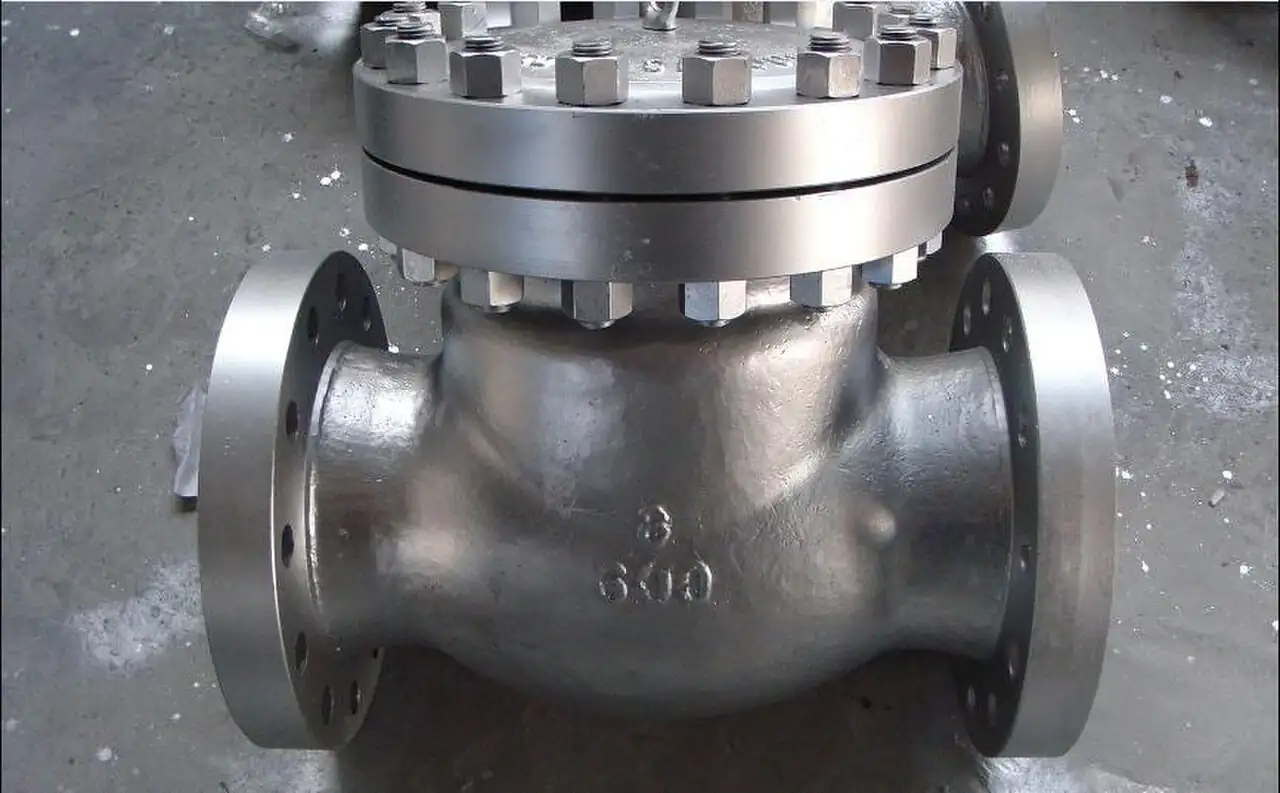
A piston check valve is an in-line, self-acting check valve whose only moving element is a piston, sometimes called a lift plug or guided disc, that slides along a machined guide bore concentric with the flow path. Forward flow lifts the piston against a spring; when forward flow stops or begins to reverse, the spring and the reverse pressure differential push the piston back onto its seat before a reverse column can accelerate. The valve has no operator, no external stem, and no linkage to adjust. It is a two-ported device with one job: pass flow in one direction and arrest reverse flow quickly enough that the line behind it does not slam.
Procurement engineers meet piston check valves on pump and compressor discharge lines, on boiler feed and condensate duties, on skid piping that includes vertical risers, and on chemical and utility package units where an unguided swing check valve would depend on gravity and a large settling distance. Sizes run from DN 15 to about DN 600 in most catalogs, with pressure classes from CL150 to CL2500. The decisions that actually land on the buyer are narrow and quantitative: whether the service needs a guided, spring-assisted element at all, which spring grade from roughly 0.03 to 0.5 bar of cracking pressure fits the hydraulic gradient, and what pressure drop penalty the guided construction is allowed to cost the system across its life.
This page decodes the piston check valve as a purchasing object: how the guided lift element behaves differently from swing and dual plate designs, what spring cracking pressure means and what it does not mean, how slam physics translates into specification numbers, and which datasheet lines decide whether a quotation matches the service. It is written for engineers who must defend an RFQ line by line, not for readers who want a marketing summary.
Chapter 1 / 06
What a Piston Check Valve Is and What Is Being Decided
The defining feature of a piston check valve is guidance over the full travel. In a swing check valve a disc hinges from a pin at the top of the body and swings through an arc with nothing controlling its return except gravity and reverse flow. In a dual plate check two spring-loaded half discs rotate about a central hinge pin. In a ball check a loose ball lifts off a seat and wanders within a cage. The piston check is the only member of the family whose element travels in a bored guide, concentric with the seat, for every millimeter of its stroke. Guidance is what buys the three properties buyers pay for: repeatable seating, controlled closure speed, and freedom from disc flutter in pulsating flow.
Specifying a piston check is three commitments at once. First, an orientation commitment: a spring-assisted piston works in horizontal lines and in vertical lines with flow upward, while a gravity lift check without a spring only works in vertical upflow, and no lift check works in vertical downflow because the element would have to fall against the flow to close. Second, a slam commitment: the spring decelerates the piston over the final millimeters of travel, which is why the design is specified on compressor discharge and on lines with rapid flow reversal where an unguided swing disc builds seating velocity. Third, a spring commitment: cracking pressure becomes a line item on the datasheet, and choosing it wrongly either starves a pump suction or fails to hold a prime.
The RFQ context is almost always rotating equipment. The classic duty is the discharge of a centrifugal pump, where the check prevents reverse rotation of the impeller when the pump stops and holds the suction column so the pump does not lose prime. The second classic duty is the discharge of reciprocating machinery, where a plunger pump or a diaphragm pump delivers pulses and a metering pump needs a low-volume, positive-seating element close to its head. A piston check with a light spring absorbs pulsation without the machine-gun chatter that an oversized swing disc produces in the same service. Buyers who state the driver, the flow range, and the reversal scenario in the RFQ receive quotable answers; buyers who state only size and class receive a default spring and hope.
The standards position of the piston check must be understood before writing a specification, because the common assumption is wrong. API 594, the check valve standard most datasheets cite, is written around wafer and dual plate designs and their face-to-face and testing requirements. Piston check valves are instead built predominantly to manufacturer standards, with body wall thickness taken from API 600 tables, pressure-temperature ratings per ASME B16.34, flanged face-to-face per ASME B16.10, and testing per API 598. The consequence for procurement is concrete: dimensions vary between makers of the same nominal size, so replacement-in-place must be verified drawing by drawing, and the test acceptance criteria should be written into the purchase order rather than inherited by reference to a standard that does not cover the design.
The valve also sits inside a neighborhood of equipment that must be named in the RFQ. Isolation is handled by a gate valve or a ball valve flanged on either side, or by a butterfly valve at larger diameters and lower classes where weight matters. New lines are protected during commissioning by a Y strainer immediately upstream so weld bead and scale do not engrave the seat on the first closure, and on stock and slurry circuits the isolation seat beside the pumps belongs to a knife gate valve because no guided check belongs there at all. And the boundary against the safety relief valve should be stated plainly: the check controls direction of flow, while the relief valve controls pressure; one cannot substitute for the other, and a system that needs both must buy both. Buyers who draw this neighborhood on the RFQ cover sheet get quotations that fit the skid rather than quotations that fit only the valve.
Chapter 2 / 06
Lift Dynamics, Spring Loading, and Slam Physics
Opening is a force balance. Line flow approaches the seat, and the pressure difference across the piston, acting on the annular piston area, produces an opening force. The valve cracks when that force exceeds the spring preload plus the element weight. The piston then rises along the guide, and flow passes around it through the annulus or through machined ports in the body, depending on the pattern. Because the element is guided, the lift achieved at any flow rate is repeatable: the same velocity produces the same open area, cycle after cycle. This is the mechanical reason a piston check can be sized from a Cv table with confidence, while an unguided disc that hangs at partial angles cannot.
Cracking pressure is the differential needed to begin lift, and it is set entirely by the spring. Catalog grades cluster at roughly 0.03, 0.05, 0.1, 0.2, 0.35, and 0.5 bar. A light 0.03 to 0.05 bar spring suits pump discharge, where every millibar of unnecessary drop erodes the available suction margin. A heavier 0.2 to 0.5 bar spring is chosen to hold a static column, to prevent siphoning on a chemical feed line, or to keep the element seated against minor backpressure from a parallel pump. The spring must also survive the temperature: 316 stainless steel springs serve to about 200 deg C, while Inconel X-750 or equivalent alloys carry hot water and steam duty beyond that. Cracking pressure is not a sealing rating; seat tightness at rest comes from the reverse differential pressing the piston into the seat, with the spring adding a small preload force.
Slam physics is where the guided design earns its price. When a pump trips, the column behind the valve decelerates, reverses, and accelerates backward until the element closes. The surge pressure generated at closure equals the fluid density multiplied by the pressure wave speed multiplied by the change in reverse velocity, the classical water hammer relationship. In a steel water line the wave speed is near 1,400 m/s, so every 1 m/s of reverse velocity arrested instantly is worth roughly 14 bar of surge. A swing disc that free-falls through its arc reaches the seat with uncontrolled velocity and converts that column energy into noise and pressure spike. A spring-loaded piston is decelerated by the spring over the last part of its travel, arriving at the seat with low velocity, which is the mechanical definition of slam resistance that appears in supplier literature.
Stability between full open and full closed is the second dynamic property. A piston check should spend its working life at full lift at normal flow, and the common rule of thumb is a continuous line velocity of about 2 to 3 m/s for clean liquids to keep the element there. At partial lift the piston oscillates in the turbulence, seating and unseating, which the ear reports as chatter and the seat reports as a wear ring within months. Pulsating service is the extreme case: the discharge of a reciprocating compressor or a plunger pump reverses local momentum many times per second, and the spring holds the element against the seat between pulses instead of letting it hammer. This is why compressor packages, where a swing check would clang on every pulse, standardize on the guided lift design.
Pressure drop is the accepted penalty. Flow through a piston check makes roughly two 90 degree turns, into the guide annulus and back to the line axis, where a full-open swing check presents nearly a straight passage. As representative figures, a DN 50 piston check carries a Cv near 150 where a full-port swing check valve reaches about 230, and the gap persists across the size range. Translated into operating cost, an extra 0.3 bar of permanent drop on a line moving 100 cubic meters per hour of water absorbs about 1.1 kW of shaft power at typical pump efficiency, running continuously. Chapter 5 converts that arithmetic into a purchase rule: pay for the guided element when slam, orientation, or pulsation demand it, and pay for the lower-drop design when they do not.
Chapter 3 / 06
Body Patterns, Materials, and Duty Boundaries
Three body patterns cover the family. The in-line straight pattern puts the seat, piston, spring, and guide on the line axis inside a compact barrel body; it is the volume product, the cheapest per class, and the pattern with the highest pressure drop. The Y-pattern body angles the guide bore at about 45 degrees off the line axis, which lowers the drop toward globe-valve territory and gives direct access to the seat and spring through a bonnet without removing the valve from the line. The bonnetless or cartridge pattern welds or threads the guide assembly into the body as a sealed unit; it is compact and tamper-proof, but seat service means removing the valve. Gravity lift checks, the springless ancestor of the family, survive in vertical water and condensate lines where nothing else fits the space.
Seat construction divides into soft and metal. Soft seats in PTFE suit chemical and clean utility service to about 200 deg C; PEEK seats push the soft-seat limit toward 250 deg C and add extrusion resistance at high differential; metal seats, typically a 17-4 PH piston lapped against a Stellite or hardened stainless seat ring, serve steam and hot hydrocarbon service from about 250 to 450 deg C depending on class and body material. Soft seats reach bubble-tight shutoff against the lapped piston face with low seating force, which is why low cracking springs and soft seats are usually specified together on instrument and chemical feed lines. Metal seats tolerate heat and abrasion but leak slightly by design, with acceptance defined by the test class written into the order.
Body and trim materials follow the fluid. Carbon steel WCB bodies with A105 or F316 trim dominate utility water, condensate, and hydrocarbon service to about 425 deg C. CF8M stainless steel bodies, or full 316L in smaller wrought sizes, serve chemical feed, demineralized water, and clean-in-place duties; stainless steel is also the default answer for any line that sits wet and idle for months. Duplex 2205 appears in seawater and high chloride cooling duties where standard stainless steel pits and crevices. Spring and guide materials deserve a line of their own in the RFQ because they, not the body, set the corrosion limit: a 316 spring inside a duplex body quietly becomes the weakest member. Sour gas service adds NACE MR0175 material qualification across body, trim, and spring.
The duty boundaries are equally concrete. Guide clearances are small, on the order of a few hundredths of a millimeter, so solids-laden fluids pack the guide and stick the piston; slurries, paper stock, and sandy water are outside the family, and slurries that must be isolated rather than checked belong to a knife gate valve in any case. Viscosity above roughly 300 to 500 cSt slows closure and stiction rises, so heavy oils either get a heated body or a different check family. The valve is not a throttling element; flow regulation is the globe valve trade, and a partially lifted piston is a chattering piston. And the standing rule for every check valve: it is direction protection, never overpressure protection, so the safety relief valve conversation is separate.
The duty map below consolidates the boundaries into one table a specifier can scan before writing the RFQ; each row pairs a service with the piston check construction that survives it and the shortcut that causes callbacks.
Service
Construction that survives
Shortcut to avoid
Centrifugal pump discharge, clean water
WCB body, 316 trim, 0.03 to 0.05 bar spring, soft seat
0.35 bar spring stealing NPSH margin
Reciprocating compressor discharge
Y-pattern, metal seat, high-temperature spring alloy
Gravity lift check (cannot close between pulses)
Vertical riser, flow up
Spring-assisted piston, any body material
Unguided swing disc installed off vertical
Boiler feed water above 180 deg C
WCB or alloy body, Stellite-faced metal seat
PTFE soft seat above its 200 deg C limit
Chemical feed with siphon risk
CF8M stainless steel body, PTFE seat, 0.35 to 0.5 bar spring
Light spring that lets the column siphon back
Seawater cooling
Duplex 2205 body and trim, matched spring alloy
CF8M body with 316 spring (pits, then sticks)
Slurry or paper stock
Not a piston check duty; select a solids-tolerant family
Any guided element (guide packs and binds)
Compressed air or inert gas
Y-pattern or straight, light spring, metal or PEEK seat
Water-service Cv assumptions on gas sizing
Chapter 4 / 06
Key Specification Parameters
The table below decodes the datasheet lines that decide whether a quoted piston check valve matches the service. Each row is purchase-defining; the paragraphs after the table explain what to demand and what a weak answer looks like.
Attribute
Typical range or options
What it decides
Nominal size
DN 15 to DN 600
Line velocity at normal flow, and whether the element stays at full lift
Pressure class
CL150 to CL2500; PN equivalents
Body rating per ASME B16.34 and the test pressures applied
Body material
WCB, CF8M or 316L stainless steel, duplex 2205
Corrosion envelope, temperature ceiling, and code acceptance
Seat type
PTFE to 200 deg C, PEEK to 250 deg C, metal to about 450 deg C
Leakage expectation and the temperature derate that follows from it
Cracking pressure
0.03 to 0.5 bar by spring grade
Hold-open margin, siphon prevention, and suction head penalty
Flow coefficient
Cv about 40 at DN 25, 150 at DN 50, 650 at DN 100, 3,200 at DN 200
Permanent pressure drop and the pump power it consumes
Orientation
Horizontal, vertical up (spring types); gravity types vertical up only
Installed position admissibility and the closure behavior attached to it
End connections
Flange per ASME B16.5, butt weld, socket weld, threaded
Face-to-face per ASME B16.10 and the fit of the skid spool
Test acceptance
API 598 or ISO 5208 seat and shell tests
The zero visible leak criterion applied at the seat during factory test
Design references
API 600 wall tables, ASME B16.34, API 594 as family context
Which document the supplier actually built and tested to
Cracking pressure deserves the paragraph the table cannot hold. It is a spring property measured as the differential at first lift, not a sealing rating and not a backpressure the valve will reliably hold; seating tightness against reverse pressure comes from the differential itself. Two errors recur in RFQs. The first is ordering the standard 0.1 bar spring on a marginal suction: 0.1 bar is roughly 1 m of water column subtracted directly from NPSH available, which is exactly the margin a hot-water suction does not have. The second is ordering a light spring to protect NPSH on a line that needs to hold a static column against siphon, then wondering why the chemical feed runs backward overnight. State the hydraulic reason for the spring choice in the RFQ and the supplier picks the grade for the stated reason.
The Cv row needs its test condition. Creditable datasheets publish Cv at fully open lift with the fluid stated; gas-service valves should be sized on gas data, not water analogies, because compressible flow through the short annulus chokes earlier than liquid logic predicts. When the purchase is energy-significant, ask for pressure drop versus flow across at least three points, not a single catalog Cv, and verify that the quoted Cv is not the Y-pattern figure pasted onto a straight-pattern quotation. A supplier who cannot state the test condition for the Cv figure has not tested it for your size and class.
Testing language closes the specification. Seat and shell testing per API 598 or ISO 5208 gives the acceptance criterion that the manufacturer-standard design otherwise lacks: shell test at 1.5 times the 38 deg C rating, seat test at 1.1 times, no visible leakage at the seat for the durations the standard assigns by size. Since API 594 does not govern this design, the test paragraph belongs in the purchase order verbatim, along with material certification EN 10204 3.1 for body, trim, and spring. These two lines convert a catalog product into a documented one.
The comparison table below positions the piston check against the rest of the check family on the four attributes that drive selection: closure behavior, orientation tolerance, pulsation tolerance, and pressure drop. It is the table to bring to the specification meeting.
Attribute
Piston check
Swing check
Dual plate wafer
Ball check
Closure control
Spring decelerates element; slam resistant
Disc free-falls; slam prone
Springs on plates; tolerant
Ball drops; moderate
Vertical upflow
Yes, spring types
Poor without special spring
Yes
Yes, caged designs
Pulsating service
Good; element held between pulses
Poor; disc flutters and chips
Fair
Fair
Relative pressure drop
Highest of the family
Lowest
Low
Moderate
Viscous fluids
Sticks above a few hundred cSt
Tolerant
Tolerant
Best of the family
Size and class span
DN 15 to DN 600, CL150 to CL2500
DN 50 to DN 1500 typical
DN 50 to DN 1200, mostly CL150/300
DN 8 to DN 200 typical
Chapter 5 / 06
Selection Decision Factors and RFQ Language
The decision sequence for a piston check valve is short enough to run as a checklist in a specification meeting, and each step eliminates a class of quotations before price comparison begins.
Confirm the reverse-flow scenario: pump trip, parallel pump backflow through an idle machine, or column reversal on shutdown. The scenario sets how fast the element must close and how much slam resistance is worth.
Confirm the installed orientation: horizontal, vertical up, or both across the package. Spring-assisted pistons cover all admissible positions; gravity types do not.
Compute normal line velocity and check it lands in the 2 to 3 m/s band that keeps the piston at full lift; resize the valve, not the line, if the velocity falls far below it.
Choose cracking pressure from the hydraulic reason: light 0.03 to 0.05 bar for suction-side protection, heavy 0.35 to 0.5 bar to hold columns and stop siphon.
Fix seat and trim from fluid and temperature: soft seats to 200 deg C, PEEK to 250, metal beyond; stainless steel or duplex bodies where the line sits wet or chlorinated.
Quantify the acceptable pressure drop and its energy cost at design flow, and compare the piston check penalty against the cheaper swing option on the same sheet.
Write the test paragraph per API 598 or ISO 5208 and the material certificate requirement into the order, since API 594 does not govern this design.
State the neighbors: isolation valve type each side, upstream Y strainer during commissioning, and the pump or compressor the valve protects.
Application mapping turns the checklist into purchases. The table below pairs the recurring applications with the construction that each one actually needs.
Application
Recommended construction
Rationale
Centrifugal pump discharge, clean water
Spring piston, 0.03 to 0.05 bar, soft seat
Protects against reverse rotation at minimum suction penalty
Vertical cooling riser
Spring piston, orientation free
Unguided designs depend on gravity the layout does not give
Compressor discharge, pulsating gas
Y-pattern, metal seat, heat-rated spring
Element held between pulses, serviceable in line
Chemical feed with siphon risk
Stainless steel body, PTFE seat, 0.35 to 0.5 bar spring
Column held when the metering pump stops
Condensate return, 150 to 200 deg C
WCB body, metal or PEEK seat
Temperature ceiling of soft seats respected
Large low-pressure water main
Consider dual plate instead
Lower drop and cost where slam is not the driver
Slurry or stock line
Not a piston check duty
Guide clearance packs; a knife gate valve covers isolation, and check duty needs a solids-tolerant family
Energy arithmetic belongs in the selection file because the piston check penalty is paid every operating hour. Permanent drop across the valve at design flow times flow times a pump efficiency factor gives the continuous kilowatts the choice consumes; a difference of 0.3 bar at 100 cubic meters per hour is about 1.1 kW, which is roughly 9,600 kWh per year on continuous duty. Against that, the slam-resistant guided element buys protection against the transient: an uncontrolled 1 m/s reverse column in a steel water line can add 14 bar of surge, which is the difference between a quiet stop and a gasket failure at 3 a.m. When the line is driven by a VFD that ramps the pump down gently, or the motor coasts down through a soft starter profile that limits the reversal rate, the slam argument weakens and the cheaper low-drop family wins; when the driver trips dead, it does not.
The RFQ block should be written once and reused. A complete block reads: quantity and size; class and body material; seat and trim materials with temperature limits; spring grade in bar with the hydraulic reason stated; orientation required; required Cv at design flow with the acceptance that the supplier quote pressure drop at that flow; design references, API 600 wall, ASME B16.34 rating, ASME B16.10 face-to-face; test requirement, API 598 or ISO 5208 seat and shell with zero visible seat leakage; material certificates EN 10204 3.1 for body, trim, and spring; and the drawing package expectation, external dimensions, weight, and the Cv table by size. A quotation returned without the spring grade or the Cv test condition is incomplete regardless of price.
Two neighboring lines convert startup arguments into checked boxes. First, isolation: a piston check is not an isolation device, so every installation needs a gate valve or ball valve arrangement, or a butterfly valve at the larger diameters where quarter-turn isolation wins on weight, that guarantees positive shutoff for maintenance, and the face-to-face of both valves belongs in the same RFQ so the spool fits. Second, protection of the pump itself: the upstream Y strainer catches commissioning debris before the first closure, and on the pump side, a dripping mechanical seal or reverse rotation noise after a trip is the field evidence that the check is not seating, which maintenance should treat as a valve fault and not a seal fault until proven otherwise.
Chapter 6 / 06
Installation, Standards, Failure Modes, and Maintenance
Installation starts with the flow arrow, because a lift check installed backward is a fast, reliable blockage. Orientation comes next: the spring-assisted design accepts horizontal and vertical upflow, and the gravity design accepts only vertical upflow, a limit that some catalogs bury in a footnote. Location matters as much as direction. Five pipe diameters of straight run upstream of the valve, clear of elbows, reducers, and the discharge nozzle of a pump, lets the piston see a developed velocity profile instead of a swirl, and swirl is what makes an otherwise healthy valve chatter. Provide a spool or flange spread clearance for maintenance access, because a bonneted Y-pattern can be serviced in line only if the bonnet can actually come off.
Commissioning practice protects the seat for the life of the valve. Flush new lines before the first closure, or install the upstream Y strainer before anything else and clean it within the first days; a single weld bead trapped under the piston face on the first shutoff writes a permanent leak path into the seat. After first pressurization, listen to the valve at minimum, normal, and maximum flow. A healthy piston check is quiet; a rattling element at low flow is sizing feedback that belongs in the file, not background noise to be tolerated. Verify the isolation valves each side actually close against full differential before relying on them for the check valve service interval.
The standards frame for this design is a patchwork and must be quoted as one. API 594 governs the wafer and dual plate part of the check family and provides family context, not this geometry. API 600 supplies the wall thickness tables the bodies are machined to, and ASME B16.34 supplies the pressure-temperature ratings by class. ASME B16.10 fixes flanged face-to-face, ASME B16.5 the flange itself, and API 598 or ISO 5208 the acceptance tests already discussed. API RP 615, the valve selection overview, is the practical bridge document when a project specification asks for a single reference on choosing among check types. A purchase order that cites this set line by line is enforceable; one that cites only API 594 is citing a standard the supplier did not build to.
Failure modes in service follow a short and predictable list. Spring fatigue and breakage leads it on compressor and pulsating duty: cycles accumulate in the millions, and a broken spring shows up as slow closure and a new metallic rattle, solved by a spring kit matched to the original alloy. Guide wear comes second: the bore and piston lap each other elliptically over years, the element starts to cock, and leakage appears at low differential; the fix is a piston and guide replacement, which is why the RFQ should list wear parts as a priced option. Stiction in aging or varnished oil is third: a piston that hesitates off its seat at startup is telling the operator the fluid has exceeded its service life. Seat wire-drawing, the fine erosion channel cut by high differential across a nearly closed element, marks lines that trip often; chatter marks from sustained partial lift mark lines that are oversized. Each of these conditions is visible or audible before it is expensive.
Maintenance intervals scale with duty. A pump discharge valve cycled only by power failures needs an annual function check: exercise off its seat, listen at operating flow, and inspect the seat at the first convenient outage. Continuous compressor or feed duty deserves quarterly attention, listening at minimum and maximum flow, checking the upstream strainer condition as a proxy for what has been reaching the guide, and trending any pressure drop increase across the valve. Keep a spring kit and a soft seat set in stores for critical sizes, and record the spring alloy and grade from the original order, because the most common delayed-repair story in this family is a valve waiting weeks for a spring nobody can specify. Every one of these checks is cheaper than the unplanned drain-down the line needs when the check fails held open.
FAQ
What cracking pressure should I order for pump discharge protection?
Use the lightest grade that meets the duty, typically 0.03 to 0.05 bar for clean pump discharge. Every 0.1 bar of cracking pressure subtracts about 1 m of water column from the suction side, which comes straight out of the NPSH margin. Reserve the heavier grades, 0.35 to 0.5 bar, for duties that must hold a static column or stop siphoning when the pump stops. State the hydraulic reason in the RFQ so the supplier grades the spring for that reason.
Can a piston check valve be installed in a vertical line with flow upward?
Yes. A spring-assisted piston check works in horizontal lines and in vertical lines with flow upward, because the spring returns the element instead of gravity. Gravity lift checks without springs work only in vertical upflow, and no lift check design closes properly in vertical downflow, since the element would have to move against the flowing column to seat. Confirm the admissible orientations in the datasheet for the exact pattern and spring grade being quoted, and state the installed orientation in the purchase order.
Why does my piston check valve chatter at low flow?
Chatter means the piston is living at partial lift, which happens when normal flow velocity is too low to hold the element fully open. The working rule is about 2 to 3 m/s of continuous line velocity for clean liquids; below that, turbulence seats and unseats the element repeatedly. The fix is a smaller valve, a line change, or acceptance of earlier seat service. Sustained chatter is also a symptom of a valve sized for a future expansion that has not arrived yet.
How does a piston check valve differ from a swing check valve?
The piston element is guided over its full travel and returned by a spring, so it closes with controlled, low seating velocity and tolerates pulsating flow and vertical installation. A swing disc hangs on a hinge, closes by gravity and reverse flow, slams on fast reversal, and prefers horizontal lines with sustained velocity. The piston design costs more permanent pressure drop because flow turns through the guide annulus, while the swing design offers the lowest drop in the family. Choose by closure duty and orientation, then price the drop.
Does API 594 apply to piston check valves?
Not directly. API 594 is written around wafer and dual plate check designs, and piston check valves are built mainly to manufacturer standards that borrow body wall thickness from API 600 and ratings from ASME B16.34. The enforceable lines in a purchase order are therefore the wall and rating references, face-to-face per ASME B16.10, and testing per API 598 or ISO 5208 with zero visible seat leakage. Citing API 594 alone does not specify this product.
Can a piston check valve handle viscous fluids?
Only within limits. Above roughly 300 to 500 cSt the element moves slowly, closure lags the reversing column, and the guide can stick after idle periods, so the valve starts to leak on reversal and chatter on start. Heated bodies, lighter springs, or caged ball check designs handle heavier oils better. If the viscosity varies with season or temperature across the duty cycle, evaluate the worst, most viscous condition, not the annual average, and ask the supplier for viscous-service references at that condition.
Is an upstream strainer necessary for a piston check valve?
On new or modified lines, yes. The guide clearance is small, and weld bead, scale, and gasket debris from construction will pack the guide or engrave the seat on the first closure, causing sticking or a permanent leak path. A Y strainer installed upstream for the commissioning period, cleaned within the first days of operation, removes that risk at trivial cost. For established clean lines the strainer is optional, though it still simplifies seat inspection by catching pipeline scale after maintenance elsewhere in the plant.