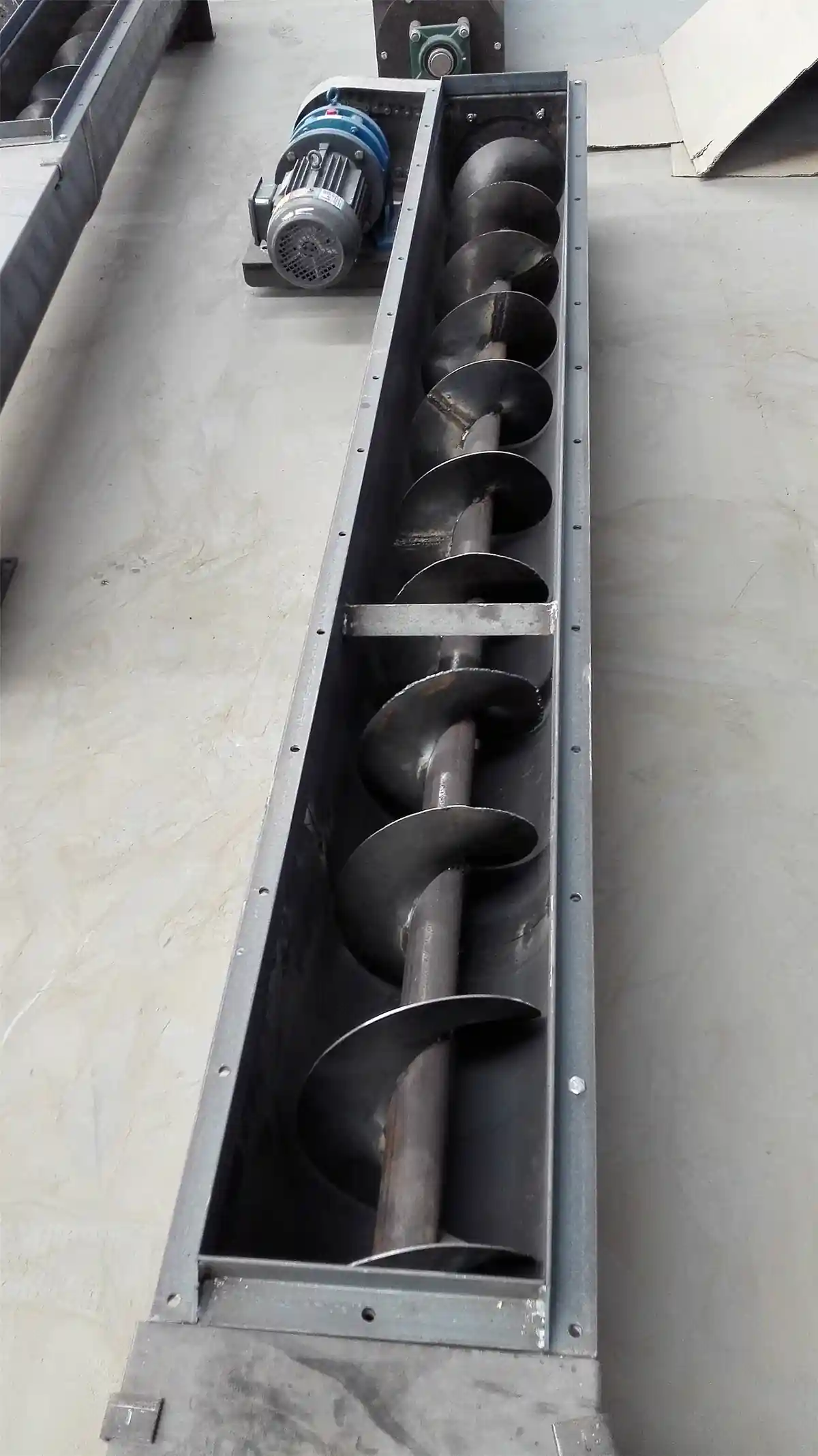
A ribbon blender is a horizontal U-shaped trough with a rotating shaft carrying inner and outer helical ribbons, counterwound so the outer ribbon conveys material toward one end while the inner ribbon returns it toward the other, folding a batch of dry powder, granules, or light paste over itself until it is uniform. It is the default machine of dry blending, the one in every spice plant, compound feed mill, plastics compounder, powder coating line, and dry chemical plant, because it mixes almost anything dry to specification in minutes, discharges by gravity, wears slowly, and costs less per liter of capacity than any alternative with the same tolerance for awkward materials.
This page treats the ribbon blender as a purchasing object: how working capacity and fill level size the trough, how ribbon geometry and tip speed set blending time and uniformity, how jackets, vacuum, and sanitary finishes extend the machine into heating, drying, and food duty, and how discharge, dust containment, and the weighing that feeds it close the installation. It stands beside the high shear mixer, which disperses rather than folds, and the static mixer, which blends inline without moving parts, and it is not the foundrysand mixer or power mixer of the casting trade.
The decision concentrates in five places: the batch size and the product's density range, which size the trough; the blend's difficulty, minor percentages, cohesion, liquid addition, which set mixing time and agitator geometry; the construction class, carbon, stainless, or sanitary, that the product demands; the process options, jacket, vacuum, liquid spray, that the recipe wants; and the discharge and containment, valve, dumping, and dust collection, that keep the blend in the package instead of the room. Get those right and drive power, ribbon pitch, and cycle time follow.
Chapter 1 / 06
What a Ribbon Blender Is and What Is Being Decided
The machine is geometrically simple: a horizontal trough with a flat or slightly dished bottom, radius sides, and a flat top with a cover; a shaft running its length on outboard bearings, end plates with seals; and on the shaft, the ribbon assembly, outer ribbons of close clearance to the trough wall, inner ribbons of smaller diameter on the same shaft, wound in opposite senses. Turn the shaft and the outer ribbon moves product axially one way along the wall while the inner ribbon moves it back along the center: the batch circulates radially and axially at once, folding a thousand times over a mixing cycle of five to twenty minutes. Variations, paddle ribbons for sticky or abrasive duty, plows for heavy paste, double ribbons for fast blend, fill the same trough.
What the machine does is convective blending at low shear. It moves the whole batch, large fractions of it per revolution, rather than shearing localized zones the way a rotor stator machine does, and that suits dry solids, whose blending problem is distribution rather than dispersion: getting the 0.5 percent minor ingredient to appear in every sample, not breaking down its particles. The uniformity target is expressed as coefficient of variation of sample assays, and a well specified ribbon blender on free flowing powders reaches a CV of 3 to 7 percent in minutes and approaches its random blend limit, the CV that perfect mixing of the particle sizes would give, within the cycle time the vendor quotes. Cohesive powders, liquid additions, and fragile agglomerates modify that story, and the geometry and time adapt.
What is being decided, in purchasing terms, is five things. First the capacity: batch liters of working volume against total trough volume, because the fill level, typically 30 to 70 percent of total, is a mixing variable, not just inventory. Second the blend duty: ingredients, minor percentages, densities, cohesion, and whether liquids go in, which set ribbon geometry, tip speed, and time. Third the construction: material of construction and surface class from carbon steel industrial to 316 pharmaceutical polish. Fourth the process options: jacket for heating or cooling, vacuum, liquid spray bars, choppers, and the cover and safety interlocks a machine this accessible demands, and the belt conveyor or chute that carries the blend away. Fifth the balance: discharge valve style, dust collection, feed weighing, and the cycle integration that makes the blender part of a plant instead of a box on legs. The paragraphs that follow work these in order.
A scale tour grounds the machine. A laboratory runs 5 liter bench blenders beside the formulation bench. A spice plant runs 300 liter stainless units dumping to a packing line every ten minutes. A feed mill runs 4,000 liter ribbons under batch weigh hoppers, cycling continuously. A powder coating plant runs jacketed vacuum blenders that mix and devolatilize in the same trough. The geometry scales cleanly, the physics scales the way everything with powders does, imperfectly, and the vendor's scale up data between pilot and plant is worth asking for by name.
Two purchase-shape variants deserve naming before the chapters start. The miniature and bench class, 5 to 50 liters, is sold as a complete plug in machine for laboratories and pilot lines, and its engineering content is mostly drives and covers; its buyers should still demand the fill band and the blend test, because the pilot data their plant will be scaled from is only as good as the trough that generated it. The production class, 300 liters and up, is sold as a component of a batch plant, structural legs, flanged discharge, cover openings engineered to the feed system, and its buyers are really buying an installation. The same vendor usually sells both, and the continuity of geometry between their pilot and their production machine is a genuine selection factor, because scale up data transfers only along a consistent geometry.
Chapter 2 / 06
How Counterwound Ribbons, Fill Level, and Time Do the Work
The counterwound ribbon pair is the folding engine. Outer ribbon moves product axially toward the discharge end, inner returns it; the trough's cross section sees a rolling circulation, up the wall and back through the center, and the axial exchange between wall and core multiplies the intermixing. Pitch ratio sets the balance: standard designs run inner to outer pitch ratios that keep axial exchange symmetrical, and the clearances between ribbon edge and trough wall, a few millimeters, sweep the wall clean and prevent the stagnant layer that would carry last batch's product into this one. Where the recipe demands faster axial blending, tighter ribbon pitches and double ribbon assemblies buy the improvement at drive power cost.
Tip speed and fill level are the two operating levers. Tip speed, the ribbon edge's peripheral velocity, runs 1 to 2 meters per second class on standard duty: fast enough to fold, slow enough not to fluidize the fines toward the cover or destruct fragile agglomerates, and drive power follows the speed cubed in the turbulent regime and the wetted geometry in the laminar powder one. Fill level sets the geometry the ribbons act on: too low, under 30 percent of total volume, and the ribbons sling material without folding it, the blend stratifies and the CV stalls; too high, over 70 percent, and the freeboard disappears, the top layer rides unmixed and the cover wears it. Working volume is honest capacity, and the quoted total liters are the trough's, not the batch's.
Mixing time to uniformity is the deliverable and it is testable. A blend run in a pilot trough with the real recipe, sampled at intervals and assayed for the minor ingredient, gives the CV curve that the plant cycle time will be built on; vendors quote 5 to 15 minute cycles for free flowing powders, longer for cohesive ones, and the curve, not the brochure's single number, is the basis. Liquid addition extends the story: oil sprayed onto a moving bed through spray bars wets incrementally, and the same ribbon geometry that folds powder then distributes the liquid as coated particles, the mechanism behind feed pellets and seasoning blends, with chopper mills added where lumps form.
Segregation is the enemy the discharge must not feed. A uniform blend in the trough can unmix in the handling after it: sifting segregation in the discharge chute, dusting separation into the package, vibration de-mixing in transport. The ribbon blender's geometry helps, discharging over the full trough length through a wide slot valve rather than a center hole that funnels the coarse and fine apart, and the plants that preserve CV through packing are the ones that specified the discharge and the downstream drop with the same seriousness as the mixing itself.
Drive sizing closes the engineering. Torque demand comes from the product's bulk density and cohesive strength at working fill, with a margin for start up under full load, the worst moment a full trough at rest represents, and the drive train, motor through gearbox, sometimes chain, sometimes direct, is sized on it; a vfd on the ac motor gives the operating speed range and the soft start that both machine and powder appreciate. Power on typical duty runs 1 to 4 kilowatts per cubic meter of working volume, with cohesive products and paste duty above that band, and the vendor's power guarantee against a defined product is a line worth having in writing.
Scale up deserves its own discipline because powders do not scale the way liquids do. Geometric similarity between pilot and plant trough preserves the folding pattern, but the peripheral speed the pilot ran at, the mixing time it needed, and the power it drew translate at best approximately: cohesive materials mix slower at scale, free flowing ones often mix faster with the larger folding fractions, and the liquid addition rate that worked in the pilot can flood a production bed. The honest scale up package from a vendor is pilot data on your recipe, a stated geometric similarity, and a plant cycle time prediction with a margin, then a commissioning blend test at the plant that resets the recipe's time and speed to the machine's reality. Plants that commission without the blend test discover their cycle time in production, one late batch at a time.
Chapter 3 / 06
Ribbon, Paddle, and Hybrid Designs and Duty Boundaries
The standard double ribbon blender, outer and inner helical ribbons, is the general purpose answer, and it covers most food, chemical, mineral, and plastics blending. The paddle ribbon replaces the outer ribbon with paddles on supports: less wall scraping, gentler on fragile products, more tolerant of sticky and abrasive materials that would pack a ribbon's edge, easier to clean between the blades, and standard on stock feed and some mineral duty. Plow and plow ribbon hybrids, plow shaped elements throwing the bed, serve heavier paste and wet mass duty at higher power. Within all of these, sanitary construction, 316 contact surfaces, polished welds, quick release covers, and wash down motors, extends the machine into food and pharmaceutical classes where the trough must prove itself clean.
Jacketed and vacuum designs are process vessels as much as blenders. A jacket on the trough, dimple or half pipe, with hot water, steam, or cooling service, heats or cools the batch while it blends, the standard move for fat coating in feed, temperature control in powder coating, and reactions in dry chemicals; vacuum on the sealed trough pulls volatiles and moisture out, dewaters and devolatilizes in place, and the vacuum blender, jacket plus vacuum plus spray bar, is a reaction dryer in disguise. These options size the services, steam pressure, cooling water temperature, vacuum pump capacity, against the batch's thermal duty, and they convert the purchase from a mixer into unit operation hardware.
Duty boundaries against the neighbors deserve plain language. The ribbon blender is not the high shear mixer: that machine's rotor stator workhead disperses, emulsifies, and deagglomerates in liquids, and a powder that needs shear, a hard agglomerate in a slurry, belongs there or in a mill, not in this trough. It is not the static mixer, which blends inline in a pipe with no moving parts and suits continuous liquid duty. It is not the foundry machines of the casting trade, the sand mixer and power mixer that mullet and hoist foundry sand and castables, heavy duty siblings built for a different industry's abrasion, and their family id should stay there. And where the duty is continuous rather than batch, continuous ribbon blenders exist, but the market's honest answer at low rate is often a batch machine with fast cycling, and at high rate a different geometry altogether.
The feeding and discharge context completes the boundaries. A weigh feeder or loss in weight hopper scale above the trough meters the recipe, its load cells closing the mass balance batch by batch; a screw conveyor or bucket elevator fills the blender from storage below or beside it; and the discharge, a full length slot valve, drop bottom, or inclined dump, hands the blend to packing or the next step. Dust containment ties the ends together: the cover's feed openings want chutes, not open drops, the discharge wants a hooded transition, and a bag filter or central vacuum keeps the fines the blend sheds out of the room's air and back in the product where they belong.
Design
Agitator
Where it wins
Watch-outs
Double ribbon (standard)
Counterwound inner and outer ribbons
General dry blending, fast axial folding
Ribbon edge wear on abrasive duty
Paddle ribbon
Paddles replacing outer ribbon
Sticky, fragile, abrasive materials
Less wall sweep; slower axial exchange
Plow and hybrid
Plow elements, heavy shafts
Paste and wet mass duty
Higher power; specialized vendors
Vacuum jacketed process blender
Ribbon plus jacket and vacuum
Heating, devolatilizing, drying in place
Services sizing; seal and cover hardware
Chapter 4 / 06
Key Specification Parameters
The specification is built from the recipe outward. The process set states batch size in working liters for the densest and lightest recipes, ingredient list with minor percentages and densities, the blend's cohesive and fragility character, and the required blend uniformity with its sampling and assay basis. The performance set states mixing time to that uniformity, discharge time, and residual holdover. The design set states total and working volume, ribbon or paddle geometry, tip speed range, drive power and service factor, and the fill level band. The construction set states material and surface class, seal type and flush capability, cover and interlock provisions, and the valve style. The options set states jacket duty and service, vacuum level, spray bar and chopper provisions, and the weighing integration.
Parameter
Typical range
Why it matters
Working volume
30 to 70 percent of total
Honest batch size; fill is a mixing variable
Mixing time
5 to 20 min free flowing
Cycle time the plant is built around
Blend uniformity CV
3 to 7 percent typical target
The quality number the recipe owns
Tip speed
1 to 2 m/s class
Folding versus fluidization and attrition
Drive power
1 to 4 kW per m3 working
Cost of the cycle; start up margin
Clearance ribbon to wall
3 to 6 mm typical
Wall sweep, cross contamination, wear
Discharge time
30 s to 3 min by valve
Cycle arithmetic with mixing time
Residual after discharge
0.2 to 2 kg by design
Batch to batch carryover on changeover
Two lines in that table deserve the sharpest pencil. Working volume at the recipe's real fill band, because troughs quoted by total liters flatter themselves by half, and the batch the plant can actually run is the number the cycle arithmetic uses. Blend uniformity with its basis, because CV means nothing without the sampling plan, how many samples, where from the trough, assayed for what, and the specification should carry the sampling procedure into the acceptance test so vendor and buyer measure the same blend.
Safety and containment complete the machine: cover interlocks that stop the agitator when the cover opens, because a ribbon blender is the most accessible entanglement hazard in the powder plant; grounding and bonding for flammable dust atmospheres, with the electrical class the dust's explosibility dictates; and the dust collection tie-in at cover and discharge sized on the air the displacements and the drops entrain. A caution: the machine that blends powdered sugar and the machine that blend oxidizers share this page and not their safety chapters, and the vendor's hazardous location questionnaire is part of a complete RFQ.
Cycle arithmetic closes the specification because the machine is bought as part of a schedule. Batch cycle equals fill time plus mix time plus discharge plus turnaround, and only the mix segment is the blender's own: a 10 minute blend fed by an 8 minute weighing and fill sequence and emptied by a 90 second discharge is a 20 minute cycle wearing a blender's name. The dead segments are the plant's purchase, the conveyor and weighing sizing, the receiver's readiness, the valve's speed, and the honest cycle table, segment by segment, belongs next to the working volume decision. Plants that buy the blender and inherit the cycle discover that their capacity constraint was never in the trough. On the packing side, a rotary airlock between the blender discharge and the bagging head keeps headspace controlled on inerted systems, and the checkweigher downstream of the filler is where the blend mass accuracy finally meets commerce.
Chapter 5 / 06
Selection Decision Factors and RFQ Language
Selection starts with the recipe, tested. A vendor's pilot trough, or a rented machine, running the real recipe at the real fill, sampled for CV over time, answers the three questions every selection hangs on: how long to uniformity, what power it takes, and what the discharge leaves behind. Recipes with minor ingredients below one percent, wide density ratios, or cohesive powders deserve the test most, because those are the cases where geometry and time trade against each other in ways no catalog resolves. The test's samples, kept and assayed independently, are the acceptance basis the purchase inherits.
Construction class follows the product and its regulators. Industrial carbon steel with paint suits minerals and plastics; 304 stainless suits food-grade adjacent duty; 316 with polished welds, radiused corners, and no horizontal flat above product, suits food and pharmaceutical; and the foundry grade machines of the casting trade, sand mixer and power mixer classes, are a different wear philosophy that a general blender vendor will politely decline. Seals and bearings, outboard on most designs, keep product out of the grease path, and flushable seal options buy the wash down duty that sanitary classes demand.
The process options deserve their own arithmetic rather than a checklist yes. A jacket is cheap at purchase and its service is not: the steam or hot water system behind it, its controls, and its insulation are project lines the trough's price hides. Vacuum is the same story with a vacuum pump train and its seals. Liquid addition wants spray bars sized on the liquid's viscosity and the recipe's tolerance for wet spots. Each option converts a machine into a unit operation, and the honest selection prices the conversion, not the checkbox.
A complete RFQ states, on one process data page: recipe summary with density range and minor percentages; batch size in working liters with the fill band; required CV with sampling basis; mixing and discharge time targets; construction class and surface specification; jacket and vacuum duties with services available; liquid addition and chopper needs; discharge valve style and residual target; dust collection tie-in; hazardous area classification and dust explosibility data; weighing integration, load cells on legs or external hopper scale; and the standards the plant's inspection regime answers to. Vendors quoting against that page quote the same machine, and their geometries, powers, and uniformity claims become comparable line items.
Balance of plant belongs in the same decision. The batch weighing, a hopper scale on load cells above the trough or gain in weight sequencing from a weigh feeder, defines the recipe's accuracy before the blender sees it; the fill conveyor or screw conveyor sizing defines the cycle's dead time; the discharge's receiver, a bag dump station or packing line hopper, defines how fast the trough can empty and turn around; and the plc that sequences weigh, fill, mix, and discharge owns the plant's cycle time. The blender is the heart of a batch plant and its purchase is only half the engineering.
Placement and access belong in the selection because the machine is maintenance-visited and sample-visited daily. Headroom above the cover for ribbon removal, the shaft and its assembly coming out the top or the end by design, should be on the layout drawing, not discovered at the first rebuild; sampling access that lets the quality technician pull a thief sample mid blend without climbing defines whether the CV curve is ever re-verified in production; and the discharge's drop to packing or the next vessel wants the height the legs were supposed to provide. A ribbon blender installed against a wall with no cover clearance is a twenty year sentence to sampling from the wrong side.
Chapter 6 / 06
Installation, Standards, Failure Modes, and Maintenance
Installation is mechanical skid or structural work: set the trough level, mount the drive, align couplings, run services to the jacket and the dust collection, and prove the interlocks before the first batch, because the cover interlock that does not stop the agitator is the injury report written in advance. Commissioning blends a real batch to the acceptance test, samples assayed per the specification's plan, records the power draw and cycle, and sets the speed and time the recipe will run on. That first batch's records are the baseline the plant's quality system files against every later blend.
The governing references are food and machinery safety practice rather than a blender product standard: machinery safety directives and their interlock expectations, sanitary design practice for the food and pharmaceutical classes, dust explosion protection practice where the product's explosibility demands it, and the vendor's own engineering documentation, ROSS and the specialist ribbon machine builders publishing the applied geometry and sizing guidance the industry works from. The pilot test and the acceptance protocol remain the honest selectors, and the vendor's reference list on similar recipes outranks any certificate.
Failure modes are mechanical and blend-logical in equal parts. Slow uniformity drift means ribbon wear, the clearances having grown until the wall layer stagnates, or recipe drift in feed accuracy; cross contamination between batches means discharge valve leakage or residual holdover beyond design, answered by valve service and a swab protocol; drive overload at start means product buildup, a mis-sized motor, or a batch above density design; seal leaks put grease where product goes and product where bearings live, answered by seal maintenance and flush provisions. Blend logic failures, wrong CV despite right machine, trace to sampling error and feed weighing error more often than to the trough, and the troubleshooting order should say so.
Symptom
Likely cause
First action
CV drifting up over months
Ribbon wear enlarging clearances, or feed drift
Measure ribbon to wall clearance; audit weighing; rerun blend curve
Cross contamination between batches
Valve leakage or residual holdover
Service slot valve seals; measure residual; add flush or swab step
Motor tripping on start
Product buildup, overload, or density beyond design
Empty and inspect; verify batch mass and motor sizing with vendor
Grease in product
Shaft seal failure
Replace seals; review flush capability and greasing schedule
Dust around cover at fill
Open drops displacing air
Add chutes and tie cover openings to dust collection
Routine maintenance is modest and inspectable: bearings and gearbox lubrication on schedule, ribbon clearance measurement quarterly with the trend driving replacement before uniformity complains, seal inspection and flush, valve seal service, and the dust collection's own care. Wear parts are the ribbon itself, three to ten years by abrasion, the valve seals, and the bearings; all are planned items, none are surprises, and the machine's simplicity is the reason a twenty year old ribbon blender with new ribbons is a common sight.
The institutional item is the blend record discipline. Every batch's recipe, weights, mixing time, speed, and the assay or check sample that closes it, is the plant's evidence that the machine is doing its job, and the trend of those records catches the slow failures, feed drift, ribbon wear, recipe creep, months before the customer catches them. The blender is the simplest machine in the plant and the one whose paperwork protects it most.
Training closes the story the same way it opened, on accessibility: the ribbon blender is the plant machine most likely to be operated by everyone and understood by no one in particular, and a one hour commissioning session that teaches the fill band, the CV sampling protocol, the interlock's purpose, and the meaning of the power trend pays for itself the first time an operator questions a batch instead of packaging it. Vendors offer the session free with the machine; the specification should make sure someone attends, and that the attendance outlives the commissioning crew.
FAQ
What is the difference between total volume and working capacity?
Total volume is the trough's; working capacity is the batch it will actually blend well, typically 30 to 70 percent of total by fill level, because too little fill lets ribbons sling without folding and too much kills the freeboard the circulation needs. Buy working liters for your recipe, not total liters for the datasheet.
How long does it take to blend to uniformity?
Five to fifteen minutes for free flowing powders, longer for cohesive ones, with the honest answer coming from a CV curve sampled over time on your real recipe: sample the batch at intervals, assay the minor ingredient, and read the time the curve reaches your specification. That test, not a brochure number, sets the plant's cycle.
When should I choose paddles instead of ribbons?
When the material punishes ribbons: abrasive minerals eating the ribbon edge, sticky products packing the helix, fragile agglomerates that a ribbon's sweep would break. Paddles are gentler and clearer, at the cost of slower axial exchange, and hybrid ribbon paddle assemblies split the difference.
Can a ribbon blender add liquids?
Yes, with spray bars over the moving bed: oils and minor liquid additions distribute onto particles as the ribbons fold, the standard route in feed pelleting and seasoning. Heavy liquid duty or hard agglomerates add chopper mills; true liquid dispersion and emulsification belong to a high shear mixer instead.
How does a ribbon blender differ from a high shear mixer?
The ribbon folds the whole batch convectively at low shear, right for distributing dry solids and coatings; the high shear machine's rotor stator head disperses locally at extreme shear, right for emulsions, deagglomeration, and wet dispersion. Powders with a distribution problem want the trough, slurries with a dispersion problem want the workhead.
What discharge valve should I specify?
A full length slot valve, drop bottom, or inclined dump that empties the trough quickly and evenly: fast for cycle time, even for segregation, because a center hole funnel discharge lets the blend's coarse and fine separate on the way out. Residual target and cleanability between recipes belong in the same line of the specification.
Is a ribbon blender suitable for food and pharmaceutical duty?
In sanitary construction, yes: 316 contact surfaces, polished welds, radiused corners, flushable shaft seals, quick release covers, and wash down drives are standard offerings from the specialist builders. The same geometry blends the batch; the construction class and the cleaning validation are what the inspection actually audits.