Selecting a labeling machine for an apparel distribution line starts with the product: flat polybagged garments, folded cartons, and hanging garments on conveyors each demand a different applicator geometry, with a realistic mid-volume target of 20–60 units per minute (1,200–3,600 units/hour) per Atwell Labellers guidance published 2026-08-18 [S2].
Across B2B catalogs surveyed on 2026-08-26, applicator pricing for apparel work spans roughly $137 for a basic second-hand sticker unit up to about $65,000 for a jacquard woven-label loom, with most automatic flat-surface machines for clothing falling in the $800–$9,900 band [S1].
Define Product Shape and Label Type Before Choosing an Applicator
Round, flat, and irregular product geometries drive applicator choice: wraparound labellers suit cylindrical items, top-and-bottom labellers suit flat cartons and polybagged garments, and conical or custom fixtures handle pouches and tapered packaging [S2]. For apparel, the dominant substrate is a flat polybag or folded carton, which lines up with a wipe-on, tamp-down, or blow-on self-adhesive applicator rather than a wraparound system [S3].
Label stock narrows the decision further. Woven labels, satin care labels, printed paper hang tags, and RFID inlays each behave differently on a dispenser: woven and satin require gentler web tension and a different peel-plate geometry than paper hang tags, while RFID inlays add a 30–50 micron antenna stack that changes the minimum bend radius a label can survive without antenna fracture [S1][S4]. If your line must run more than one label type, changeover time between formats becomes a first-class selection criterion, not a footnote [S3].
Capacity Planning: Convert Shift Targets into Units-Per-Minute
Production capacity must be expressed as target output under real conditions, not as a manufacturer's peak speed, because product spacing, loading, inspection, label replacement, and changeovers reduce usable production time [S3]. A line that must ship 12,000 labeled units across an 8-hour shift needs roughly 25 units per minute sustained, which is well within the medium-volume band of 20–60 units/min where semi-automatic and entry-level automatic systems are the typical fit [S2][S3].
Atwell Labellers places "medium volume" at 20–60 units per minute (1,200–3,600 units per hour) and ties that band to growing manufacturers supplying regional retailers or distribution networks, while high-volume fully-automatic wraparound or top-and-bottom systems push well above 60 units/min and only pay back when uptime and changeover discipline are already in place [S2]. A useful internal rule: pick a machine whose realistic sustained speed is 1.2–1.5x your calculated requirement, so that wear, label roll changeovers, and jam clearing do not push the line below target [S3].
Specification Sheet: The Numbers Buyers Should Write Down First

A realistic apparel project specification for a flat-surface self-adhesive applicator typically includes a target of 60 products per minute, a label placement accuracy of ±1 mm, a product height range of 50–180 mm, and a 220–240 V, 50 Hz electrical supply, with the caveat that these values must be confirmed through product testing rather than assumed [S5]. Other values to put on the spec sheet before talking to suppliers: label width and length, gap between labels, backing material, adhesive type, roll unwind direction, and core size, since each of these drives the dispenser head and sensor choice [S3][S5].
Placement tolerance is where most apparel audits fail. Self-adhesive applicators routinely hold ±1 mm on rigid cartons, but soft polybags can stretch and slide, pushing real placement to ±2–3 mm unless the line uses a top-belt hold-down or a vacuum platen [S5]. RFID inlays tighten the budget further: a misaligned inlay can move outside the reader's interrogation zone and force a manual re-scan, so RFID-enabled lines usually spec ±0.5 mm placement and a vision verification station rather than a simple photoelectric sensor [S1][S5].
Application Method Comparison for Apparel Substrates
The main applicator technologies map to apparel substrates as follows: tamp-down applicators suit flat cartons and rigid boxes with a tolerance of roughly ±1 mm at up to 60 units/min; wipe-on pads suit flat polybags and flexible packaging at similar speed but with looser placement tolerance; blow-on air applicators suit irregular shapes and delicate labels at the cost of higher label waste; pin taggers (pneumatic tagging guns) suit hang tags and price tickets on hanging garments at a lower capital cost but with manual or semi-automatic handling [S1][S2][S5].
On the supplier side, the surveyed catalog shows pneumatic tag-pin machines like the ML6540X at $650–$780, semi-automatic tamp-down units from Orshang at $800–$1,800, automatic flat-surface self-adhesive applicators from Haolian at $2,300–$3,500, paging feeder hang-tag systems from SKILT at $7,990–$9,900, and a high-end jacquard woven-label machine from Goodfore at $65,000, with a 12-year-old Shenzhen Juste model priced at $2,880–$3,380 for small-business flat-foil work [S1]. For a general overview of how these machines fit into a wider packaging line, see the labeling machine reference page for applicator taxonomy and integration points [S1][S2].
Integration, Controls, and Verification
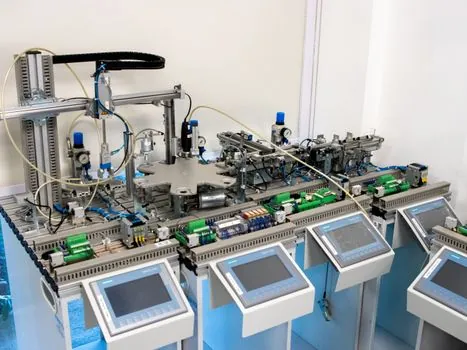
An automatic apparel line typically uses a conveyor with product sensors, a label dispenser head, a PLC or HMI control panel, and an optional reject station for missing or skewed labels, plus an optional thermal-transfer or inkjet printer for batch codes, barcodes, or QR codes on the label face [S5]. For variable data, the labeling machine, printer, and inspection system should be evaluated together: a label applicator may place a label accurately, but does not automatically guarantee that the printed barcode is readable, because barcode quality depends on symbol size, contrast, quiet zones, and print quality as defined by GS1 [S5].
Power and control integration also matters for apparel distribution centers that share floor space with power distribution cabinets and distribution cabinet boards, because a 220–240 V, 50 Hz labeling line typically needs a dedicated breaker, an earth fault monitor, and in some EU sites an ATEX-rated explosion-proof distribution panel if the line runs near solvent-based adhesives or cleaning fluids [S5]. A related VFD and conveyor-control spec is covered in VFD selection for packaging lines, which is the right reference if the labeling machine is sharing a conveyor with a variable-speed wrapper or case erector [S5].
Who This Spec Path Is For, and Where It Breaks
This selection path fits mid-volume apparel distributors, contract packers, and brand-owned fulfillment centers shipping 1,200–3,600 labeled units per hour per line, who need ±1 mm placement on flat polybags or cartons and who can tolerate a single-format line [S2][S5]. It does not fit high-fashion woven-label finishing (which is a textile mill job, not a distribution job, and uses a $65,000-class jacquard loom), nor does it fit sub-zero or condensation-prone cold-chain apparel, which needs a refrigerated-rated applicator and condensation control as covered in cold-chain labeling machine spec map [S1].
The path also breaks if the buyer's specification is built around the manufacturer's headline speed rather than a tested, documented realistic output, because real placement accuracy, changeover time, and label waste can each move the line's effective cost-per-labeled-unit by 20–40% relative to the catalog number [S3][S5]. Two trackable signals for the next planning cycle: (1) require a factory acceptance test on the buyer's actual garments, bags, and labels before issuing a purchase order, and (2) lock the spec to ±1 mm placement, 220–240 V 50 Hz supply, 50–180 mm product height range, and a documented changeover time in seconds, with a separate verification plan for any printed barcodes or RFID inlays [S3][S5].