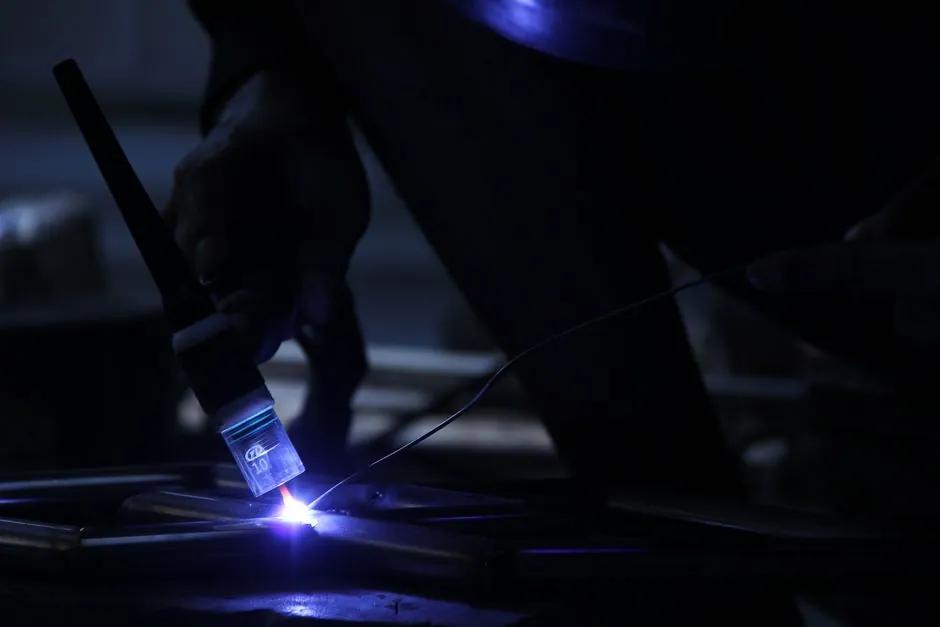
An arc welder is sized by four interacting parameters: process, input voltage, output amperage range, and the duty cycle at that working output, with conductor and breaker sizing then locked to NEC Article 630 [S3].
Industrial buyers routinely conflate "max amperage" with "welding capacity", a mistake that costs money twice, once in an oversized machine and again in feeders that trip under real load. The practical path is process first, duty cycle second, electrical feed third.
Process First: SMAW, GMAW, GTAW, FCAW Matched to Material
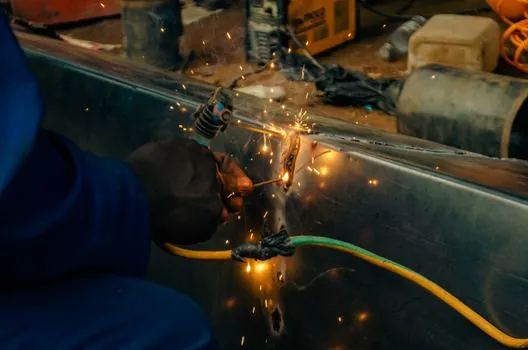
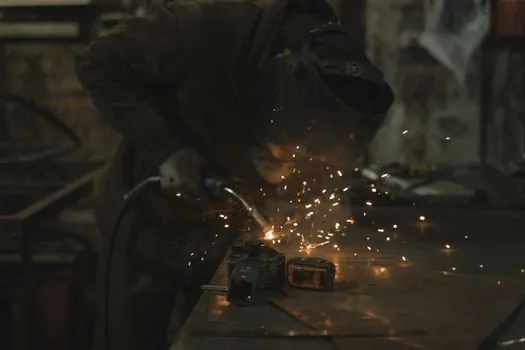
Stick (SMAW), MIG/GMAW, TIG/GTAW, and flux-cored (FCAW) are the four dominant arc processes, and each has a defined material fit [S2][S4]. SMAW handles steel and cast iron in outdoor, dirty, or repair conditions; GMAW covers steel, stainless, and aluminum for general fabrication; GTAW targets stainless, aluminum, and thin metals where precision and clean bead profile matter; FCAW is essentially GMAW with a flux-cored wire, chosen for thicker steel outdoors where shielding gas coverage is unreliable [S4].
Material chemistry drives the second-tier call. Carbon steel welds on any of the four; stainless is most often GMAW or GTAW because it does not need the heat input of SMAW [S2]. Aluminum generally needs GMAW (pulse or spray transfer) or high-end GTAW, and is not a friendly SMAW job. Picking the wrong process for the alloy is the single most common cause of porosity, distortion, and rework on a 200–500 A industrial job.
Amperage Range: Output Window vs. Plate Thickness
Output range is the spec that actually matters on the floor. A Lincoln Electric MIG 210 MP multi-process unit is rated 20–220 A at 120/230 V input, weighing about 40 lb, and is positioned for home and light auto work [S4]. A Miller Maxstar 161 (TIG/stick) outputs 20–160 A on 120/240 V at 13 lb, aimed at portable, thin-metal work [S4]. At the heavy end, a Lincoln Ranger 305 G is engine-driven, 50–300 A, about 510 lb, sold for outdoor heavy-duty sites without grid power [S4]. An ESAB Rebel EMP 215ic multi-process unit covers 5–220 A on 120/240 V at 40 lb for multi-metal versatility [S4].
Welding current roughly tracks plate thickness at about 1 A per 0.001 in of steel for stick and MIG, so a 1/4 in (6.4 mm) plate wants 150–250 A depending on joint and position [S1][S4]. Going below the lower bound of the machine's output range is just as bad as going over: the arc becomes unstable, the rod sticks, and the operator compensates by slowing travel speed, which piles heat into the plate.
Duty Cycle: The Number That Trips the Breaker
Duty cycle is the percentage of a 10-minute window the machine can deliver its rated output without overheating, and it falls as output rises. A real-world nameplate like the Miller Syncrowave 350 LX lists 30% at 400 A, 40% at 350 A, and 100% at 250 A [S3]. That same plate shows a primary (input) current i1 of 131.1 A at 240 V [S3].
This is where buyers get burned. Two welders with identical maximum amps can have very different continuous ratings, and the input current that the electrical feeder must support depends on which output level and duty cycle the operator actually runs. Spec the machine at 400 A/30% and feed it for that, not for a marketing-curve "max" [S3]. The same Syncrowave spec is also why the owner's manual feeder tables are computed at a 60% duty cycle, a fact that confuses electricians sizing the branch circuit and is exactly what NEC Article 630 Table 630.11(A) is built to resolve [S3].
Input Power: 120 V vs. 240 V vs. Engine Drive
Input voltage sets the upper limit of usable output. A 120 V receptacle is fine for light-duty, thin-material, and home-shop work; 220/240 V single-phase is the industrial baseline for thicker material and sustained output; engine-driven welders (gas or diesel) cover field sites where grid power does not exist [S4]. Dual-voltage machines (e.g., 120/240 V at 20–220 A) give the operator flexibility but still cap output when running on 120 V.
Three-phase input is common in heavy fabrication shops running 300–500 A inverter or transformer-rectifier sets, and it is worth specifying up front, because retrofits from single-phase to three-phase later are rarely cheap. If the job is structural steel, pressure vessel, or shipbuilding, three-phase is the default; if it is HVAC duct or auto body, single-phase is the default.
Feeder Sizing per NEC Article 630
Once output and duty cycle are fixed, conductor and breaker sizing follow NEC Article 630, and the duty cycle at the working output is the multiplier that most engineers get wrong. The nameplate for the Syncrowave 350 LX calls out multiple duty cycles at multiple currents, and the electrician has to pick the row that matches how the operator will actually use the machine, not how it is being demonstrated on the showroom floor [S3].
For a unit drawing i1 = 131.1 A at 240 V, the branch-circuit overcurrent device and conductors are typically sized off the 100%-rated primary current unless the documented duty cycle is lower, in which case the table permits a demand factor [S3]. This is why a proper sizing pass needs the owner's manual in hand, not just the data sheet: the data sheet lists maximums, the manual lists the derated continuous values that actually feed the breaker. The same logic is why a 112 A nameplate input can still call for #4 AWG feeders, a detail that has tripped more than one inspector [S3].
Multi-Process vs. Single-Process: When Versatility Pays
Multi-process inverters (MIG/TIG/Stick in one box) are the right call for crews that switch between GMAW on structural steel, GTAW on stainless trim, and SMAW for repair, because one machine replaces three, one set of feeders, and one spare-parts inventory. Single-process machines win on shop floors that run the same process eight hours a day, where dedicated duty cycle and arc characteristics beat flexibility. [S2]
If the site does only one type of weld, buy a single-process machine at the right duty cycle. If the site does three or more, buy a multi-process unit rated for the highest-amperage process on the list, and verify it can sustain that output continuously. Cross-shop buyers can lean on a TIG welding machine spec map for bridge work when the workload tilts GTAW-heavy, or check an arc welder fit guide for interior finishing crews when the work is on building interiors where light weight and low noise matter.
Selection Checklist: A Five-Line Decision
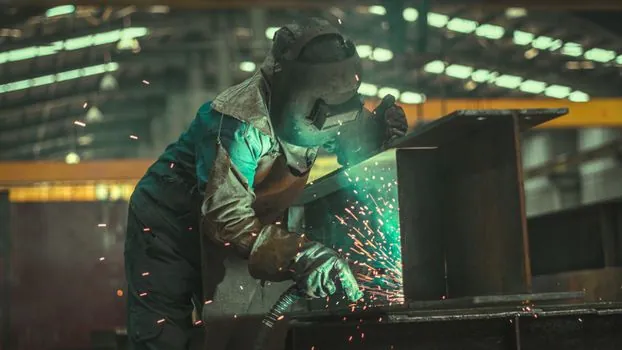
Process first: SMAW for outdoor/repair, GMAW for general fab, GTAW for stainless/aluminum/precision, FCAW for thick steel outdoors [S2][S4]. Input next: 120 V light, 240 V industrial single-phase, three-phase heavy fab, engine drive off-grid. Output range third: roughly 1 A per 0.001 in of steel; 20–160 A for thin metals, 200–300 A for general structural, 300–500 A for heavy plate. Duty cycle fourth: confirm the rating at the actual working output, not the marketing maximum, and use the manual's feeder table, not the data sheet. Feeder fifth: apply NEC Article 630 Table 630.11(A) at the matched duty cycle and primary current, and overprovision the breaker if the operator may push output up [S3].
The signals to watch on the next buying cycle are inverter power density (more amps per pound at the same duty cycle) and engine-driven emissions tiers for off-grid units. Both move year over year, and both are worth a re-spec before a multi-machine purchase, alongside cross-references like the TIG welder selection guide for demolition and precision overlap when a job mixes cut and weld on the same site.
The underlying component specifications are covered under arc welder, welding cutting tool, and linear guide.