
Interior finishing air picks sit in a narrow 2-3 kg mid-range chipping-hammer class delivering 5-10 J per stroke at 1500-3000 BPM with 12-19 mm hex or round shank tooling, drawing 12-18 CFM at 90 psi working pressure [S2]. The decision starts with the chisel inventory already on the truck, not the catalogue.
HVAC installation crews punch through plaster, light-weight concrete block, and brick or aerated concrete for line-set and condensate routes, with occasional light chipping for floor-slab or wall-sleeve work, sitting between tile/chip work and heavy demolition [S4].
Why a finishing air pick is a different class from a demolition pick
A demolition-grade air pick runs 8-15 J per stroke at 1000-2000 BPM and weighs 5-7 kg in the handpiece, which is too much stroke and too much mass for a finisher who is working overhead against a soffit or chasing a 25 mm channel for a conduit into 100 mm of aerated block [S2]. The 19 mm (3/4 inch) hex shank family delivers 50-70 mm stroke at 8-15 J per blow and 1100-1300 BPM at 6.3 bar, which is the band most HVAC and interior-trades crews have standardised on because it breaks 100-150 mm of standard hollow concrete block cleanly without blowing out the back skin [S4]. For pure tile-and-thinset removal on a bathroom gut, the smaller 12-14 mm hex or 10-12 mm round shank at 5-8 J per stroke is the controlled choice; stepping up to demolition class on thinset usually fractures the substrate and adds a day of patch work.
Shank selection: match the chuck to the chisel rack, not the brochure
Three shank systems dominate 2026 air-pick fittings: round shank 10-12 mm for light chipping, hex shank 10.6/14.6/17.3/20 mm for the chipping-hammer chisel family, and the 1/2 inch square or 3/4 inch hex reserved for rotary-hammer conversions on poured concrete [S2]. A finishing contractor already running 14.6 mm hex chisels for tile and thinset work should not buy a 17.3 mm hex scaler; the small dimension difference locks out the existing inventory and the operator ends up regrinding shanks on a bench grinder, which is a known shop bottleneck [S2]. Quick-change retainers (spring or twist-lock) appear on the 2-3 kg class and cut chisel-change time on a production line by an order of magnitude, which is the right feature for a finish crew that swaps between moil point, narrow chisel, and 12-needle scaler head four or five times a day [S2]. The 12-needle scaler head with replaceable 3 mm steel needles in a cage is the workhorse for paint, thinset residue, and weld-slag touch-up on a finishing job, with needle sets in standard, beveled, and chisel-tip forms sized to the substrate hardness.
Air budget at the work point: 12-18 CFM is the realistic band
A 2-3 kg mid-range chipping hammer with 19 mm hex shank pulls 12-18 CFM at 90 psi (6.2 bar), and the air supply at the work point has to deliver that or the BPM number on the nameplate no longer holds [S2]. Hose ID has to be at least 1/2 inch for the 3/4 inch bore class; undersized hose drops effective pressure at the tool and the per-blow energy collapses before the operator notices the gauge on the compressor [S2]. Reciprocating compressors deliver roughly 70% of their displacement figure at 90 psi, so a compressor rated at 25 CFM displacement only puts about 17-18 CFM at the tool, which is exactly the lower edge of the 19 mm hex pick window; the practical rule on a finishing site is to add 30-50% margin on compressor CFM rating so a single finishing pick plus a framing nailer or air-assisted spray gun can run off the same drop without starving [S2].
Comparison frame: finishing pick vs light-duty scaler vs demolition pick
On a four-axis decision grid the three functional classes line up as follows. (1) Handpiece mass: 0.6-1.5 kg light scaler, 2-3 kg mid-range finishing pick, 5-7 kg demolition pick. (2) Per-blow energy: 2-5 J, 5-10 J, 8-15 J. (3) BPM band: 1000-3000, 1500-3000, 1000-2000. (4) Typical CFM at 90 psi: 4-6, 12-18, 20-30 [S2]. A finishing contractor who tries to save money by buying a demolition-class pick for tile removal will overshoot on per-blow energy and fracture the substrate; one who buys a light scaler to chase a channel in masonry will stall on the first 50 mm of block [S2][S4]. The mid-range class is the only one that holds the per-blow energy high enough to break 100-150 mm hollow block while keeping the handpiece weight under 3 kg for overhead work [S4]. The 28 mm (1-1/8 inch) hex shank is reserved for outdoor pad work on poured concrete, where the crew trades 9-11 kg of handpiece mass for 15-25 J per blow and 900-1100 BPM; that tool does not belong on a finishing truck [S4].
Anti-vibration and noise: the gates contractors actually fail
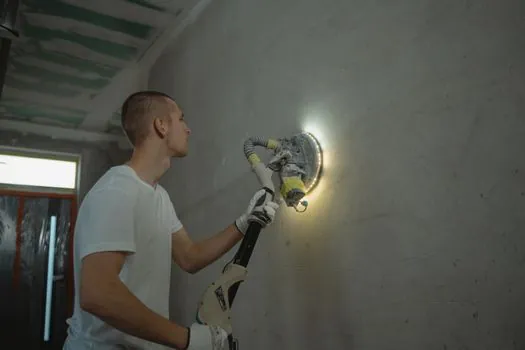
Hand-arm vibration (HAV) is the single biggest health-and-safety gate on a finishing air pick because the work is sustained chipping against a wall, not intermittent demolition blows. The 2026 HVAC-install spec band sets a ceiling of 5 m/s² hand-arm vibration as the gate most contractors fail first, and that is achievable on the 2-3 kg mid-range class with an integrated anti-vibration handle but rarely met on the demolition class [S4]. Air picks are the worst HAVS offenders in the pneumatic fleet because the vibration is sustained high-amplitude axial, which behaves differently from the short torsional shocks of an air impact wrench, so daily trigger-time caps have to be set on a finishing site rather than borrowed from an impact-wrench exposure assessment [S5]. Noise exposure follows the same pattern; the mid-range class typically sits at 95-105 dB(A) at the operator station, which still demands hearing protection but does not push a finishing crew into double protection the way a demolition-class pick does.
Substrate match: where the finishing pick earns its keep
Tile and thinset removal on a bathroom or kitchen gut is the canonical finishing-pick job: 5-8 J per stroke on a 12-14 mm hex or 10-12 mm round shank pulls thinset off cement backer board without punching through the substrate [S2]. Chasing a 25-40 mm channel for conduit or a line-set into aerated concrete or hollow block is the second canonical job, and that is the 19 mm hex band at 8-15 J per stroke and 1100-1300 BPM, which is the same envelope HVAC installers run for duct and bracket anchor work [S4]. Anchor-point drilling for handrails, cabinet blocking, or TV mounts into brick or poured concrete is the upper edge of the finishing envelope; a 19 mm hex at the high end of its BPM band will sink a 12 mm wedge anchor in under ten seconds in standard hollow block, and the operator drops to a 28 mm hex only on dense aggregate or outdoor pad work where the extra weight is justified [S4]. Plaster and lath removal on a historic renovation is the one finishing job where a light scaler (0.6-1.5 kg, 2-5 J per stroke) outperforms the mid-range class, because the goal is to clean the lath for re-plastering, not to break the wood lath itself. For surface preparation on interior concrete that will receive a self-levelling underlayment, the 12-needle scaler head on the mid-range class strips paint, thinset residue, and curing compound faster than a grinder on a 100-150 mm square patch.
Spec checklist before purchase

Five numbers have to be on the spec sheet before a finishing air pick leaves the warehouse, and a unit that does not carry all five is the wrong tool for the truck. (1) Piston bore or shank family, named in mm and matched to existing chisel inventory. (2) BPM at rated working pressure of 6.2-6.3 bar (90 psi), not the no-load marketing figure. (3) Per-blow energy in joules, calculated or measured, in the 5-10 J band for the mid-range finishing class. (4) Air consumption in CFM or L/s at rated working pressure, in the 12-18 CFM band for the 19 mm hex class, with a reciprocal-compressor margin of 30-50% on top. (5) Hand-arm vibration value in m/s² and declared noise value in dB(A), both at the operator station, with the HAV figure below 5 m/s² to clear the gate most contractors fail [S2][S4].
What a finishing air pick is not for
An air pick is the wrong tool for driving fasteners, breaking a seized nut, or any rotary torque work, because it has no rotary output; a 1" twin-hammer air impact wrench at 1500-2500 ft-lb breakaway torque is the right tool for the bolt, and the per-blow air cost on the pick versus the stored-torque air cost on the wrench is so different that running them on the same compressor drop without sizing the drop first will stall one of the two within minutes [S5]. An air pick is also the wrong tool for a finishing crew whose actual work is removing vinyl wallpaper or scraping paint; a 12-needle scaler head on a mid-range pick will do the job but burns air at 12-18 CFM for a task a 1 CFM heat gun or a razor scraper handles, so the per-job cost is uneconomic. For interior concrete grinding in preparation for a coating system, a masonry sander spec map covers the dust-controlled abrasive path; an air pick is for material removal, not surface finishing. Finally, a finishing air pick is the wrong tool for climbing formwork anchor release or any vertical concrete element, where the working-at-height risk and the per-blow energy requirement put the work back into the demolition-class band.
The trackable signals over the next buying cycle are the air-consumption bands published in 2026 mid-range catalogues (watch for sub-15 CFM 19 mm hex units as the efficiency benchmark) and the hand-arm vibration declarations on the same data sheets, since the 5 m/s² gate is the regulatory pressure point for finishing crews. For a finishing contractor standardising a truck, the automatic level selection map and the infrared line level selection map cover the layout side of the same workflow.
Component reference pages worth checking: air pick, finishing material, and air impact wrench.